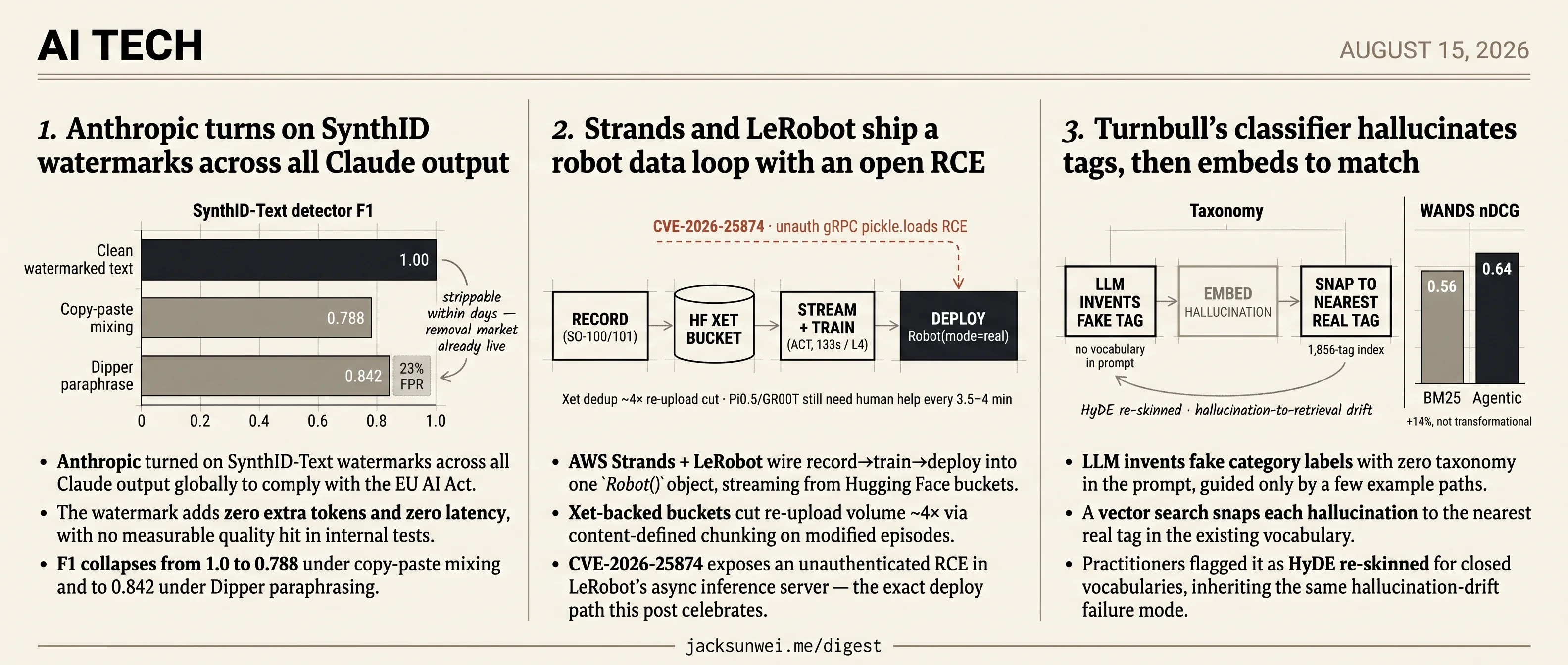
Anthropic turns on SynthID, LeRobot loop hides RCE, Turnbull hallucinates tags
Each of today's three tech drops ships next to a same-day artifact that changes what the launch means.
Anthropic turns on SynthID, LeRobot loop hides RCE, Turnbull hallucinates tags
TL;DR
- Anthropic turns on SynthID watermarks across all Claude output for EU AI Act compliance.
- SynthID F1 collapses to 0.788 under copy-paste mixing before Anthropic’s detector API goes public.
- Commercial watermark-removal market appeared within days of the global Claude rollout.
- AWS Strands + LeRobot ship a robot record→train→deploy loop with CVE-2026-25874 open.
- Turnbull’s hallucinate-then-embed classifier lifts BM25 nDCG 0.56 → 0.64 on WANDS.
Three unrelated tech drops today — a frontier-lab compliance rollout, an AWS robotics data loop, and a developer’s classifier trick — and each one ships next to a same-day artifact that reshapes what the launch means. Anthropic turns on SynthID-Text watermarks across all Claude output to meet the EU AI Act, and a commercial removal market appears before the detection API is even public; internal numbers already show F1 dropping under paraphrase.
AWS Strands + LeRobot wire record→train→deploy into a single Robot() object streaming from Xet-backed HF buckets — the same async inference server that path lands on carries an unauthenticated RCE filed as CVE-2026-25874. And Turnbull’s hallucinate-then-embed classifier, elegant on its own terms, gets flagged in the same thread as HyDE re-skinned for closed vocabularies, inheriting the drift failure mode it looked like it avoided.
Anthropic turns on SynthID watermarks across all Claude output
Source: anthropic-news · published 2026-08-14
TL;DR
- Anthropic turned on SynthID-Text watermarks across all Claude output globally to comply with the EU AI Act.
- The watermark adds zero extra tokens and zero latency, with no measurable quality hit in internal tests.
- F1 collapses from 1.0 to 0.788 under copy-paste mixing and to 0.842 under Dipper paraphrasing.
- A commercial watermark-removal market appeared within days, before Anthropic’s detection API is even public.
What actually shipped
Anthropic has turned on Google DeepMind’s SynthID-Text watermarking across Claude, worldwide, to satisfy the EU Code of Practice on Transparency of AI-Generated Content. Coverage is retroactive to models launched before August 2, 2026, during a transitional period. The mechanic is the one Scott Aaronson sketched in 2022: instead of sampling the next token with a plain RNG, Claude uses a cryptographic key plus preceding context to bias choices between near-equivalent candidates (“overcast” vs. “grey”). A holder of the key can then run a statistical test on any passage and estimate the probability Claude wrote it.
The engineering claims are genuinely tidy. No extra tokens, so no latency or billing overhead. No user or session identifiers in the signal. Watermarking degrades gracefully in low-entropy contexts — it barely touches 2+2=4 or code logic, because there’s no alternative token to prefer. For images, Anthropic uses C2PA metadata instead. Detection is a forthcoming API, initially gated to “verified” third parties.
The robustness story is weaker than the post implies
Anthropic writes that “light editing” preserves the watermark and a “complete manual rewrite” defeats it. The research literature puts the bar much lower.
| Attack | Detector performance |
|---|---|
| Clean watermarked text | F1 = 1.00 1 |
| Copy-paste mixing with human text | F1 = 0.788 1 |
| Dipper (T5-XXL) paraphrasing | F1 = 0.842, 23% FPR 1 |
| Back-translation via FR/ZH | Further degradation 1 |
| Recursive paraphrase (DetectGPT baseline) | AUROC 96.5% → 25.2% 2 |
ETH Zurich’s SRI Lab adds a nastier wrinkle: SynthID-Text is harder to spoof than competing schemes but easier to scrub, and a black-box adversary can cheaply probe whether a watermark is present before attacking it — inverting the usual “attacker is blind” assumption 3. Sadasivan and Feizi go further, demonstrating spoofing attacks that let adversaries frame human-written text as AI-generated without white-box access 2 — a reputational risk Anthropic’s announcement doesn’t acknowledge.
flowchart LR
    C[Claude generation] -->|SynthID key biases tokens| W[Watermarked text]
    W --> E{Adversary}
    E -->|copy-paste mix| S1[F1 0.79]
    E -->|Dipper paraphrase| S2[F1 0.84, 23% FPR]
    E -->|back-translate| S3[degraded]
    W --> D[Detection API<br/>gated access]
Governance and user pushback
Aaronson, whose PRF construction underlies both the OpenAI and DeepMind lines of work, has publicly criticized Google’s “stinginess” in granting detector access — a critique Anthropic inherits by keeping the API behind an expert-verification gate 4. Meanwhile SC World reports a commercial removal market (GitHub projects, paid “bypasser” services) materialized within days of the Claude rollout, targeting SynthID signals before the detector is even live 5.
On r/ClaudeAI, some subscribers are canceling over a specific fear: the watermark signals that Claude touched the text, not that Claude authored it, so a document merely proofread by Claude may carry the same signature as one generated end-to-end 6.
The net
SynthID-Text in Claude is technically elegant and adequate to check the EU AI Act box. As evidence in any adversarial setting — plagiarism cases, disinformation attribution, contract disputes — it is trivially strippable by motivated actors 312 while strong enough to implicate legitimate assistive use 6. Read it as compliance infrastructure, not a provenance breakthrough.
Strands and LeRobot ship a robot data loop with an open RCE
Source: huggingface-blog · published 2026-08-13
TL;DR
- AWS Strands + LeRobot wire record→train→deploy into one
Robot()object, streaming from Hugging Face buckets. - Xet-backed buckets cut re-upload volume ~4× via content-defined chunking on modified episodes.
- CVE-2026-25874 exposes an unauthenticated RCE in LeRobot’s async inference server — the exact deploy path this post celebrates.
- Top VLAs Pi0.5 and GR00T need human intervention every 3.5–4 minutes on industrial pick-and-place.
The four-stage loop
The pitch is genuinely tidy: one Robot() abstraction handles an SO-100 or SO-101 arm through record, store, train, and deploy, with the LeRobot dataset format as the on-disk contract at every hop. Joint telemetry and camera frames land as Parquet + MP4 shards, sync to a Hugging Face Storage Bucket, and then stream back into training without a full download — stream_dataset() decodes video on the fly and keeps only metadata local. A 500-step ACT training run (51.6M params) on a 120-frame episode clocks 133 seconds on an NVIDIA L4. Flip the mode from sim to real and the same object drives hardware.
That’s a real improvement over the standard robotics workflow, where teams shuttle multi-gigabyte episode dumps between a capture rig, a training box, and a deploy target by hand.
Xet’s dedup is a tuned compromise
The ~4× reduction on modified files comes from byte-level content-defined chunking — only changed chunks re-upload when you tweak an episode. What the post skips: aggressive dedup fragments chunks across 64 MB “xorbs,” which tanks read latency, so Xet’s protocol deliberately skips some dedup opportunities to preserve contiguous runs 7. The 4× figure is a chosen operating point, not a ceiling. On the read side, the headline 1,124 MB/s number is a CDN-warm best case on an m5dn.24xlarge.
The storage layer has other rough edges an S3 refugee will notice. The S3-compatible gateway is single-region and lacks Object Lock, lifecycle policies, and IAM-style bucket policies 8. Buckets are intentionally mutable and non-versioned for write throughput — which is why the post itself warns you to keep final artifacts in regular dataset repos.
The security section buries the lede
The post’s “Safety” callout is about bucket overwrite semantics. The urgent LeRobot security story in 2026 is CVE-2026-25874: the asynchronous inference PolicyServer deserializes attacker-controlled input via pickle.loads() over an unauthenticated gRPC endpoint, yielding remote code execution on both the policy server and the connected robot client 9. Because inference typically runs with elevated privileges on GPU-backed servers, a successful exploit can hijack the robot or pivot into the surrounding network 10.
That is the same deploy path this data loop terminates in. A pipeline that shortens the distance from “record a demo” to “run a policy on hardware” also shortens the distance from a poisoned checkpoint or a spoofed policy server to a moving arm.
flowchart LR
    A[Record: SO-100/101 telemetry + video] --> B[(HF Storage Bucket<br/>Xet-backed, mutable)]
    B --> C[Train: stream_dataset<br/>ACT / VLA policies]
    C --> D[Deploy: Robot mode=real]
    E((Unauth gRPC<br/>CVE-2026-25874)) -. pickle.loads RCE .-> D
    F[Poisoned checkpoint] -. via mutable bucket .-> D
NVIDIA is the quiet partner
Framing this as an AWS × Hugging Face story undersells the stack. The high-level VLAs the post lists as compatible — Isaac-GR00T, Cosmos 3, Pi0, SmolVLA — are largely NVIDIA’s, and NVIDIA’s own integration ships Isaac Lab-Arena as the evaluation harness for LeRobot policies, claiming up to 13.5× faster policy evaluation via GPU-parallel sim 11. AWS is contributing the agent SDK and the storage egress path; the physics and the foundation models sit elsewhere.
Where the real bottleneck is
Faster iteration matters, but iteration isn’t what’s keeping these robots out of production. On the PhAIL benchmark, the strongest available VLAs — Pi0.5 and GR00T — still need human intervention every 3.5–4 minutes on industrial pick-and-place 12. Strands + LeRobot compresses the loop; the policies going through it are still the limiting reagent.
Turnbull’s classifier hallucinates tags, then embeds to match
Source: simon-willison · published 2026-08-14
TL;DR
- LLM invents fake category labels with zero taxonomy in the prompt, guided only by a few example paths.
- A vector search snaps each hallucination to the nearest real tag in the existing vocabulary.
- Practitioners flagged it as HyDE re-skinned for closed vocabularies, inheriting the same hallucination-drift failure mode.
- Turnbull’s own agentic search on WANDS lifted BM25 nDCG 0.56 → 0.64 — useful, not transformational.
The trick
The pipeline is two steps. First, prompt the model with a handful of example category paths (Furniture / Living Room Furniture / Coffee Tables) and ask it to invent a fitting label for the input — no vocabulary provided. Second, embed that invented label and nearest-neighbor it against your real taxonomy. The model never sees the tag list; the tag list never bloats the prompt.
Willison’s motivating case is concrete: 1,856 tags on his blog, far too many to jam into a single classification prompt, and a long tail of old posts he never got round to tagging. The dev.to write-up formalises the same pipeline and calls out the real economic driver — shovelling hundreds of categories into every request is “quietly expensive” in tokens and latency, and the win is offloading the taxonomy to a pre-embedded index rather than any accuracy bump 13.
It’s HyDE with a haircut
The Hacker News thread was quick to name the lineage: this is Hypothetical Document Embeddings (HyDE) narrowed to classification. Instead of generating a fake answer paragraph to seed retrieval, you generate a fake label and retrieve the closest real one. That inheritance brings baggage. A survey of HyDE failure modes warns of a “hallucination-to-retrieval” loop:
If the LLM generates a hypothetical document containing factual errors or ‘phantom findings,’ the vector search will retrieve documents that align with those falsehoods rather than the user’s actual intent 14.
The vector index will happily confirm the model’s confabulation, and the error surfaces as a confidently-wrong tag rather than an obvious miss.
The sharper technical objection came from commenter vessenes, who argued the LLM hop is redundant outright — modern embedding models are strong enough to match a raw query against taxonomy strings directly, collapsing the whole pipeline back to plain semantic search 15. Turnbull’s in-thread rebuttal was itself a retreat toward the middle: use BM25 or embeddings to pre-filter top-N candidates, then let the LLM choose. That’s standard retrieval-augmented classification, not pure hallucinate-and-match.
The philosophical objection landed too. Sharlin’s widely-upvoted comment framed the pattern as emblematic of the era:
modern programming now encourages developers to purposefully solicit incorrect answers from a computer to eventually arrive at a correct one 16.
Where it actually pays
The honest scope is narrow. Turnbull’s own agentic-search benchmark on WANDS showed a GPT-5 reasoning loop pushing BM25 from 0.56 to 0.64 nDCG — a ~14% lift, not a revolution 17. And the Procycons 2025 long-document benchmark found XGBoost and logistic regression still beating transformer-based classifiers on both F1 and cost when you have training data 18.
So the hallucinate-then-embed trick earns its keep in exactly the regime Willison’s blog occupies: sparse labels, no training data, an evolving taxonomy nobody wants to maintain a classifier for. For a legacy backlog or a churning e-commerce catalogue it’s a clean shortcut. For anything with stable categories and labelled examples, the boring baseline still wins.
Footnotes
-
Moonlight review of ‘Robustness Assessment and Enhancement of Text Watermarking for Google’s SynthID’ (arXiv 2508.20228) — https://www.themoonlight.io/en/review/robustness-assessment-and-enhancement-of-text-watermarking-for-googles-synthid
↩ ↩2 ↩3 ↩4 ↩5Under copy-and-paste attacks the detector’s F1 drops from 1.0 to 0.788; Dipper (T5-XXL) paraphrasing pushes F1 to 0.842 with a 23% false-positive rate, and back-translation via French/Chinese further degrades detectability.
-
Sadasivan, Feizi et al., ‘Can AI-Generated Text be Reliably Detected?’ (ResearchGate) — https://www.researchgate.net/publication/369380286_Can_AI-Generated_Text_be_Reliably_Detected
↩ ↩2 ↩3Recursive paraphrasing dropped DetectGPT’s AUROC from 96.5% to 25.2%; the authors also demonstrate spoofing attacks that let adversaries infer a watermark’s signature without white-box access and frame human text as AI-generated.
-
SRI Lab, ETH Zurich (Probing SynthID) — https://www.sri.inf.ethz.ch/blog/probingsynthid
↩ ↩2SynthID-Text is more resistant to spoofing than other state-of-the-art schemes, but is paradoxically easier to ‘scrub’ or remove by naive adversaries; black-box queries can cheaply detect the watermark’s presence, letting attackers focus removal.
-
zk-f.com summarizing Scott Aaronson’s remarks — https://zk-f.com/synthid-text/
↩Aaronson noted SynthID-Text is ‘extremely similar’ to his 2022 proposal but criticized Google’s ‘stinginess’ in granting access to its detector, limiting utility for educators and independent researchers.
-
SC World, ‘Market for AI watermark removal tools emerges after Anthropic’s Claude update’ — https://www.scworld.com/brief/market-for-ai-watermark-removal-tools-emerges-after-anthropics-claude-update
↩A cat-and-mouse market emerged within days of Anthropic’s announcement, with GitHub projects and web tools claiming to neutralize Claude’s watermarks before the detection API is even public.
-
r/ClaudeAI thread on Anthropic’s watermark rollout — https://www.reddit.com/r/ClaudeAI/comments/1vndlg3/some_claude_users_are_mad_that_anthropics_new/
↩ ↩2Users report canceling subscriptions over concerns that watermarking degrades ‘human-like’ tone and could unfairly flag documents merely proofread by Claude as fully AI-generated.
-
Analytics India Magazine — Xet vs Git LFS — https://analyticsindiamag.com/ai-features/hugging-face-is-replacing-git-lfs-with-xet-storage-heres-why
↩Aggressive deduplication can lead to file fragmentation, where chunks are scattered across different xorbs (64MB storage blocks), causing high read latency; Xet’s protocol intentionally skips some deduplication opportunities to maintain contiguous runs of chunks.
-
Hugging Face docs — Storage Buckets S3 gateway — https://huggingface.co/docs/hub/en/storage-buckets-s3
↩Buckets are intentionally mutable and non-versioned to support high-throughput writes; the gateway is centralized in a single region and lacks Object Lock, lifecycle policies, and IAM-style bucket policies.
-
Resecurity — CVE-2026-25874 disclosure — https://www.resecurity.com/blog/article/cve-2026-25874-hugging-face-lerobot-unauthenticated-rce-via-pickle-deserialization
↩The flaw resides in LeRobot’s asynchronous inference PolicyServer, which uses unsafe pickle.loads() to deserialize attacker-controlled data over unauthenticated gRPC endpoints, allowing unauthenticated remote code execution on both robot client and policy server.
-
GBHackers — LeRobot RCE coverage — https://gbhackers.com/hugging-face-lerobot-flaw/
↩Because the asynchronous inference design often runs with elevated privileges on GPU-backed servers, exploitation could allow attackers to hijack connected robots or pivot across the network.
-
Hugging Face / NVIDIA — Isaac Lab-Arena + LeRobot — https://huggingface.co/blog/nvidia/generalist-robotpolicy-eval-isaaclab-arena-lerobot
↩Isaac Lab-Arena can achieve up to 13.5× faster policy evaluation compared to sequential methods, enabling a sim-to-real loop where LeRobot handles data plumbing and Isaac Lab handles GPU-parallel simulation.
-
PhAIL benchmark discussion (r/MachineLearning) — https://www.reddit.com/r/MachineLearning/comments/1sajdwr/p_phail_phailai_an_open_benchmark_for_robot_ai_on/
↩On the PhAIL benchmark, Pi0.5 and GR00T demonstrated the highest performance in industrial pick-and-place tasks, though both still require human intervention every 3.5 to 4 minutes.
-
dev.to — ‘Why your LLM classifier doesn’t need the taxonomy’ — https://dev.to/chenyuan20509/why-your-llm-classifier-doesnt-need-the-taxonomy-hypothetical-classification-with-embeddings-387d
↩Passing this entire taxonomy into an LLM prompt as a schema is quietly expensive due to token costs and increased latency… embeddings of semantically similar terms—even if one is a hallucination—tend to cluster together in vector space
-
emergentmind.com — HyDE topic overview — https://www.emergentmind.com/topics/hypothetical-document-embeddings-hyde
↩If the LLM generates a hypothetical document containing factual errors or ‘phantom findings,’ the vector search will retrieve documents that align with those falsehoods rather than the user’s actual intent
-
Hacker News comment by vessenes — https://news.ycombinator.com/item?id=49249523
↩modern embedding models are sophisticated enough to match the original text directly to a taxonomy, making the intermediate LLM step redundant
-
Hacker News comment by Sharlin — https://news.ycombinator.com/item?id=49249523
↩modern programming now encourages developers to purposefully solicit incorrect answers from a computer to eventually arrive at a correct one
-
softwaredoug.com — Doug Turnbull, ‘All Search is Structured Now’ — https://softwaredoug.com/blog/2025/04/02/all-search-structured-now
↩a naive BM25 baseline achieved a relevance score of 0.56, while an agent-driven BM25 tool (utilizing GPT-5 reasoning) improved this to 0.64
-
procycons.com — Long Document Classification Benchmark 2025 — https://procycons.com/en/blogs/long-document-classification-benchmark-2025/
↩traditional models like XGBoost and Logistic Regression frequently outperform transformer-based models in both F1-score and cost-efficiency