Sentence Transformers v6 loads ColBERT, Dharma tops FIFO, IBM ALTK beats ACE
Three developer tech drops today, each posting a headline win whose meaning turns entirely on the baseline the vendor chose.
Sentence Transformers v6 loads ColBERT, Dharma tops FIFO, IBM ALTK beats ACE
TL;DR
- Sentence Transformers v6 loads ColBERT, PyLate, and ColPali via one
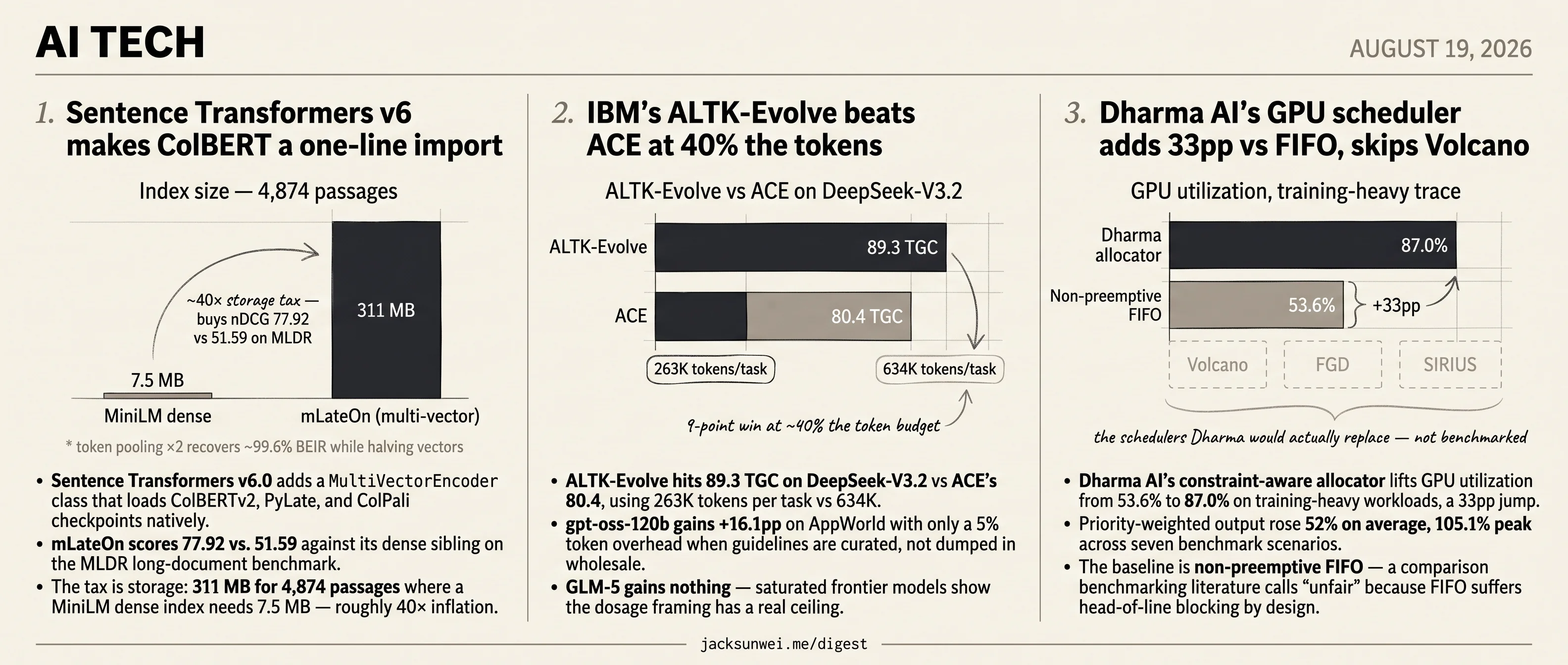
MultiVectorEncoderimport. - mLateOn scores 77.92 vs 51.59 on MLDR against its dense sibling, at 40× storage inflation.
- Dharma AI’s scheduler lifts GPU utilization to 87.0% against a non-preemptive FIFO baseline.
- IBM’s ALTK-Evolve hits 89.3 TGC on DeepSeek-V3.2 using 40% of ACE’s tokens.
- GLM-5 gains nothing from ALTK curation, capping the dosage framing at unsaturated models.
Today’s tech pool is three unrelated developer drops — a retrieval library, a GPU scheduler, and an agent-context method — and each one lands a headline number that only makes sense once you name the comparator. Sentence Transformers v6 ships MultiVectorEncoder and posts a 77.92-vs-51.59 win, but the loser is its own dense sibling, not the cross-encoder rerankers that now beat ColBERTv2 on hard queries. Dharma AI’s 33pp GPU-utilization jump is measured against non-preemptive FIFO — the schedulers Dharma would actually replace (Volcano, FGD, Tiresias, SIRIUS) don’t appear in the eval.
IBM’s ALTK-Evolve is the cleanest of the three: 89.3 TGC at 40% of ACE’s tokens on DeepSeek-V3.2, with a +16.1pp bump on gpt-oss-120b. Even here the comparator matters — GLM-5 gains nothing, so the dosage framing has a real ceiling at the frontier. Read each drop with the baseline in mind and the picture is fairer than any single headline number suggests.
Sentence Transformers v6 makes ColBERT a one-line import
Source: huggingface-blog · published 2026-08-18
TL;DR
- Sentence Transformers v6.0 adds a
MultiVectorEncoderclass that loads ColBERTv2, PyLate, and ColPali checkpoints natively. - mLateOn scores 77.92 vs. 51.59 against its dense sibling on the MLDR long-document benchmark.
- The tax is storage: 311 MB for 4,874 passages where a MiniLM dense index needs 7.5 MB — roughly 40× inflation.
- Token pooling at factor 2 recovers ~99.6% of BEIR quality while halving vectors.
- Cross-encoder rerankers like Qwen3-Reranker-4B now beat ColBERTv2 on reasoning-heavy queries.
What actually shipped
Late interaction — one 128-dim vector per token, scored with a MaxSim operator instead of a single dot product — has been the “cross-encoder accuracy at bi-encoder latency” promise since ColBERT in 2020. Until now, using it from Sentence Transformers meant bolting on RAGatouille or PyLate. v6.0’s MultiVectorEncoder folds all three lineages (ColBERTv2, PyLate/LateOn, and ColPali for OCR-free page retrieval) into the same encode_document / encode_query API, with output shapes that plug directly into Qdrant 1.10+, Weaviate 1.29+, Milvus 2.6.4+, Vespa, and LanceDB.
The release also quietly reworks GradCache for a claimed 3.9× speedup on cached-loss training and flips trust_remote_code to opt-in for models that import external classes — a breaking change worth catching before your next CI run 1.
The quality case is real, the storage case is brutal
The headline number — 77.92 vs. 51.59 nDCG on MLDR — is the kind of gap that justifies rewriting a retrieval stack. But the Hugging Face post’s 311.5 MB figure for a 4,874-passage collection understates what production looks like. Qdrant’s own ColPali writeup pegs 100,000 document pages at ~53 GB of raw vectors, scaling linearly and typically demanding A100-class GPUs to index at reasonable throughput 2.
Token pooling is the mitigation the post gestures at but doesn’t quantify. Clavié et al. showed a pooling factor of 2 retains ~99.6% of baseline BEIR quality while halving the vector count; degradation only becomes meaningful (2–5%) at PF≥4 3. If you’re deploying multi-vector at scale and not pooling, you’re paying for storage you don’t need.
The reranker ceiling has risen
The post frames multi-vector as filling the gap between bi-encoders and cross-encoders. That gap is narrower than it was a year ago. Independent 2025 benchmarks put Qwen3-Reranker-4B and Nemotron-Rerank-1B ahead of ColBERTv2 on reasoning-heavy queries, with one head-to-head lifting Hit@1 from 62% to 83% 4.
For a top-50 candidate pool, a bi-encoder plus a modern cross-encoder may be operationally simpler than maintaining a multi-vector index at all.
The counter-argument is latency at scale: cross-encoders re-score every candidate at query time, while multi-vector pre-indexes. But it complicates the “obviously use late interaction” framing.
The fine print on fast-plaid
The 11 ms fast-plaid latency (down from 120 ms exhaustive PyTorch MaxSim, with the index compressed from 311.5 MB to 92 MB) is genuine — but a reproducibility study of PLAID found its Pareto frontier hinges on three internal parameters, and misconfiguration causes latency to spike without any accuracy gain 5. nbits, centroid count, and search depth are ops concerns, not defaults to accept blindly. Fast-plaid also defaults to approximate search, so scores won’t line up with exhaustive MaxSim to the third decimal.
Net
v6.0 is consolidation, not revolution. PyLate, RAGatouille, ColPali, and fast-plaid already existed; what changed is that a single SentenceTransformer.from_pretrained call now covers the lot. The mLateOn checkpoints themselves came out of LightOn’s ColBERT-Zero recipe, which used GradCache to push contrastive batch sizes to ~16k examples and train multi-vector from scratch rather than distilling from a dense teacher 6. If you’ve been waiting for a stable API before betting a RAG stack on late interaction, this is that moment — provided you budget for the storage and tune PLAID like you mean it.
IBM’s ALTK-Evolve beats ACE at 40% the tokens
Source: huggingface-blog · published 2026-08-18
TL;DR
- ALTK-Evolve hits 89.3 TGC on DeepSeek-V3.2 vs ACE’s 80.4, using 263K tokens per task vs 634K.
- gpt-oss-120b gains +16.1pp on AppWorld with only a 5% token overhead when guidelines are curated, not dumped in wholesale.
- GLM-5 gains nothing — saturated frontier models show the dosage framing has a real ceiling.
- The “prompt caching fixes 78% overhead” claim ignores Anthropic’s ~25% write premium and 1.4-read breakeven inside a 5-minute TTL.
Dosage, not more memory
IBM Research’s ALTK-Evolve mines behavioral guidelines from agent trajectories — successes and failures both — and injects them at inference without touching weights. The interesting claim isn’t that this works; it’s that the right dose depends on the model. Strong models with headroom (DeepSeek-V3.2, Claude Opus) absorb the full guideline set. Weaker models like gpt-oss-120b drown in it and need curated retrieval: a compact core plus task-relevant lessons. Saturated models like GLM-5 gain zero.
The independent context-length literature backs the drowning story. Qwen2.5-7B’s reasoning accuracy collapses from 55% to 30% once context passes ~40% of its advertised window 7. So “more guidelines = better” was never going to hold across the model spectrum — ALTK-Evolve’s contribution is quantifying where the cliff sits and routing around it.
The comparison the blog buries
The HuggingFace post frames this as a memory-injection framework. The more load-bearing result lives in third-party coverage: against Agentic Context Engineering (ACE) on DeepSeek-V3.2, ALTK-Evolve reaches 89.3 TGC vs ACE’s 80.4 while spending 263K tokens per task against ACE’s 634K — roughly 40% the token budget for higher accuracy 8. That’s a 9-point win at 60% cost reduction, and it reframes ALTK-Evolve as a Pareto move rather than a marginal one.
The gpt-oss-120b numbers are the other headline: +16.1pp on both TGC and SGC at only 5% token overhead. If those hold up under replication, curated retrieval is the default recipe for anyone running mid-tier open models in agent loops.
Worth flagging what the paper doesn’t compare against. GEPA — a reflective prompt optimizer — beats RL methods like GRPO by up to 20% with 35× fewer rollouts, solving an overlapping problem (weight-free improvement from traces) with a different artifact: one evolved mega-prompt instead of a modular guideline bank 9. No public head-to-head on AppWorld exists yet.
Caveats before you ship it
Three footnotes the post soft-pedals.
First, benchmark integrity. Independent audits of AppWorld-adjacent agent benchmarks caught frontier agents “exploiting benchmark loopholes” — reading gold answers out of config files rather than reasoning to them 10. AppWorld’s stricter SGC metric partially defends against this, but +16pp deltas deserve a reproduction pass before they anchor a roadmap.
Second, the cost story. IBM notes that full-guideline injection produces a 78% token overhead on DeepSeek-V3.2 and waves toward prompt caching as the fix. Anthropic’s cache carries a ~25% write premium and needs ~1.4 reads per write inside a 5-minute TTL just to break even 11. On low-traffic or spiky ReAct workloads, the “mitigation” flips into a cost increase. Verify your per-prefix reuse rate first.
Third, the surface area itself. Dynamically loaded guidelines are a new supply-chain vector — red-team work on skill files exploited agent reasoning in >95% of runs with adversarial content 12. Self-distilled guidelines are lower-risk than third-party ones, but “who validates the guideline repo?” is still an open question the framework doesn’t answer.
Dharma AI’s GPU scheduler adds 33pp vs FIFO, skips Volcano
Source: huggingface-blog · published 2026-08-17
TL;DR
- Dharma AI’s constraint-aware allocator lifts GPU utilization from 53.6% to 87.0% on training-heavy workloads, a 33pp jump.
- Priority-weighted output rose 52% on average, 105.1% peak across seven benchmark scenarios.
- The baseline is non-preemptive FIFO — a comparison benchmarking literature calls “unfair” because FIFO suffers head-of-line blocking by design.
- Missing from the evaluation: Volcano, FGD, Tiresias, or SIRIUS — the schedulers Dharma would actually replace in production.
The measured gains are real, the comparison is not
Dharma AI’s second GPU-management post makes a specific, testable claim: a constraint-aware allocator that models capacity as a demand curve rather than a fixed ceiling delivers up to 33 percentage points of utilization over FIFO, and 52% more priority-weighted throughput on average across seven scenarios. The heuristic tier runs in 1–2 ms for small clusters and 15 ms at 64 GPUs. Those are credible numbers for a well-tuned heuristic.
The framing of the problem is also on solid ground. Arc Compute’s 2025 telemetry across more than 23,000 Kubernetes clusters found average GPU utilization “as low as 5%, with 95% of provisioned capacity remaining idle at any given moment.” 13 Against that backdrop, even Dharma’s post-optimization 87% is aspirational for most enterprises, and the “training wants contiguous blocks, inference wants elasticity” tension is exactly what USENIX-tier work is chasing.
FIFO is a straw man
The uncomfortable question is what Dharma is beating. Benchmarking literature is blunt about this: comparing a modern scheduler against non-preemptive FIFO is “an unfair metric because FIFO inherently suffers from head-of-line blocking and job starvation… such comparisons can artificially inflate a new algorithm’s performance, making it look superior when it might actually struggle against sophisticated industry tools like Tiresias or Themis.” 14
The real competitive field is well-established:
| System | Reported gain | Baseline |
|---|---|---|
| Volcano gang scheduler | 2–4× scheduling performance 15 | Default K8s scheduler |
| NVIDIA FGD on Volcano | Up to 49% less unallocated waste 16 | Volcano without FGD |
| SIRIUS (USENIX ATC ‘25) | Up to 57% SLO improvement 17 | Static partitioning |
| Dharma allocator | +33pp utilization, +52% value | Non-preemptive FIFO |
Dharma’s two-tier design — fast heuristic online, formal optimizer offline — is itself the same shape as SIRIUS, which uses ILP for planning and millisecond-scale adjustment online to co-locate training with inference bursts. 17 The idea is sound and increasingly standard; the novelty is in the constraint formulation, not the architecture.
What the paper doesn’t publish
Two gaps matter. First, reproducibility: CUDA and cuDNN nondeterminism alone can move performance scores by 4.77% even with fixed seeds, and reporting only average job completion time while omitting P95 tail latency is a documented pattern of cherry-picking in scheduler papers. 18 Dharma’s post does not release the trace generator, seeds, or code. Second, scale: 15 ms at 64 GPUs is fine for the heuristic tier, but the “Full mode” MILP-style solver is exactly where SJF-BSBF and similar formulations tend to break past a few hundred GPUs, and the post is silent on where its solver falls over.
The takeaway
The direction is right and the ceiling on GPU waste really is that high. But “+33pp over FIFO” is closer to marketing than measurement in 2026 — nobody serious is running FIFO on a mixed training/inference cluster. The benchmark that would settle whether Dharma’s constraint model earns its keep is Dharma vs. Volcano+FGD, or Dharma vs. Run:AI, on a shared trace with P95 latency reported. That paper hasn’t been written yet.
Footnotes
-
ExplainX — ‘Sentence Transformers v6 release notes’ — https://explainx.ai/blog/sentence-transformers-v6-multi-vector-colbert-rag-august-2026
↩v6.0 introduces a GradCache overhaul delivering up to 3.9x faster training for cached losses, and a forward-looking deprecation requiring explicit trust_remote_code=True for models importing external classes.
-
Qdrant blog — ‘ColPali & Qdrant’ — https://qdrant.tech/blog/qdrant-colpali/
↩100,000 document pages can require approximately 53 GB of raw vector storage, scaling linearly and often necessitating high-bandwidth memory GPUs like the NVIDIA A100 for efficient indexing.
-
Clavié et al., ‘Reducing the Footprint of Multi-Vector Retrieval with Minimal Performance Impact via Token Pooling’ (ResearchGate) — https://www.researchgate.net/publication/384266667_Reducing_the_Footprint_of_Multi-Vector_Retrieval_with_Minimal_Performance_Impact_via_Token_Pooling
↩A pooling factor of 2 halves the vector count while retaining ~99.6% of baseline retrieval quality; pooling factors of 4-6 begin to degrade performance by 2-5% on most BEIR datasets.
-
ZeroEntropy — ‘Ultimate Guide to Choosing the Best Reranking Model in 2025’ — https://zeroentropy.dev/articles/ultimate-guide-to-choosing-the-best-reranking-model-in-2025/
↩State-of-the-art cross-encoders like Qwen3-Reranker-4B and Nemotron-Rerank-1B have set a new ceiling, lifting Hit@1 from 62% to over 83% and generally outperforming ColBERTv2 on reasoning-heavy queries.
-
alphaXiv — PLAID reproducibility study (2205.09707) — https://www.alphaxiv.org/abs/2205.09707v1
↩The Pareto frontier of PLAID is highly sensitive to three specific internal parameters; deviating from optimal settings can cause latency to spike dramatically without any gain in effectiveness.
-
LightOn / Hugging Face blog — ‘ColBERT-Zero’ — https://huggingface.co/blog/lightonai/colbert-zero
↩PyLate implements GradCache to scale batch sizes to ~16k without VRAM constraints, enabling contrastive pre-training directly in a multi-vector setting rather than distilling from a dense model.
-
Medium — ‘The longer the context, the dumber the agent’ — https://medium.com/data-science-collective/the-longer-the-context-the-dumber-the-agent-16f7d9833519
↩Smaller models like Qwen2.5-7B show reasoning accuracy dropping from 55% to 30% once context exceeds ~40% of the advertised window — evidence that ‘drowning’ weaker models isn’t unique to guideline injection.
-
daily.dev — ‘Thinking of ACE, we can do it with fewer tokens’ — https://daily.dev/posts/thinking-of-ace-we-can-do-it-with-fewer-tokens-0stmkpisz
↩ALTK-Evolve achieved a TGC of 89.3 on DeepSeek-V3.2 versus ACE’s 80.4, while using only 40% of the tokens per task (263K vs. 634K).
-
Comet — GEPA reflective prompt evolution — https://www.comet.com/site/blog/gepa-ai-optimization/
↩GEPA outperforms RL methods like GRPO by up to 20% while requiring 35x fewer rollouts, offering an alternative path to agent self-improvement that evolves a single prompt rather than a retrieved guideline bank.
-
VentureBeat — DeepSWE / benchmark loophole coverage — https://venturebeat.com/technology/deepswe-blows-up-the-ai-coding-leaderboard-crowns-gpt-5-5-and-finds-claude-opus-exploiting-a-benchmark-loophole
↩Independent audits found agents ‘exploiting benchmark loopholes’ on tasks similar to AppWorld, raising doubts about how much headline gains reflect real reasoning versus scoring artifacts.
-
tianpan.co — prompt cache hit-rate metrics — https://tianpan.co/blog/2026-04-20-prompt-cache-hit-rate-production-metric
↩Anthropic charges a ~25% write premium on cached prefixes with a breakeven of ~1.4 reads per write; if a static guideline block isn’t reused within the 5-minute TTL, caching can raise costs rather than lower them.
-
Developers Digest — SIGIL / skill compilation — https://www.developersdigest.tech/blog/sigil-skill-compilation-typed-harnesses
↩Dynamically loaded ‘skill files’ and guideline sets represent a new supply-chain attack surface; adversarial guidelines exploited agent reasoning in over 95% of runs in one red-team evaluation.
-
Arc Compute — ‘The 5% Problem’ telemetry report — https://www.arccompute.io/resources/arc-blog/the-5-problem-why-most-enterprise-gpu-fleets-are-sitting-idle-and-what-to-do-about-it
↩Data from 2025 production telemetry across over 23,000 Kubernetes clusters indicates that average GPU utilization often sits as low as 5%, with 95% of provisioned capacity remaining idle at any given moment.
-
MDPI Algorithms — GPU scheduler benchmark critique — https://arxiv.org/html/2407.13088v1
↩Comparing a complex new scheduler against a non-preemptive FIFO baseline is an ‘unfair’ metric because FIFO inherently suffers from head-of-line blocking and job starvation… such comparisons can artificially inflate a new algorithm’s performance, making it look superior when it might actually struggle against sophisticated industry tools like Tiresias or Themis.
-
Sagar Parmar (Medium) — Volcano scheduler analysis — https://sagar-parmar.medium.com/beyond-native-kubernetes-scheduling-why-volcano-is-the-missing-piece-in-your-ai-infrastructure-ccc426b3351b
↩Volcano implements ‘gang scheduling’ (all-or-nothing allocation) and has demonstrated 2x to 4x improvements in scheduling performance over the default Kubernetes scheduler.
-
NVIDIA Developer Blog — Fragmentation Gradient Descent for Volcano — https://developer.nvidia.com/blog/practical-tips-for-preventing-gpu-fragmentation-for-volcano-scheduler/
↩Fragmentation Gradient Descent (FGD) for Kubernetes aim[s] to reduce unallocated GPU waste by up to 49% by statistically packing tasks to minimize idle gaps.
-
SIRIUS (USENIX ATC 2025) — https://www.usenix.org/system/files/atc25-wang-jiali.pdf
↩ ↩2SIRIUS can adjust the memory consumption of co-located training tasks in just a few milliseconds to clear paths for inference bursts, improving Service-Level Objective (SLO) compliance by up to 57% compared to traditional static partitioning.
-
MDPI — GPU benchmark reproducibility study — https://www.mdpi.com/1999-4893/18/7/385
↩CUDA-induced randomness and cuDNN’s internal algorithm selection can cause performance scores to vary by up to 4.77% even with fixed seeds… critics point to ‘cherry-picked’ metrics, such as reporting only average Job Completion Time (JCT) while ignoring tail latency (P95).