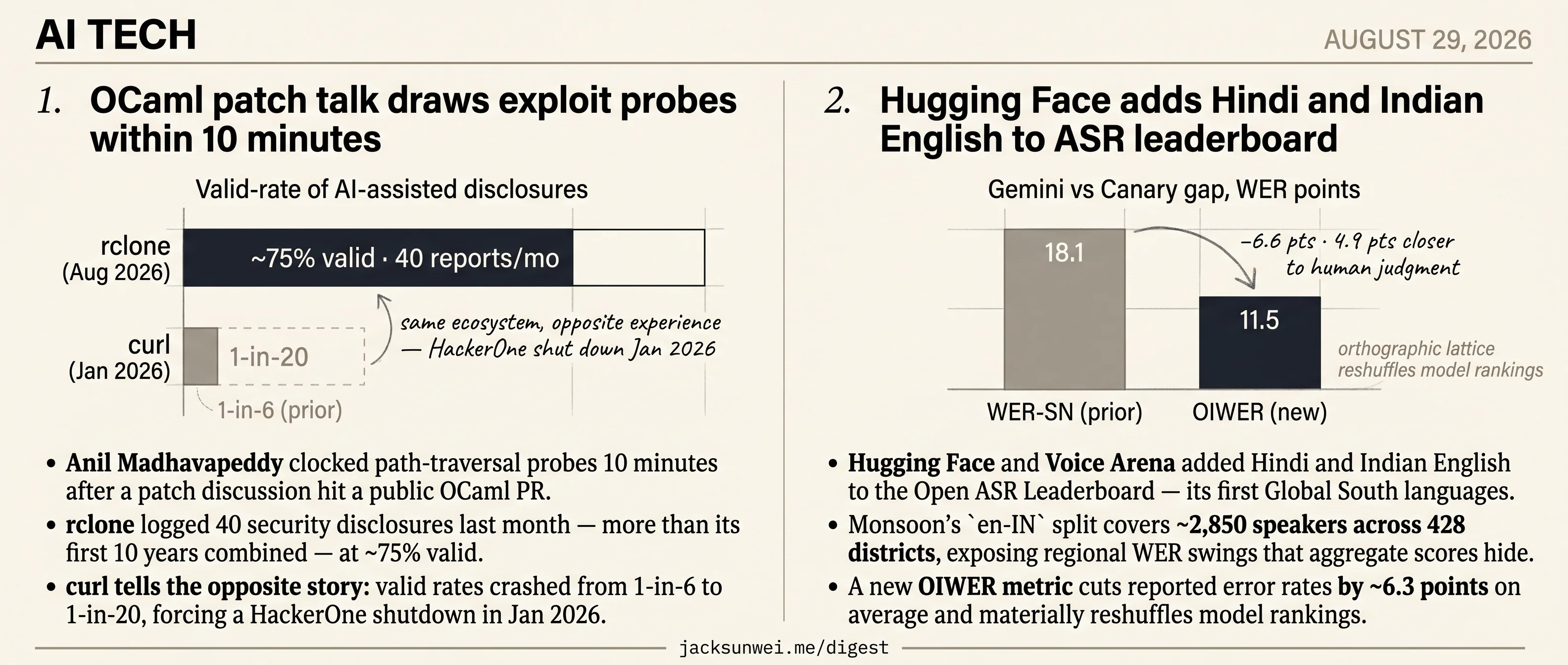
OCaml patch probed in 10 minutes, Hugging Face adds Hindi to ASR leaderboard
An OCaml patch discussion drew exploit probes within ten minutes, and Hugging Face's ASR leaderboard finally added Hindi and Indian English.
OCaml patch probed in 10 minutes, Hugging Face adds Hindi to ASR leaderboard
TL;DR
- OCaml patch discussion drew path-traversal probes within 10 minutes of hitting a public PR.
- rclone logged 40 security disclosures last month, more than its first 10 years combined.
- curl valid-report rate crashed from 1-in-6 to 1-in-20, forcing a HackerOne shutdown.
- Hugging Face added Hindi and Indian English to its Open ASR Leaderboard.
- New OIWER metric cuts reported ASR error rates ~6.3 points and reshuffles model rankings.
Today’s two developer drops don’t share a frame, but they both touch public infrastructure that used to be quiet plumbing. The lead story is Anil Madhavapeddy clocking path-traversal probes within ten minutes of a patch discussion hitting a public OCaml PR — sitting alongside rclone fielding more security disclosures in a month than in its first decade combined, curl shutting its HackerOne intake as valid-report rates cratered, and GitHub’s Advisory Database running 5× its historical monthly volume. The disclosure surface is being reshaped by LLM-speed adversaries and LLM-generated noise at the same time.
Separately, Hugging Face and Voice Arena extended the Open ASR Leaderboard to Hindi and Indian English — its first Global South languages — with a ~2,850-speaker en-IN corpus across 428 districts and a new OIWER metric that trims reported error rates ~6.3 points and materially reorders which models look best. The demographic metadata that makes those regional splits legible also raises fresh data-sovereignty questions.
OCaml patch talk draws exploit probes within 10 minutes
Source: simon-willison · published 2026-08-28
TL;DR
- Anil Madhavapeddy clocked path-traversal probes 10 minutes after a patch discussion hit a public OCaml PR.
- rclone logged 40 security disclosures last month — more than its first 10 years combined — at ~75% valid.
- curl tells the opposite story: valid rates crashed from 1-in-6 to 1-in-20, forcing a HackerOne shutdown in Jan 2026.
- GitHub’s Advisory Database published 1,560 advisories in May 2026 — 5× its historical monthly average.
The 10-minute window
Anil Madhavapeddy, a Cambridge CS professor and OCaml core maintainer, reports that within roughly ten minutes of a patch being discussed on a public repository, his infrastructure was already fielding probes for the exact percent-encoded traversal sequences the patch addressed. He reproduced the reverse direction with his own agents — feeding them only a bug rumor and watching them synthesize working exploits. Claude Fable refused the task on safety grounds; DeepSeek V4 Pro did not.
The implication he draws is blunt: the open-source embargo model, which assumes days of human-speed triage between “we think there’s a bug here” and “here’s a working exploit,” is dead. rclone maintainer Nick Craig-Wood confirms the pressure from the other side of the pipeline: 40 security disclosures in the last month against ~20 across the project’s first decade, with about three-quarters containing a real issue — and CVE assignments that used to land in 2-3 days now taking 3-4 weeks, forcing him to ship point releases marked CVE-PENDING.
The signal-to-noise fault line
The uncomfortable counterpoint comes from Daniel Stenberg at curl, whose project shut down its HackerOne bounty in January 2026 after AI-generated reports arrived every 18 hours with valid rates plummeting from 1-in-6 to worse than 1-in-20 1. Same ecosystem, opposite experience.
The distinguishing variable looks like the incentive layer. Cash bounties attract low-effort beg-bounty slop; unpaid disclosure funnels self-select for operators with real tooling. ZeroPath’s 170 verified curl bugs — praised by Stenberg himself — show that professional AI static analysis produces genuine signal when the operator has skin in the game 2.
Skeptics on Hacker News pushed back on the 10-minute anecdote too: percent-encoded traversal probes are constant background noise on any public IP, and path traversal is a classic flaw whose detection doesn’t need agentic reasoning once a PR points at the vulnerable function 3. The window may be less a demonstration of AI reconnaissance than of a probe fleet that would have hit any pattern eventually.
The pipeline has already broken
Whichever side of the signal-vs-slop debate you sit on, the plumbing is buckling in public. GitHub’s Advisory Database processed over 6,000 advisory decisions per month against a review capacity built for a fraction of that 4, and in July 2026 restructured its bug bounty into public and private tiers to gate high-value scope behind vetted “VIP researchers” 5 — a tacit admission that open-door disclosure no longer scales.
Madhavapeddy’s proposed answer goes beyond the alarm. His “antibotty” scheme envisions fast-propagating inoculation rules in a safe DSL, deployed to MirageOS unikernel gateways, that can drop malicious traffic within seconds of a vulnerability being identified — bypassing the recompile-and-package cycle entirely 6. He’s paired it with an ocaml-ai-disclosure mechanism that adds ai_disclosure stanzas to dune and solver constraints in opam, so downstream users can deprioritize AI-generated code.
Whether network-level auto-mitigations are trustworthy enough to deploy without human review is, by his own admission, unresolved. What’s not in dispute is that a disclosure model built around days of embargo is now negotiating with adversaries measured in minutes.
Hugging Face adds Hindi and Indian English to ASR leaderboard
Source: huggingface-blog · published 2026-08-28
TL;DR
- Hugging Face and Voice Arena added Hindi and Indian English to the Open ASR Leaderboard — its first Global South languages.
- Monsoon’s
en-INsplit covers ~2,850 speakers across 428 districts, exposing regional WER swings that aggregate scores hide. - A new OIWER metric cuts reported error rates by ~6.3 points on average and materially reshuffles model rankings.
- Deep demographic metadata — income, education, handset on a modest ~17h corpus — raises data-sovereignty questions.
What actually landed
The Open ASR Leaderboard now scores models on Indian English by default and on Hindi via its Multilingual tab. The evaluation sets — collectively called Monsoon — are jointly released by Hugging Face and Voice Arena, a Josh Talks AI initiative backed by roughly $5M from Ankur Capital and MDIF 7. Total audio is modest: about 11.2 hours of en-IN and 5.8 hours of hi-IN, split into public and private partitions. What Monsoon trades volume for is speaker breadth (~2,850 unique en-IN speakers, 2,000+ for hi-IN) and 12 metadata fields per segment, including occupation, income, and one of 500+ handset models.
That design targets a specific failure mode: corpus-wide WER numbers that look tied but hide sharp regional gaps. On the Indian English set, whisper-large-v3-turbo varied by 0.46 points across Indian zones, while Voxtral-Mini-3B-2507 swung 1.68 points, doing markedly better in Central India than the East. IBM’s granite-speech-3.3-2b collapsed most in the North; Microsoft’s VibeVoice-ASR-HF collapsed most in the South. The pattern is training-set fingerprints, not intrinsic accent difficulty.
This is not a novel observation. AI4Bharat’s Vistaar work already showed IndicWhisper falling from 10.3% WER on Kathbath-Hindi read speech to 26.8% on spontaneous GramVaani telephony 8, and IndicVoices provided multi-reference transcripts across 22 Indian languages back in 2024 9. Monsoon’s real contribution is routing that rigor into the leaderboard developers actually optimize against.
Why OIWER is the interesting bit
The technical innovation worth attention is Orthographically-Informed WER. Hindi has no fixed romanization and heavy code-mixing, so a correct transcription can lose to an annotator’s spelling preference. OIWER replaces the single reference string with a lattice of accepted spellings.
The underlying paper isn’t a rhetorical flourish. It reports OIWER cutting error rates by ~6.3 points on average, and — more consequentially — compressing the apparent Gemini-vs-Canary gap from 18.1 to 11.5 WER points, moving 4.9 points closer to human judgment than the previous WER-SN normalization 10. In other words: orthographic tolerance isn’t a cosmetic softener. It reshuffles rankings and blunts benchmark-fitting to one annotator’s style.
The sovereignty subtext
Monsoon’s metadata depth — district, income, education, handset — is what makes the bias analysis granular, and also what makes some observers nervous. Recent scholarship on “algorithmic sovereignty” argues that deep demographic profiling of Global South speakers can entrench extractive dependencies even as it improves bias metrics 11. The counter-model already exists: Masakhane’s African Languages Hub funded 26 projects in 2026 under a “By Africa, For Africa” collection ethos 12, and an African-language analog to Monsoon’s leaderboard slot is the obvious next move.
For now, Monsoon is best read as the productization of half a decade of Indic-ASR work by a commercially backed platform. The leaderboard finally reflects that work. The politics of who owns the metadata beneath it are unresolved.
Footnotes
-
Daniel Stenberg (curl) — ‘Death by a thousand slops’ — https://daniel.haxx.se/blog/2025/07/14/death-by-a-thousand-slops/
↩By mid-2025, approximately 20% of all submissions were identified as AI slop, with the volume rising to a new report every 18 hours by early 2026… the ‘valid-rate’ of reports plummeted from 1-in-6 to roughly 1-in-20 or worse.
-
ZeroPath blog — 170 valid bugs in curl — https://zeropath.com/blog/how-zeropath-won-over-curl-with-170-valid-bugs
↩In late 2025, the tool ZeroPath used AI to identify 170 verified issues in curl, ranging from C logic errors to RFC compliance bugs, receiving praise from Stenberg for its quality.
-
ai-tldr.dev / HN skeptics on cohttp PR 1145 — https://ai-tldr.dev/releases/simonw-rumour-is-the-exploit-aug28/
↩Dissenting commenters argued that the recorded probes might have been ‘coincidental noise’ from automated script-kiddie scanners that constantly spray common path traversal payloads… path traversal is a ‘classic’ flaw that does not require sophisticated AI to detect.
-
cyberpress.org — GitHub Advisory Database surge — https://cyberpress.org/github-advisory-database-hits/
↩GitHub’s Advisory Database published 1,560 reviewed advisories in May 2026 — more than five times its historical monthly average — while inflow exceeded 6,000 advisory decisions per month.
-
TechRadar — GitHub restructures bug bounty (July 2026) — https://www.techradar.com/pro/security/github-restructures-bug-bounty-program-following-flood-of-ai-generated-reports
↩GitHub restructured its bug bounty program into a two-tier system (public and private) to prioritize high-signal reports from ‘VIP researchers’.
-
Anil Madhavapeddy — ‘antibotty’ / microupdate proposal — https://anil.recoil.org/notes/2026w15
↩Deploying fast-propagating ‘inoculation rules’ — expressed in a safe DSL — directly to network enforcement points like MirageOS unikernel gateways… can drop malicious traffic within seconds of a vulnerability being identified, bypassing the slow process of full software recompilation.
-
Tracxn — Josh Talks / Voice Arena — https://tracxn.com/d/companies/josh-talks/__YIotT4T06EgwBAcmnuADr-kBQB1rcjdD5WN_vSUhv_4
↩Voice Arena operates under Josh Talks AI (founders Shobhit Banga and Supriya Paul), which has raised ~$5M including a $3.5M round led by Ankur Capital and earlier MDIF backing.
-
AI4Bharat Vistaar (GitHub) — https://github.com/AI4Bharat/vistaar
↩On the Kathbath-Hindi ‘known’ test set, IndicWhisper reaches a WER as low as 10.3%; on the GramVaani spontaneous telephone set the same model’s WER jumps to 26.8%.
-
IndicVoices (ResearchGate) — https://www.researchgate.net/publication/384214970_IndicVoices_Towards_building_an_Inclusive_Multilingual_Speech_Dataset_for_Indian_Languages
↩IndicVoices already provides multi-reference transcriptions and dialectal metadata for 22 Indian languages, positioning Monsoon as an evaluation-focused extension of a broader inclusive-dataset lineage.
-
arXiv (OIWER methodology paper) — https://arxiv.org/html/2603.00941v1
↩OIWER reduces reported error rates by ~6.3 points on average and narrows the perceived Gemini-vs-Canary gap from 18.1 to 11.5 WER points, aligning 4.9 points closer to human judgment than WER-SN.
-
WJARR — ‘Algorithmic sovereignty and new security dependencies’ — https://wjarr.com/content/algorithmic-sovereignty-and-new-security-dependencies-how-foreign-ai-surveillance
↩Global South ASR datasets risk becoming a form of ‘digital neocolonialism’ when extracted without sovereign control, introducing algorithmic-sovereignty risks even when technical bias metrics improve.
-
Masakhane African Languages Hub (Facebook post) — https://www.facebook.com/multilingualmagazine/posts/the-masakhane-african-languages-hub-has-announced-26-projects-funded-through-the/1515012313978164/
↩The Masakhane African Languages Hub announced 26 funded projects in 2026 pursuing ‘By Africa, For Africa’ ASR data collection for underrepresented tonal and agglutinative languages.