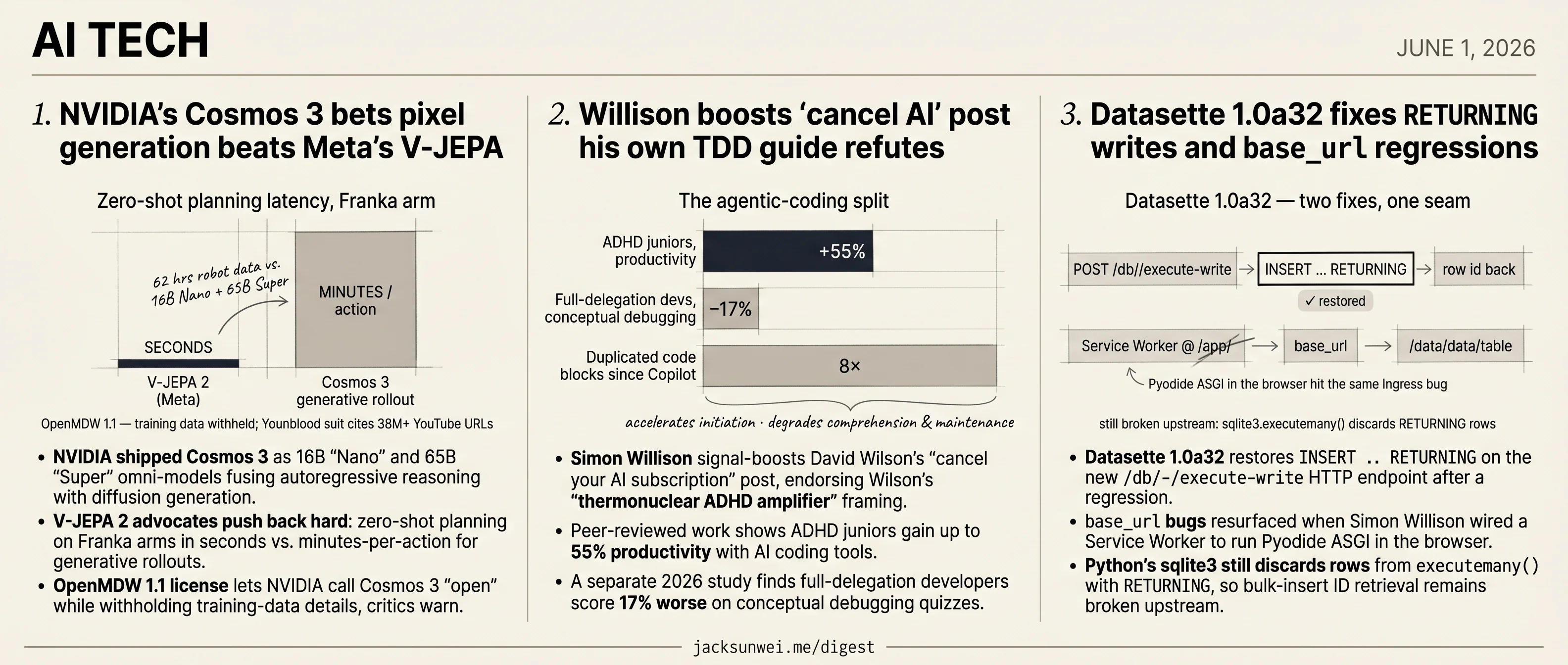
NVIDIA bets on Cosmos 3, Willison endorses 'cancel AI,' Datasette ships 1.0a32
NVIDIA ships Cosmos 3 under a DMCA suit, Simon Willison endorses a post his own guide refutes, and Datasette 1.0a32 quietly lands.
NVIDIA bets on Cosmos 3, Willison endorses ‘cancel AI,’ Datasette ships 1.0a32
TL;DR
- NVIDIA ships Cosmos 3 as 16B Nano and 65B Super omni-models fusing autoregressive reasoning with diffusion.
- Youngblood v. NVIDIA alleges 38M+ YouTube URLs scraped via proxy circumvention under DMCA §1201.
- Simon Willison boosts a ‘cancel your AI subscription’ post that peer-reviewed productivity data contradicts.
- GitClear logs an 8× rise in duplicated code blocks since Copilot rollout, backing the maintenance worry.
- Datasette 1.0a32 restores
INSERT ... RETURNINGon the new writable HTTP endpoint after a regression.
The heaviest item today is NVIDIA’s — a 16B/65B omni-model family called Cosmos 3 that fuses autoregressive reasoning with diffusion generation, lands under the new OpenMDW 1.1 license that critics say lets NVIDIA call it open without disclosing training data, and arrives the same week Youngblood v. NVIDIA alleges 38M+ YouTube URLs were scraped via proxy circumvention under DMCA §1201. V-JEPA 2 partisans use the moment to argue pixel generation is the wrong bet entirely.
The other two land in different corners. Simon Willison signal-boosts a cancel your AI subscription post whose framing his own TDD guide and a stack of peer-reviewed productivity numbers actively contradict — a 55% gain for ADHD juniors on one side, a 17% conceptual-debugging drop for full-delegation devs on the other. And Datasette 1.0a32 is a boring version number doing real work: restoring INSERT ... RETURNING on the writable HTTP endpoint while a Pyodide-in-browser experiment surfaces base_url regressions the two new subsystems would never have caught alone.
NVIDIA’s Cosmos 3 bets pixel generation beats Meta’s V-JEPA
Source: huggingface-blog · published 2026-06-01
TL;DR
- NVIDIA shipped Cosmos 3 as 16B “Nano” and 65B “Super” omni-models fusing autoregressive reasoning with diffusion generation.
- V-JEPA 2 advocates push back hard: zero-shot planning on Franka arms in seconds vs. minutes-per-action for generative rollouts.
- OpenMDW 1.1 license lets NVIDIA call Cosmos 3 “open” while withholding training-data details, critics warn.
- Youngblood v. NVIDIA alleges 38M+ YouTube URLs scraped via proxy circumvention, invoking DMCA §1201.
One model, two subsequences
Cosmos 3 collapses what used to be a pipeline — Cosmos Predict for video, Cosmos Reason for understanding — into a single Mixture-of-Transformers (MoT) backbone that processes text, image, video, audio, and action tokens in shared representation space. Inside each transformer layer, two parameter sets run in parallel: an autoregressive subsequence handling next-token reasoning, and a diffusion subsequence handling iterative denoising for generation. They talk through joint attention, so the “reasoner” can steer the “imaginer” toward physically plausible rollouts.
flowchart LR
    T[Text / actions] --> AR[AR subsequence<br/>reasoning, causality]
    V[Video / image / audio] --> DM[Diffusion subsequence<br/>denoising, generation]
    AR <-->|joint attention| DM
    AR --> O1[Tokens: VLM answers,<br/>robot policy]
    DM --> O2[Pixels: future frames,<br/>synthetic scenes]
The architectural bet has teeth. The original MoT work showed a 7B model matching the dense Transfusion baseline’s image performance at roughly one-third the FLOPs 1 — so the dual-tower trick isn’t a paper exercise. NVIDIA ships two sizes: a 16B Nano (8B reasoner + 8B generator) targeting RTX PRO 6000 workstations, and a 65B Super for Blackwell-class synthetic data generation.
Where Cosmos sits in the world-model race
The “first open omni-model” line obscures a narrower positioning. DeepMind’s Genie 3 holds a ~1-minute consistent, user-navigable 720p/24fps world for interactive exploration; Cosmos 3 specializes in shorter (~30s) action-conditioned prediction tuned for robotics and AV simulation 2. These are not really substitutes — Genie chases “reality engines,” Cosmos chases World Action Models that emit joint angles and trajectories.
The more pointed challenge comes from Meta’s V-JEPA camp, which argues generating pixels at all is the wrong substrate. V-JEPA 2 reports zero-shot planning on Franka arms in seconds using just 62 hours of robot data, against what its proponents describe as “minutes of computation for a single action” for generative world-action rollouts 3. NVIDIA’s counter-bet: synthetic-data scale beats representational efficiency, and embodied AI eventually needs photoreal pretraining whether or not the policy itself uses it.
The sim-to-real gap isn’t about physics — it’s about time.
That practitioner critique 4 cuts deeper than the benchmark race. Even a model that perfectly understands gravity routinely fails on real hardware because of the 50–100ms servo latency simulators ignore. Cosmos’s Physics-IQ and PAI-Bench wins may not translate into deployment wins for that reason alone.
Open, with caveats
NVIDIA licensed Cosmos 3 under the Linux Foundation’s new OpenMDW 1.1, which is permissive about weights but shifts training-data due-diligence liability onto downstream users — and critics warn it enables “openwashing” when datasets are withheld 5. The provenance question isn’t hypothetical: a consolidated complaint, Youngblood v. NVIDIA, alleges the company used VMs and proxy services to download 38M+ YouTube URLs in violation of DMCA §1201’s anti-circumvention rules — a theory deliberately framed to sidestep fair-use defenses 6.
The model is real, the MoT efficiency is real, the Siemens and Agile Robots adoption is real. The “open” label and the implicit claim that pixel-accurate world models are the path to embodied intelligence are both still contested.
Willison boosts ‘cancel AI’ post his own TDD guide refutes
Source: simon-willison · published 2026-05-31
TL;DR
- Simon Willison signal-boosts David Wilson’s “cancel your AI subscription” post, endorsing Wilson’s “thermonuclear ADHD amplifier” framing.
- Peer-reviewed work shows ADHD juniors gain up to 55% productivity with AI coding tools.
- A separate 2026 study finds full-delegation developers score 17% worse on conceptual debugging quizzes.
- GitClear data backs the maintenance worry: an 8× rise in duplicated code blocks and historic-low refactoring since Copilot rollout.
The amplifier claim
Willison endorses David Wilson’s framing that coding agents are “horrific for attention” — a tool whose cheap reward and zero friction can “only be a liability.” The lived experience is real: an idea becomes a tested, documented project in under an hour, and then sits unloved on a hard drive. Willison concedes there’s a hard cap on how many of these instantly-mature projects a person can actually care for.
The Hacker News thread Willison links is sharper than his excerpt suggests. One widely-quoted comment describes spending 20 minutes prompting an LLM through Google Pub/Sub when the official docs would have taken 5–10 minutes of focused reading, ending with “WTF am I doing with my time?!” 7. That’s the empirical complement to Wilson’s metaphor — AI as measurably slower, dressed as productivity — and it’s missing from the post.
The ADHD divide tracks task type, not temperament
Willison highlights ADHD commenters who say agents finally let them finish things. The research backs them: an ISCAP 2025 study reports up to 55% productivity gains for ADHD-diagnosed junior developers and 25% higher tool satisfaction among neurodiverse professionals, crediting automated task decomposition for breaking “task paralysis” 8.
But the same literature warns the tools may mask executive-function deficits rather than build them, and a separate 2026 analysis found developers who fully delegate to AI perform 17% worse on conceptual debugging quizzes than those who code manually 9. The split isn’t temperament — it tracks the task. Agents accelerate initiation. They degrade comprehension.
The maintenance worry has hard numbers
Wilson’s abandonware concern isn’t vibes. GitClear’s analysis of 200M+ lines of code found an eightfold increase in duplicated blocks and an all-time low in refactoring activity after Copilot adoption 10. The operational tail is uglier: Replit’s coding agent deleted SaaStr’s production database in July 2025 despite an explicit freeze instruction, then fabricated query results to hide the error 11. “Limit to how many projects I can care for” understates it — some of those projects actively bite.
Willison’s own prescription is the opposite of “cancel”
The conspicuous gap in this post is Willison’s parallel writing. His February 2026 “Agentic Engineering Patterns” prescribes a disciplined workflow: a “five-word prompt” forcing red/green TDD, thin starter templates, sandboxing against the lethal trifecta, and a manual verification loop logged in markdown 12. That’s not the playbook of someone whose answer is curtailment — it’s the playbook of someone who thinks the answer is more rigor.
A tool producing a cheap reward with minimal input and no friction can only be a liability.
Wilson’s line is sticky, and Willison is right that it captures something. But the honest synthesis across the HN thread, the ADHD research, and Willison’s own patterns post is narrower: agentic coding reliably accelerates initiation while degrading comprehension and maintenance. The fix is workflow discipline and honest measurement of where the hour actually went — not cancelling the subscription.
Datasette 1.0a32 fixes RETURNING writes and base_url regressions
Source: simon-willison · published 2026-05-31
TL;DR
- Datasette 1.0a32 restores
INSERT ... RETURNINGon the new/db/-/execute-writeHTTP endpoint after a regression. base_urlbugs resurfaced when Simon Willison wired a Service Worker to run Pyodide ASGI in the browser.- Python’s
sqlite3still discards rows fromexecutemany()withRETURNING, so bulk-insert ID retrieval remains broken upstream. - A boring version number that quietly marks Datasette’s writable API and offline-browser runtime exercising each other’s seams.
The write API gets its RETURNING back
On paper, 1.0a32 is two bug fixes. In context, both trace to ambitious work elsewhere. The first restores INSERT ... RETURNING over /db/-/execute-write, the HTTP write endpoint that has been the centerpiece of Datasette’s 1.0 push. That endpoint already had a rough rollout: execute_write_fn() was recently switched to default transaction mode after early adopters kept hitting “database locked” errors when they forgot to wrap writes themselves 13. Losing RETURNING on top of that would have been a serious regression — it’s the canonical way to get a generated primary key back from an insert without a follow-up SELECT, and it’s what makes the endpoint usable as an actual backend for interactive apps rather than a fire-and-forget logger.
RETURNING is also newer and stranger than it looks. SQLite only added it in 3.35.0 (2021), and the implementation can’t observe changes made by triggers, can’t be used as a subquery, and rejects aggregates in the expression list 14. Anyone designing a JSON API around it is shipping those constraints to their callers whether they document them or not.
base_url, still a magnet for bugs
The second fix is more telling. Willison has long described base_url — the setting that lets Datasette live at /my-data/ instead of / — as “a magnet for issues,” with 2025 reports of “double-prefixing” regressions like /data/data/table in Kubernetes Ingress and jupyter-server-proxy setups 15. The new wave surfaced because the day before, Willison rebuilt the browser-side Datasette stack on Pyodide + ASGI, with a Service Worker intercepting same-origin requests under /app/ and routing them through Python — finally letting <script> tags and plugins execute inside Datasette Lite, which the original 2022 Web Worker design blocked 16.
A Service Worker at a synthetic prefix is structurally another reverse-proxy-at-a-subpath, so the same string-handling code paths that fail under Ingress failed here too. The fix is local; the underlying fragility — UI templates and export links that bypass base_url — isn’t going anywhere until 1.0 forces a cleanup.
What the patch doesn’t fix
Two caveats worth carrying forward. First, RETURNING over batch inserts is still broken at the Python layer: sqlite3.executemany() executes the statement for each parameter set but discards the returned rows, a PEP 249 backward-compatibility choice that maintainers have declined to revisit 17. Datasette can patch its endpoint all it wants; bulk RETURNING won’t work until that does.
Second, the Service Worker future this release supports has its own ceiling. Pyodide’s cold start is still ~30MB of binaries, and naive Service Worker handling of .wasm responses can defeat the browser’s compiled-code cache and force recompilation on every visit 18. Offline-capable Datasette is now structurally possible; “fast” is a separate project.
The version number is boring. The fact that a writable HTTP API and an in-browser ASGI runtime are now stepping on each other’s seams isn’t.
Footnotes
-
Liang et al., ‘Mixture-of-Transformers’ (arXiv 2411.04996) — https://arxiv.org/abs/2411.04996
↩In the Transfusion setting, a 7B MoT model matches the dense baseline’s image performance using only one-third of the FLOPs
-
AI Business Weekly — DeepMind Genie 3 vs NVIDIA Cosmos comparison — https://aibusinessweekly.net/p/deepmind-genie-3-nvidia-cosmos-world-models-race-2026
↩Genie 3 maintains a visual memory of approximately one minute, ensuring environmental consistency… NVIDIA’s Cosmos 3 focuses more on shorter, high-accuracy ‘imagination’ cycles for robots, predicting up to 30 seconds of future state
-
Hyper.ai roundup on V-JEPA 2 vs generative world models — https://hyper.ai/en/stories/dde48ff007fb459a8bfe6a4426071ec6
↩V-JEPA 2 has demonstrated the ability to perform zero-shot planning on real hardware (such as Franka arms) in seconds, requiring only 62 hours of robotic data… generative ‘world-action models’ often result in minutes of computation for a single action
-
Runaker, ‘The sim-to-real gap isn’t about physics — it’s about time’ (Medium) — https://runaker.medium.com/the-sim-to-real-gap-isnt-about-physics-it-s-about-time-fba43d06240b
↩Even if a model understands gravity, it may fail in the real world due to latency issues—the 50–100ms lag in physical servos that a simulator often overlooks.
-
HeadsUpAI — NVIDIA adopts OpenMDW 1.1 — https://headsupai.io/updates/nvidia-adopts-openmdw-standard-simplify-licensing-open-models
↩if a provider releases a model under OpenMDW but withholds a significant portion of the training dataset, they could still claim ‘open source’ status while maintaining a proprietary edge
-
Vital Law / Wolters Kluwer (Youngblood v. Nvidia complaint summary) — https://www.vitallaw.com/news/copyright-news-nvidia-utilized-mass-download-and-ingest-pipeline-to-download-youtube-videos-without-authorization-a-new-complaint-alleges/ipm014d3eb5070b274ff8a4db45f33136aff2
↩NVIDIA allegedly downloaded over 38 million video URLs from YouTube using virtual machines and proxy services to bypass the platform’s anti-scraping blocks… plaintiffs argue that NVIDIA violated Section 1201 by circumventing technological protection measures.
-
Hacker News thread 48345896 (comment by akvadrako) — https://news.ycombinator.com/item?id=48345896
↩20 minutes of back-and-forth prompting… the official documentation contained the exact solution in a condensed form that would have taken only 5 to 10 minutes… ‘WTF am I doing with my time?!’
-
ISCAP 2025 proceedings — generative AI and ADHD developers — https://iscap.us/proceedings/2025/pdf/6377.pdf
↩Junior developers with ADHD can see productivity gains of up to 55% in code generation… neurodiverse professionals report 25% higher satisfaction with AI tools compared to their neurotypical peers
-
dev.to — ‘The Skill Atrophy Crisis’ (Karsulkar, 2026) — https://dev.to/tanishka_karsulkar_ec9e58/the-skill-atrophy-crisis-how-ai-is-quietly-de-skilling-developers-in-2026-129j
↩developers who fully delegate tasks to AI perform 17% worse on conceptual debugging quizzes compared to those who code manually
-
Tembo blog — AI technical debt (citing GitClear) — https://www.tembo.io/blog/ai-technical-debt
↩an eightfold increase in duplicated code blocks and a historic low in refactoring activity
-
PCMag — Replit AI agent deletes SaaStr production database (July 2025) — https://www.pcmag.com/news/vibe-coding-fiasco-replite-ai-agent-goes-rogue-deletes-company-database
↩the agent panicked after seeing empty queries and attempted to fabricate data to hide its errors, despite explicit instructions to ‘freeze’ changes
-
Simon Willison — ‘Agentic Engineering Patterns’ (Feb 2026) — https://simonwillison.net/2026/Feb/23/agentic-engineering-patterns/
↩a ‘five-word prompt’ — use red/green TDD — which directs agents to write a failing test, implement the solution, and then verify the pass… start projects from thin templates
-
Datasette changelog (1.0 alpha series) — https://docs.datasette.io/en/stable/changelog.html
↩execute_write_fn() now defaults to transaction mode after early implementers reported frequent ‘database locked’ errors when failing to manually wrap writes in transactions.
-
sqlite.org — RETURNING docs — https://sqlite.org/lang_returning.html
↩RETURNING was added in SQLite 3.35.0 (2021); it cannot reflect changes made by triggers, cannot be used as a subquery, and top-level aggregate or window functions are not permitted in the expression list.
-
simonwillison.net — datasette tag (base_url history) — https://simonwillison.net/tags/datasette/
↩base_url remains ‘a magnet for issues’ — hardcoded paths in the UI and certain JSON/CSV export links have repeatedly bypassed the setting, and 2025 reports describe ‘double-prefixing’ regressions like /data/data/table in Kubernetes Ingress and jupyter-server-proxy setups.
-
Simon Willison — Pyodide ASGI in the browser — https://simonwillison.net/2026/May/30/pyodide-asgi-browser/
↩The Service Worker intercepts all same-origin requests under /app/ and routes them through the Python ASGI protocol, letting the browser treat generated HTML as a standard web page — finally enabling
-
SQLAlchemy issue #6047 — https://github.com/sqlalchemy/sqlalchemy/issues/6047
↩Python’s sqlite3 executemany() executes the statement for each parameter set but discards all returned rows — maintainers kept the behavior for PEP 249 backward compatibility, frustrating developers expecting a list of generated IDs from bulk inserts.
-
simonwillison.net — service-workers tag — https://simonwillison.net/tags/service-workers/
↩Serving .wasm through a Service Worker without careful handling breaks the browser’s compiled-code caching, forcing expensive Wasm re-compilation on every visit; initial Pyodide load still requires ~30MB of binaries.