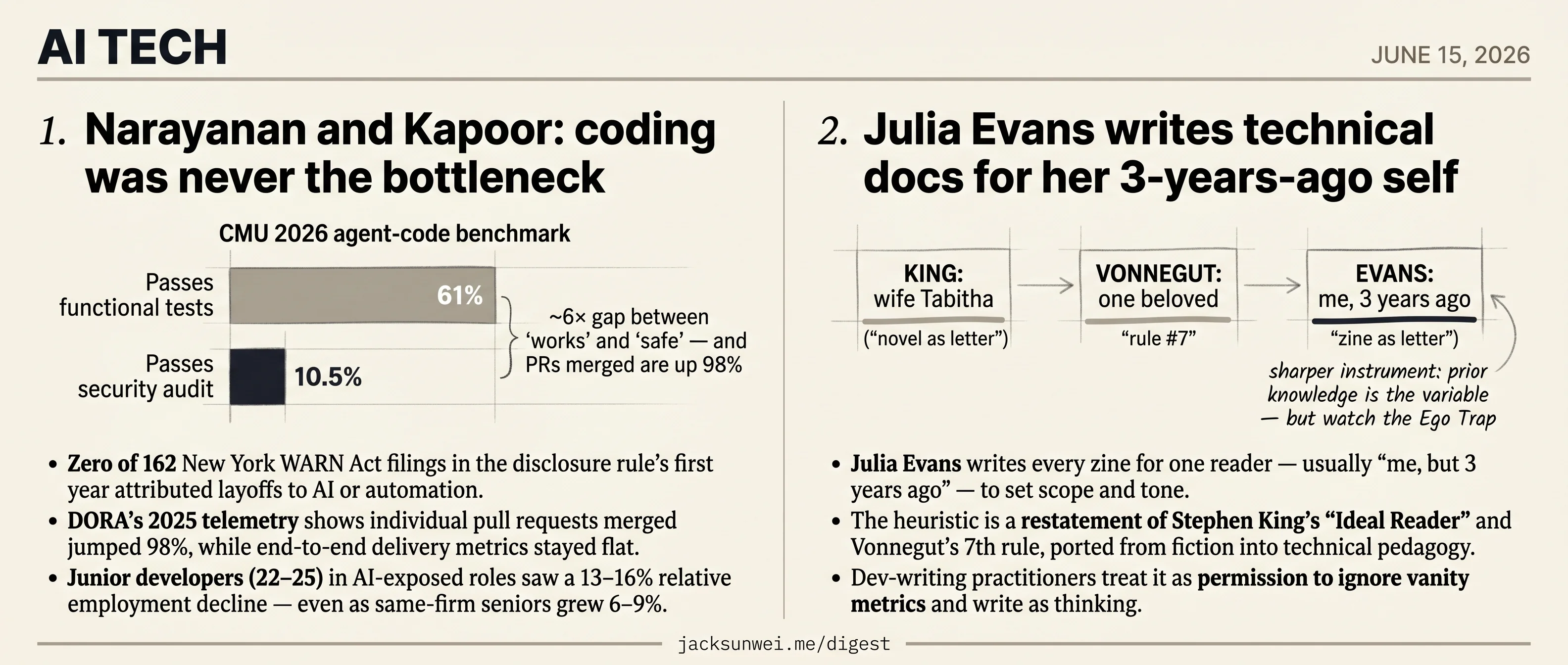
Narayanan-Kapoor reframe AI coding data, Evans writes for her past self
Two AI-tech reads today measure the gap between a much-quoted metric and the craft it's supposed to be tracking.
Narayanan-Kapoor reframe AI coding data, Evans writes for her past self
TL;DR
- Narayanan and Kapoor find 0 of 162 NY WARN filings cite AI as a layoff cause.
- DORA 2025 shows PR merges up 98% while end-to-end delivery stays flat.
- CMU’s 2026 benchmark logs a 6× gap between functional pass (61%) and security audit (10.5%).
- Junior devs (22-25) in AI-exposed roles drop 13-16% as same-firm seniors gain 6-9%.
- Julia Evans writes each zine for one reader — typically her own self from 3 years ago.
Two AI-tech reads today, both built around the same move: take a metric everyone’s been quoting and show what it actually measures. Arvind Narayanan and Sayash Kapoor work the AI-coding numbers — WARN Act filings, DORA telemetry, junior-dev employment, CMU’s security-audit benchmark — and find each headline figure pointing somewhere different from the story it’s used to tell. PR merges spike; delivery doesn’t. Layoffs land; nobody files AI as the cause. Functional tests pass; security audits don’t.
Julia Evans, writing about technical writing, lands in the same place from the other direction. Her heuristic — write every zine for one reader, usually ‘me, three years ago’ — exists precisely to ignore the vanity metrics (audience size, completeness, reach) that pull docs toward vague usefulness for no one. Critics flag an ‘Ego Trap’ in the move, but the underlying point holds: the metric that’s easy to optimize isn’t the one that tracks the work.
Narayanan and Kapoor: coding was never the bottleneck
Source: simon-willison · published 2026-06-14
TL;DR
- Zero of 162 New York WARN Act filings in the disclosure rule’s first year attributed layoffs to AI or automation.
- DORA’s 2025 telemetry shows individual pull requests merged jumped 98%, while end-to-end delivery metrics stayed flat.
- Junior developers (22–25) in AI-exposed roles saw a 13–16% relative employment decline — even as same-firm seniors grew 6–9%.
- CMU’s 2026 benchmark clocked a 6× gap between agent code that passes functional tests (61%) and security audits (10.5%).
The thesis, and why the data backs it
Arvind Narayanan and Sayash Kapoor’s argument is blunt: if AI were going to cause mass software-engineering layoffs, we’d see them by now, and we don’t. Simon Willison flagged the essay because the empirical backstop is unusually clean. New York’s March 2025 WARN Act amendment added a checkbox for AI-attributed layoffs; in the rule’s first full year, 162 companies filed notices and not one checked the box 1. That’s not proof of nothing happening, but it’s a strong null result in the jurisdiction most likely to surface it first.
The mechanism Narayanan and Kapoor propose is that coding was never the binding constraint. Independent telemetry agrees. Google’s 2025 DORA report found a 98% increase in pull requests merged per individual under AI assistance — and roughly no change in organizational delivery metrics 2. The throughput went somewhere; it didn’t reach customers. METR’s randomized trial, which last year embarrassed itself (and the field) by finding AI tools slowed experienced developers by 19%, has since updated: developers practiced in “spec-first” workflows now show ~18% speedups 3. The locus of value moved upstream, toward deciding what to build.
The junior-pipeline hole
The essay’s weakest flank is the entry level. Stanford’s Digital Economy Lab payroll study — the “Canaries in the Coal Mine” paper — finds developers aged 22–25 in highly AI-exposed roles down 13–16% in relative employment since late 2022, while developers aged 35–49 at the same firms grew 6–9% 4. This is fully consistent with the WARN data: firms aren’t firing incumbents, they’re not hiring juniors. Narayanan and Kapoor’s “deep human understanding” moat protects engineers who already have it. It silently closes the apprenticeship that produces the next cohort, and the essay underweights that.
Verification is winning the argument and losing the race
Narayanan and Kapoor name verification and accountability as durable human work. CMU’s 2026 benchmark sharpens the point uncomfortably: 61% of agent-generated code passes functional tests, but only 10.5% passes a rigorous security audit — a roughly 6× gap between “works” and “safe” 5. Combine that with DORA’s 98% PR-throughput jump 2 and the implication is grim arithmetic. The code requiring human review is multiplying faster than reviewers are.
The dissent worth taking seriously
Zvi Mowshowitz pushes back hardest, arguing the “normal technology” framing is exactly the error skeptics keep making as capabilities climb an exponential — the mundane utility is already undeniable and the curve hasn’t bent 6. He’s not contesting the 2026 data. He’s contesting its half-life.
The honest read: Narayanan and Kapoor’s descriptive claims hold. Their predictive claim rests on two bets — that the junior-pipeline erosion doesn’t compound into a senior-supply crisis a decade out, and that verification tooling closes the security gap before the volume of unaudited agent code becomes the story. Neither bet is yet in evidence.
Julia Evans writes technical docs for her 3-years-ago self
Source: simon-willison · published 2026-06-15
TL;DR
- Julia Evans writes every zine for one reader — usually “me, but 3 years ago” — to set scope and tone.
- The heuristic is a restatement of Stephen King’s “Ideal Reader” and Vonnegut’s 7th rule, ported from fiction into technical pedagogy.
- Dev-writing practitioners treat it as permission to ignore vanity metrics and write as thinking.
- Critics flag an “Ego Trap”: a remembered past self is a flattering composite, not an actual novice.
Old advice, new audience
Simon Willison’s quote-post surfaces a one-liner from Julia Evans’ Wizard Zines: “I picture a specific person and I just write for them. Often this person is ‘me, but 3 years ago’ or a good friend.” The line is doing more work than it looks. It’s a near-verbatim port of advice that fiction writers have been giving each other for decades.
Stephen King’s On Writing introduced the “Ideal Reader” — for him, his wife Tabitha — and framed a novel as “a letter aimed at one person,” with King constantly asking what she’d think of a given joke or scene 7. Kurt Vonnegut’s seventh rule in Bagombo Snuff Box is the same idea with more attitude: “Write to please just one person. If you open a window and make love to the world, so to speak, your story will get pneumonia.” 8
Evans’ contribution is the substitution. Where King picks a real intimate and Vonnegut picks an unnamed beloved, Evans picks a past version of herself at a known skill level. For technical writing — where the reader’s prior knowledge is the variable that actually determines whether a sentence lands — that’s a sharper instrument than “a friend.”
Why dev writers latch on
Inside the dev-blogging community, Evans’ framing gets adopted less as a stylistic choice and more as a productivity unlock. Chris Coyier reads her practice as license to “ignore vanity metrics and prioritize the organization of [your] own thoughts,” with reach as a side effect rather than a target 9. That’s the part anxious technical writers actually need to hear: the heuristic dissolves the paralysis of trying to write for “developers” as a category.
It also chains cleanly with the scope filter Evans has described elsewhere for picking zine topics — fundamental to computing, useful in daily work, stable over time, and learnable quickly 10. The four-part filter decides what to write; the one-person rule decides what to leave out. If three-years-ago-you already knew it, cut it. If they got stuck on it for a week, expand it.
The ego trap
The advice isn’t unchallenged, and the dissent is worth keeping next to the quote. Vonnegut himself noted that great writers routinely break his rules — Flannery O’Connor being his go-to counterexample 11. More pointed: craft commentary on Adam Grant’s Hidden Potential labels the past-self framing an “Ego Trap,” where the author “prioritizes their personal journey over the reader’s current needs” and produces memoir where reference material was wanted 12.
The remembered past self is usually a fictionalized, more-competent version of an actual novice.
That’s the failure mode to watch for. The curse of knowledge doesn’t disappear just because you’ve named a target reader — it hides inside the target. Evans’ zines work because she’s unusually honest about what she didn’t know, but the heuristic taken literally can collapse into solipsism. Useful starting device, dangerous load-bearing wall.
Footnotes
-
Hunton Employment & Labor Perspectives — https://www.hunton.com/hunton-employment-labor-perspectives/new-york-warn-act-no-ai-related-layoffs-reported-in-first-year-of-adding-ai-related-disclosure-to-the-system
↩162 companies filed WARN notices … not a single company checked the box to attribute layoffs to ‘technological innovation or automation’
-
Google/DORA 2025 State of AI-assisted Software Development — https://services.google.com/fh/files/misc/2025_state_of_ai_assisted_software_development.pdf
↩ ↩2telemetry data shows a 98% increase in pull requests merged at the individual level, yet end-to-end delivery metrics often remain flat
-
METR follow-up study (Feb 2026) — https://metr.org/blog/2026-02-24-uplift-update/
↩developers with significant experience in AI-specific workflows (such as ‘spec-first’ development) began to show speedups of approximately 18%
-
Stanford Digital Economy Lab — ‘Canaries in the Coal Mine’ — https://digitaleconomy.stanford.edu/app/uploads/2025/11/CanariesintheCoalMine_Nov25.pdf
↩software developers aged 22 to 25 in highly AI-exposed roles experienced a relative employment decline of 13% to 16% since late 2022 … even as employment for developers aged 35 to 49 in the same firms grew by 6% to 9%
-
Re-entry.ai citing CMU benchmark — https://www.re-entry.ai/blog/ai-generated-code-security-vulnerability-rates-2026
↩while 61% of code generated by advanced agents passed functional tests, only 10.5% passed rigorous security audits
-
Zvi Mowshowitz, ‘AI #168: Not Leading the Future’ — https://thezvi.substack.com/p/ai-168-not-leading-the-future
↩critics often fail to update their models as AI moves up the exponential curve … ‘mundane utility’ of AI is already undeniable
-
Austin Kleon — Stephen King’s ‘Ideal Reader’ — https://austinkleon.com/tag/stephen-king/
↩King views the novel as a ‘letter aimed at one person’ … he often finds himself wondering what [his wife Tabitha] will think of a particular scene or joke
-
Gotham Writers — Vonnegut’s 8 Basics — https://www.writingclasses.com/toolbox/tips-masters/kurt-vonnegut-8-basics-of-creative-writing
↩Write to please just one person. If you open a window and make love to the world, so to speak, your story will get pneumonia.
-
Chris Coyier on Julia Evans’ blogging — https://chriscoyier.net/2023/09/06/julia-evans-on-blogging/
↩writers should ignore vanity metrics and prioritize the organization of their own thoughts, making the act of writing intrinsically rewarding regardless of reach
-
r/launchschool thread on Wizard Zines — https://www.reddit.com/r/launchschool/comments/khnvp0/holiday_gift_to_launch_school_students_all_10_of/
↩Evans applies four criteria for a zine topic: fundamental to computing, useful for daily work, stable over time, and possible to learn relatively quickly
-
Janice Hardy, ‘Kurt Vonnegut Can Bite Me’ — http://blog.janicehardy.com/2013/01/kurt-vonnegut-can-bite-me.html
↩great writers often break his rules, citing Flannery O’Connor as an example of a master who defied conventional creative writing guidelines while still succeeding
-
Paws and Reflect blog (notes on Adam Grant) — https://www.pawsandreflect.blog/p/notes-from-hidden-potential-by-adam
↩the ‘writing for me’ mindset often falls into an ‘Ego Trap,’ where the author prioritizes their personal journey over the reader’s current needs