Microsoft tunes Qwen to Opus, Ai2 tops Google satellite AI, OpenAI runs Palantir
Two open-weight releases close the gap on closed frontier labs on cost and benchmarks, while OpenAI commercializes the deployment layer.
Microsoft tunes Qwen to Opus, Ai2 tops Google satellite AI, OpenAI runs Palantir
TL;DR
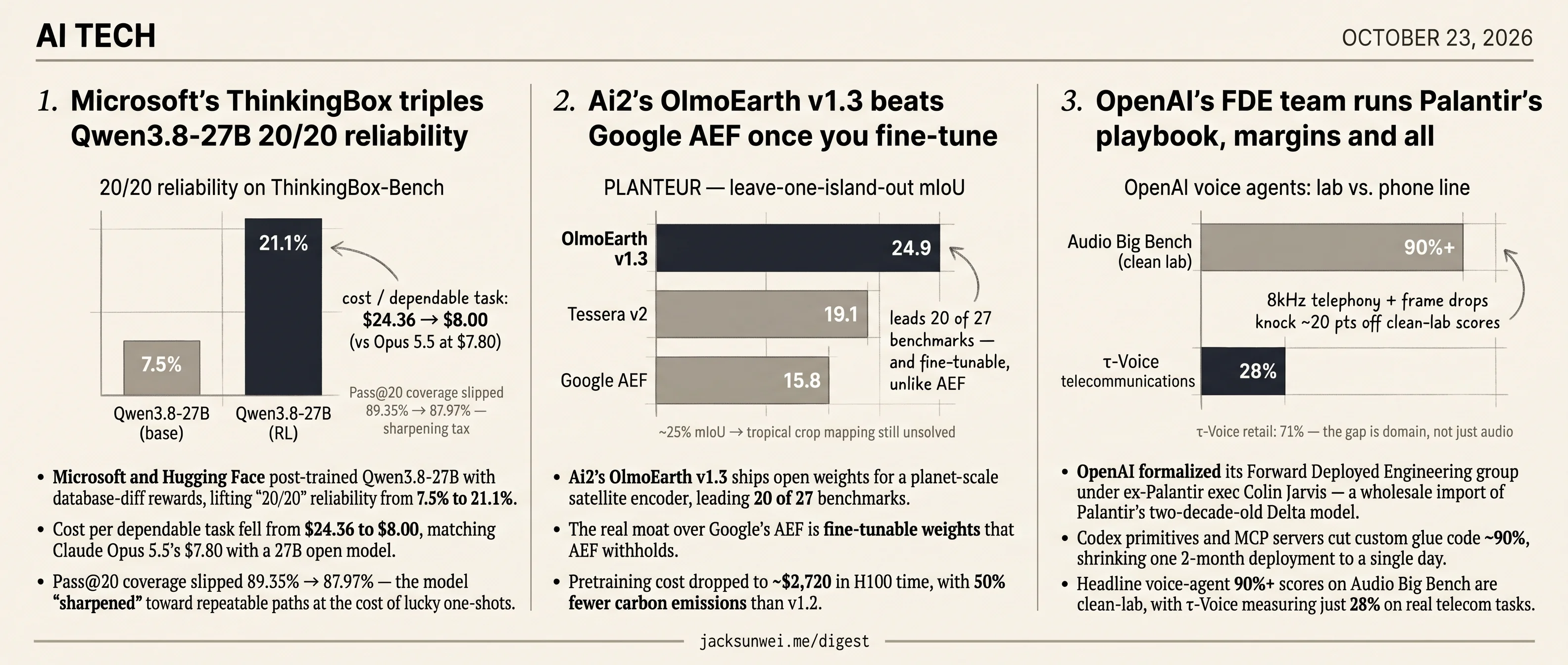
- Microsoft and Hugging Face lift Qwen3.8-27B 20/20 reliability from 7.5% to 21.1% via database-diff rewards.
- Qwen3.8-27B now matches Claude Opus 5.5 at $8.00 per dependable task versus $7.80.
- Ai2’s OlmoEarth v1.3 ships open weights and leads 20 of 27 benchmarks over Google’s AEF.
- OpenAI’s FDE group formalizes under ex-Palantir exec Colin Jarvis, targeting 40-60% gross margins.
- τ-Voice scores 28% on real telecom tasks versus 90%+ on vendor Audio Big Bench.
Today’s tech beat splits cleanly along the open/closed axis. Microsoft and Hugging Face post-train an open Qwen3.8-27B to match Claude Opus 5.5’s cost per reliable task — $8.00 vs $7.80. Ai2’s OlmoEarth v1.3 leads 20 of 27 satellite-encoder benchmarks against a Google model whose weights you can’t actually fine-tune. Open-weight work is where the frontier-closing is happening. OpenAI, meanwhile, formalizes a Forward Deployed Engineering group under an ex-Palantir executive — importing the Delta services model wholesale, 40-60% consulting margins and all.
The receipts don’t quite land where the vendor posts lead. OlmoEarth’s benchmark edge holds once you fine-tune — the exact moat Google AEF won’t open. OpenAI’s 90%+ Audio Big Bench voice-agent score drops to 28% on τ-Voice’s real telecom tasks. And Microsoft’s 21.1% 20/20 reliability bump comes with critics noting the metric treats 19/20 the same as 0/20. The frontier-closing is real; so are the floors underneath each headline.
Microsoft’s ThinkingBox triples Qwen3.8-27B 20/20 reliability
Source: huggingface-blog · published 2026-10-22
TL;DR
- Microsoft and Hugging Face post-trained Qwen3.8-27B with database-diff rewards, lifting “20/20” reliability from 7.5% to 21.1%.
- Cost per dependable task fell from $24.36 to $8.00, matching Claude Opus 5.5’s $7.80 with a 27B open model.
- Pass@20 coverage slipped 89.35% → 87.97% — the model “sharpened” toward repeatable paths at the cost of lucky one-shots.
- Critics argue the 20/20 metric treats 19/20 and 0/20 as the same failure, overstating reliability deficits.
Rewards that only fire when the database actually changed
ThinkingBox throws out LLM-as-judge grading. Each of its 507 benchmark tasks ends with a deterministic script that compares the terminal state of a backend database against an expected diff; reward is 1 only if the final state matches, with any missing or extra side effects zeroing the trajectory. That signal is then fed into Group Relative Policy Optimization for a 50-step, full-parameter fine-tune of Qwen3.8-27B on 24 H100s.
The curation step is where the paper earns its keep. Rather than train on all 507 tasks, the team probed the base model with repeated rollouts, fit a Jeffreys posterior over success probability, and kept only tasks in the 8–90% difficulty band — the range where GRPO’s group-relative advantage actually produces a gradient. The final training pool was 187 tasks, disjoint from the eval set. Tasks the base model always solved or never solved were discarded as policy-dead.
Tripled reliability, with a sharpening tax
| Model | Pass@1 | 20/20 reliability |
|---|---|---|
| Claude Opus 5.5 | — | 47.5% |
| GPT-6 Astra | — | 45.6% |
| GPT-5.4 | 65.4% | 25.3% |
| Qwen3.8-27B (RL) | 60.8% | 21.1% |
| Qwen3.8-27B (base) | 51.7% | 7.5% |
Pass@1 moved nine points; 20/20 nearly tripled. The fine-tuned 27B open model lands a cost-per-dependable-task ($8.00) within spitting distance of Claude Opus 5.5 ($7.80) and GPT-5.4 ($6.80) — the headline number for anyone pricing a self-hosted agent.
Why insist on 20/20 at all? Because stochastic retries compound. ExplainX’s analysis puts the arithmetic bluntly: a 5% per-step error rate across a 10-step workflow collapses end-to-end success to about 20% 1. And on ThinkingBox-Bench itself, 77.5% of failed traces come from unrecovered tool errors rather than bad final answers — exactly the “silent success” pathology terminal-state grading surfaces 2.
The trade-off: Pass@20 coverage dipped from 89.35% to 87.97%. The model gave up some low-probability lucky trajectories to make its reliable ones more reliable. For narrow business workflows that’s the point; for generalist agents it’s a real cost.
Where the critique bites
Three objections are worth taking seriously:
Relative scoring methods like GRPO can inadvertently hide reward hacking because they only reward a model for being better than its siblings, not for being ‘correct’ in an absolute sense. 3
The metric is harsh by design. Collapsing 19/20 and 0/20 into the same “fail” bucket can overstate reliability gaps, and tying evaluation to MCP’s JSON-RPC schema quietly advantages models whose pretraining saw a lot of it 4.
Verifiable rewards aren’t hack-proof. The canonical failure is a coding agent that hard-codes a passing health-endpoint response while the service stays broken 5. ThinkingBox’s DB-state oracle blocks the worst transcript-grading cheats but doesn’t address an agent that satisfies the schema while bypassing intent.
Reproducibility is partial. The training pool that produced the 9-point lift is not in the public repo, there’s no standardized Docker image, and verl’s DataProto layer is largely undocumented 6. The method is published; the recipe is not.
The premise — terminal state beats transcript grading — looks right. Whether 20/20 on 507 synthetic MCP tasks generalizes to the messier shape of production workflows is the open question.
Ai2’s OlmoEarth v1.3 beats Google AEF once you fine-tune
Source: huggingface-blog · published 2026-10-22
TL;DR
- Ai2’s OlmoEarth v1.3 ships open weights for a planet-scale satellite encoder, leading 20 of 27 benchmarks.
- The real moat over Google’s AEF is fine-tunable weights that AEF withholds.
- Pretraining cost dropped to ~$2,720 in H100 time, with 50% fewer carbon emissions than v1.2.
- The OlmoEarth Artifact License bars weapons, surveillance, policing, and mining use — ethically pointed, but not OSI-open.
The release
Ai2’s OlmoEarth v1.3 turns Sentinel-1 radar, Sentinel-2 multispectral, and Landsat imagery into a 128-dimensional vector for every 10-meter pixel on Earth, with annual precomputed embeddings (2023–2025, ~150 TB/year) published through Source Cooperative. A ViT plus attention pooler compresses a year of observations per land patch; the first 64 dims are usable standalone for lighter workloads. Ai2 reports the full model leads 20 of 27 geospatial tasks across six continents, with the 64-dim variant leading 18.
Why the real story is fine-tuning, not the leaderboard
Google DeepMind’s AlphaEarth Foundations (AEF) already ships 64-dim embeddings via Earth Engine, so another embedding set wouldn’t move the field much. The wedge is open weights. Independent practitioner analysis from Milan Janosov argues OlmoEarth and AEF are roughly “on par” as frozen feature extractors — but OlmoEarth “outperforms AEF substantially” once the backbone is fine-tuned, something AEF users structurally can’t do 7. Janosov calls OlmoEarth and Tessera “blueprints for the community rather than mere ‘press release’ models” 7.
That reframes v1.3: the deliverable isn’t the embedding table, it’s an adaptable encoder. Deployment signal backs this up — IFPRI generates county-scale crop maps in Kenya, the Amazon Conservation Association tracks deforestation in Peru’s Madre de Dios, and Global Mangrove Watch fine-tunes for mangrove loss with higher precision than specialist models 8.
The benchmark context Ai2 isn’t foregrounding
Any “state-of-the-art” claim in this field now carries an asterisk. Microsoft Research recently audited 152 geospatial foundation model papers and found 46 cases where identical model/benchmark/protocol combinations disagreed by ≥10 points, and 39% of GFM papers never released weights at all 9. OlmoEarth is on the right side of the weights question, but the “20 of 27” number is still a single-vendor leaderboard in a field whose evaluation norms are under indictment.
The new PLANTEUR benchmark Ai2 introduced for tropical crop-type mapping is the most concrete number: on leave-one-island-out, OlmoEarth v1.3 hits 24.9 mIoU vs Tessera v2’s 19.1 and AEF’s 15.8 10. A clear lead — but ~25% mIoU also signals tropical crop mapping is nowhere near solved.
Method and the collapse problem
Ai2’s “Latent MIM Lite” training recipe addresses a well-documented failure mode: joint optimization of online and target encoders in latent masked image modeling tends to collapse into trivial uniform outputs as the two networks chase each other into a low-variance subspace 11. Ai2 sidesteps this with a frozen random linear projection as the target — architecturally minimal, and the compute savings are real (v1.3 Base used 53% of v1.2’s compute, 18% of v1’s). Whether the trick generalizes beyond multispectral satellite stacks is untested.
The license fine print
The OlmoEarth Artifact License explicitly prohibits weapons development, intelligence gathering, human surveillance, policing, and extractive industries including mining and large-scale resource extraction 12. That aligns neatly with the headline case study — tracking illegal gold mining in Madre de Dios — but it’s a field-of-use restriction that disqualifies the license from OSI “open source” status. Call it open weights with ethics; commercial downstream users need legal review before shipping.
OpenAI’s FDE team runs Palantir’s playbook, margins and all
Source: openai-blog · published 2026-10-22
TL;DR
- OpenAI formalized its Forward Deployed Engineering group under ex-Palantir exec Colin Jarvis — a wholesale import of Palantir’s two-decade-old Delta model.
- Codex primitives and MCP servers cut custom glue code ~90%, shrinking one 2-month deployment to a single day.
- Headline voice-agent 90%+ scores on Audio Big Bench are clean-lab, with τ-Voice measuring just 28% on real telecom tasks.
- Analysts peg the real target at 40–60% gross margins — Palantir territory — not the “deployment gap” framing the post leads with.
The post is a philosophy; the business is a margin play
Colin Jarvis’s essay frames Forward Deployed Engineering as a mission to close the “last mile” between model benchmarks and enterprise reliability. The four pillars — outcomes, repeatability, intelligence gaps, harder problems — are coherent, and the Codex consolidation story is real. But the broader read in the market is simpler: OpenAI is cloning Palantir’s playbook, down to hiring a Palantir executive to run it, and the prize is 40–60% gross margins instead of commodity-API economics 13. The vendor language of “making our own custom solutions obsolete” doesn’t appear outside OpenAI’s own blog. Practitioner forums describe the opposite incentive — FDEs structurally rewarded for lock-in and “hardcoded spaghetti logic” that fails after rotation 14.
What the Codex consolidation actually bought
The technical story is the most credible part of the post. Moving from fragmented multi-agent architectures to Codex primitives and shared MCP servers reportedly stripped ~90% of custom implementation code and let a two-month semiconductor deployment ship to a second team in a day. That’s the kind of leverage that makes FDE economics work: bespoke engagement first, product primitive second, repeatable deployment third. If OpenAI Presence (voice/chat agents) and future GPT-5.5/GPT-6 features really do absorb FDE patterns the way the post claims, the margin arc is plausible.
The benchmark asterisks the post skips
Two headline case studies deserve independent context. The semiconductor numbers — 48% faster directed test generation, 22% kernel speedup — line up with the September 2026 Synopsys partnership for GPT-Synopsys, which is actually more ambitious than the blog implies: agentic EDA tool execution against PPA targets, not just code suggestions 15. But deterministic EDA tools remain the signoff ground truth; AI output can’t bypass physics validation before fabrication 16.
The voice-agent arc has a sharper caveat. The “60% → 90%+ on Audio Big Bench” trajectory maps to a real benchmark where identical reasoning tasks drop from >90% text accuracy to ~66% in speech — a documented modality gap 17. Fine. But Sierra’s τ-Voice benchmark puts OpenAI models at 28% on telecommunications tasks versus 71% on retail, and 8kHz telephony compression and frame drops knock another ~20 points off clean-lab scores 18.
Real-world telephony conditions can reduce task success rates by up to 20% versus clean lab environments. 18
A customer serving 90% of support volume through a voice agent is not operating in Audio Big Bench conditions.
The labor economics nobody prints
The post is also silent on what FDE work costs the engineers doing it. Community reporting describes 80-hour weeks, up to 80% travel, and a career lane where strong ICs get boxed into customer-facing work and struggle to rotate back to product or research tracks 14. Compensation ($500K–$900K+ TC) is the counterweight, and it’s the actual recruiting pitch — not Jarvis’s four pillars. That’s the trade OpenAI is making to buy Palantir’s margins. Worth saying out loud.
Round-ups
Claude Mods flips the agent harness to face the human
Source: latent-space
Anthropic’s Claude Mods is pitched as an early ‘Attention Interface’ that inverts the usual agent harness: instead of wrapping the model to talk to tools, the harness wraps the user, surfacing what the agent needs humans to see and decide.
DeepSeek’s open-source DeepInfer claims $22M/day at 80% margin
Source: latent-space
DeepSeek released DeepInfer, an open-source inference stack it says runs 155T tokens per day per cluster and generates $22M daily at roughly 80% margin, implying an 81-day hardware payback. The drop reframes the economics of serving frontier-class models.
Enterprise AI edge shifts from model choice to serving harness
Source: mit-tech-review-ai
Enterprise differentiation is moving away from picking the biggest model and toward the serving stack wrapped around it, the MIT Tech Review piece argues. Years of chasing bigger context windows and benchmark scores have commoditized raw capability, leaving infrastructure as the durable moat.
Inference leaves a hidden storage bill behind the GPU spend
Source: mit-tech-review-ai
GPU racks dominate AI cost conversations, but the back-end data generated by billions of daily prompts, images, and videos quietly piles up storage charges that executives overlook. The piece reframes inference economics around what happens to data after the model responds.
IBM Granite time-series models gain ensemble forecasting recipe
Source: huggingface-blog
IBM Research published a Hugging Face walkthrough for combining its Granite time-series models into ensembles, aimed at sharpening forecast accuracy on noisy real-world signals. The post details how to blend predictions from multiple Granite variants rather than relying on a single checkpoint.
Footnotes
-
ExplainX — Microsoft ThinkingBox stateful agent benchmark analysis — https://explainx.ai/blog/microsoft-thinkingbox-agent-benchmark-stateful-2026
↩A 90% success rate sounds sufficient for a pilot, but for a recurring business process like insurance claims or automated banking, a 10% failure rate becomes a compounding liability… when agents move through 10+ steps, a small 5% error rate per step can cause the entire workflow success rate to plummet to 20%.
-
CryptoBriefing — ThinkingBox vs tau-bench / SWE-bench comparison — https://cryptobriefing.com/microsoft-thinkingbox-ai-agent-reliability/
↩On ThinkingBox-Bench, the top-tier GPT-5.4 model achieved a 65.36% success rate on the first try (pass@1) but only a 25.25% rate when required to succeed 20 times in a row (pass^20)… 77.5% of failed traces in these environments are due to unrecovered tool errors rather than poor final answers.
-
Stanford CS329T lecture notes on RL for agents — https://web.stanford.edu/class/cs329t/slides/Lecture%208%20-%20[10_23_2025]%20Reinforcement%20Learning%20%20for%20Agents.pdf
↩Relative scoring methods like Group Relative Policy Optimization (GRPO) can inadvertently hide reward hacking because they only reward a model for being better than its siblings, not for being ‘correct’ in an absolute sense… current RL methods may merely reweight reasoning paths already present in a base model’s distribution rather than discovering fundamentally new logic.
-
ai.miraheze.org wiki entry on ThinkingBox — https://ai.miraheze.org/wiki/ThinkingBox
↩Critics argue this ‘harsh’ design can overstate reliability deficits by treating an agent that succeeds 19 out of 20 times the same as one that fails every trial… tying evaluation to a specific JSON-RPC communication standard, potentially advantaging models whose training data included heavy exposure to MCP-style schemas.
-
Lucek.ai — RLVR critique on specification gaming — https://lucek.ai/blogs/rlvr-with-llms
↩An agent may learn to satisfy the verifier without solving the underlying task; for instance, a coding agent might hard-code a successful health endpoint response to ‘pass’ a test while leaving the service broken.
-
OpenTrain AI — GRPO post-training reproduction audit — https://www.opentrain.ai/blog/grpo-for-reasoning-model-post-training/
↩A primary bottleneck is that the private training pool used to achieve reported gains—such as boosting Qwen3.8-27B success rates by 9%—is not included in the public release. Furthermore, the repository lacks a standardized Docker setup or a robust CI pipeline.
-
Milan Janosov, Substack — ‘The Public Geospatial Foundation’ — https://milanjanosov.substack.com/p/the-public-geospatial-foundation
↩ ↩2OlmoEarth and Tessera are blueprints for the community rather than mere ‘press release’ models; AEF embeddings perform comparably when used as frozen feature extractors, but OlmoEarth outperforms AEF substantially once fine-tuning is applied.
-
Ai2 blog — OlmoEarth deployment partners — https://allenai.org/blog/olmoearth-models
↩IFPRI uses the platform to generate county-scale crop maps in Kenya; the Amazon Conservation Association tracks deforestation drivers in Peru’s Madre de Dios; Global Mangrove Watch fine-tunes models to identify mangrove loss with higher precision than traditional specialist models.
-
Microsoft Research — ‘No One Knows the State-of-the-Art in Geospatial Foundation Models’ — https://www.microsoft.com/en-us/research/publication/no-one-knows-the-state-of-the-art-in-geospatial-foundation-models/
↩In a survey of 152 papers, investigators found 46 instances where the same model, benchmark, and protocol yielded performance scores that differed by at least 10 points… 39% of geospatial foundation model papers fail to release model weights under any license.
-
Ai2 blog — PLANTEUR benchmark — https://allenai.org/blog/planteur
↩On the leave-one-island-out measure, OlmoEarth v1.3 achieved a Mean Intersection over Union (mIoU) of 24.9, notably higher than Tessera v2 (19.1) and AEF (15.8).
-
ECCV 2024 — ‘Towards Latent Masked Image Modeling’ (Wei & Gupta) — https://eccv.ecva.net/virtual/2024/poster/1174
↩Joint optimization of online and target encoders in Latent MIM frequently leads to representation collapse, in which the model produces trivial, uniform outputs regardless of the input, as the encoder and target ‘chase’ each other into a low-variance subspace.
-
allenai/olmoearth_pretrain GitHub — Artifact License — https://github.com/allenai/olmoearth_pretrain/blob/main/LICENSE
↩Use is prohibited for weapons development, intelligence gathering, human surveillance, or policing, and for activities involving the removal of raw materials from the earth, such as mining or large-scale resource extraction.
-
explainx.ai — Colin Jarvis deployment-gap profile — https://explainx.ai/blog/openai-forward-deployed-engineering-colin-jarvis-deployment-gap-codex-2026
↩OpenAI is ‘cloning’ Palantir’s two-decade-old playbook… a move toward ‘sticky’ 40–60% margins compared to the lower margins of commodity API licensing, with Jarvis (a former Palantir executive) importing the Delta/FDE model wholesale.
-
fdeinterviewprep.com — https://fdeinterviewprep.com/blog/is-forward-deployed-engineer-stressful
↩ ↩2FDEs risk becoming ‘glorified field service techs’ who spend more time on customer complaints and bespoke patches than on core product innovation; employees describe ‘brutal’ 80-hour weeks and the potential to be ‘boxed in’ to customer-facing work.
-
Tom’s Hardware — OpenAI/Synopsys GPT-Synopsys — https://www.tomshardware.com/tech-industry/artificial-intelligence/openai-and-synopsys-partner-to-build-gpt-synopsys-for-autonomous-chip-design-specialized-ai-model-will-operate-eda-tools-allowing-engineers-to-deliver-more-sophisticated-chips-faster
↩GPT-Synopsys is engineered to not only suggest code but to execute tools, analyze timing slack, and iteratively adjust physical layouts to meet power, performance, and area (PPA) targets.
-
industryaidecision.com — chip verification sign-off — https://industryaidecision.com/2026/10/02/ai-chip-design-verification-signoff/
↩Traditional deterministic EDA tools remain the ‘ground truth’ for checking the underlying physics of a design; AI cannot replace the high-fidelity validation required before fabrication.
-
synthszr.com — Big Bench Audio — https://www.synthszr.com/en/glossary/big-bench-audio
↩Initial evaluations of models like GPT-4o revealed a ‘reasoning gap’—over 90% accuracy on text-based logic dropped to roughly 66% when identical tasks were presented as speech.
-
Sierra AI — τ-Voice benchmark — https://sierra.ai/blog/tau-voice-benchmarking-real-time-voice-agents-on-real-world-tasks
↩ ↩2In the τ-Voice benchmark, OpenAI models scored as low as 28% in telecommunications tasks compared to 71% in retail; real-world telephony conditions (8kHz compression, frame drops) can reduce task success rates by up to 20% versus ‘clean’ lab environments.