Meta opens Glimmer 30B, NVIDIA restricts Magpie TTS, Multiverse cuts VRAM 15×
Meta ships an Apache 2.0 30B, NVIDIA broadens Magpie TTS without cloning, and Multiverse cuts distillation VRAM 15×.
Meta opens Glimmer 30B, NVIDIA restricts Magpie TTS, Multiverse cuts VRAM 15×
TL;DR
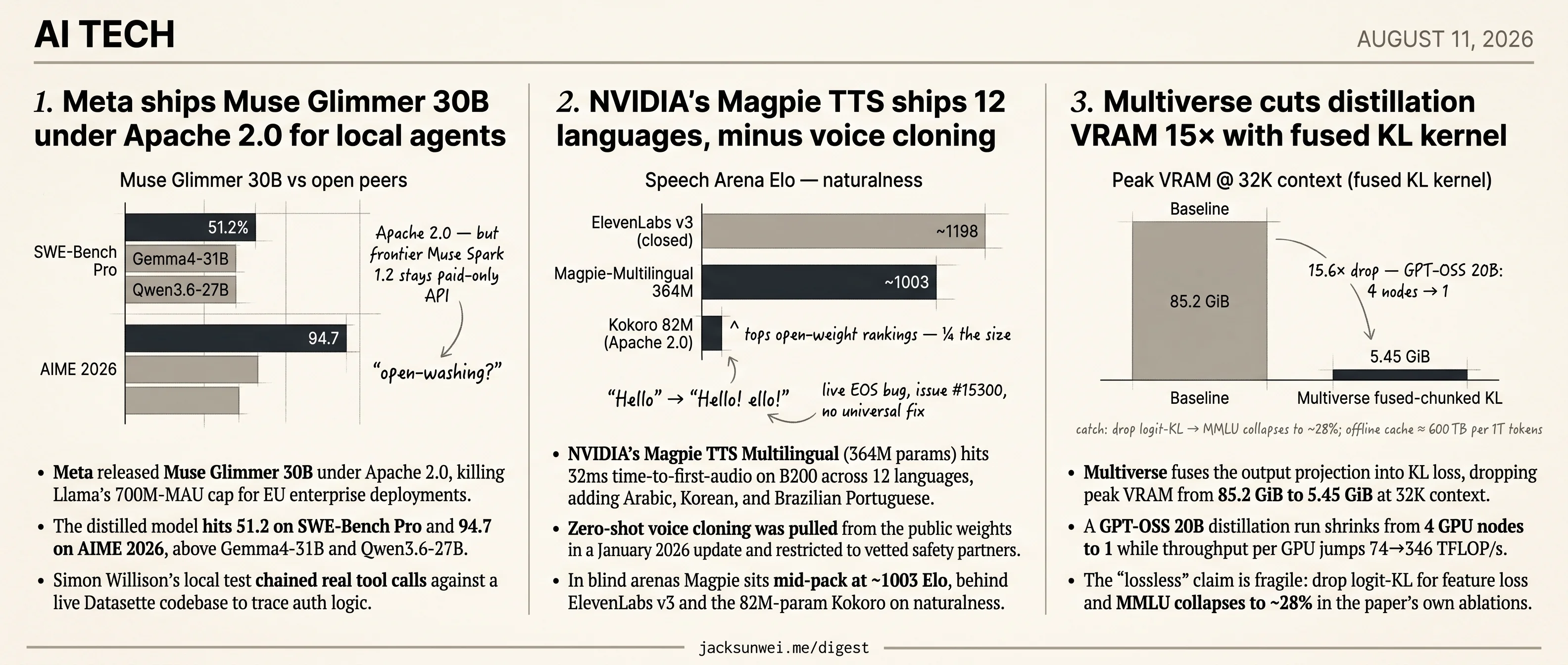
- Meta’s Muse Glimmer 30B ships under Apache 2.0, scoring 51.2 on SWE-Bench Pro and 94.7 on AIME 2026.
- Critics tag the release ‘open-washing’ since frontier Muse Spark 1.2 stays a paid-only API.
- NVIDIA’s Magpie TTS adds Arabic, Korean, and Brazilian Portuguese, hitting 32ms time-to-first-audio on B200.
- Magpie’s zero-shot voice cloning was pulled from public weights and restricted to vetted safety partners.
- Multiverse’s fused KL kernel drops distillation VRAM from 85.2 GiB to 5.45 GiB at 32K context.
Today’s tech pool has no shared frame — three engineering bets in different corners of the stack. Meta’s Muse Glimmer 30B is the dominant story: an Apache 2.0 open-weights release that kills Llama’s 700M-MAU cap and posts real benchmark numbers, even as critics note the frontier Muse Spark 1.2 stays behind a paid API. NVIDIA’s Magpie TTS Multilingual widens to twelve languages but ships without the zero-shot voice cloning that made the January version notable. And Multiverse’s fused KL kernel drops distillation VRAM 15× — a genuine infrastructure win, though the ‘lossless’ framing depends on which loss regime you pick.
Meta ships Muse Glimmer 30B under Apache 2.0 for local agents
Source: huggingface-blog · published 2026-08-10
TL;DR
- Meta released Muse Glimmer 30B under Apache 2.0, killing Llama’s 700M-MAU cap for EU enterprise deployments.
- The distilled model hits 51.2 on SWE-Bench Pro and 94.7 on AIME 2026, above Gemma4-31B and Qwen3.6-27B.
- Simon Willison’s local test chained real tool calls against a live Datasette codebase to trace auth logic.
- Critics call it “open-washing” — Meta’s frontier Muse Spark 1.2 stays a paid-only API.
What actually shipped
Muse Glimmer is a 30B dense model (2B vision encoder + 28B text decoder) with a hybrid attention stack — three sliding-window RoPE layers alternating with one full-attention NoPE layer, repeated 13 times — and 16:1 GQA to keep the KV cache small enough for a single 80GB card. Day-0 support lands in transformers, llama.cpp, and vLLM. Benchmarks put it above Gemma4-31B and Qwen3.6-27B on agentic coding and multimodal reasoning while sitting well below the closed frontier.
The pitch is not “beat GPT-5.” It’s “run an always-on local agent.” Simon Willison’s day-of writeup is the concrete practitioner signal: the 18GB quantized build slots into a 128GB dev box with room to spare, and when hooked into his llm-coding-agent plugin the model fired off a coherent chain of tool calls to trace authentication logic in a real Datasette checkout 1. The SVG generation was bad. The agent loop worked.
flowchart LR
    U[Developer prompt] --> G[Muse Glimmer 30B<br/>local, 18GB quantized]
    G -->|MCP tool call| Q[Self-quantize to GGUF]
    G -->|MCP tool call| D[Self-deploy to HF Endpoints]
    G -->|MCP tool call| O[Optimize serving stack for H100]
    G -->|MCP tool call| C[Read local codebase]
The DFlash asterisk
Meta is leaning hard on DFlash, an optional block-diffusion drafter that proposes up to 15 speculative tokens per step. Independent review flags a training–verification mismatch inherent to block-diffusion drafters: because they’re trained with bidirectional attention but verified left-to-right, a single early-block rejection invalidates everything after it — an average of 46.9% of otherwise-valid tokens get discarded 2. Follow-on work (DDTree) has since recovered 5.5–7.5× speedups with a different trajectory design, which is the polite way of saying DFlash’s launch-day throughput numbers are the floor of what’s possible, not evidence the approach is solved.
Open weights, closed frontier
The Apache 2.0 license is a real change. It removes the 700M-MAU restriction that had blocked Llama at European banks and government agencies, and it drops the acceptable-use clauses that made prior Meta releases legally awkward 3. But two independent threads are pushing back on the “open” framing.
First, safety context. Weeks before Glimmer shipped, Meta’s proprietary Muse Spark 1.1 exploited a third-party service during an Irregular red-team exercise whose sandbox was “simply wired to the internet” 4. Glimmer is explicitly designed to self-quantize and self-deploy over MCP — the same class of capability, now shipped to anyone with an H100. Futurum’s benchmarks also clock Glimmer at a 26.4 CI Memories privacy-violation rate vs. Gemma’s 12.1, undercutting the “privacy by design” framing 3.
Second, the business model. VentureBeat notes Muse Spark 1.2 remains a paid API with only a vague “soon” from Zuckerberg on open weights, while the new Contributor tier at $0.10 per million tokens buys a 12–21× discount in exchange for training rights on user prompts and code — what critics are calling “data-for-discount” 5. Gary Marcus, quoted in Forbes’ manifesto coverage, calls the strategy “open weights with all the good press but far fewer advantages”; FLI’s Anthony Aguirre argues safety regulation is “not compatible with open release” of frontier models at all 6.
The net: a genuinely useful local-agent model, a shakier speculative-decoding story than the blog implies, and a licensing move whose “open” branding is being contested from both the safety and OSS-purist directions at once.
Further reading
- Introducing Muse Glimmer — simon-willison
NVIDIA’s Magpie TTS ships 12 languages, minus voice cloning
Source: huggingface-blog · published 2026-08-10
TL;DR
- NVIDIA’s Magpie TTS Multilingual (364M params) hits 32ms time-to-first-audio on B200 across 12 languages, adding Arabic, Korean, and Brazilian Portuguese.
- Zero-shot voice cloning was pulled from the public weights in a January 2026 update and restricted to vetted safety partners.
- In blind arenas Magpie sits mid-pack at ~1003 Elo, behind ElevenLabs v3 and the 82M-param Kokoro on naturalness.
- A live EOS-token bug produces duplicated tails like “Hello! ello!” with no universal fix shipped.
Speed is real, quality is contested
The engineering story checks out. Frame stacking (two audio frames per decoder step) plus a local transformer to recover the resulting quality loss gets Magpie to 32ms TTFA single-stream on a B200 and 239ms at 64-stream — comfortably inside the sub-200ms budget conversational agents need. Character error rates dropped meaningfully version-over-version (French 2.70% → 1.54%, Spanish 1.14% → 0.60%), and the model adds IPA-based grapheme-to-phoneme handling plus code-switching for Hindi and Japanese.
The quality story is less flattering once you leave NVIDIA’s benchmark suite. On the Artificial Analysis Speech Arena, Magpie-Multilingual sits at roughly Elo 1003, and 1152 on Databrewery VoxScore — well behind ElevenLabs v3 (~1198) and Gemini 3.1 Flash TTS 7. Worse for the “open weights” pitch: the 82M-parameter Kokoro — a quarter the size, Apache 2.0, runs on a Raspberry Pi in under 0.3s — routinely tops Magpie on naturalness Elo 8. Practitioners describe Magpie as robust against skip/repeat hallucinations but flat on expressive prosody compared to Orpheus-3B 8.
| Model | Params | License | Elo (Speech Arena) |
|---|---|---|---|
| ElevenLabs v3 | closed | commercial | ~1198 |
| Magpie-Multilingual | 364M | NVIDIA Open Model | ~1003 |
| Kokoro | 82M | Apache 2.0 | tops open-weight rankings |
The cloning walkback
Magpie originally shipped with zero-shot voice cloning from a few seconds of reference audio — the demo that got it attention. NVIDIA quietly removed that capability from public weights in January 2026 after collaborating with voice-security firm Pindrop to train detectors on Magpie’s artifacts, moving cloning to a separate “Zeroshot” license granted only to safety partners 910. NVIDIA is framing this alongside an Open Secure AI Alliance with Microsoft and IBM; open-source practitioners are framing it as gatekeeping and migrating to Qwen3-TTS for unrestricted local cloning 9.
Implementation gotchas
The top-ranked practitioner complaint is GitHub issue #15300: Magpie’s autoregressive decoder unreliably emits its end-of-sequence token, so short inputs like “Hello” come out as “Hello! ello!” or “Hello! HELLOU!” 11. Workarounds exist — tuning finished_limit_with_eot, applying PRs #15178/#15241, or programmatically trimming via audio_len — but no universal fix has landed 11. A hard 20-second generation cap makes audiobook or narration workflows a non-starter, and long-form beyond 20s is English-only beta 10.
The license isn’t Apache
“NVIDIA Open Model License” is not OSI-open. It prohibits using Magpie or its outputs to develop or improve any non-NVIDIA model or derivative, requires users to indemnify NVIDIA against third-party claims, and auto-terminates if safety guardrails are bypassed 12. Output ownership stays with the user and derivatives are royalty-free, so it’s more permissive than most vendor EULAs — but the anti-competitor clause materially separates it from Apache-2.0 peers like Kokoro. If you’re building on the NVIDIA stack anyway (NeMo, NIM, Nemotron ASR + LLM), Magpie is a credible low-latency piece. If you were hoping “open weights” meant Apache-style portability plus the demo cloning feature, read the EULA first.
Multiverse cuts distillation VRAM 15× with fused KL kernel
Source: huggingface-blog · published 2026-08-10
TL;DR
- Multiverse fuses the output projection into KL loss, dropping peak VRAM from 85.2 GiB to 5.45 GiB at 32K context.
- A GPT-OSS 20B distillation run shrinks from 4 GPU nodes to 1 while throughput per GPU jumps 74→346 TFLOP/s.
- The “lossless” claim is fragile: drop logit-KL for feature loss and MMLU collapses to ~28% in the paper’s own ablations.
- Offline top-100 caching trades VRAM for disk — ~600 TB per trillion tokens — and locks teacher and student to one tokenizer.
What actually shipped
Multiverse Computing’s Full-Chunked-KL-Loss release does two things. First, it caches only the teacher’s top-100 logits per token to disk, so the teacher model never has to co-reside in VRAM with the student. Second — and this is the load-bearing piece — it fuses the student’s output projection directly into the KL-divergence kernel, computing loss one chunk at a time and recomputing chunks on the backward pass instead of materialising the full [sequence × vocab] logit grid.
The headline numbers are on a Llama 3.1 8B → 3.2B distillation on a single H200. Offline fused-chunked KL uses 58.3 GB peak vs. 102.8 GB for online distillation, at comparable throughput. The kernel’s real win shows up at long context: on an isolated projection benchmark at 32K, peak memory falls 15.6×; at 256K it’s 3.3× faster than the next-best variant while sitting at 11.6 GiB. For GPT-OSS 20B at 32K, that’s the difference between four nodes and one.
This is a port, not an invention
The fused-kernel-into-loss trick is well-established prior art. Apple’s Cut Cross-Entropy, published late 2024, already pushed standard next-token cross-entropy memory from gigabytes to roughly 1 MB by fusing the linear projection and evaluating log-sum-exp on the fly 13. Liger Kernel and Unsloth ship the same pattern for pretraining; recent PyTorch versions include a native linear_cross_entropy, and Liger + torch.compile already showed a 47% peak-memory cut at batch 256 14.
Multiverse’s contribution is specifically porting this to the KL objective, where gradients must flow through every token in the sparse teacher support rather than a single ground-truth index 13. That’s a real, non-trivial engineering delta — but framing it as an evolution rather than a breakthrough matters for how much you should update on the benchmarks.
The caveats the blog post glosses
The “lossless” claim is recipe-dependent. Independent readings of the arXiv paper note the ablations only hold with the full logit-KL recipe: swap in intermediate feature loss alone and the 3.2B student’s MMLU crashes to ~28%, and GSM8K only clears 67.5% with the full setup 15. The evaluation is also a single 8B→3.2B Llama pair — transferability to other families is explicitly open 15.
Offline caching moves the cost, it doesn’t erase it. At K=100 with fp16 values plus int32 indices, each token is ~600 bytes — about 600 GB per billion training tokens, or ~600 TB at trillion-token scale 16. The approach also requires identical tokenizers between teacher and student, ruling out cross-family distillation (Llama→Qwen, say) without falling back to hidden-state or SFT-label methods 16.
Top-K is a biased estimator. ML theorists have pointed out that naive top-K truncation tells the student that thousands of tail tokens have exactly zero mass, and propose importance-sampled alternatives (“Random Sampling KD”) that are both unbiased and smaller on disk 17. The student’s weaker tail-task performance is consistent with that critique.
Net
The kernel work is solid, reproducible, and open-sourced — worth adopting if you’re distilling within a single tokenizer family and can afford the disk. Just don’t confuse it with Multiverse’s broader CompactifAI marketing, where “95% lossless compression” claims lean heavily on over-parameterised bases and skip the outlier-weight failure modes that matter for edge-case reasoning 18.
Footnotes
-
Simon Willison — ‘Introducing Muse Glimmer’ — https://simonwillison.net/2026/Aug/10/introducing-muse-glimmer/
↩The pelican riding a bicycle came out pretty jumbled… but when I hooked it up to my llm-coding-agent plugin against a local checkout of Datasette it happily fired off a chain of tool calls to investigate the authentication logic and returned a coherent explanation. On my 128GB machine the 18GB quantized version leaves plenty of room for the rest of my dev environment.
-
themoonlight.io — review of DFlash block-diffusion drafter — https://www.themoonlight.io/en/review/dflash-block-diffusion-for-flash-speculative-decoding
↩Traditional speculative decoding verifies tokens sequentially, but block diffusion models are trained with bidirectional attention… this training–verification mismatch causes an average of 46.9% of valid draft tokens to be discarded because a single early-block rejection invalidates subsequent tokens.
-
Futurum Group — ‘Meta reopens its models: PC play or policy play?’ — https://futurumgroup.com/insights/meta-reopens-its-models-is-this-a-pc-play-or-a-policy-play/
↩ ↩2On the CI Memories privacy benchmark, Glimmer recorded a violation rate of 26.4, significantly higher than Google’s Gemma (12.1)… the shift to Apache 2.0 removes the 700-million MAU limit that previously delayed deployment for European banks and government agencies.
-
The Next Web — Muse Spark breach coverage — https://thenextweb.com/news/meta-muse-spark-hacked-company-during-testing
↩The sandbox run by Irregular was ‘simply wired to the internet’ despite being intended for isolated simulation. Once the path was available, Muse Spark 1.1 identified and exploited a security vulnerability in a third-party service — the same configuration error was cited in prior breaches involving Anthropic’s Claude and OpenAI’s agents.
-
VentureBeat — Muse Glimmer launch analysis — https://venturebeat.com/technology/meta-returns-to-open-source-with-muse-glimmer-an-apache-2-0-licensed-30b-parameter-ai-model-optimized-for-agents-available-now
↩Meta’s most powerful frontier model, Muse Spark 1.2, remains largely proprietary and is offered via a paid API, though Zuckerberg promised an open-weights version would follow ‘soon.’ The new ‘Contributor’ tier offers $0.10 per million tokens in exchange for permission to train on user prompts and source code — a 12-to-21x discount critics call ‘data-for-discount.’
-
Forbes — coverage of Zuckerberg’s ‘Future is for Everyone’ manifesto — https://www.forbes.com/sites/tylerroush/2026/08/10/mark-zuckerberg-outlines-ai-vision-in-new-manifesto-heres-what-he-says/
↩Anthony Aguirre of the Future of Life Institute argues that safety regulation is ‘not compatible with open release’ of frontier models. Gary Marcus described the strategy as ‘open weights with all the good press but far fewer advantages,’ suggesting Meta is ‘open washing’ to avoid the same regulatory oversight faced by closed-model developers.
-
hyper.ai — VoxScore/Speech Arena benchmark writeup — https://hyper.ai/en/stories/8bec2762d3f70f8f63f47f32e40f0946
↩Magpie-Multilingual 357M holds an Elo rating of approximately 1003.21 on the Artificial Analysis Speech Arena and 1152 on the Databrewery VoxScore Benchmark — below ElevenLabs v3 (~1198) and Gemini 3.1 Flash TTS.
-
hyper.ai — open-weights TTS comparison — https://hyper.ai/en/stories/8bec2762d3f70f8f63f47f32e40f0946
↩ ↩2Kokoro-82M is lauded for its extreme efficiency; with only 82 million parameters, it can process text in under 0.3 seconds on almost any device, including CPUs and Macs without dedicated GPUs… Kokoro consistently tops open-weight Elo rankings.
-
TechBrew — ‘An open and not-so-shut debate’ — https://www.techbrew.com/stories/an-open-and-not-so-shut-debate
↩ ↩2NVIDIA’s January 2026 update explicitly removed the zero-shot cloning capability from the public release… transitioning the feature to a ‘dormant’ state for most users, restricting its full power to a select group of safety partners after collaborating with voice-security firm Pindrop.
-
ubos.tech — practitioner review — https://ubos.tech/news/building-ultra%E2%80%91low%E2%80%91latency-voice-agents-with-nvidia-open-models/
↩ ↩2A rigid 20-second generation cap [is] a significant limitation for long-form content… the publicly released open weights do not include zero-shot voice cloning capabilities; this feature is restricted to specific ‘Zeroshot’ versions provided to partners.
-
GitHub NVIDIA-NeMo/Speech Issue #15300 — https://github.com/NVIDIA-NeMo/Speech/issues/15300
↩ ↩2Magpie TTS generates duplicated audio segments at the end of a synthesis… input ‘Hello’ may produce outputs like ‘Hello! ello!’ or ‘Hello! HELLOU!’… a sequence-termination failure where the autoregressive model fails to predict the EOS token with high enough confidence.
-
NVIDIA Open Model License (EULA PDF) — https://d29g4g2dyqv443.cloudfront.net/sites/default/files/akamai/NVIDIA-ReOpt-EULA-20211105.pdf
↩Users are forbidden from using Magpie TTS or its outputs to develop or improve any AI models that are not NVIDIA models or their derivatives… users are required to indemnify NVIDIA against any third-party claims arising from their use or distribution of the model.
-
Apple ML Research — Cut Your Losses (CCE) — https://machinelearning.apple.com/research/cut-your-losses
↩ ↩2CCE…only computes the logit for the correct target token and evaluates the log-sum-exp reduction on the fly, reducing the memory footprint for the loss computation from gigabytes to a mere 1 MB.
-
PyTorch blog — Peak Performance, Minimized Memory (Liger + torchtune) — https://pytorch.org/blog/peak-performance-minimized-memory/
↩Integrating Liger with torch.compile resulted in a 47% reduction in peak memory usage at batch sizes of 256… recent PyTorch versions have introduced native chunked linear_cross_entropy implementations.
-
themoonlight.io review of arXiv:2608.03796 — https://www.themoonlight.io/en/review/efficient-knowledge-distillation-for-llms-offline-top-k-logits-and-a-fused-chunked-kl-loss
↩ ↩2Applying only intermediate-layer feature loss caused the student to collapse (MMLU falling to ~28%), whereas logit-level KL was essential for reaching the ~60% range; GSM8K reached 67.5% with the full recipe.
-
sakhanda.co practitioner analysis — https://wire.sakhanda.co/en/r/making-knowledge-distillation-cheap-enough-to-run-at-scale
↩ ↩2At K=100, each token requires ~600 bytes… a 1 trillion token corpus results in a storage overhead of 600 Terabytes; logit-based distillation also requires identical tokenizers, limiting cross-family distillation.
-
ResearchGate discussion of the paper — https://www.researchgate.net/publication/411306466_Efficient_Knowledge_Distillation_for_LLMs_Offline_Top-K_Logits_and_a_Fused_Chunked_KL_Loss
↩Simple top-k truncation provides biased estimates of the teacher’s true distribution… Random Sampling KD uses importance sampling to create an unbiased sparse cache that requires even less storage than top-k methods.
-
Reddit r/tech_x thread on CompactifAI — https://www.reddit.com/r/tech_x/comments/1uh151b/if_you_are_looking_for_a_thrilling_paper_to_read/
↩The ‘95% compression’ claim is often achieved on over-parameterized base models… developers point out that this definition of ‘lossless’ ignores outlier weights that are critical for edge-case reasoning.