GPT-Live matches Moshi, Crawshaw bets on rebase, Baseten credits Blackwell
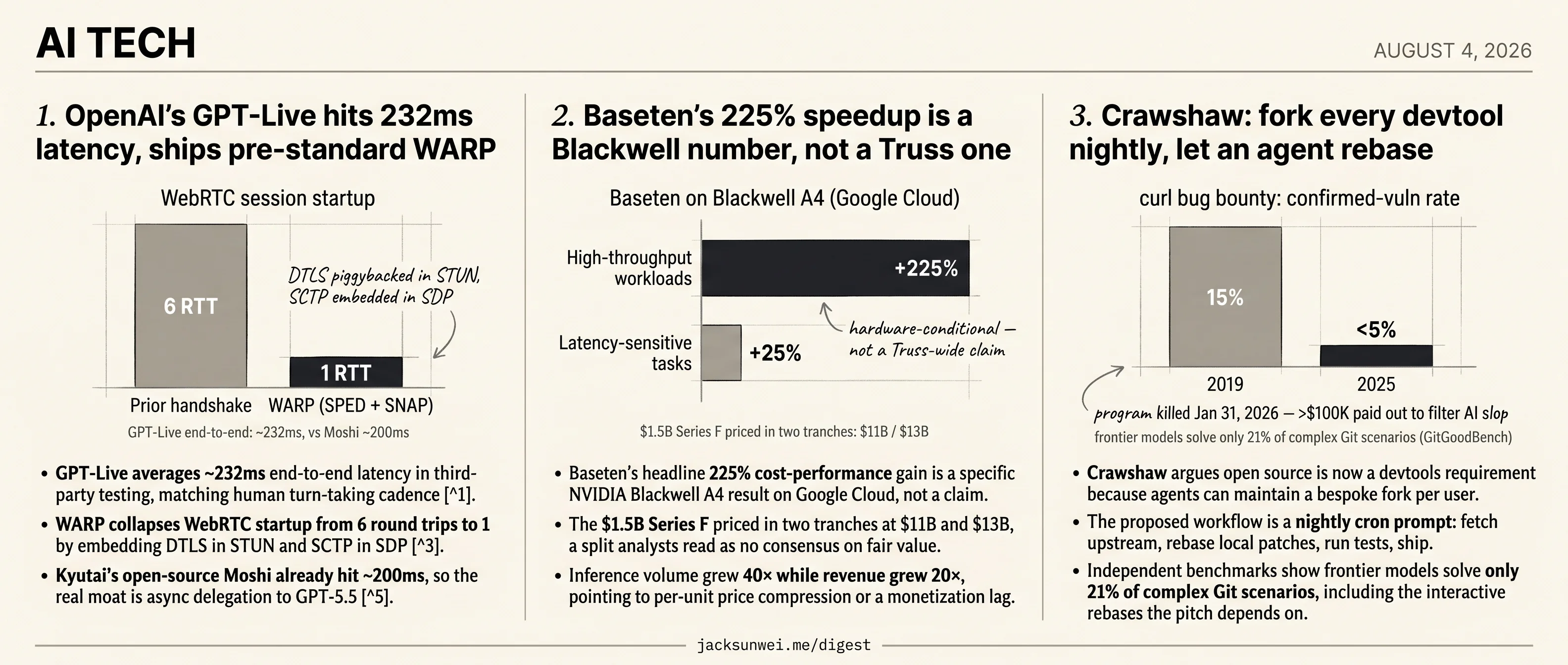
Three tech launches today headline a metric — 232ms latency, agent rebase, 225% speedup — that the underlying detail reassigns elsewhere.
GPT-Live matches Moshi, Crawshaw bets on rebase, Baseten credits Blackwell
TL;DR
- GPT-Live hits ~232ms voice latency, matching open-source Moshi’s ~200ms from months earlier.
- WARP collapses WebRTC startup from 6 round trips to 1, still pre-standard.
- Crawshaw pitches nightly agent-rebased forks of every devtool, one per user.
- Frontier models solve only 21% of complex Git scenarios, undermining the rebase pitch.
- Baseten’s 225% cost-performance win is a specific Blackwell A4 result, not a framework claim.
Today’s three tech launches each foreground a headline — a latency number, a workflow pitch, a cost-performance figure — and in each case the fine print reassigns the credit. OpenAI’s GPT-Live posts ~232ms voice latency, but Kyutai’s open-source Moshi already hit ~200ms months ago; the real moat is async delegation to GPT-5.5, not the pre-standard WARP protocol underneath. Baseten’s 225% cost-performance headline turns out to be a specific NVIDIA Blackwell A4 result on Google Cloud, not a Truss framework claim. And David Crawshaw’s pitch that agents should maintain a bespoke devtool fork per user depends on interactive Git skill where frontier models score 21%.
Read together, the three pieces are a useful reminder to check the credit line before the metric. Two round-ups sit alongside — Steve Yegge’s post-mortem on Claude Opus 4.7 breaking his Gas Town coding agent, and Niklas Gruhn’s meat proxy term for peers who paste raw model output without reading it.
OpenAI’s GPT-Live hits 232ms latency, ships pre-standard WARP
Source: openai-blog · published 2026-08-03
TL;DR
- GPT-Live averages ~232ms end-to-end latency in third-party testing, matching human turn-taking cadence 1.
- WARP collapses WebRTC startup from 6 round trips to 1 by embedding DTLS in STUN and SCTP in SDP 2.
- Kyutai’s open-source Moshi already hit ~200ms, so the real moat is async delegation to GPT-5.5 3.
- Barge-in state is still broken for API consumers: the server emits transcript deltas for audio the user never heard 4.
The latency numbers survive independent testing
OpenAI’s headline claim — sub-second, full-duplex voice with p95 latency now matching the old p50 — holds up when someone else runs the stopwatch. BuildFastWithAI clocked GPT-Live at roughly 232ms average response latency in live conversations, inside the window human speakers use for natural turn-taking 1. Runtimewire’s teardown makes the more interesting engineering point: the internal capacity metric shifted from “requests per GPU” to “concurrent sessions where every audio frame lands on schedule” 5. That reframing, plus rewriting the media frontend from Python asyncio to Go, is what actually bought the tail-latency improvement — not a model swap.
WARP is real, but it’s a pre-standard shipped into production
The “six round trips to one” story is not marketing hand-waving. It maps directly onto draft-uberti-tsvwg-warp at the IETF, which specifies two mechanisms: SPED piggybacks the DTLS ClientHello inside STUN Binding Requests, and SNAP embeds SCTP handshake parameters in the initial SDP exchange 2. Combined with Instant Connect’s pre-negotiated SDP, a client really can open a session with a single UDP packet.
The caveat the blog post skips: WARP is a draft submission, not a standard. OpenAI has effectively shipped a pre-standard transport at scale, which is fine for a first-party client but complicates any third party that wants to interop without waiting for the IETF process.
The architecture the post is quietly proud of
flowchart LR
    U[User audio] -->|continuous stream| V[Voice model<br/>full-duplex]
    V -->|immediate speech| U
    V -.async delegate.-> R[GPT-5.5<br/>reasoning + tools]
    R -.non-blocking result.-> V
    V --> H[Stateful handoff<br/>warm prefill + compaction]
The decoupling matters: a slow tool call or a deep GPT-5.5 reasoning step no longer stalls the audio stream. The voice model keeps the conversation alive while the frontier model works in the background, with prompt caching and session affinity keeping the handoff cheap.
What the post glosses over
Two things deserve more skepticism than the launch got.
First, barge-in. The OpenAI developer forum has an active thread documenting that when a user interrupts, the server keeps emitting transcript deltas for text that was generated but never spoken aloud, forcing developers to manually rewind session state to the millisecond of interruption or accept “ghost context” polluting future turns 4. The blog’s “discrete turn derivation” section — speculative view for UI, authoritative view for analytics — is the mechanism, but it doesn’t yet solve the developer-visible problem.
Second, the stateful handoff. OpenAI frames context compaction as a pure latency win. Recent work on agent compaction shows the same mechanism can drive safety-constraint violations from 0% to nearly 60% across compaction cycles unless constraints are explicitly pinned or quarantined from the summary 6. Long-session handoffs are a governance surface, not just a performance one.
Takeaway
The engineering claims check out 125. The differentiator over Moshi-class open systems isn’t latency — it’s the async delegation path to a frontier model and a bespoke transport OpenAI is willing to ship before the IETF finishes ratifying it. The unsolved half is on the API side: interruption bookkeeping 4 and compaction safety 6 are both real, and both are quietly the customer’s problem today.
Baseten’s 225% speedup is a Blackwell number, not a Truss one
Source: latent-space · published 2026-08-03
TL;DR
- Baseten’s headline 225% cost-performance gain is a specific NVIDIA Blackwell A4 result on Google Cloud, not a framework-wide claim.
- The $1.5B Series F priced in two tranches at $11B and $13B, a split analysts read as no consensus on fair value.
- Inference volume grew 40× while revenue grew 20×, pointing to per-unit price compression or a monetization lag.
- SGLang beats vLLM by ~30% on multi-turn chat via RadixAttention, making engine choice workload-shaped.
- TensorRT-LLM wins 20–40% on low-batch latency, but at a 10–90 minute build cost per model/GPU/dtype.
The masterclass and its subtext
Latent Space’s inference-engineering episode with Baseten’s Philip Kiely and Ali Taha is a solid technical walkthrough of autoregressive and diffusion serving. It also dropped weeks after Baseten’s $1.5B Series F at a $13B valuation — a round with enough oddities that the podcast doubles as a credibility play. The financing was split across two tranches priced at $11B and $13B, a structure analysts read as later entrants paying up for allocation rather than consensus on fair value 7. In the same window, inference volume grew 40× year-over-year while revenue grew only 20× 7 — either aggressive per-unit price compression or a monetization lag as customers scale workloads faster than they generate billable spend. The valuation tripled from a $5B mark in January 8.
Where the 225% actually comes from
The number Baseten repeats across marketing and the episode traces to one collaboration: NVIDIA Blackwell A4 VMs on Google Cloud, delivering a 25% improvement on latency-sensitive tasks and 225% on high-throughput workloads 9. That’s a real, measured gain — but it’s hardware-conditional. It’s not what Truss buys you on last-generation GPUs, and it’s not what you’ll see on latency-bound serving. The episode doesn’t lie about this; it just doesn’t front-load the qualifier.
The engine debate the podcast smooths over
Kiely and Taha treat vLLM, SGLang, and TensorRT-LLM as interchangeable tools in a toolkit. Independent benchmarks disagree — the right engine depends on your workload shape:
| Engine | Best at | Cost |
|---|---|---|
| vLLM | General-purpose, easy to deploy | Baseline |
| SGLang | Multi-turn chat, RAG (~30% higher throughput via RadixAttention) 10 | Newer, smaller ecosystem |
| TensorRT-LLM | Low-batch latency (20–40% lower per-token) 11 | 10–90 min build per model/GPU/dtype combo 11 |
That compilation tax is justified for dense enterprise deployments with stable models; it isn’t for teams shipping weekly 11. Baseten’s product value is partly in hiding this matrix behind Truss — which is also the abstraction some developers flag as vendor lock-in.
Kiely’s book as the honest companion
The accompanying O’Reilly volume, Inference Engineering, is reviewed as a “roadmap grounded in reality” with uneven pacing — linear layers explained on one page, CUDA kernels on the next 12. Its sharpest argument is that generic benchmarks like MMLU are “orthogonal to enterprise adoption” and should be replaced by domain-specific evals before any optimization work begins 12. That reframes every throughput number in the episode: speedups only matter against a quality bar the customer defines.
What’s actually at stake
The technical content is worth the listen — Baseten has earned the reputation. But the commercial narrative is running ahead of the unit economics 78, and the optimization playbook is more contested than a single-vendor masterclass conveys 1011. Treat the 225% as a Blackwell datapoint, not a promise, and pick your engine before you pick your provider.
Crawshaw: fork every devtool nightly, let an agent rebase
Source: simon-willison · published 2026-08-03
TL;DR
- Crawshaw argues open source is now a devtools requirement because agents can maintain a bespoke fork per user.
- The proposed workflow is a nightly cron prompt: fetch upstream, rebase local patches, run tests, ship.
- Independent benchmarks show frontier models solve only 21% of complex Git scenarios, including the interactive rebases the pitch depends on.
- Curl killed its bug bounty on Jan 31, 2026 after AI reports crashed confirmed-vuln rate from 15% to under 5%.
The pitch: source code is the extension system
David Crawshaw’s “Devtools must be open source” — amplified this weekend by Simon Willison quoting the money prompt — reframes the open-source argument around agents rather than ideology. The claim isn’t that closed tools are unethical; it’s that they’re unautomatable. If your coding agent can patch a tool, rebuild it, and rebase your local changes onto tomorrow’s upstream, then plugin systems and config files are legacy scaffolding. “The source code is the extension system” 13.
Crawshaw backs this with a working stack: Shelley, his open-source agent, plus meat.dev, a diff preprocessor that strips imports, nil-checks, and error boilerplate so a human reviewer sees only the semantically interesting hunks 13. The cron prompt Willison quoted is the demo: fetch upstream, rebase local mods, run the test suite, replace the binary. Every user runs a “team-of-one” fork. Claude Code is called out by name as the anti-pattern — a closed binary an agent can’t reach into.
The ROI framing is the interesting part. Bespoke forks used to be expensive because merge-conflict resolution scaled with fork depth. Push that cost near zero and personalization becomes the default, not the exception.
The rebase doesn’t actually work yet
The technical premise deserves more scrutiny than the essay gives it. GitGoodBench measured GPT-4o at 21.11% on complex Git scenarios including interactive rebases and merge-conflict resolution 14 — a long way from the confident tone of “check that the software works as intended and replace the current version.” A green test suite doesn’t catch silent semantic drift, and practitioner writeups are converging on the view that agents shouldn’t touch raw Git at all: htek.dev’s “Hookflows” argues for governed CLI wrappers because unrestricted agents routinely branch off the wrong HEAD, stage .env files, or force-push over teammates 15.
Crawshaw’s model assumes a solo expert babysitting their own machine. That’s the setting where “just re-run it tomorrow if it broke” is an acceptable failure mode.
The commons pays the bill
Point the same capabilities at a shared project and the economics invert. Daniel Stenberg killed curl’s seven-year bug bounty on January 31, 2026 after AI-generated reports collapsed the confirmed-vulnerability rate from 15% (2019) to under 5% (2025) — a “DDoS attack on maintainers” that had already cost the project over $100K in payouts to filter 1617. His July “Summer of Bliss” moratorium refused all new vulnerability reports for a month 16.
RedMonk framed the asymmetry cleanly: a contributor spends five minutes prompting an agent, then a maintainer spends hours reviewing the resulting “unmanageable disaster” 18. Crawshaw’s workflow works because it quietly assumes users don’t push their agent-managed forks upstream. It’s a private-consumption model wearing open-source clothing.
What to take from the cluster
The two posts describe a real capability shift for solo power users — a Neovim tinkerer with Shelley and a nightly cron probably will run a more personalized editor by year-end. But the essay’s rhetorical leap from “I can maintain my fork” to “devtools must be open source” skips the load-bearing question: who eats the review cost when everyone’s agent tries to contribute back? In 2026 the answer, empirically, is Daniel Stenberg — and he’s out.
Further reading
- Devtools must be open source (exe.dev) — simon-willison
Round-ups
Yegge says Claude Opus 4.7’s ‘two more things’ tic broke Gas Town
Source: simon-willison
Steve Yegge’s self-hosting coding agent Gas Town worked through Opus 4.6 but collapsed on 4.7, when the model developed a habit of endlessly fiddling with its own scaffolding instead of converging on real tasks. Yegge calls the regression the final straw for the project.
‘Meat proxy’ names the habit of pasting raw AI output to peers
Source: simon-willison
Niklas Gruhn’s term targets workers who relay model responses verbatim to colleagues without reading or validating them. His prescription: prompt freely, but rewrite the answer in your own words as a certificate that you actually understood and checked it.
Footnotes
-
BuildFastWithAI review (Jul 2026) — https://www.buildfastwithai.com/blogs/gpt-live-review-openai-voice-model-july-2026
↩ ↩2 ↩3GPT-Live’s primary achievement is sub-second latency, averaging approximately 232 milliseconds… matches the natural cadence of human pauses
-
IETF draft-uberti-tsvwg-warp — https://datatracker.ietf.org/doc/draft-uberti-tsvwg-warp/
↩ ↩2 ↩3SPED (STUN Protocol for Embedding DTLS)… piggybacking DTLS handshake data directly inside STUN Binding Requests and Responses; SNAP avoids the standard SCTP handshake by embedding parameters within the initial SDP exchange
-
Medium explainer on Kyutai Moshi — https://medium.com/@ravindu.somawansa/how-moshi-works-a-simple-guide-to-the-to-open-source-real-time-voice-llms-85e30ed4d3f5
↩Moshi achieves a theoretical latency of 160ms (200ms in practice) by predicting audio tokens directly from a neural audio codec while modeling parallel streams for the user and the AI
-
OpenAI developer community thread on Realtime truncation — https://community.openai.com/t/openai-realtime-how-to-correctly-truncate-a-live-streaming-conversation-on-speech-interruption-twilio-media-streams/1371637
↩ ↩2 ↩3the API often continues to emit transcript deltas for text that was generated but never actually heard by the user… developers are forced to implement complex client-side logic to manually ‘rewind’ the transcript to the exact millisecond of the interruption
-
Runtimewire analysis of GPT-Live stack — https://runtimewire.com/article/openai-gpt-live-voice-stack-full-duplex
↩ ↩2primary capacity question shifted from ‘How many requests per GPU?’ to ‘How many concurrent sessions can the system sustain while keeping every frame on schedule?‘
-
arXiv paper on context compaction governance decay — https://arxiv.org/abs/2606.22528
↩ ↩2safety violations can rise from 0% to nearly 60% after multiple compaction cycles if constraints are not explicitly ‘pinned’ or quarantined from the summary
-
ValueAdd VC — Baseten pricing/valuation breakdown — https://valueaddvc.com/blog/how-does-baseten-make-money-gpu-minute-pricing-600m-arr-and-the-13b-valuation-breakdown
↩ ↩2 ↩3The Series F was reportedly raised across two tranches priced at $11 billion and $13 billion… inference volume grew 40x while revenue grew 20x, indicating either a significant drop in per-unit pricing or a monetization lag.
-
Angel Investors Network — Baseten Series F analysis — https://angelinvestorsnetwork.com/venture-capital/baseten-15b-ai-infrastructure-vc-deal-2026
↩ ↩2The valuation tripled in just five months, up from $5 billion in January 2026, leading some experts to warn that the private market has outpaced public-market multiples.
-
Google Cloud blog — Baseten on Blackwell A4 VMs — https://cloud.google.com/blog/products/ai-machine-learning/how-baseten-achieves-better-cost-performance-for-ai-inference
↩Baseten integrated NVIDIA Blackwell-based A4 virtual machines via Google Cloud, resulting in a 25% improvement in cost-performance for latency-sensitive tasks and a 225% boost for high-throughput workloads.
-
Particula.tech — SGLang vs vLLM comparison — https://particula.tech/blog/sglang-vs-vllm-inference-engine-comparison
↩ ↩2SGLang’s RadixAttention uses a radix tree to automatically cache and reuse partial conversation histories, whereas vLLM’s automatic prefix caching typically requires exact block-level matches… SGLang can achieve up to 30% higher throughput in multi-turn scenarios.
-
IoT Digital Twin PLM — engine benchmarks 2026 — https://iotdigitaltwinplm.com/sglang-vs-vllm-vs-tensorrt-llm-benchmark-2026/
↩ ↩2 ↩3 ↩4TensorRT-LLM remains the gold standard, often delivering 20-40% lower per-token latency than vLLM at low batch sizes… the core trade-off is a 10-90 minute build process for every unique model-GPU-dtype combination.
-
LinearB blog — review of Kiely’s Inference Engineering book — https://linearb.io/blog/inference-engineering-baseten-philip-kiely-production-ai
↩ ↩2The text sometimes explains basic concepts like linear layers while simultaneously tackling advanced CUDA kernels… general model benchmarks like MMLU are often orthogonal to enterprise adoption.
-
David Crawshaw, ‘Devtools must be open source’ (blog.exe.dev) — https://blog.exe.dev/devtools-must-be-open-source
↩ ↩2I almost never need to see the import blocks… get it off the screen so I can focus on the meat. The source code is the extension system.
-
Pragmatic Engineer — ‘Is GitHub still best for AI-native development?’ — https://blog.pragmaticengineer.com/the-pulse-is-github-still-best-for-ai-native-development/
↩GitGoodBench found frontier models like GPT-4o achieved only a 21.11% solve rate on complex Git scenarios, including interactive rebases and merge conflict resolution.
-
htek.dev — ‘Hookflows: governed Git for AI agents’ — https://htek.dev/articles/hookflows-governed-git-for-ai-agents
↩Agents should be barred from raw Git commands and instead interact with governed CLI extensions that enforce workflow rules — otherwise they routinely branch off the wrong HEAD, stage .env files, or force-push over teammates.
-
The New Stack — ‘Curl’s Daniel Stenberg: AI is DDoSing open source’ — https://thenewstack.io/curls-daniel-stenberg-ai-is-ddosing-open-source-and-fixing-its-bugs/
↩ ↩2Between 2019 and 2025 the confirmed-vulnerability rate on curl reports fell from 15% to under 5% as AI-generated ‘slop’ flooded triage; Stenberg described it as a ‘Denial-of-Service attack’ on human maintainers.
-
BleepingComputer — ‘Curl ending bug bounty program after flood of AI slop reports’ — https://www.bleepingcomputer.com/news/security/curl-ending-bug-bounty-program-after-flood-of-ai-slop-reports/
↩Curl officially ended its bug bounty on Jan 31, 2026 after nearly seven years and >$100,000 in payouts, citing an unsustainable maintainer tax from unverified AI submissions.
-
RedMonk video interview with Daniel Stenberg on ‘AI onslop’ — https://redmonk.com/videos/daniel-stenberg-ai-onslop/
↩A contributor spends five minutes prompting an agent while a maintainer must spend hours reviewing the resulting ‘unmanageable disaster’ — a principal-agent imbalance Crawshaw’s model doesn’t address for public projects.