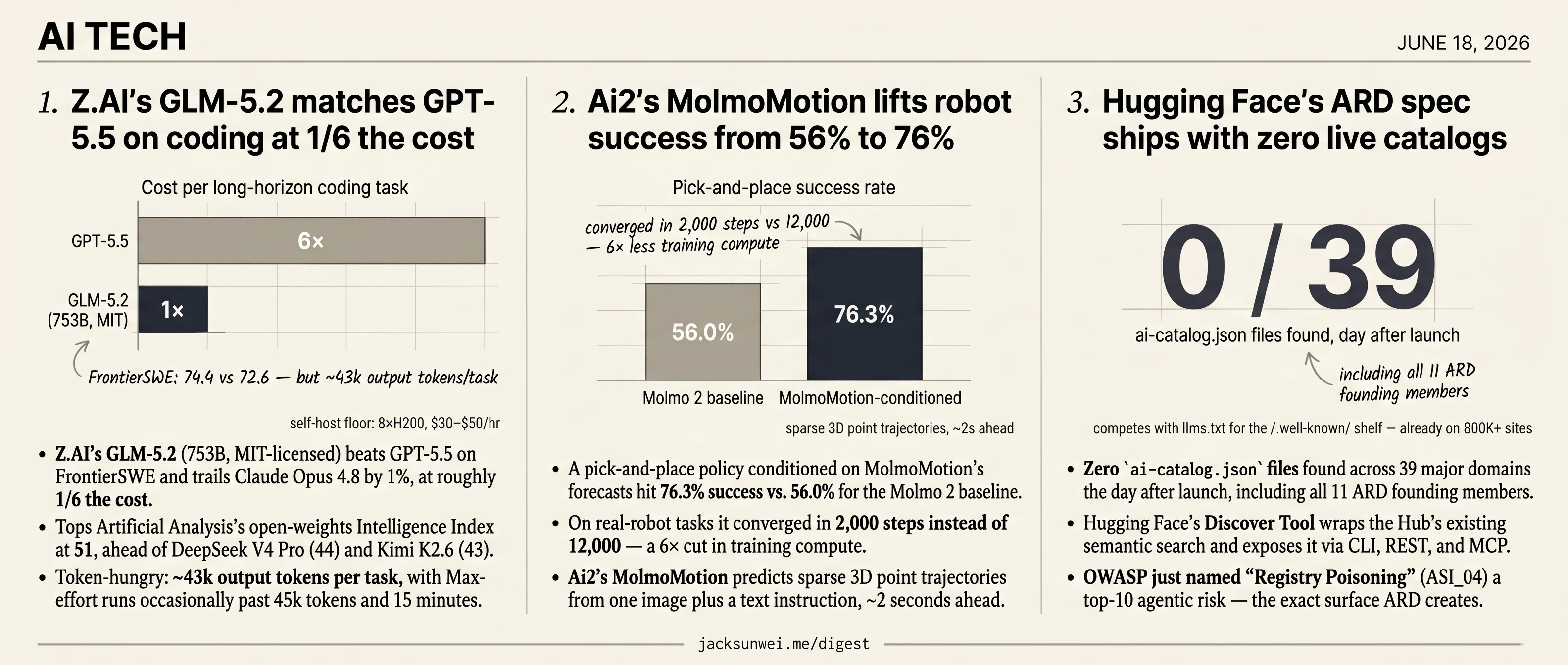
GLM-5.2 matches GPT-5.5 at 1/6 cost, MolmoMotion hits 76%, ARD spec ships empty
Three open AI-tech releases land today — each defines openness differently: enterprise-only weights, an unadopted spec, a full data-plus-benchmark bundle.
GLM-5.2 matches GPT-5.5 at 1/6 cost, MolmoMotion hits 76%, ARD spec ships empty
TL;DR
- GLM-5.2 beats GPT-5.5 on FrontierSWE at roughly 1/6 the cost, MIT-licensed at 753B params.
- Self-hosting GLM-5.2 needs an 8×H200 node at $30–$50/hr, gating the open-weights pitch to enterprises.
- MolmoMotion lifts real-robot pick-and-place success from 56% to 76% over the Molmo 2 baseline.
- Ai2 bundles a 1.16M-video dataset and PointMotionBench eval set with the MolmoMotion release.
- Hugging Face’s ARD spec found zero live
ai-catalog.jsonfiles across 39 domains the day after launch.
Three open-stack releases land in AI tech today, and each defines open a different way. Z.AI’s GLM-5.2 sweeps coding benchmarks at roughly 1/6 of GPT-5.5’s cost under an MIT license — but self-hosting demands an 8×H200 node, so the openness here is enterprise-portable, not laptop-runnable. Ai2’s MolmoMotion is the maximalist version: a real-robot policy lifts pick-and-place from 56% to 76%, shipped alongside a 1.16M-video dataset and a public benchmark.
Hugging Face’s ARD spec is the aspirational one — it arrived with zero ai-catalog.json files live across 39 major domains, including all 11 of its own founding members, the day after launch. Open weights, open data, and open standards all shipped today; the three packages aren’t the same product.
Z.AI’s GLM-5.2 matches GPT-5.5 on coding at 1/6 the cost
Source: huggingface-blog · published 2026-06-17
TL;DR
- Z.AI’s GLM-5.2 (753B, MIT-licensed) beats GPT-5.5 on FrontierSWE and trails Claude Opus 4.8 by 1%, at roughly 1/6 the cost.
- Tops Artificial Analysis’s open-weights Intelligence Index at 51, ahead of DeepSeek V4 Pro (44) and Kimi K2.6 (43).
- Token-hungry: ~43k output tokens per task, with Max-effort runs occasionally past 45k tokens and 15 minutes.
- Self-hosting needs an 8×H200 node ($30–$50/hr) — “open weights” here means enterprise-portable, not laptop-runnable.
- Simon Willison’s opossum-on-an-e-scooter prompt regressed versus GLM-5.1, despite the benchmark sweep.
A genuine frontier-class open-weights drop
The headline number is real. GLM-5.2 scores 74.4 on FrontierSWE versus GPT-5.5’s 72.6, 81.0 on Terminal-Bench 2.1 (up from 5.1’s 63.5), and 99.2 on AIME 2026 — and VentureBeat’s independent framing pegs the cost at roughly one-sixth of GPT-5.5’s for comparable long-horizon coding workloads 1. Artificial Analysis corroborates the leaderboard story, putting GLM-5.2 at the top of its open-weights Intelligence Index with a score of 51, comfortably ahead of DeepSeek V4 Pro and Kimi K2.6 2. Latent.Space’s hands-on summary — “GLM-5.2 treats the system prompt like a spec” — backs the agentic-reasoning claim and ranks it second on Code Arena WebDev behind only Anthropic’s proprietary Claude Fable 5 3.
The architectural story underneath is the part worth taking seriously. IndexShare reuses one sparse-attention indexer across every four DSA layers, cutting per-token FLOPs by 2.9× at max context, and the slime infrastructure let Z.AI parallel-train ten expert models and merge them in two days. The anti-hack module — a rule-based filter plus LLM judge that blocks the model from curl-ing solutions off GitHub mid-training — is the kind of detail that suggests the team has actually run agentic RL at scale rather than retrofitted the term.
The token-hungry asterisk
The “1/6 the cost” claim deserves an immediate qualifier: GLM-5.2 burns roughly 43k output tokens per task on Artificial Analysis’s harness, with Max-effort runs occasionally going past 45k tokens and 15 minutes 2. That’s a real number you have to multiply against the per-token discount before celebrating. The flexible “thinking effort” toggle helps, but the model’s default behavior is to think out loud — a lot.
”Open weights” with an enterprise asterisk
The MIT license is the geopolitically interesting bit — no regional restrictions, full commercial use, zero dependency on US export-controlled APIs — but the 753B footprint sharply limits who can actually self-host. ofox.ai’s deployment math puts an 8×H200 FP8 node at $30–$50/hour, and the 1M-token KV cache alone demands 35–50 GB at 4-bit or up to 200 GB at 16-bit. Self-hosting only beats Z.ai’s hosted API past roughly 3,000 prompts/day 4. The r/LocalLLaMA reaction captures it bluntly:
None of us are running it at home without an enterprise cluster, but the distillation potential here is massive. 5
That’s the real local-AI bet: not GLM-5.2 itself, but the 8B/70B distillations that will follow.
The vibes test split
Simon Willison’s review is the useful counterweight to the benchmark sweep. His pelican-on-a-bicycle prompt — a long-running informal eval — produced “a self-contained fully animated SVG, and the animations aren’t broken!” 6. His opossum-on-an-e-scooter prompt, by contrast, regressed versus GLM-5.1: no animations, “weird background gridlines” 6. Aggregate scores went up while a specific creative test got worse — the kind of per-prompt inconsistency that FrontierSWE will never surface, and a reminder that “highest-ranked open model” still means picking your spots.
Further reading
- GLM-5.2 is probably the most powerful text-only open weights LLM — simon-willison
Ai2’s MolmoMotion lifts robot success from 56% to 76%
Source: huggingface-blog · published 2026-06-17
TL;DR
- A pick-and-place policy conditioned on MolmoMotion’s forecasts hit 76.3% success vs. 56.0% for the Molmo 2 baseline.
- On real-robot tasks it converged in 2,000 steps instead of 12,000 — a 6× cut in training compute.
- Ai2’s MolmoMotion predicts sparse 3D point trajectories from one image plus a text instruction, ~2 seconds ahead.
- The release bundles a 1.16M-video dataset (5,600 objects, 736 motion types) and the PointMotionBench evaluation set.
What MolmoMotion actually predicts
Most vision-language action models emit action tokens; MolmoMotion emits the world’s future motion. Given an RGB frame and a phrase like “rotate the bowl while sliding it left,” it outputs sparse 3D surface points — eight per object — tracing where those points will be over the next ~2 seconds in a metric world frame. A downstream controller (a robot policy, a video generator) consumes the trajectory.
Two heads sit on the Molmo 2 backbone. The autoregressive variant quantizes coordinates into text tokens and produces clean, single-mode paths. The flow-matching variant denoises continuous 3D trajectories and is meant for genuinely uncertain futures — useful when “push the cup” could plausibly go in three directions.
flowchart LR
    A[RGB frame] --> M[MolmoMotion VLM]
    B["Text: 'slide bowl left'"] --> M
    M --> T[Sparse 3D point trajectory<br/>8 points/object, ~2s horizon]
    T --> R[Robot policy]
    T --> V[Image-to-video model<br/>e.g. DaS + WAN]
The numbers that matter
The robotics result is the loudest signal: decoupling trajectory forecasting from policy learning means the controller stops having to learn physics and grounding simultaneously. That shows up as the 76.3% vs. 56.0% pick-and-place gap and the 6× reduction in real-world training steps. NVIDIA has been pitching this exact decoupling as the “world-action model” shift — pretrained backbones that imagine future states before acting, closing the so-called grounding wall between language and trajectories 7.
On the video side, plugging MolmoMotion into Diffusion-as-Shader to steer image-to-video synthesis beat WAN-14B on four of five motion-centric metrics, despite WAN being the larger model. Trajectory conditioning, in other words, beats parameter count for motion fidelity.
Lineage and what’s missing
This is not a paradigm break. Any-point Trajectory Modeling (RSS 2024) already used predicted 2D point paths as subgoals and reported ~80% gains over generic video pretraining 8. Google DeepMind’s RT-Trajectory established sketched paths as a disambiguation layer for language commands 9. Ai2’s own MolmoPoint — the grounding backbone here — already topped Point-Bench at 70.7% using rotary-embedded pointing 10. MolmoMotion’s distinctive moves are pushing the representation into a metric 3D frame, training at 1.16M-video scale, and releasing the whole stack openly.
The harder questions go unanswered. DaS, the video-generation partner cited in the post, can’t represent objects that appear mid-clip, and its base model’s visual priors can override trajectory guidance when they disagree — a stiff object rendered as soft, for instance 11. The pick-and-place benchmark is short-horizon and simulated; the broader VLA literature still pegs large foundation policies near 6 Hz inference and <50% success on long-horizon (>5-step) tasks 12. The two-second forecast window and t0-camera-frame coordinates also rule out mobile and multi-agent settings without further work.
Trajectory conditioning beats parameter count for motion fidelity — but only when the downstream generator agrees to be conditioned.
The bet is that “predict the world, then act” generalizes. The open dataset and benchmark make it cheap for someone else to find out.
Hugging Face’s ARD spec ships with zero live catalogs
Source: huggingface-blog · published 2026-06-17
TL;DR
- Zero
ai-catalog.jsonfiles found across 39 major domains the day after launch, including all 11 ARD founding members. - Hugging Face’s Discover Tool wraps the Hub’s existing semantic search and exposes it via CLI, REST, and MCP.
- OWASP just named “Registry Poisoning” (ASI_04) a top-10 agentic risk — the exact surface ARD creates.
- Linux Foundation owns the draft under Apache 2.0, with no IETF or W3C standardization yet.
ai-catalog.jsoncompetes for the same/.well-known/shelf as llms.txt, already live on 800K+ sites.
What ARD actually specifies
Hugging Face, Google, Microsoft, and GoDaddy published the Agentic Resource Discovery (ARD) draft on June 17, framing it as a fix for how agents find tools. Two pieces: a static ai-catalog.json manifest at a well-known URL, and a POST /search endpoint that takes natural-language intent and returns ranked capabilities. The pitch is that capability selection moves out of the LLM context window and into a federated registry layer, with media types (application/ai-skill, application/mcp-server+json) keeping it protocol-agnostic — MCP, A2A, or whatever ships next can ride on top.
Hugging Face’s Discover Tool is the first concrete implementation. It maps the Hub’s existing semantic search over Spaces, Skills, and MCP servers into ARD responses, filters to RUNNING Spaces only, and ships behind hf discover search "..." plus an MCP endpoint any client can hit.
Day-one adoption is essentially zero
This is the part the launch post doesn’t mention. An independent Synscribe census run one day after launch crawled 39 major domains — including all eleven ARD working-group founding members — and found zero ai-catalog.json files in production 13. The companies that announced the spec haven’t deployed it on their own domains. What exists today is a reference implementation by Hugging Face plus draft text on GitHub. “Federated registry” is the property that makes ARD interesting; federation does not yet exist.
Skeptics on r/GeminiAI are already asking whether federation will hold or collapse into the usual gatekeeper shape, where “the ranking and indexing of capabilities are controlled by the registry provider rather than the end user” 14.
Discovery is a new attack surface
ARD’s trust story leans on DNS ownership, extended by GoDaddy’s Agent Name Service, which adds ACME-style domain validation and Certificate-Transparency-style immutable logs so an orchestrator can verify a publisher before handing over data 15. That’s stronger than the Hugging Face post conveys — but it verifies the publisher, not the skill.
OWASP’s 2026 Agentic Top 10, published the week before ARD, formally introduced “Registry Poisoning” (ASI_04) and flagged “AI Hallucination Squatting,” where attackers register package names that agents have hallucinated into existence, planting dormant attack vectors 16. A natural-language-to-tools layer is exactly the surface this class targets.
flowchart LR
    A[Agent intent:<br/>'fine-tune a model'] --> B[ARD /search]
    B --> C[Federated registries]
    C --> D[Verified publisher<br/>via ANS/DNS]
    C -.poisoned entry.-> E[Squatted skill<br/>matching hallucinated name]
    D --> F[Skill execution]
    E -.silent compromise.-> F
Governance and the well-known shelf
The data model sits with the Linux Foundation’s AI Catalog Working Group under Apache 2.0; it is not yet an IETF or W3C standard 17. And ai-catalog.json lands on the same /.well-known/ shelf as llms.txt, which by early 2026 was already on 800,000+ sites 18. Practitioners are starting to frame the two as complementary — ARD for what a domain can do, llms.txt for how to read it — but the layering is informal, and the launch post doesn’t address it.
Read the Discover Tool as a first-mover bet on a draft, not infrastructure. The interesting question is whether anyone past the founding eleven ships a catalog in the next 90 days.
Round-ups
Models with advanced hacking skills are about to go mainstream
Source: ars-technica-ai
Frontier labs and open-weight releases are converging on models that can autonomously discover and exploit vulnerabilities, and containment is slipping out of reach. Anthropic’s Claude work features in the reporting as a case study in how fast offensive capability is normalizing.
Charity Majors: code generation went from scarce to disposable in 2025
Source: simon-willison
Charity Majors argues the economics of software flipped last year, with AI making code generation effectively free and instant. Lines once curated and reused are now disposable and regenerable, a shift she says demands more engineering discipline, not less.
Nvidia enlists AI coding agents to train robots autonomously
Source: ars-technica-ai
Nvidia’s self-improvement program hands robot training over to teams of AI coding agents, which have already taught machines to install GPUs and snip zip ties. The setup closes the loop between code generation and physical task learning without human supervision at each step.
Strands Agents and LeRobot push Hugging Face models to robot hardware
Source: huggingface-blog
A new Amazon-Hugging Face integration wires Strands Agents into LeRobot so models pulled from the Hub run directly on physical robots. The pipeline shortens the path from a checkpoint download to on-device control, targeting developers building agent-driven robotics stacks.
How to silence Gemini’s ‘write with AI’ prompts in Google Docs
Source: techcrunch-ai
Google Docs users tired of Gemini pop-ups can disable the assistant through Workspace settings, killing the inline suggestions and sidebar prompts. The walkthrough covers both personal accounts and admin-managed domains where IT controls the toggle.
Footnotes
-
↩Z.ai’s open-weights GLM-5.2 beats GPT-5.5 on multiple long-horizon coding benchmarks for 1/6th the cost
-
AI Weekly — Artificial Analysis Intelligence Index — https://aiweekly.co/alerts/zhipu-ais-glm-52-tops-open-weights-intelligence-index-with-score-of-51
↩ ↩2GLM-5.2 tops the open-weights Intelligence Index with a score of 51, ahead of DeepSeek V4 Pro (44) and Kimi K2.6 (43), but is notably token-hungry, consuming up to 43k output tokens per task.
-
Latent.Space AINews — https://www.latent.space/p/ainews-glm-52-the-top-frontend-coding
↩GLM-5.2 treats the system prompt like a spec… ranked as the top frontend coding model behind only the proprietary Claude Fable 5 on Code Arena WebDev.
-
ofox.ai self-host guide — https://ofox.ai/blog/glm-5-2-self-host-vllm-hardware-cost-2026/
↩Self-hosting becomes more economical than Z.ai’s API once a team exceeds roughly 3,000 prompts per day; an 8x H200 node runs $30–$50/hour and a 1M-token KV cache adds 35–50 GB at 4-bit, up to 200 GB at 16-bit.
-
r/LocalLLaMA thread ‘GLM-5.2 is a win for local AI’ — https://www.reddit.com/r/LocalLLaMA/comments/1u8ai2a/glm52_is_a_win_for_local_ai/
↩None of us are running it at home without an enterprise cluster, but the distillation potential here is massive.
-
ainew.jp coverage of Simon Willison’s review — https://news.ainew.jp/article/20b1e006-e9d5-467c-842c-72e76883da79
↩ ↩2It’s a self-contained fully animated SVG, and the animations aren’t broken!… Very impressive. [On the opossum-on-an-e-scooter prompt] a step down from GLM-5.1, with no animations and weird background gridlines.
-
NVIDIA Developer Blog — World-Action Models — https://developer.nvidia.com/blog/pretrained-to-imagine-fine-tuned-to-act-the-rise-of-world-action-models/
↩Newer WAMs leverage pretrained video backbones to ‘imagine’ future states before executing a motion… addressing the ‘grounding wall’ where models previously struggled to translate linguistic concepts into precise spatial trajectories.
-
Any-point Trajectory Modeling (RSS 2024 paper) — https://www.roboticsproceedings.org/rss20/p092.pdf
↩ATM extracts control-specific guidance from human or cross-embodiment videos by predicting trajectories for arbitrary points, demonstrating an 80% improvement in success rates over traditional video pre-training baselines by providing closed-loop future trajectories as subgoals.
-
RT-Trajectory project page (Google DeepMind) — https://rt-trajectory.github.io/
↩RT-Trajectory allows users to provide 2D sketches or ‘human-drawn’ trajectories, which the model uses to reduce semantic ambiguity in language instructions.
-
Ai2 — MolmoPoint blog — https://allenai.org/blog/molmopoint
↩MolmoPoint moves away from external coordinate formats, instead tying pointing directly to the model’s internal visual representation using rotary embeddings… MolmoPoint-8B reaches 70.7% on Point-Bench, surpassing specialized pointing models like Poivre.
-
EmergentMind — Diffusion as Shader (DaS) — https://www.emergentmind.com/topics/diffusion-as-shader-das
↩DaS ensures 3D consistency but cannot currently represent ‘emerging’ objects that were not present in the initial frame; models still struggle with hallucinated content in occluded regions and failing to follow trajectories when they conflict with internal physical priors.
-
Robotics Center — VLA Models Comparison 2025 — https://www.roboticscenter.ai/research/vla-models-comparison-2025
↩Large VLAs typically run at low frequencies (~6 Hz), often insufficient for high-speed industrial tasks… long-horizon tasks frequently see success rates drop below 50%.
-
Synscribe census (June 18, 2026) — https://www.synscribe.com/agentic-discovery/agentic-resource-discovery
↩An independent census conducted on June 18, 2026 analyzed 39 major domains, including all eleven founding members of the ARD working group. The survey found zero discoverable ai-catalog.json files in the wild.
-
Reddit r/GeminiAI discussion — https://www.reddit.com/r/GeminiAI/comments/1u8ufrn/google_github_and_nvidia_just_dropped_the_ard/
↩Federated registries could easily become centralized monopolies, where the ranking and indexing of capabilities are controlled by the registry provider rather than the end user… developers are wary of ARD becoming ‘yet another layer’ that adds fragmentation rather than resolving it.
-
Help Net Security — https://www.helpnetsecurity.com/2026/06/18/google-agentic-resource-discovery/
↩GoDaddy’s Agent Name Service (ANS) uses ACME-based domain validation and immutable Transparency Logs to issue cryptographic certificates for agents… before an orchestrator hands data to an agent or tool, it can independently verify the publisher’s identity.
-
OWASP Top 10 for Agentic Applications 2026 (via Help Net Security) — https://www.helpnetsecurity.com/2026/06/11/owasp-prompt-injection-ai-security-failures/
↩‘Registry Poisoning’ (ASI_04) has been formally introduced as a critical risk… ‘AI Hallucination Squatting’ has emerged where agents generate fake package names which attackers register on public repositories to plant dormant attack vectors.
-
LetsDataScience — https://letsdatascience.com/news/google-publishes-agentic-resource-discovery-specification-c80b3e40
↩The primary authority over the ai-catalog.json format currently resides with the Linux Foundation’s AI Catalog Working Group… published under Apache 2.0… not yet an official IETF or W3C standard.
-
Publii guide to llms.txt — https://getpublii.com/blog/llms-txt-complete-guide.html
↩Community adoption of llms.txt has been rapid, with over 800,000 sites implementing it by early 2026… ARD for finding what a site can do, and llms.txt for reading how to use it — they form a complementary stack.