GitHub commits triple, Opus 5.5 ships fun games, Nemotron ties Voxtral
GitHub's agent commit surge, Anthropic's playable Opus 5.5 games, and NVIDIA's efficient Nemotron each ship with a quality gate still unresolved.
GitHub commits triple, Opus 5.5 ships fun games, Nemotron ties Voxtral
TL;DR
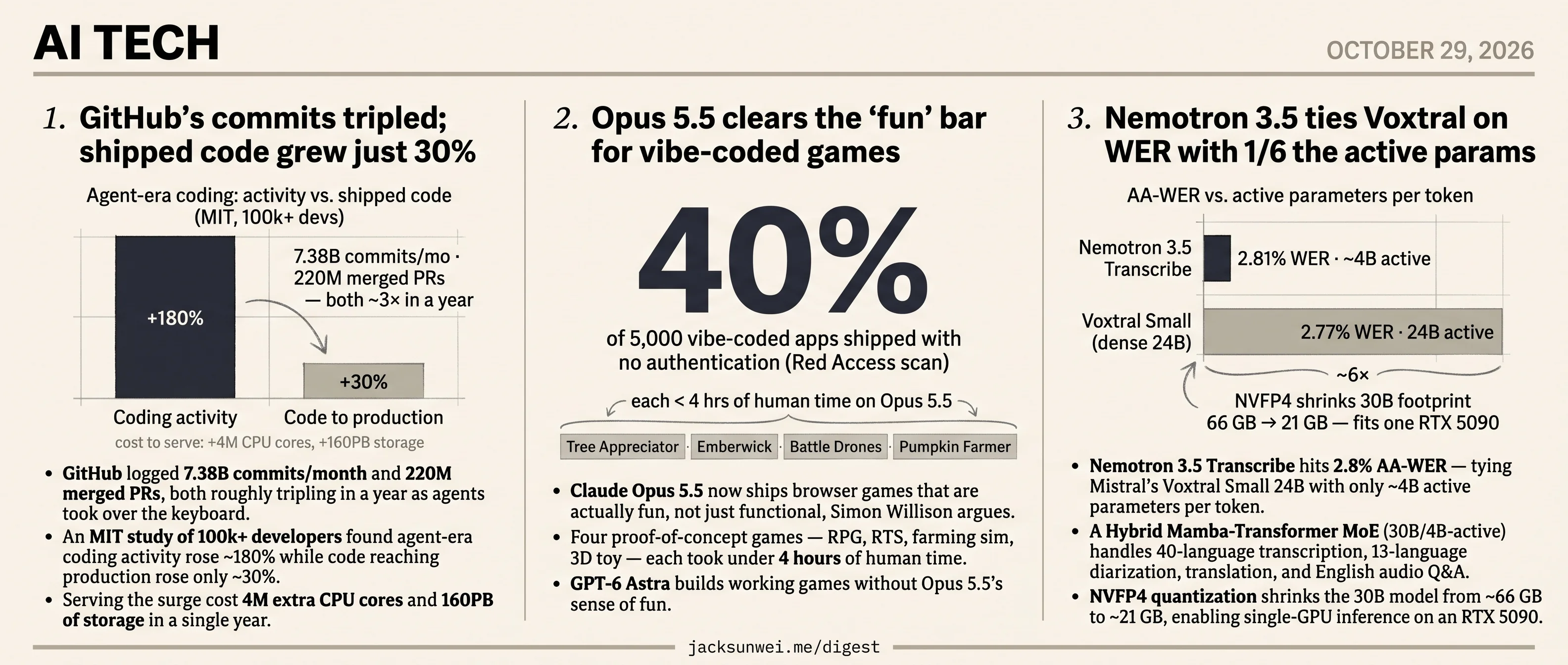
- GitHub logged 7.38B monthly commits as agent coding roughly tripled year-over-year.
- Production code grew only 30%, per an MIT study of 100k+ developers.
- Claude Opus 5.5 ships browser games with genuine fun, each built in under 4 hours.
- 40% of vibe-coded apps still launch with no authentication, a Red Access scan found.
- Nemotron 3.5 matches Voxtral’s 2.8% WER with just 4B active parameters per token.
Three releases today each post a real throughput win — and each leaves a quality gate open that the headline number doesn’t close. GitHub’s own telemetry shows agent-era commit volume roughly 3× year-over-year while shipped code grew just 30%, and maintainers are testing repo-level PR kill switches to keep review from drowning. Anthropic’s Opus 5.5 clears a bar earlier models missed — browser games that are actually fun to play — while a Red Access scan finds 40% of vibe-coded apps shipping with no authentication at all. NVIDIA’s Nemotron 3.5 ties Voxtral’s 2.8% word-error rate at a sixth the active parameters, but the Granary corpus underneath is English-dominated and ships as a licensing patchwork.
The wins are genuine. What’s lagging is the gate each release bypassed on its way out — review bandwidth, auth hygiene, dataset breadth — and in every case the gap sits in a number the vendor itself disclosed.
GitHub’s commits tripled; shipped code grew just 30%
Source: simon-willison · published 2026-10-28
TL;DR
- GitHub logged 7.38B commits/month and 220M merged PRs, both roughly tripling in a year as agents took over the keyboard.
- An MIT study of 100k+ developers found agent-era coding activity rose ~180% while code reaching production rose only ~30%.
- Serving the surge cost 4M extra CPU cores and 160PB of storage in a single year.
- Maintainers are pushing back: GitHub is testing repo-level PR “kill switches” as agentic submissions overwhelm review.
The curves everyone will quote
GitHub EVP Jay Parikh’s three charts at Universe — 220M merged PRs, 7.38B commits, 30.3M new repos per month, each roughly tripling or doubling inside twelve months — are the cleanest visual yet of agent-driven development hitting the mainline. Most of the commit spike landed in the second half of 2026, which is consistent with Copilot-style agents, Claude Code, and Codex-style tools graduating from autocomplete to multi-step PR authors over the course of this year.
Simon Willison called the chart “a pretty stark representation of the impact of agentic engineering.” It is. It’s just not a representation of shipped software.
The proof gap
A 2026 MIT study by Demirer, Musolff and Yang, covering more than 100,000 GitHub developers, found that autonomous agents boosted individual coding activity by up to 180% — but the volume of code actually reaching production rose only about 30% 1. In high-activity repositories the PR merge rate reportedly fell from near 50% to under 10%.
That reframes Octoverse’s headline numbers. The 7.38B commits measure keystrokes-equivalent, not delivery. The binding constraint has moved from “write the code” to “convince a human it’s safe to merge,” and senior engineers are migrating from authors to reviewers and context designers. Commit volume is now a weak proxy for engineering throughput — arguably a misleading one.
The infrastructure bill GitHub didn’t put on stage
Absent from Parikh’s keynote: what it cost to serve those curves. Tom’s Hardware reports GitHub added roughly 4 million CPU cores and 160PB of storage in a single year to absorb the sixfold activity spike 2. DevX counted 257 service incidents between May 2025 and April 2026, with ~83 directly tied to capacity failures as agents push in machine-rhythm bursts that break scheduling assumptions built around human workdays 3.
Agents don’t take lunch, don’t stagger across time zones, and don’t back off when a queue gets hot. The platform is being retuned around that fact in real time.
The maintainers are not okay
The sharpest signal that generation has outrun review comes from the receiving end. GitHub is reportedly weighing repository-level kill switches that let maintainers cap or disable external PRs — effectively acknowledging that agentic submission volume functions as a denial-of-service attack on human attention 4. curl’s Daniel Stenberg offers the canonical datapoint: bug bounty submissions rose 8× while the confirmed-vulnerability rate fell from 15% to under 5%, prompting outright bans on reports judged to be AI slop and a five-week “summer of bliss” pause on new submissions 5.
What the report is actually measuring
Octoverse 2026 is a generation metric dressed as a productivity metric. The honest read of the three charts: agents can now produce commits, PRs and whole repositories at a rate the ecosystem’s review, CI, and maintainer bandwidth cannot absorb. The methodology additions — LLM-classified country codes, embedding-based NAICS tagging, keyword tracking for “clean room implementation” and “drop-in replacement” — are themselves a tell that GitHub needs AI to make sense of the AI-generated firehose it’s hosting.
The question for 2027 isn’t whether commit volume keeps climbing. It’s whether anything downstream — review, merge rate, production deploys, maintainer retention — climbs with it.
Opus 5.5 clears the ‘fun’ bar for vibe-coded games
Source: simon-willison · published 2026-10-28
TL;DR
- Claude Opus 5.5 now ships browser games that are actually fun, not just functional, Simon Willison argues.
- Four proof-of-concept games — RPG, RTS, farming sim, 3D toy — each took under 4 hours of human time.
- GPT-6 Astra builds working games without Opus 5.5’s sense of fun.
- A Red Access scan found 40% of vibe-coded apps ship with no authentication.
The capability claim
Willison’s thesis is narrow and testable: Claude Opus 5.5 crossed a threshold where it can design a gameplay loop, not just render one. For months, models could produce something that looked like a game. What changed is taste — the model now responds meaningfully to prompts like Make it a LOT more fun and surprise and delight the user frequently, and the output measurably improves.
The evidence is four games, all HTML/JavaScript, all built via chat or Claude Code with no manual code review:
| Game | Scope | Human effort |
|---|---|---|
| Tree Appreciator | One-shot three.js spot-the-difference | Single prompt |
| Emberwick | Top-down RPG, 15-min story, level editor | A few hours + playtest iteration |
| Battle Drones | 2-4 player RTS, replays, 7 maps, AI-vs-AI mode | ~4 hours over weeks |
| Pumpkin Farmer | Cosy farming sim, animal townsfolk | Spec file + two days of Opus 5.5 Ultracode |
The GPT-6 Pro comparison for Emberwick is the sharpest data point: fed the same prompt sequence, it produced a visually comparable village that Willison says doesn’t play as well. “Fun” is now a model-level differentiator.
Independent corroboration
The Battle Drones story checks out and then some. Within 24 hours of the Apache 2.0 release, Gabriel Turpin shipped Panache, a Belle Époque reskin with a 12-mission campaign, silent-film title cards, dirigibles, and steam-powered Fardiers — with Opus 5.5 credited as co-author in the repo 6. That’s the open-source flywheel Willison hints at, moving faster than his post implies.
But the “no looking at the code” purity has a crack. Hacker News readers pulled apart the multiplayer sync and surfaced that Math.sin and Math.cos return subtly different values across Chrome and Safari — enough to drift multiplayer state. A human had to notice the desync and impose a determinism constraint 7. Vibe coding gets you to a working RTS; IEEE-754 edge cases still need someone who can reason about them.
Where the framing cracks
Willison acknowledges “AI slop” discourse with one link and moves on. The October 2026 context is harsher. Community pressure for an official no-AI filter on Steam Next Fest got loud enough to spawn third-party Chrome extensions that dim disclosed titles 8. AI-disclosed games made up roughly a third of demos but took only four of the top-50 played slots, and indies reported extortion attempts from clone-makers threatening to ship AI knockoffs first unless paid 9.
The policy fight is weirder than a simple pro/anti split. Tim Sweeney called Valve’s AI disclosure a “political act” and “Scarlet Letter” inviting “hate mobs” 10 — a defense of generative tooling from Epic, aimed at the platform most tolerant of it.
His caveat — “how much damage can you cause with a bug in a personal vibe coded game?” — holds for browser toys. It does not hold for the audience actually reading him.
A Red Access scan of 5,000 vibe-coded apps found 40% exposed sensitive data without authentication, with technical debt accruing at roughly 3× traditional codebases 11. The people building Tree Appreciator on a phone are also the people shipping SaaS this way.
Takeaway
The capability claim is real and the Panache fork proves the ecosystem effect. The cultural framing is the part worth arguing with: “you should build a game!” is a fine recreational pitch, but the same workflow is quietly producing the Steam Next Fest flood and the unauthenticated-SaaS problem. Opus 5.5 learned fun. The industry hasn’t learned how to price that yet.
Nemotron 3.5 ties Voxtral on WER with 1/6 the active params
Source: huggingface-blog · published 2026-10-28
TL;DR
- Nemotron 3.5 Transcribe hits 2.8% AA-WER — tying Mistral’s Voxtral Small 24B with only ~4B active parameters per token.
- A Hybrid Mamba-Transformer MoE (30B/4B-active) handles 40-language transcription, 13-language diarization, translation, and English audio Q&A.
- NVFP4 quantization shrinks the 30B model from ~66 GB to ~21 GB, enabling single-GPU inference on an RTX 5090.
- Granary v2’s 463k hours is English-dominated (~275k), ships as a licensing-patchwork manifest, and doesn’t fix code-switching.
A frontier open-weight ASR release, with asterisks
Nemotron 3.5 Transcribe is NVIDIA’s bid to collapse transcription, diarization, translation, and audio Q&A into a single open-weight model — and the headline numbers hold up. On the Hugging Face Open ASR leaderboard it sits first among open-weight systems at 5.33% WER; on Artificial Analysis it posts 2.81% AA-WER. Independent Cekura testing, which mixes private phone-call data to blunt training-set contamination, ranks it #1 at 2.28% WER, ahead of Whisper and Deepgram Nova-3 12.
The architectural story is where it gets interesting. The 30B-A4B Hybrid Mamba-Transformer MoE activates only ~4.3B parameters per token, which puts it in a near-tie with Voxtral Small’s 2.77% AA-WER despite Voxtral running a dense 24B 13. Reading NVIDIA’s “tops the leaderboard” framing literally overstates the gap — the real win is parameter efficiency, not raw accuracy.
NVFP4 is the deployment story
Without quantization, this is an H100-class model and effectively inaccessible to self-hosters. NVIDIA’s engineering blog documents that NVFP4 drops the footprint from ~66 GB (BF16) to 21–22 GB, fitting a single RTX 5090 or RTX PRO 6000, with Quantization-Aware Distillation recovering accuracy to 4.71% mean WER 14. That’s the difference between a research artifact and something developers can actually run on a workstation. Serving is still rough around the edges: vLLM and SGLang-Omni need special handling for the dual KV-cache plus Mamba-state pool, and the hybrid-MoE serving path is visibly maturing in public issue trackers.
The dissent: data ≠ orchestration
The sharpest pushback targets Granary v2’s framing. A dev.to critique argues NVIDIA is conflating acoustic data scale with production readiness:
High-quality acoustic data does not solve orchestration failures such as code-switching, background noise, or high-stress callers. 15
The 463k-hour figure is also heavily English-weighted (~275k hours), with low-resource languages like Maltese under 1k. “Open” is doing work, too — Granary ships as a manifest that users must hydrate from YouTube-Commons, VoxPopuli, and other corpora under their original (often restrictive) licenses.
Practitioners also warn against reading Nemotron as a Whisper replacement. Whisper still covers 99 languages vs. Nemotron’s 40 and remains the “safe default” for low-resource tongues or heavy code-switching 16. Nemotron is strictly offline — one-hour recordings, no streaming — pushing live use cases to the separate 0.6B Parakeet variant.
The reproducibility artifact worth stealing
The medical case study is the strongest piece of the launch and the one most portable to other domains. NVIDIA published the full NeMo recipe on GitHub: ~153 hours of synthesized TTS medical speech plus “convention-conditioned labels” that teach the model to format drug names as “HbA1c” vs. “H B A one C” based on prompt context, taking Eka Care WER from 23.8% (prompt-only) to 11.8% with LoRA fine-tuning 17. Independent re-runs haven’t landed yet, but the artifact is sitting in a public repo, which is more than most vendor case studies offer.
The net: a legitimate frontier open-weight release for English/European ASR and diarization, with real parameter-efficiency gains — just don’t confuse it with a Whisper-killer or a streaming solution.
Round-ups
ChatGPT keeps sending tech-support users to 404 Media
Source: simon-willison
Routine tech-support questions put to ChatGPT are increasingly answered with suggestions that the user contact 404 Media, Jason Koebler reports, with the chatbot framing mundane bugs as journalistically notable scoops. The pattern reflects how absent human support at big platforms has pushed users toward LLMs that hallucinate referrals.
Footnotes
-
Hicron Software (summarizing MIT study by Demirer, Musolff, Yang) — https://hicronsoftware.com/blog/ai-code-production-gap/
↩autonomous AI agents boosted individual coding activity by up to 180%, but the actual volume of software reaching production only increased by approximately 30%
-
↩sixfold increase in activity over one year required extra 4 million CPU cores and 160PB of storage
-
DevX — https://www.devx.com/devx-daily-news/github-outages-2026-ai-coding-agents/
↩GitHub encountered 257 service incidents between May 2025 and April 2026, with approximately 83 directly linked to capacity failures as agentic traffic broke human-rhythm assumptions
-
Open Source For U — https://www.opensourceforu.com/2026/02/github-weighs-pull-request-kill-switch-as-ai-slop-floods-open-source/
↩GitHub introduced repository-level ‘kill switches’ allowing maintainers to cap or disable external PRs, acknowledging the agentic PR flood acts as a functional denial-of-service attack on human maintainers
-
StingrAI on curl’s Daniel Stenberg — https://www.stingrai.io/blog/curl-bug-bounty-ai-slop-triage-real-findings
↩submission volume spiked eightfold by mid-2025 while confirmed vulnerabilities fell from 15% to below 5%; Stenberg banned reports judged to be AI slop
-
contentmemory.com — Panache fork writeup — https://contentmemory.com/a/2026-10-22/panache-rts-belle-epoque-pour-mobile
↩Within 24 hours of Battle Drones’ Apache 2.0 release, Gabriel Turpin shipped Panache with a 12-mission campaign ‘La Campagne de 1900,’ silent-film title cards, dirigibles and steam-powered Fardiers — with Claude Opus 5.5 listed as co-author.
-
howclaude.com — Battle Drones technical writeup — https://howclaude.com/blog/simon-willisons-battle-drones-vibe-coded-rts-audio-multiplayer
↩Hacker News focused on the discovery that Math.sin and Math.cos produce slightly different results across Chrome and Safari — a human still had to impose a ‘determinism constraint’ to prevent multiplayer state drift.
-
IGN — Steam Next Fest AI slop coverage — https://www.ign.com/articles/valve-ai-slop-on-steam-comments
↩Steam fans are begging for a no-AI filter as Steam Next Fest is filled with slop
-
This Week in Video Games — Valve on Next Fest — https://thisweekinvideogames.com/news/valve-fully-aware-of-ai-clones-and-low-effort-games-during-steam-next-fest/
↩Only four AI-disclosed titles reached the top 50 most-played list, despite making up roughly 1 in 3 demos; developers reported extortion attempts from AI ‘clone-makers’ threatening to release knockoffs early unless paid.
-
IGN — Tim Sweeney on Valve’s AI policy — https://www.ign.com/articles/epic-games-boss-tim-sweeney-doubles-down-on-valve-criticism-says-steams-ai-content-disclosure-is-a-political-act
↩Epic Games CEO Tim Sweeney called Valve’s mandatory AI disclosure a ‘political act’ and ‘Scarlet Letter’ that invites ‘hate mobs’ against developers.
-
TechTarget — Red Access vibe-coding security report — https://www.techtarget.com/news/Research-shows-the-vibe-coding-security-crisis-CIOs-cant-ignore/846525/
↩A scan of 5,000 vibe-coded applications found 40% contained sensitive data without basic authentication or access controls; Gartner analysts flag technical debt accruing at roughly 3x the rate of traditionally developed software.
-
DeepInfra blog / Cekura Bench — https://deepinfra.com/blog/nvidia-nemotron-3-5-transcribe-release
↩In third-party Cekura testing on a mix of public clips and private phone calls, Nemotron 3.5 Transcribe scored 2.28% WER, surpassing 20 other models including OpenAI’s Whisper series and Deepgram Nova-3.
-
Gadgets Now / IndiaTimes — https://gadgetsnow.indiatimes.com/tech-news/nvidias-nemotron-3-5-transcribe-tops-open-speech-models-from-mistral-alibaba-and-ibm/articleshow/135286877.cms
↩On the Artificial Analysis AA-WER index, Voxtral Small maintains a slight edge with 2.77% WER, narrowly beating Nemotron’s 2.81% — but Nemotron activates only ~4.3B parameters per token versus Voxtral’s 24B dense.
-
NVIDIA Developer Blog (NVFP4/QAD) — https://developer.nvidia.com/blog/developing-nemotron-3-5-lightning-nvfp4-with-qad-using-nvidia-model-optimizer/
↩NVFP4 quantization reduces the 30B model’s footprint from ~66 GB (BF16) to ~21–22 GB, enabling single-GPU inference on RTX 5090 or RTX PRO 6000, with Quantization-Aware Distillation recovering accuracy to 4.71% mean WER.
-
dev.to — Vrinda Damani critique — https://dev.to/vrinda_damani/nvidias-granary-dataset-is-remarkable-but-it-exposes-a-fundamental-misunderstanding-about-7dg
↩NVIDIA’s Granary dataset is remarkable but it exposes a fundamental misunderstanding about production voice AI… high-quality acoustic data does not solve orchestration failures such as code-switching, background noise, or high-stress callers.
-
OpenWhispr comparison — https://openwhispr.com/blog/parakeet-vs-whisper-vs-nemotron
↩Whisper remains the safe default for global applications due to unmatched linguistic breadth, supporting 99 languages compared to Nemotron 3.5’s 40 — developers still prioritize Whisper for low-resource tongues or heavy code-switching.
-
NVIDIA NeMo-Speech GitHub (medical ASR recipe) — https://github.com/NVIDIA-NeMo/Speech/blob/main/examples/speechlm2/finetuning/docs/medical-asr-synthetic-data.md
↩The Eka Care medical adaptation synthesized ~153 hours of TTS medical speech and used ‘convention-conditioned labels’ so the model formats drug names like ‘HbA1c’ vs ‘H B A one C’ based on prompt instructions, cutting WER from 23.8% to 11.8%.