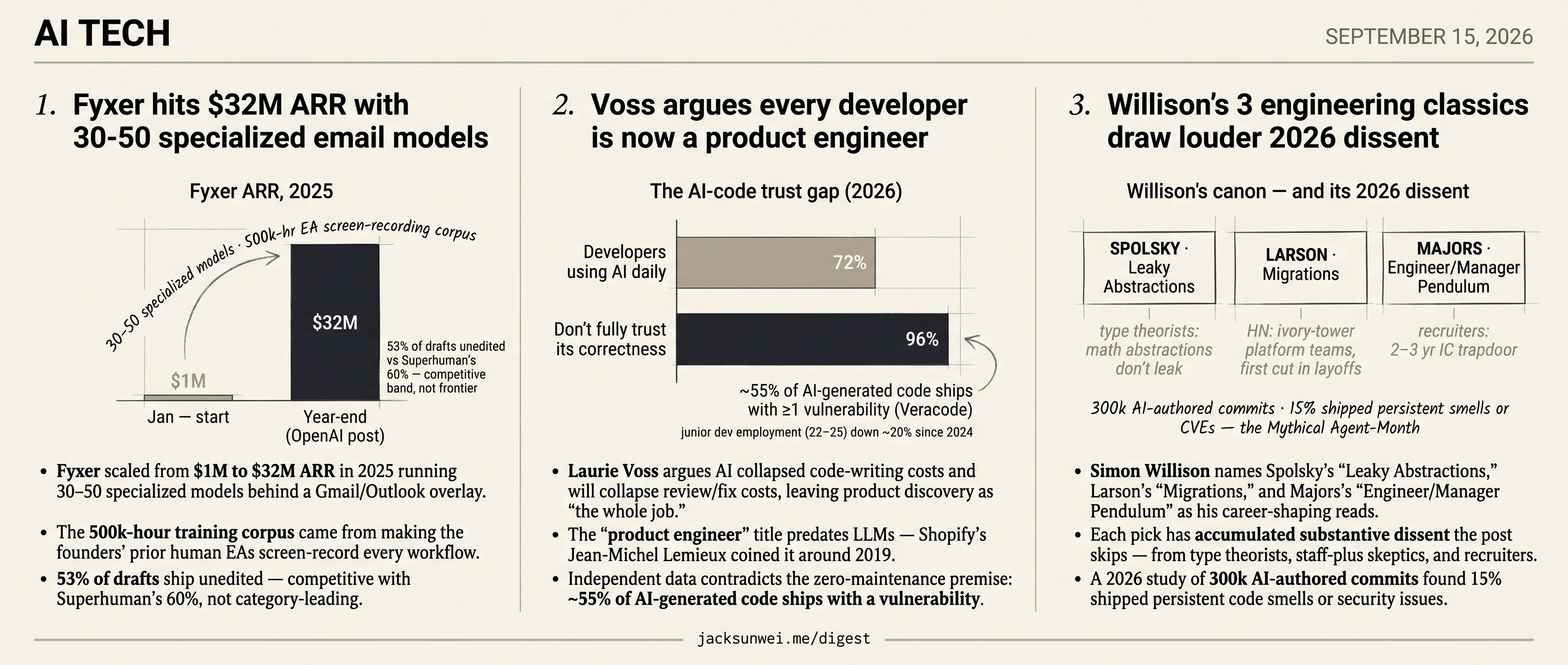
Fyxer buries $450 charges, Voss omits 55% vulns, Willison ducks dissent
Today's three tech reads each restore what the source omitted: Fyxer's billing risk, Voss's vulnerability data, Willison's accumulated dissent.
Fyxer buries $450 charges, Voss omits 55% vulns, Willison ducks dissent
TL;DR
- Fyxer hits $32M ARR behind $450–€900 surprise post-trial billing flags.
- Voss calls every dev a product engineer, ignoring 55% AI-code vulnerability rate.
- Junior developer employment fell 20% since 2024, breaking Voss’s apprenticeship premise.
- Willison’s 3 classics each carry substantive dissent the post skips.
- 300k AI commits study finds 15% shipped code smells or security issues.
Today’s three tech features share a shape: each is a persuasive artifact — a vendor’s ARR chart, an essayist’s thesis, a curator’s reading list — whose sharpest counter-data lives outside the piece itself. Fyxer’s $32M ARR headline sits alongside Trustpilot complaints about surprise post-trial charges and top-tier risk flags on its full-inbox scope. Laurie Voss’s every developer is a product engineer argument depends on AI-generated code being cheap to maintain — a premise independent data (55% vulnerability rate, 20% junior-hiring collapse) actively contradicts. Simon Willison’s three engineering classics each carry accumulated dissent from type theorists, staff-plus skeptics, and recruiters — dissent his post walks past. The features aren’t debunkings; they’re the second column of a two-column ledger the sources chose to publish with only the first.
Fyxer hits $32M ARR with 30-50 specialized email models
Source: openai-blog · published 2026-09-14
TL;DR
- Fyxer scaled from $1M to $32M ARR in 2025 running 30–50 specialized models behind a Gmail/Outlook overlay.
- The 500k-hour training corpus came from making the founders’ prior human EAs screen-record every workflow.
- 53% of drafts ship unedited — competitive with Superhuman’s 60%, not category-leading.
- Trustpilot and VerifyWise flag surprise $450–€900 post-trial charges and top-tier risk for full read/write/send inbox scope.
The dataset is the real moat
OpenAI’s case study frames Fyxer as a textbook fine-tuning story: LoRA adapters, Direct Preference Optimization on user edits, a swarm of 30–50 task-specific models orchestrated by frontier OpenAI models for the final drafting pass. The engineering is credible, but the load-bearing asset is the training data — 500,000 hours of annotated executive-assistant workflows.
Madrona’s investment memo adds the provenance the OpenAI post skips: Fyxer’s founders ran a human EA agency first and required their assistants to record their screens and log time so engineers could “map the exact workflows” of inbox triage and meeting scheduling 1. That reframes the corpus as a deliberate multi-year data-collection operation piggybacked on a services business, not incidental exhaust from a product. It’s a moat competitors can’t buy — and it’s why the model-architecture story matters less than the labeling story underneath it.
The engineering culture matches. An independent profile clocks Fyxer’s four-person growth team at ~514 experiments in a year — roughly two per workday — using Claude Code and Cursor to one-shot backend changes and upsell flows 2.
The growth numbers mostly check out
Independent reporting corroborates the trajectory with slightly tighter figures. The SaaS News pegs mid-2025 ARR at “$1M to over $17M in eight months” and confirms the $30M Series B led by Madrona with Lakestar, 20VC, and Marc Benioff participating 3. The OpenAI post’s $32M year-end figure is directionally consistent with that mid-year run-rate but hasn’t been independently confirmed at time of writing.
Where the trust story cracks
The “assistant people trust” framing is the part that doesn’t survive contact with users. Trustpilot surfaces a recurring billing complaint — surprise post-trial charges in the $450–€900 range — alongside concrete drafting bugs like forced 1.5 line spacing and stripped signatures and inline images, which directly undercut the “in your voice” pitch 4.
VerifyWise’s audit flags a structural issue the case study doesn’t address: Fyxer requires full read/write/send inbox scope, and its terms reportedly claim ownership over user “suggestions, ideas, and feedback” while leaving personal-data retention timelines vague. That combination puts Fyxer in the highest-risk tier for enterprise buyers even with SOC 2 and ISO 27001 in hand 5.
Competitive band, not frontier
The 53% unedited-acceptance headline sits inside a competitive band rather than at the top of it.
| Product | Unedited-send rate | Model | Positioning |
|---|---|---|---|
| Fyxer | 53% of drafts | Overlay on Gmail/Outlook | Reduce time in inbox |
| Superhuman | 60% of Auto Drafts | Full mail client | Maximize keyboard speed |
| Shortwave | Not disclosed | Full mail client | Agentic retrieval |
Reviewers characterize the split cleanly: Fyxer is a non-invasive layer aimed at reducing time in the inbox, while Superhuman and Shortwave replace the client entirely to make time spent there faster 6. Fyxer’s real bet isn’t model quality — it’s distribution. Not making users leave native mail is the wedge. The 500k-hour corpus is what keeps competitors from copying it.
Voss argues every developer is now a product engineer
Source: simon-willison · published 2026-09-14
TL;DR
- Laurie Voss argues AI collapsed code-writing costs and will collapse review/fix costs, leaving product discovery as “the whole job.”
- The “product engineer” title predates LLMs — Shopify’s Jean-Michel Lemieux coined it around 2019.
- Independent data contradicts the zero-maintenance premise: ~55% of AI-generated code ships with a vulnerability.
- Junior developer employment fell ~20% since 2024, breaking the apprenticeship pipeline Voss’s model depends on.
The claim
Laurie Voss’s essay, quoted approvingly by Simon Willison, argues that the cost of writing code has already collapsed, the cost of reviewing and operating it is following, and what remains — finding out what users want, defining it precisely, making it pleasant — becomes the entire job. Because that residual cost is per-product and doesn’t amortize, and because demand for software has no ceiling, product work asymptotically is software engineering.
It’s a clean argument. It’s also less novel than it reads. The “product engineer” title has a documented lineage: Sherif Mansour credits Shopify’s Jean-Michel Lemieux with popularizing it around 2019, and by the early 2020s it was a distinct career track at Stripe, PostHog, and others 7. Voss’s real contribution isn’t naming the role — it’s asserting that AI has made the transition involuntary for everyone else.
Where the mechanism breaks
The load-bearing claim is that review, fix, and operate costs will track write costs to zero. Independent 2025–26 data pushes back hard on that specific mechanism.
| Signal | Finding | Cuts against Voss? |
|---|---|---|
| GitClear (211M lines, 2024) | Duplication up 8×, refactoring down 70% vs. 2022 8 | Yes — AI is creating maintenance debt |
| Veracode 2026 | ~55% of AI-generated code has ≥1 vulnerability 9 | Yes — security review scales with volume |
| Developer trust survey | 72% use AI daily, 96% don’t fully trust correctness 10 | Yes — human review isn’t going away |
| CIO/Anthropic 2026 | AI touches 60% of work; only 20% fully delegated 11 | Partially supports — orchestration is the new value |
The CIO data is the one Voss can cite: engineers report their primary value shifting to “orchestrating long-running systems of agents” rather than line-by-line authoring 11. That’s directionally his thesis. But the quality and security data suggests the cost side of the equation isn’t collapsing — it’s migrating. Bugs that used to cost a junior an afternoon now ship at machine speed and land on a security team that hasn’t scaled 8×.
The pipeline gap
There’s a demographic hole in the argument Voss doesn’t address. Stanford’s AI Index 2026 finds employment for developers aged 22–25 has fallen roughly 20% since 2024, across 33 consecutive months of decline 12. Product judgment — knowing what users want, translating vague desires into precise requirements — is traditionally acquired by doing the mechanical work Voss says is dying. Shopify-style product engineers were built from senior ICs who’d shipped things.
As the amount of software goes to infinity… that cost becomes the whole job.
If the entry-level rung disappears, so does the training path for the role Voss says everyone must now fill. His essay treats this as skills reallocation. The hiring data suggests it’s a generational rupture.
Net
Voss is probably right about the direction: product judgment and agent orchestration are where the leverage is moving 11. He’s on shakier ground claiming review-and-operate costs are following write costs to zero — the security and quality data say those costs are being displaced onto different teams, not eliminated 89. And the model has no story for where the next cohort of product engineers comes from when the apprenticeship rung is gone 12.
Willison’s 3 engineering classics draw louder 2026 dissent
Source: simon-willison · published 2026-09-14
TL;DR
- Simon Willison names Spolsky’s “Leaky Abstractions,” Larson’s “Migrations,” and Majors’s “Engineer/Manager Pendulum” as his career-shaping reads.
- Each pick has accumulated substantive dissent the post skips — from type theorists, staff-plus skeptics, and recruiters.
- A 2026 study of 300k AI-authored commits found 15% shipped persistent code smells or security issues.
- Sean Goedecke’s counter-take: with agent coding, holding a full Naur theory of a codebase is no longer feasible.
The canon holds
Willison’s Lobste.rs comment picks three consensus classics: Joel Spolsky’s The Law of Leaky Abstractions, Will Larson’s Migrations: the sole scalable fix to tech debt, and Charity Majors’s The Engineer/Manager Pendulum. All three recur across 2026 recommendation digests alongside Alexis King’s Parse, Don’t Validate, Rich Hickey’s Simple Made Easy, and Sandi Metz’s The Wrong Abstraction 13. As a canon it’s uncontroversial. As a reading list in 2026, it’s incomplete — because each essay has spent a decade collecting sharp critique that the short post elides.
Each pick has grown critics
Spolsky’s “law” reads as universal, but formal-methods practitioners have long argued it’s an artifact of weak type systems. Mathematically-grounded abstractions — bignums, verified monads, sets — behave identically regardless of implementation and don’t leak 14. The rebuttal (Meltdown/Spectre prove even the ISA leaks) keeps the debate live rather than closed, but “always dig into the layer below” is a heuristic, not a law.
Larson’s migrations essay draws pointed pushback on Hacker News, where practitioners warn the doctrine produces “engineering ivory towers” that ship infrastructure churn to product teams and get gutted first in layoffs 15. The tension is real: treating migration as a first-class engineering skill scales technical decisions, but it also concentrates power in platform teams whose ROI is hardest to defend when budgets tighten.
Majors’s pendulum faces two independent critiques. In an efficiency-focused labor market, recruiters increasingly read an IC swing as demotion, and there’s a widely-cited “2–3 year” trapdoor after which a returning manager can’t reclaim senior IC pay 16. Structurally, John Barton argues the pendulum is a personal coping strategy for a broken dual-ladder — organizations that force the choice should redesign the ladder, not celebrate the swing 17. Willison’s own career vindicates the pendulum; most readers’ won’t.
The agent-era wrinkle
The 2026 backdrop matters more than the post lets on. A recent analysis of over 300,000 AI-authored commits found 15% introduced code smells or security issues that persisted long after deployment — the authors frame it as Brooks’s essential-vs-accidental complexity distinction resurrected as the “Mythical Agent-Month” 18. That empirical result cuts two ways for Willison’s canon. It strengthens Spolsky: when an agent writes code against an abstraction it doesn’t fully model, the leak becomes a shipped CVE. It weakens the implicit “understand the layers below you” mandate, because no human can now hold a Naur-style theory of every module an agent has touched. Sean Goedecke’s contrarian “In defense of not understanding your codebase,” also circulating in the same 2026 threads, argues exactly that 13.
What to take from it
Willison’s list is a fine starting point, not a finished syllabus. The essays that ages best in an agent-heavy workflow are the ones about structural decay — Metz on wrong abstractions, Brooks on essential complexity, Hickey on simplicity — because those are the failure modes an LLM will cheerfully accelerate. Read the classics, but read the dissent next to them.
Footnotes
-
Madrona investment memo on Fyxer — https://www.madrona.com/fyxer-ai-productivity-tools-for-email-and-meetings/
↩The founders required their original human EAs to record their screens and track their time meticulously, allowing the engineering team to ‘map the exact workflows’ of inbox management and meeting scheduling.
-
Growth Unhinged — ‘The AI-native growth team’ — https://www.growthunhinged.com/p/the-ai-native-growth-team
↩An independent analysis of their growth team revealed they conducted over 514 experiments in a single year—roughly two per workday—using a lean team of four engineers leveraging Claude Code and Cursor.
-
The SaaS News (Series B coverage) — https://www.thesaasnews.com/news/fyxer-raises-30-million-in-series-b/
↩Fyxer AI’s annual recurring revenue reportedly skyrocketed from $1 million to over $17 million in just eight months during 2025, with the Series B closing at $30M led by Madrona alongside Lakestar, 20VC and angels including Marc Benioff.
-
Trustpilot reviews of fyxer.com — https://www.trustpilot.com/review/fyxer.com?page=2
↩Multiple users have reported surprise charges of several hundred dollars (e.g., $450 to €900) immediately following the 7-day trial period, and drafts introducing irregular 1.5 line spacing or stripping signatures and embedded images.
-
VerifyWise AI Trust Index — Fyxer — https://verifywise.ai/ai-trust-index/fyxer
↩Because Fyxer requires full read/write/send inbox access it belongs to the highest-risk tier of AI applications; reviews cite indefinite personal-data retention and terms that let Fyxer claim ownership over user ‘suggestions, ideas, and feedback.’
-
cmdk.email — Superhuman vs Shortwave — https://cmdk.email/post/superhuman-vs-shortwave/
↩Superhuman reported that 60% of its ‘Auto Drafts’ are sent without any manual editing… Fyxer’s assistant-layer model aims to reduce the time spent touching the inbox, whereas Superhuman aims to make the time spent there as fast as humanly possible.
-
vipshek.com — ‘What is a Product Engineer?’ — https://www.vipshek.com/blog/product-engineer
↩Sherif Mansour of Atlassian credits Jean-Michel Lemieux (former CTO of Shopify) with using the term to describe developers who engage with the ‘why’ of a feature rather than just the ‘how’… By the early 2020s, what was once a startup oddity began appearing in major job listings as a distinct career track.
-
jonas.rs summary of GitClear 2025 code-quality report — https://www.jonas.rs/2025/02/09/report-summary-gitclear-ai-code-quality-research-2025.html
↩ ↩2The frequency of code duplication increased eightfold in 2024, while ‘moved lines’—a key indicator of refactoring and code reuse—dropped by 70% compared to 2022.
-
Recorded Future / Veracode 2026 findings — https://www.recordedfuture.com/research/the-hidden-cost-of-ai-security-debt
↩ ↩2Roughly 55% of AI-generated code contains at least one security vulnerability, often in areas like cross-site scripting (XSS) or log injection… these flaws scale at the speed of the AI, potentially overwhelming manual security review cycles.
-
Interclypse — ‘The AI Trust Gap’ — https://interclypse.com/happenings/the-ai-trust-gap-what-developers-actually-believe-about-ai-code
↩72% of developers use AI tools daily, [but] a staggering 96% do not fully trust the output to be functionally correct.
-
CIO.com — ‘How agentic AI will reshape engineering workflows in 2026’ — https://www.cio.com/article/4134741/how-agentic-ai-will-reshape-engineering-workflows-in-2026.html
↩ ↩2 ↩3Engineers use AI in roughly 60% of their work, [but] only ‘fully delegate’ 20%, shifting their primary value to ‘orchestrating long-running systems of agents’ rather than line-by-line creation.
-
Medium summary of Stanford AI Index 2026 — https://medium.com/write-a-catalyst/stanford-says-employment-for-junior-developers-dropped-20-97edd2137e9c
↩ ↩2Employment for software developers aged 22 to 25 has plummeted nearly 20% since 2024, marking over 33 consecutive months of decline.
-
daily.dev — Best of Lobste.rs digest — https://daily.dev/sources/lobsters/best-of/2026/05
↩ ↩2Recurring 2026 recommendations pair Spolsky and Larson with Alexis King’s ‘Parse, Don’t Validate,’ Rich Hickey’s ‘Simple Made Easy,’ and Sandi Metz’s ‘The Wrong Abstraction’ — with Sean Goedecke’s ‘In defense of not understanding your codebase’ sparking debate that maintaining a full Naur theory of a system has become impossible.
-
Wikipedia — Leaky abstraction — https://en.wikipedia.org/wiki/Leaky_abstraction
↩Critics from the functional programming community argue Spolsky’s law is a triviality resulting from weak type systems; abstractions grounded in mathematics (bignum classes, verified monads, sets, integers) behave identically regardless of implementation and do not leak.
-
Hacker News discussion (item 46092217) — https://news.ycombinator.com/item?id=46092217
↩Larson’s techniques can lead to ‘engineering ivory towers’ where infrastructure teams force complex changes on product teams, causing friction with the business and potentially leading to organizational gutting during layoffs.
-
Medium — ‘The Engineer/Manager Pendulum is Dead, Long Live the Pendulum’ — https://medium.com/@DebaA/the-engineer-manager-pendulum-is-dead-long-live-the-pendulum-81c4a1f02ee1
↩In an efficiency-focused market with lower job security, swinging back to an IC role can be perceived as a demotion by external recruiters; if a manager stays away from hands-on work for more than 2–3 years, returning to a senior IC role becomes impossible without a downgrade in seniority and pay.
-
John Barton — ‘Pendulum on the Ladder’ — https://johnbarton.co/posts/pendulum-on-the-ladder/
↩The pendulum is merely a way to survive a flawed status quo rather than fixing the underlying organizational designs that force the choice in the first place.
-
arXiv 2606.05608 — empirical study of AI-authored commits — https://arxiv.org/html/2606.05608v1
↩A 2026 analysis of over 300,000 AI-authored commits found that 15% introduced code smells or security issues that persisted in repositories long after deployment, reviving Brooks’s distinction between accidental and essential complexity as the ‘Mythical Agent-Month.’