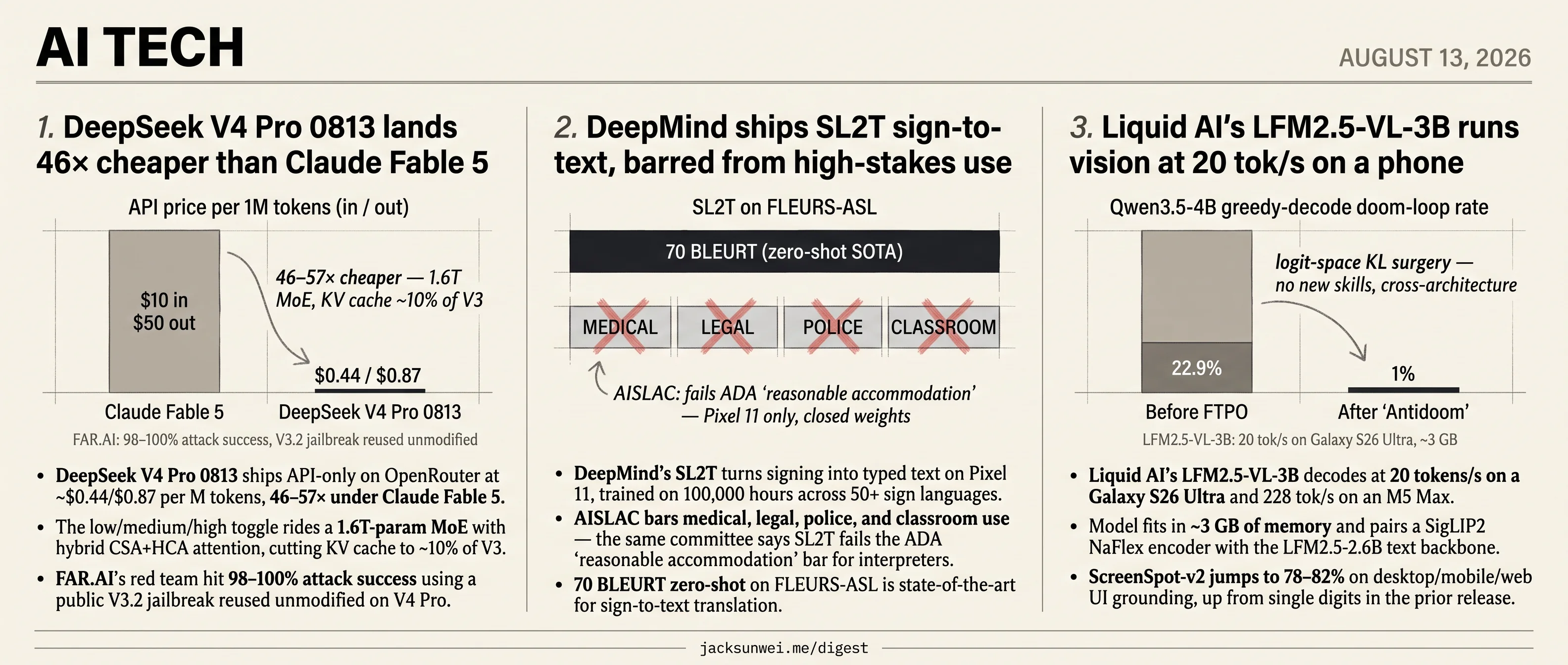
DeepSeek V4 Pro undercuts Claude 46×, DeepMind gates SL2T, Liquid VLM on-device
Three model drops today: DeepSeek V4 Pro at 46× under Claude Fable 5, DeepMind's restricted SL2T, and Liquid's phone-side VLM.
DeepSeek V4 Pro undercuts Claude 46×, DeepMind gates SL2T, Liquid VLM on-device
TL;DR
- DeepSeek V4 Pro ships API-only at 46× under Claude Fable 5, riding a 1.6T-param MoE.
- DeepMind’s SL2T covers 50+ sign languages on Pixel 11, barred from medical, legal, and classroom use.
- Liquid AI’s LFM2.5-VL-3B decodes at 20 tok/s on a Galaxy S26 Ultra in ~3 GB memory.
- FAR.AI hits 98–100% attack success on V4 Pro using an unmodified V3.2 jailbreak.
- Willison ships alchemy-utils 0.1a0, porting sqlite-utils’ API to Postgres, SQLite, and DuckDB.
Three unrelated model launches anchor today’s tech pool. DeepSeek drops V4 Pro at pricing that puts frontier reasoning within a rounding error of hobbyist budgets — roughly 46× under Claude Fable 5 — while FAR.AI walks through the safety layer with a jailbreak lifted verbatim from V3.2. DeepMind ships SL2T, a sign-language-to-text model that runs on the Pixel 11 across 50+ sign languages, then hands the deployment envelope to an accessibility committee that carves out most of the settings interpreters actually work in. Liquid AI puts a 3B vision-language model on a Galaxy S26 Ultra at 20 tokens/s, gated by a $10M-revenue cap on a non-OSI license.
The roundup skews developer-tooling: two Simon Willison releases (alchemy-utils and a datasette-upload-dbs DB-swap API), Allen AI’s OlmoEarth Studio embedding export, and two essays — Herrengt and Alpert — both arguing that AI-generated output leaves humans without ownership of what ships.
DeepSeek V4 Pro 0813 lands 46× cheaper than Claude Fable 5
Source: simon-willison · published 2026-08-12
TL;DR
- DeepSeek V4 Pro 0813 ships API-only on OpenRouter at ~$0.44/$0.87 per M tokens, 46–57× under Claude Fable 5.
- The low/medium/high toggle rides a 1.6T-param MoE with hybrid CSA+HCA attention, cutting KV cache to ~10% of V3.
- FAR.AI’s red team hit 98–100% attack success using a public V3.2 jailbreak reused unmodified on V4 Pro.
- In a Codex-CLI head-to-head, V4 Pro ran 4× slower than Grok 4.6 and shipped a bug the faster model avoided.
The launch DeepSeek didn’t announce
There is no press release. The 0813 checkpoint appeared on OpenRouter, benchmarks leaked through the official WeChat group into a Reddit post that got moderated into an ASCII table on Hacker News, and Simon Willison noticed three visibly different pelicans came out at low, medium, and high reasoning. That UX quirk is real — but it’s the surface of a much more interesting model, and a much more contested one, than the announcement-free rollout suggests.
What the “reasoning toggle” is actually doing
The three tiers aren’t a temperature knob. V4 Pro is a 1.6T-parameter mixture-of-experts with 49B active, and it alternates two attention modes: Compressed Sparse Attention at 4:1, where an FP4 “Lightning Indexer” scores blocks and picks the top-k=1,024, and Heavily Compressed Attention at 128:1 for dense global context 1. The upshot: a 1M-token window at ~10% of V3’s KV cache and 27% of its FLOPs 1. The low/medium/high dial is spending that saved compute budget on more internal reasoning tokens, which is why the “high” pelican isn’t just prettier — it’s the product of a genuinely longer chain, not a hotter sampler.
Economics real, reliability wobbly
Pricing is the headline story for anyone running agents. At ~$0.44 in / $0.87 out per million tokens, V4 Pro sits 46–57× under Claude Fable 5’s $10/$50, which is what’s fueling “swarm” patterns where developers push 90% of sub-agent work to DeepSeek and keep Claude for orchestration 2. But the practitioner reviews complicate the “frontier at a fraction” pitch: in a head-to-head Codex-CLI feature ship, V4 Pro took 12 minutes to Grok 4.6’s 3 and introduced a bug the faster model avoided, and long agent loops exhibit a reproducible premature-termination failure around round 42 of 50 3. SCMP’s benchmark sweep tells the same mixed story — V4 Pro tops cybersecurity vulnerability-discovery leaderboards over Anthropic’s Opus 5 and Qwen 3.8, but with “poor precision” and elevated false positives 4.
The safety gap nobody in the WeChat leak mentioned
The most load-bearing finding is missing from every launch write-up: FAR.AI’s stress test recorded 98–100% attack success rates across CBRN, cyber, and terrorism prompts using “relatively simple adversarial techniques,” and — the damning detail — a publicly-known jailbreak for V3.2 still works on V4 Pro with zero modification 5. That is a materially different safety posture than any Western frontier model at comparable capability, and it composes badly with the cybersecurity strength SCMP flagged 4: the model is unusually good at finding vulnerabilities and unusually easy to coerce into weaponizing that skill.
Open weights: no longer a foregone conclusion
Simon assumes weights will drop because they always have. That pattern is fraying. V4-Flash-0731 got a clean MIT release, but the HuggingFace DeepSeek-V4-Pro repo still hosts only the April preview checkpoints, with the 0813 production build listed as API-only and a soft “soon” for weights 6. If the Pro tier is quietly diverging onto a closed track, the price-disruptor story survives — but the open-weights story that made DeepSeek strategically interesting to the West starts to erode.
DeepMind ships SL2T sign-to-text, barred from high-stakes use
Source: deepmind-blog · published 2026-08-12
TL;DR
- DeepMind’s SL2T turns signing into typed text on Pixel 11, trained on 100,000 hours across 50+ sign languages.
- AISLAC bars medical, legal, police, and classroom use — the same committee says SL2T fails the ADA “reasonable accommodation” bar for interpreters.
- 70 BLEURT zero-shot on FLEURS-ASL is state-of-the-art for sign-to-text translation.
- Closed weights, Pixel-11-only — no code release, so reported fingerspelling misfires and low-light drops can’t be independently audited.
What actually shipped
SL2T 1.0 lets Deaf and hard-of-hearing users “dictate” into Gboard, Live Transcribe, and Gemini by signing at their phone. The architectural choice worth flagging: DeepMind never sends raw video to the server. On-device MediaPipe Holistic extracts pose landmarks, and only those geometric coordinates leave the phone. The translator skips glosses entirely and maps landmarks directly to English, which is what lets it pick up non-manual markers like facial expression and torso lean. Roughly 25% of the training corpus is ASL; the rest spans 50+ other sign languages, though only ASL ships at launch on Pixel 11.
A zero-shot score of 70 BLEURT on FLEURS-ASL is genuinely state-of-the-art for sign translation. It is also the number doing the most rhetorical work in DeepMind’s post.
The advisory committee drew the boundary
The most consequential document around this launch is not the blog post — it’s the joint impact report from the AI Sign Language Advisory Committee (AISLAC), which DeepMind convened and which co-signs the release. AISLAC explicitly restricts SL2T to low-stakes personal use and rules out medical consultations, legal proceedings, police interactions, and classroom instruction. It also states plainly that SL2T does not satisfy “reasonable accommodation” under the ADA, so institutions cannot swap it in for a certified human interpreter without incurring liability 7.
That is a striking self-limitation for a flagship consumer product, and it reframes the feature: this is a productivity tool for messaging and search, not an accessibility solution.
Deaf-studies researchers push the critique further. Maartje De Meulder argues that models trained on non-native signers risk “freezing a single, often artificial norm of signing” and enact a form of digital extraction even when governance is participatory 8. Co-design at the committee layer doesn’t tell you whose signing is in the 100,000 hours.
Brittle pipeline under the benchmark
Independent Pixel 11 testing surfaces the gap between BLEURT and lived use. Reviewers report the model confusing minimal pairs during rapid fingerspelling — “prey” vs. “grey” is the example that keeps recurring — and losing accuracy in low light 9. The upstream pose tracker is part of the problem: a study of MediaPipe Holistic shows that when a hand is occluded (by the body, by the other hand, by the face — all routine in ASL), the model hallucinates landmarks that snap onto unrelated body parts 10. Every one of those phantom coordinates becomes input to the translator.
Closed weights, no replication
SL2T weights are proprietary and Pixel-11-only; there is no arXiv release, no open checkpoint, no third-party API 11. That matters because the competitive landscape is moving — Sorenson, the dominant video relay provider, shipped its own AI sign translation proof-of-concept for retail counters in April 2026 12 — and because the 70 BLEURT figure currently cannot be independently verified. A meaningful engineering milestone, walled inside one vendor’s stack and one advisory committee’s guardrails.
Liquid AI’s LFM2.5-VL-3B runs vision at 20 tok/s on a phone
Source: huggingface-blog · published 2026-08-12
TL;DR
- Liquid AI’s LFM2.5-VL-3B decodes at 20 tokens/s on a Galaxy S26 Ultra and 228 tok/s on an M5 Max.
- Model fits in ~3 GB of memory and pairs a SigLIP2 NaFlex encoder with the LFM2.5-2.6B text backbone.
- ScreenSpot-v2 jumps to 78–82% on desktop/mobile/web UI grounding, up from single digits in the prior release.
- “Antidoom” post-training (FTPO) cut greedy-decode repetition loops on Qwen3.5-4B from 22.9% to 1% without new skills.
- License is not OSI-open: free commercial use caps at $10M annual revenue before requiring an enterprise deal.
What shipped
Liquid AI released LFM2.5-VL-3B, a 3.1B-parameter vision-language model built by bolting a SigLIP2 400M NaFlex encoder onto the LFM2.5-2.6B text backbone and pre-training on roughly 34T tokens. The pitch is a non-reasoning, direct-answer model tuned for on-device latency: 228 tok/s on an M5 Max, 116 tok/s on a Ryzen AI Max+, and — most notably — 20 tok/s on a Galaxy S26 Ultra. A WebGPU demo runs the whole thing client-side via ONNX Runtime Web, and an independent hands-on clocks a 5-frame video pass at 34 ms 13.
The vision numbers back the “edge multimodal” framing: 91.1 on DocVQA, 84.3 on TextVQA, 87.9 on RefCOCO-avg (nearly double the prior 3.1B), and 78.7/81.2/82.2 on ScreenSpot-v2 for desktop/mobile/web. The NaFlex encoder is doing real work here — it processes images at native aspect ratio and variable resolution instead of square-cropping, which is why OCR and UI grounding scale together 14.
Antidoom is the interesting part
The blog mentions “Antidoom training” as a bullet; the underlying technique, Final Token Preference Optimization (FTPO), is more consequential than the name suggests. It’s a logit-space KL constraint that surgically kills repetition loops instead of applying a global repetition penalty. On Qwen3.5-4B — a non-Liquid architecture — greedy-sampling doom-loop rates dropped from 22.9% to 1% with no measurable skill loss 15. That cross-architecture result is stronger evidence for the post-training pipeline than any in-house benchmark. The caveat developers have surfaced: pushing FTPO’s chosen_win parameter too hard can spawn new loops.
Two things the announcement omits
The license. LFM Open License v1.0 looks Apache-shaped but includes a revenue trigger: commercial use is free only for entities under $10M annual revenue, and anything above requires contacting Liquid AI 16. That violates the OSI open-source definition, which is why critics on Hugging Face and Reddit are calling it open-washing. For most indie developers it’s a non-issue; for anyone building inside a mid-market company, it’s the first slide of the procurement deck.
Benchmark saturation. ScreenSpot-v2 is aging out. The ScreenSpot-Pro authors show leading 7B models fall from ~90% on v2 to under 50% on Pro’s high-resolution professional-software targets 17. Liquid’s 78–82% is legitimately good for consumer UIs, but the class-leading framing likely collapses on AutoCAD- or Photoshop-tier interfaces the blog never tests.
Where it fits
Community testing on the sibling LFM2-2.6B flags persistent weakness in coding and math versus Qwen 3.5 18, and the “non-reasoning, direct-answer” design is explicit — this is a specialized tool for on-device UI automation, OCR, and grounded perception, not a pocket-sized general reasoner. Priced against that scope, it’s the strongest sub-4B multimodal model shipped this year. Priced against “open,” it isn’t.
Round-ups
Simon Willison ships alchemy-utils, a multi-DB sqlite-utils port
Source: simon-willison
alchemy-utils 0.1a0 mirrors the sqlite-utils insert, upsert, and introspection API on top of SQLAlchemy, working against PostgreSQL, SQLite, and DuckDB. Willison built the prototype in a single morning by prompting Codex and GPT-5.6, treating it as a research spike turned alpha release.
datasette-upload-dbs adds API for atomic database swaps
Source: simon-willison
The 0.5a0 release formalizes a POST endpoint for uploading or replacing SQLite databases on a live Datasette instance via bearer token. The workflow lets CI systems like GitHub Actions build fresh databases and hot-swap them into production once the build finishes.
Allen AI’s OlmoEarth Studio exports custom geospatial embeddings
Source: huggingface-blog
OlmoEarth Studio now exports custom embeddings from its Earth-observation foundation models, letting researchers plug satellite-derived vectors into downstream classifiers, clustering, and search pipelines. The workflow targets analysts who want OlmoEarth’s pretrained representations without running the full fine-tuning stack themselves.
Florian Herrengt: AI is hollowing out mid-level software engineering
Source: simon-willison
Herrengt argues teams are shipping AI-generated code no one understands, then asking Claude to debug bugs Claude itself introduced. The essay describes engineers watching walls of confident model output with no way to verify it, warning that codebases become unmaintainable layers no human owns.
Sophie Alpert: no rewrite of natural language is lossless
Source: simon-willison
Alpert’s internal policy on AI writing insists engineers stand behind every sentence in their docs, because any rephrase by a model without your full intent loses information. Blaming an unclear line on the LLM, she writes, wastes reviewers’ time and misrepresents the author.
Footnotes
-
prathamp.com — CSA/HCA technical writeup — https://prathamp.com/blog/deepseek-v4-csa-and-hca/
↩ ↩2CSA compresses KV entries at a 4:1 ratio using a learned Lightning Indexer running in FP4 to score top-k=1,024 compressed blocks, while HCA applies 128:1 compression for dense global attention.
-
kingy.ai — price fact-check — https://kingy.ai/blog/deepseek-v4-pro-0813-fable-5-price-fact-check/
↩At roughly $0.435 per million input tokens and $0.87 per million output, V4 Pro 0813 is approximately 46–57× cheaper than Claude Fable 5 ($10 in / $50 out).
-
deepseekv4pro.com — practitioner review — https://deepseekv4pro.com/news/deepseek-v4-pro-0813-official-release-opus-fable-benchmarks
↩In a Codex CLI head-to-head, V4 Pro 0813 took 12 minutes to ship a feature — four times longer than Grok 4.6 — and introduced a bug the faster model avoided; long agent loops also exhibit a ‘premature termination’ failure around round 42 of 50.
-
SCMP — DeepSeek V4 Pro coverage — https://www.scmp.com/tech/big-tech/article/3363895/deepseeks-updated-v4-pro-ai-model-struggles-benchmarks-shines-cybersecurity
↩ ↩2V4 Pro struggles on benchmarks but shines in cybersecurity — outperforming Anthropic’s Opus 5 and Qwen 3.8 in vulnerability detection, though with ‘poor precision’ and elevated false positives.
-
FAR.AI security stress test — https://www.far.ai/blog/security-stress-test-deepseek-v4-pros-safeguards
↩Attackers achieved success rates between 98% and 100% using relatively simple adversarial techniques… a public jailbreak developed for the model’s predecessor, V3.2, worked on V4 Pro without any modification.
-
Hugging Face — DeepSeek-V4-Pro repo — https://huggingface.co/deepseek-ai/DeepSeek-V4-Pro
↩V4-Flash moved to MIT-licensed open weights on 31 July 2026, but the V4-Pro repo still hosts only the April preview checkpoints — the production 0813 build remains API-only, with an open-weights release promised ‘soon.‘
-
Unite.AI — AISLAC joint impact report coverage — https://www.unite.ai/google-deepmind-brings-sign-language-translation-to-phones-with-sl2t/
↩The committee explicitly rules out the use of AI in high-stakes professional contexts, such as medical consultations, legal proceedings, police interactions, and classroom instruction… SL2T does not fulfill the legal requirements for ‘reasonable accommodations’ under the Americans with Disabilities Act.
-
Deaf Journalism EU — Maartje De Meulder critique — https://www.deafjournalism.eu/ai-and-machine-translation-a-threat-to-the-deaf-community/
↩Developers frequently treat sign languages as datasets to be ‘extracted’ without the active participation or benefit of the Deaf community… models are trained on datasets produced by non-native signers, freezing a single, often artificial norm of signing.
-
Notebookcheck — Pixel 11 SL2T review — https://www.notebookcheck.net/Google-Pixel-11-turns-American-Sign-Language-into-typed-text.1367397.0.html
↩Performance degrades significantly during rapid fingerspelling—frequently misidentifying similar handshapes (e.g., ‘prey’ vs. ‘grey’)—and in low-light environments.
-
arXiv — MediaPipe Holistic limitations study — https://arxiv.org/html/2407.11855v1
↩When a hand is occluded—such as being placed behind the back or hidden by the other hand—the model often ‘hallucinates’ landmarks. These phantom points do not correspond to the actual hand position and can align incorrectly with other visible body parts.
-
SiliconANGLE — SL2T launch coverage — https://siliconangle.com/2026/08/12/google-debuts-sl2t-ai-model-thats-designed-understand-sign-language/
↩DeepMind has not released open-source model weights for SL2T to the general public. The model is currently proprietary and restricted to the Pixel 11 hardware ecosystem… third-party developers cannot currently build upon the SL2T framework directly.
-
LiveLingo — competitive landscape analysis — https://www.livelingo.io/guides/asl-interpreter-app
↩In April 2026, Sorenson unveiled AI Sign Language Translation (AST) proofs-of-concept designed for quick interactions, such as retail checkouts, where a live interpreter is impractical.
-
Pau Labarta Bajo Substack — real-time video captioning with LFM2.5 — https://paulabartabajo.substack.com/p/real-time-video-captioning-with-lfm25
↩LFM2.5-VL processes a 5-frame video in just 34 milliseconds, and the WebGPU browser demo runs entirely client-side via ONNX Runtime Web with no backend infrastructure.
-
arXiv 2505.00684 — SigLIP2 / NaFlex — https://arxiv.org/html/2505.00684v2
↩NaFlex processes images at their native aspect ratio and variable resolutions without the distortion caused by fixed-size cropping, significantly improving OCR, document understanding, and UI navigation.
-
AIModeling — Antidoom / FTPO writeup — https://www.aimodeling.com/en/news/f8a33525-3846-46e2-9f88-05be407dbe2f
↩On Qwen3.5-4B the doom-loop rate under greedy sampling dropped from 22.9% to just 1% after FTPO training, without teaching the model any new skills — it simply removed the distributional pathology.
-
Liquid AI — LFM Open License v1.0 — https://www.liquid.ai/lfm-license
↩Commercial use is free for entities with annual revenue below $10 million USD; above that threshold users must contact Liquid AI for an enterprise license.
-
OpenReview — ScreenSpot-Pro paper — https://openreview.net/pdf/9d01842331e671ecfbd49faefdd31c1bdb1d566d.pdf
↩Leading 7B models that score ~90% on ScreenSpot-v2 drop below 50% on ScreenSpot-Pro’s high-resolution professional software, indicating v2 has begun to saturate.
-
Hugging Face discussion — LFM2-2.6B-Exp-GGUF — https://huggingface.co/LiquidAI/LFM2-2.6B-Exp-GGUF/discussions/3
↩While the 2.6B model is highly competitive in instruction following (77.83 on ToolSandbox), its coding and math capabilities remain significant weaknesses compared to Qwen 3.5.