DeepMind skips memory safeguards, Astra costs 2.5×, IBM leads Apache forecasters
DeepMind photorealistically reconstructs a memory without safeguards, Astra ties Sol at 2.5× price on a .blend pipeline, IBM leads Apache forecasters.
DeepMind skips memory safeguards, Astra costs 2.5×, IBM leads Apache forecasters
TL;DR
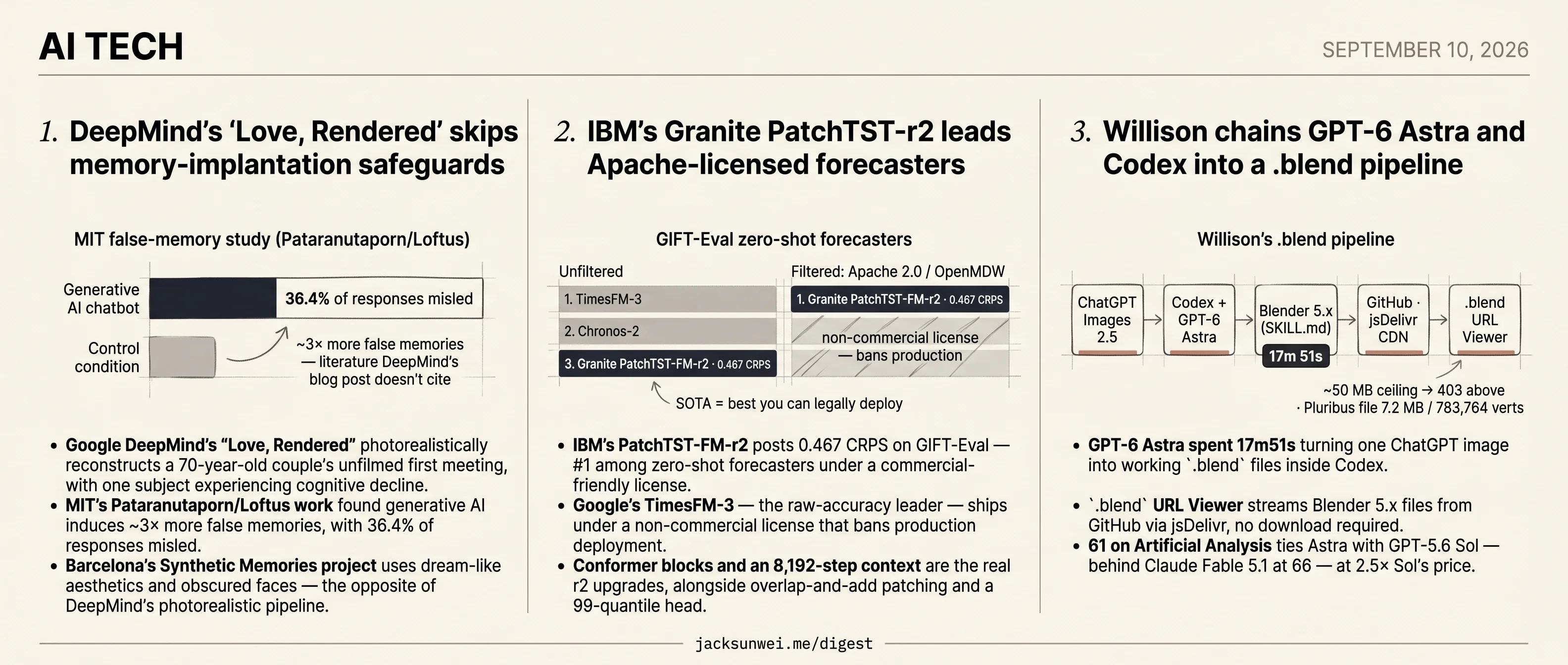
- DeepMind’s Love, Rendered photorealistically reconstructs a couple’s first meeting, skipping aesthetic safeguards peer projects use.
- MIT’s Pataranutaporn/Loftus work shows generative AI induces ~3× more false memories than baselines.
- GPT-6 Astra ties GPT-5.6 Sol at 61 on Artificial Analysis, at 2.5× the price, in Willison’s .blend chain.
- IBM’s PatchTST-FM-r2 posts 0.467 CRPS on GIFT-Eval, leading zero-shot forecasters under an Apache license.
- Google’s TimesFM-3 posts higher raw accuracy under a non-commercial license that bars production deployment.
Three tech ships today land on unrelated axes, and the honest read is to take each on its own terms. DeepMind’s Love, Rendered photorealistically reconstructs a 70-year-old couple’s unfilmed first meeting — one subject in cognitive decline — and skips the aesthetic safeguards that Barcelona’s Synthetic Memories project builds in and that MIT’s Pataranutaporn/Loftus work has quantified (~3× more false memories under generative AI). GPT-6 Astra ties GPT-5.6 Sol at 61 on Artificial Analysis inside Simon Willison’s .blend pipeline test, but the parity holds at 2.5× Sol’s price and against a jsDelivr ceiling that AI-generated Blender scenes hit fast.
IBM’s Granite PatchTST-FM-r2 takes #1 among zero-shot forecasters at 0.467 CRPS on GIFT-Eval — a ranking earned partly because Google’s more accurate TimesFM-3 shipped under a non-commercial license that disqualifies it from production use. Confluent’s Flink SQL now calls Granite directly on Kafka streams via AI_FORECAST, skipping the feature-store detour.
DeepMind’s ‘Love, Rendered’ skips memory-implantation safeguards
Source: google-ai-blog · published 2026-09-09
TL;DR
- Google DeepMind’s “Love, Rendered” photorealistically reconstructs a 70-year-old couple’s unfilmed first meeting, with one subject experiencing cognitive decline.
- MIT’s Pataranutaporn/Loftus work found generative AI induces ~3× more false memories, with 36.4% of responses misled.
- Barcelona’s Synthetic Memories project uses dream-like aesthetics and obscured faces — the opposite of DeepMind’s photorealistic pipeline.
- Same producer, opposite reception: Aronofsky’s other DeepMind-backed project is being called “AI slop” and a labor-displacement case study.
A tearjerker as wedge strategy
Love, Rendered, the Liz Garbus short produced with Darren Aronofsky’s Primordial Soup, premiered at a Telluride festival whose own director Julie Huntsinger has called AI a “threat” and a “humanity dilemma,” and where Bill Gates described “wonder and catastrophe” from the same stage 1. That is the room DeepMind chose to walk into with a story about Burt and Ethelle Shatz using generative models to recreate a first meeting no camera ever captured. It is not an accident that the wedge is empathetic: DeepMind needs a use case that survives contact with a skeptical creative audience.
The contrast with Aronofsky’s other current Primordial Soup/DeepMind collaboration, On This Day… 1776, is stark. Critics called it “AI slop” 2, and unions have treated its “everything seen on screen” pipeline as a template for displacing concept artists, animators and cinematographers in a post-strike environment 3. Same producer, same model stack, opposite verdict.
The science DeepMind doesn’t cite
The pipeline Google describes — restore photos, transfer present-day “micro-mannerisms” onto younger digital selves, then have Ethelle correct staircase curves and shoe heels — is exactly the interactive suggestibility loop that MIT Media Lab’s Pataranutaporn and Elizabeth Loftus flagged as high-risk. Their 2024 study found generative chatbots induced roughly 3× more immediate false memories than controls, and AI-edited images and video roughly doubled false-recall rates versus unedited stimuli 4. None of that literature appears in the blog post, and the subject population — someone with cognitive decline being asked to authenticate a photorealistic scene — is precisely where the effect size is most concerning.
A precedent that chose the opposite path
Barcelona’s Domestic Data Streamers has been generating “synthetic memories” since 2022 and by 2024 opened a municipal Citizens’ Office of Synthetic Memories at Disseny Hub, adding ~25 memories a week 5. Their explicit ethical guardrail is aesthetic: dream-like renderings and obscured faces, so outputs cannot be confused with historical evidence 5. DeepMind’s pipeline goes the other way — photorealism, preserved likeness, mannerism transfer — abandoning the guardrail that this field’s earlier practitioners converged on.
What’s actually under the hood
flowchart LR
    A[1950s B&W photos] --> B[Generative restoration + colorization]
    C[Present-day interviews] --> D[Performance capture: mannerisms, speech, pose]
    B --> E[Veo 3.x latent diffusion + audio fusion]
    D --> E
    F[Ethelle: staircase, shoe heel corrections] --> E
    E --> G[Photorealistic scene + SynthID watermark]
The “dual-stage workflow” is almost certainly Veo 3.x — a 3D latent diffusion-transformer with native audio-visual fusion and SynthID provenance watermarking 6. That watermark is the single technical safeguard in the entire story, and Google’s post doesn’t mention it. Which is telling: the piece is pitched as a meditation on memory, but the only feature that would let a viewer verify what they’re seeing goes uncredited.
The takeaway
Love, Rendered is craft-impressive and emotionally legible. It is also a photorealistic memory implanted in a cognitively vulnerable subject, produced by the same shop shipping “AI slop” next door, at a festival whose director thinks the technology is a civilizational threat. The blog treats those tensions as absent. They aren’t.
IBM’s Granite PatchTST-r2 leads Apache-licensed forecasters
Source: huggingface-blog · published 2026-09-09
TL;DR
- IBM’s PatchTST-FM-r2 posts 0.467 CRPS on GIFT-Eval — #1 among zero-shot forecasters under a commercial-friendly license.
- Google’s TimesFM-3 — the raw-accuracy leader — ships under a non-commercial license that bans production deployment.
- Conformer blocks and an 8,192-step context are the real r2 upgrades, alongside overlap-and-add patching and a 99-quantile head.
- Confluent/Flink SQL now calls Granite directly on Kafka streams via
AI_FORECAST, skipping the usual feature-store detour.
The “SOTA” claim comes with an asterisk
IBM’s headline — “state-of-the-art zero-shot forecasting” — is technically true and rhetorically narrow. On the raw GIFT-Eval leaderboard, Google’s TimesFM-3 currently sits on top, and Amazon’s Chronos-2 has the highest win rate among pretrained models thanks to a “group attention” mechanism that shares context across related series and covariates in a single forward pass 7. Granite PatchTST-FM-r2’s edge is a licensing edge: TimesFM-3’s weights are gated by a v1.0 non-commercial license that explicitly bars production deployment 8, and Chronos-2’s pretraining corpus is allowed to overlap with benchmark data. Filter the leaderboard to models you can actually self-host under Apache 2.0 or OpenMDW, and IBM wins. Don’t filter, and it’s third.
That’s still a meaningful win — most enterprise buyers do need Apache-grade licensing — but the framing matters. “SOTA” here means “best you can legally deploy,” not “best full stop.”
What actually changed in r2
The 385M-parameter architecture is a real revision, not a checkpoint bump. The backbone grew from 20 to 30 blocks, and IBM replaced vanilla Transformer layers with Conformer blocks — multi-head attention interleaved with temporal convolutions (kernel sizes cycling {5, 5, 3, 3}) so the model gets both long-range dependency modeling and a local-structure inductive bias in the same stack.
The patching scheme is the other quiet upgrade. Patches now overlap by 50% and are re-weighted with a Hamming window before an overlap-and-add reconstruction — a signal-processing move that eliminates the boundary artifacts point-forecast Transformers usually leak at patch seams. Combined with an 8,192-step context window and a 99-quantile prediction head, r2 is aimed squarely at enterprise use cases where uncertainty intervals matter more than the point estimate.
Where it still loses
PatchTST’s channel-independent design is a genuine liability when exogenous variables carry signal. Grid Dynamics’ independent benchmark found that adding weather covariates improved iTransformer accuracy roughly 3× more efficiently than PatchTST, because iTransformer mixes information across variables natively 9. Chronos-2’s group attention targets the same gap 7. Granite dominates univariate and rhythmic signals — solar, energy load, demand curves — but if your forecasting problem is “sales given weather, promotions, and holidays,” benchmark against iTransformer before committing.
On the training-data side, IBM’s disclosure of KernelSynth, TSMixup, and ~500K CauKer sequences is unusually transparent, and the CauKer paper shows purely synthetic pretraining can match real-corpus baselines with clean scaling laws from 10K to 10M samples 10. But OpenReview reviewers note that CauKer’s evaluation is “largely confined to zero-shot classification” and that transfer to fine-tuning and extreme-tail domains like high-frequency finance is still open 11.
The Flink integration is the real story
The most substantive shift isn’t the benchmark number — it’s the deployment posture. Through IBM’s Confluent partnership, Flink SQL functions like AI_FORECAST and AI_DETECT_ANOMALIES now call Granite models directly on Kafka streams, with Flink’s state layer managing the historical context window so no external feature store is required 12. That collapses a common ML-ops seam: teams that used to shuttle stream data to a batch system for inference can now forecast in-line.
Caveats worth flagging: the integration is Early Access on AWS only, doesn’t yet accept BYO fine-tuned weights, and the default AI_FORECAST still routes to the older TTM model unless PatchTST-FM-r2 is explicitly named. For most buyers, that’s the story to watch — a “best under Apache 2.0” foundation model is only as useful as the pipe you can plug it into.
Willison chains GPT-6 Astra and Codex into a .blend pipeline
Source: simon-willison · published 2026-09-09
TL;DR
- GPT-6 Astra spent 17m51s turning one ChatGPT image into working
.blendfiles inside Codex. .blendURL Viewer streams Blender 5.x files from GitHub via jsDelivr, no download required.- 61 on Artificial Analysis ties Astra with GPT-5.6 Sol — behind Claude Fable 5.1 at 66 — at 2.5× Sol’s price.
- jsDelivr caps GitHub files near 50 MB, returning 403 above that — a ceiling AI-generated scenes hit fast.
The workflow, not the egg
The Pluribus Fabergé is a fun demo; the pipeline behind it is the actual news. Willison pointed ChatGPT Images 2.5 at a text prompt (“research first”), pasted the resulting PNG into Codex running GPT-6 Astra (high), and let a SKILL.md file drive Blender locally for nearly 18 minutes. Out came several .blend files, one of which now renders in a browser tab.
flowchart LR
    A[Text prompt] --> B[ChatGPT Images 2.5]
    B -->|PNG reference| C[Codex + GPT-6 Astra]
    C -->|blender-local SKILL.md| D[Blender 5.x on macOS]
    D -->|.blend on GitHub| E[jsDelivr CDN]
    E --> F[Browser .blend viewer]
The load-bearing piece is the skill file. Willison has argued elsewhere that SKILL.md-style progressive disclosure is a bigger deal than MCP: one measurement clocked ~1,365 tokens per CLI-skill run vs ~44,026 tokens for MCP-based agents 13. That token math is what makes a 20-minute Blender session economically survivable — MCP’s habit of injecting every tool schema into every turn would eat the budget before the model finished blocking out the shell.
The vendor numbers vs the independent ones
OpenAI markets Astra as purpose-built for exactly this kind of long-horizon 3D work, citing 95.9% on BenchCAD 3D-reconstruction and 99.9% on ARC-AGI-3 14. The independent picture is less flattering. Artificial Analysis puts Astra at 61 on its Intelligence Index, a statistical tie with the older GPT-5.6 Sol and behind Claude Fable 5.1 at 66, while charging roughly 2.5× Sol’s per-token price 15.
Academic work on LLM-driven Blender is bleaker still. General-purpose frontier models fail on 21–92% of 3DCodeBench-style prompts, and even scripts that execute cleanly frequently produce disconnected geometry — floating chair backrests are the canonical example. Specialised fine-tunes like BlenderLLM beat frontier models on procedural CAD 16. Willison’s polished egg is a best-case demo, not a representative sample; the blender-mcp issue tracker is full of macOS focus bugs, agents halting mid-task, and over-engineered meshes that need human cleanup 17.
The viewer has ceilings the demo hasn’t hit
The .blend URL Viewer proxies GitHub through jsDelivr to dodge CORS — elegant at demo scale, brittle at production scale. jsDelivr caps GitHub-hosted files at roughly 50 MB (sometimes 20 MB) and returns 403 above that; raw.githubusercontent.com rate-limits unauthenticated clients around 5,000 requests/hour per IP 18. The Pluribus file is 7.2 MB with 387 meshes and 783,764 vertices — comfortably under the ceiling, but any Astra run with baked textures or higher-poly output will hit it fast.
What’s actually new here
Strip the vibes and there are two durable pieces: skill files as a genuinely cheaper alternative to MCP for long-running agent work, and a public tool that turns any GitHub-hosted .blend into a shareable URL. The Astra-generated egg is the marketing; the pipeline plumbing is what’s worth copying.
Round-ups
Google’s AlphaGenome scores every single-base human DNA variant
Source: ars-technica-ai
AlphaGenome runs through every possible one-base substitution in the human genome to flag the rare changes that disrupt splicing or gene regulation. Most single-base edits are silent, so exhaustive scoring helps researchers isolate the few variants that actually matter in non-coding DNA.
Google’s AI weather model gains accuracy from raw satellite feeds
Source: ars-technica-ai
The updated forecasting system now ingests more raw satellite data instead of pre-processed inputs, mirroring how traditional numerical models improve when fed a broader observation set. The wider input stream lifts forecast accuracy across the model’s predictions.
Footnotes
-
LA Times — Bill Gates at Telluride — https://www.latimes.com/entertainment-arts/movies/story/2026-09-06/bill-gates-warns-of-ai-risks-at-telluride-film-festival
↩Festival director Julie Huntsinger described AI as a ‘threat’ and a ‘humanity dilemma’… Gates voiced a mix of ‘wonder and catastrophe,’ comparing the lack of AI control to a science-fiction threat.
-
Kotaku on Aronofsky’s Primordial Soup — https://kotaku.com/darren-aronofskys-ai-movie-is-as-bad-as-it-sounds-slop-about-the-forming-of-the-country-that-is-about-to-crumble-2000664225
↩Darren Aronofsky’s AI Movie Is As Bad As It Sounds: Slop About the Forming of the Country That Is About to Crumble
-
Newsweek — Aronofsky AI backlash — https://www.newsweek.com/darren-aronofsky-backlash-ai-generated-series-11453177
↩By using AI to generate ‘everything seen on screen,’ the production avoids hiring thousands of concept artists, animators, and cinematographers, a move seen as a betrayal in a post-SAG/WGA strike environment.
-
MIT Media Lab (Pataranutaporn/Loftus) — AI-amplified false memories — https://www.media.mit.edu/publications/conversational-ai-powered-by-large-language-models-amplifies-false-memories-in-witness-interviews/
↩Generative chatbots induced over three times more immediate false memories than control conditions… approximately 36.4% of participant responses were successfully misled.
-
Domestic Data Streamers — Citizens’ Office of Synthetic Memories — https://www.domesticstreamers.com/work/the-citizens-office-of-synthetic-memories/
↩ ↩2Images are generated with a ‘dream-like’ or surreal aesthetic, and faces are often obscured to prevent them from being mistaken for objective historical evidence.
-
Medium — Anatomy of Veo 3 — https://medium.com/@frinktyler1445/the-anatomy-of-veo-3-deepminds-audiovisual-diffusion-model-1721bec4b156
↩Veo utilizes a 3D latent diffusion model… audio signals (spectrograms) are fused directly into the latent space during the generation process… Security is managed through SynthID watermarking.
-
Amazon Science blog — Chronos-2 — https://www.amazon.science/blog/introducing-chronos-2-from-univariate-to-universal-forecasting
↩ ↩2Chronos-2 introduces a ‘group attention’ mechanism enabling in-context learning across related series and covariates in a single forward pass, achieving the highest win rate among pretrained models on GIFT-Eval.
-
AI Weekly on Google TimesFM-3 — https://aiweekly.co/alerts/google-timesfm-3-tops-forecast-benchmarks-non-commercial
↩Google TimesFM-3 tops forecast benchmarks but weights are restricted under a non-commercial license (v1.0) that prohibits production deployment.
-
Grid Dynamics TSFM comparison — https://www.griddynamics.com/blog/ai-models-demand-forecasting-tsfm-comparison
↩When weather covariates were added, the iTransformer improved accuracy three times more efficiently than PatchTST due to its inherent ability to mix information across variables.
-
CauKer paper (Paris Descartes preprint) — https://helios2.mi.parisdescartes.fr/~themisp/publications/iclr26-cauker.pdf
↩Models pretrained exclusively on CauKer synthetic data can match or exceed zero-shot performance of those trained on real-world corpora, with clear scaling laws from 10K to 10M samples.
-
OpenReview review of CauKer — https://openreview.net/pdf?id=PG8fLaWZoY
↩The individual components (GP and SCM) are well-established… evaluation is largely confined to zero-shot classification; further research is needed on downstream fine-tuning.
-
IBM Research blog — Time series AI for enterprise — https://research.ibm.com/blog/time-series-ai-enterprise
↩Through the Confluent integration, Flink SQL functions like AI_FORECAST and AI_DETECT_ANOMALIES call Granite models directly on Kafka streams, with Flink’s state managing the historical context window — no external database required.
-
Simon Willison — ‘Code research projects with async coding agents’ (Substack) — https://simonw.substack.com/p/code-research-projects-with-async
↩Skill files are a bigger deal than MCP: they use progressive disclosure so instructions load only when a task matches, versus MCP injecting full tool schemas into every prompt — one study measured ~1,365 tokens per CLI-skill run vs ~44,026 tokens for MCP-based agents.
-
Emergent.sh — GPT-6 Astra benchmarks — https://emergent.sh/learn/gpt-6-astra-benchmarks
↩OpenAI reports Astra hitting 95.9% on BenchCAD 3D-reconstruction and 99.9% on ARC-AGI-3, positioning it as the first model marketed specifically for long-horizon agentic 3D/CAD work.
-
Mindstudio — GPT-6 Astra benchmarks analysis — https://www.mindstudio.ai/blog/gpt-6-astra-benchmarks-analysis
↩Artificial Analysis scores Astra at 61 on its Intelligence Index, effectively a tie with GPT-5.6 Sol and trailing Claude Fable 5.1 at 66; Astra is roughly 2.5× more expensive per token than Sol.
-
SJSU ScholarWorks — 3DCodeBench / CodeGen-3D paper — https://scholarworks.sjsu.edu/cgi/viewcontent.cgi?article=7835&context=faculty_rsca
↩General-purpose LLMs fail on 21–92% of Blender-script prompts; even when scripts execute, outputs frequently exhibit ‘disconnected geometry’ such as floating chair backrests, and specialised BlenderLLMs outperform frontier models on procedural CAD tasks.
-
GitHub issue #201, ahujasid/blender-mcp — https://github.com/ahujasid/blender-mcp/issues/201
↩Practitioners driving Blender through LLM agents report repeated failure modes — unintuitive stops, focus bugs on macOS, and over-engineered geometry — that require manual intervention despite the ‘autonomous’ framing.
-
GitHub issue #18294, jsdelivr/jsdelivr — https://github.com/jsdelivr/jsdelivr/issues/18294
↩jsDelivr enforces a ~50 MB per-file cap (sometimes as low as 20 MB) on GitHub-sourced assets and returns 403 above that, while raw.githubusercontent.com rate-limits unauthenticated clients around 5,000 req/hour — both bite the moment a browser .blend viewer sees real traffic.