OpenAI merges 15 Codex fixes, ChatPRD blocks token fraud, Postgres 19 ships late
OpenAI's Codex merges 15 of 400 fixes, ChatPRD ends free trials over token fraud, and PostgreSQL 19 ships two months late on a CVE surge.
OpenAI merges 15 Codex fixes, ChatPRD blocks token fraud, Postgres 19 ships late
TL;DR
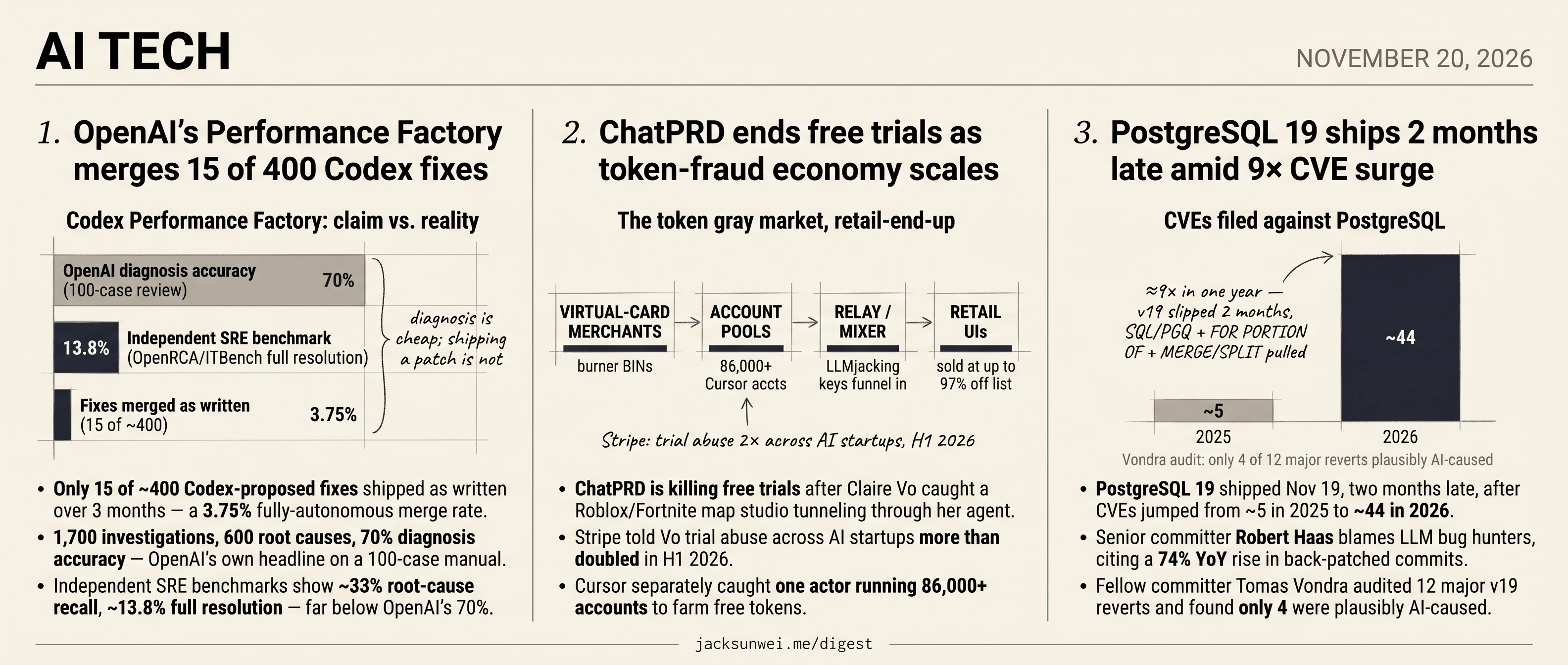
- OpenAI’s Codex merged only 15 of ~400 proposed fixes over 3 months at 3.75% autonomous.
- Independent SRE benchmarks peg Codex at 13.8% full resolution versus OpenAI’s 70% diagnosis headline.
- ChatPRD ends free trials after Stripe data shows AI-startup trial abuse more than doubled in H1 2026.
- Cursor caught one actor running 86,000+ accounts to farm free frontier-lab tokens.
- PostgreSQL 19 shipped 2 months late as CVEs jumped from ~5 in 2025 to ~44 in 2026.
OpenAI, ChatPRD, and PostgreSQL each shipped an AI-adjacent story today, and each landed with the same subtext: the launch pitch names a capability, the operational data names the cleanup work it creates. OpenAI’s own Performance Factory writeup headlines 70% diagnosis accuracy for Codex, but the merge rate underneath is 3.75% of proposed fixes, and independent SRE benchmarks put full resolution closer to 14%. ChatPRD’s end of free trials isn’t a pricing tweak — Claire Vo caught a game-asset studio tunneling her agent for free compute, and Stripe told her trial abuse across AI startups more than doubled in H1. PostgreSQL 19’s two-month slip pulls a committer dispute into the open: Robert Haas blames LLM bug hunters for a 74% rise in back-patches; Tomas Vondra audits 12 major reverts and can only pin 4 on AI. Three ecosystems, same shape — the real cost of AI deployment sits in the human triage queue, not the launch slide.
OpenAI’s Performance Factory merges 15 of 400 Codex fixes
Source: openai-blog · published 2026-11-19
TL;DR
- Only 15 of ~400 Codex-proposed fixes shipped as written over 3 months — a 3.75% fully-autonomous merge rate.
- 1,700 investigations, 600 root causes, 70% diagnosis accuracy — OpenAI’s own headline on a 100-case manual review.
- Independent SRE benchmarks show ~33% root-cause recall, ~13.8% full resolution — far below OpenAI’s 70%.
- Uber’s distinguished engineer says they had to “dial back” similar tools over compute cost and context limits.
The gap between diagnosis and shipping code
OpenAI’s new write-up pitches the Performance Factory — a Codex-agent pipeline that detects, investigates, and patches ChatGPT latency regressions — as end-to-end autonomy. The numbers it leads with are genuinely striking: 1,700 investigations, 600 confirmed root causes, ~17 automated investigations per day, and 70% of agent-proposed root causes graded accurate on a manual review of 100 cases.
The number OpenAI doesn’t foreground, which a third-party analysis pulled out of the post: of roughly 400 fixes the agents proposed, 15 were merged as written, and another 35 were “agent-influenced” 1. That’s a 3.75% fully-autonomous conversion rate, 12.5% with partial credit. Diagnosis is cheap; shipping a patch into a hot path without introducing a cache-staleness regression is not.
How the factory is wired
The architecture is the interesting part, independent of the merge rate. Four components — a Task Service defined in Markdown + TOML, a Dispatch Loop that assigns work, a Codex Cloud API with access to metrics and flame graphs, and event subscriptions that hibernate agents waiting on CI or human review — compose into a regression workflow with an adversarial twist.
flowchart LR
    A[Perf alert] --> B[perf-forensics agent]
    B --> C{Adversarial<br/>reviewer agent}
    C -->|disproved| X[Close task]
    C -->|confirmed| D[Code fix + PR]
    D --> E[Human review]
    E --> F[Merge + verify<br/>in production]
The adversarial-reviewer step — a second Codex instance whose job is to falsify the first agent’s diagnosis — is the load-bearing idea. Research on “vibe science” argues this falsification-first loop, especially when the reviewer is a different model, is the portable pattern for breaking self-approval failure modes in agent systems 2. Human-in-the-loop DevSecOps work backs this up empirically: gating agent actions behind human sign-off cut false-positive remediations by up to 67% 3.
Independent benchmarks tell a harsher story
OpenAI’s 70% is a graded accuracy figure on a hand-picked sample. On open SRE benchmarks like OpenRCA and ITBench, LLM agents solve roughly 33% of real root-cause cases and fully resolve only ~13.8% of scenarios without human help 4. That gap is closer to the 3.75% merge rate than to the 70% diagnosis headline — and it’s the number anyone trying to replicate this outside OpenAI should plan around.
Meta announced a parallel system the day before: the Ranking Engineer Agent, which claims it now drives 60% of technique propagation across ads ranking models, a 5× engineering throughput gain, and ~$45M in annual compute savings 5. REA uses a stateful hibernate-and-wake persistence model instead of OpenAI’s event-subscription handoffs, and it’s scoped to a single domain where “better” is measurable in ranker metrics. That narrower problem shape is a big part of why its numbers look stronger.
The cost question nobody is answering
Buried in VentureBeat’s exclusive: Uber distinguished engineer Uday Kiran Medisetty noted Uber had to “dial back” AI coding tools because of compute cost and context-window limits 6. Seventeen Codex investigations a day, each burning through profiles, heap dumps, and multi-turn adversarial review, is a budget line that only makes sense at OpenAI’s internal model-access rates. The architecture is real and worth copying. The unit economics are not yet portable.
ChatPRD ends free trials as token-fraud economy scales
Source: simon-willison · published 2026-11-20
TL;DR
- ChatPRD is killing free trials after Claire Vo caught a Roblox/Fortnite map studio tunneling through her agent for free compute.
- Stripe told Vo trial abuse across AI startups more than doubled in H1 2026.
- Cursor separately caught one actor running 86,000+ accounts to farm free tokens.
- A mature four-layer gray market resells frontier-lab tokens at up to 97% off list.
The six-pattern taxonomy behind the pelican SVGs
Simon Willison’s clip of Claire Vo’s talk highlights the funniest detail — attackers probing ChatPRD with “SVG of a pelican riding a bicycle” prompts to fingerprint the underlying model — but the full talk is more structured. On the How I AI podcast, Vo enumerated six distinct abuse patterns: trial farming, promo-code resale, relay wrapping, malicious MCP servers turning her agent into a 24/7 worker, card testing, and model probing 7. The pelican trick is just the last of those; the Roblox/Fortnite map studio running loops of free trials to build commercial game content is the first two combined.
Her defensive stack is equally specific: Vercel BotID at the edge, Stripe Radar on payments, Clerk for identity, Vercel AI Gateway for observability, and a “Jev loop” from TypeSafe AI — a cheap (~$0.042/M tokens) discriminative classifier that scores intent before the expensive model ever runs 8. Stripe told Vo that trial abuse across AI startups more than doubled in the first half of 2026 8. ChatPRD is a bellwether, not an outlier.
The industrialized gray market underneath
The reason a solo-founder PM tool gets hit this hard is that it sits at the retail end of a mature supply chain. Trending Topics describes a four-layer structure that resells frontier-lab API access at up to 97% off list 9:
flowchart LR
    A[Virtual-card<br/>merchants] --> B[Account pools<br/>e.g. 86K Cursor accts]
    B --> C[Relay / mixer<br/>infrastructure]
    C --> D[Retail UIs<br/>sold to end users]
    E[Stolen API keys<br/>LLMjacking] --> C
Cursor disclosed at Stripe Sessions that a single actor had spun up more than 86,000 accounts to harvest free tokens, and that power users on its old unlimited plan were burning $50–$60 of Claude per session — the trigger for its abrupt pricing migration 10. Further up the stack, Mandiant has documented “LLMjacking” losses of $100K in a single day for individual victims, with stolen keys funneled into “LLM mixers” that aggregate capacity from thousands of compromised accounts 11. The pelican-SVG probing suddenly makes commercial sense: resellers need to know which frontier model they’re actually reselling.
Killing free trials isn’t free
Vo’s conclusion — end free trials entirely — is defensible but not the only move on the board. Rework’s survey of AI-product pricing notes that requiring a credit card up front can slash conversion by more than 50%, and recommends “silent limits”: downgrade suspicious sessions to a cheaper model rather than hard-block them 12. That matches Vo’s own stealth-downgrade tactic inside her defensive stack 8, which suggests the real lesson is segmentation, not elimination.
There’s also a false-positive tax the Willison post skips. Cursor’s aggressive fingerprinting has locked out legitimate developers on VPNs and shared IPs 10. Every AI startup is now running a fraud team whether it wanted to or not — and the users paying for it are the ones who look slightly weird to a bot classifier.
The Roblox map studio is funny. The $1M LLMjacking losses before detection 11 are not.
PostgreSQL 19 ships 2 months late amid 9× CVE surge
Source: simon-willison · published 2026-11-19
TL;DR
- PostgreSQL 19 shipped Nov 19, two months late, after CVEs jumped from ~5 in 2025 to ~44 in 2026.
- Senior committer Robert Haas blames LLM bug hunters, citing a 74% YoY rise in back-patched commits.
- Fellow committer Tomas Vondra audited 12 major v19 reverts and found only 4 were plausibly AI-caused.
- Headline feature
WAIT FOR LSNgives standbys read-your-writes consistency without synchronous replication.
The delay has a number, and it’s 9×
PostgreSQL normally ships in September. Version 19 slipped to November 19, and Robert Haas’s now-widely-quoted post blames LLMs: back-patched commits to stable branches rose 74% year-over-year, with reviewers who “have not gotten any smarter between 2025 and 2026” absorbing the load 13. The downstream tally is worse than the headline suggests — CVE reports against PostgreSQL went from roughly 5 in 2025 to 44 in 2026, and three flagship features were pulled late in beta to make room for the triage work: SQL/PGQ (property graph queries), FOR PORTION OF temporal updates, and partition MERGE/SPLIT 14.
That ~9× CVE growth is the load-bearing number in the whole story. It also isn’t a Postgres-only phenomenon. curl’s Daniel Stenberg briefly closed curl’s paid bug bounty in early 2026 after being swamped with low-quality, non-reproducible AI-assisted submissions 15. On the signal side, Joshua Rogers’s AISLE group disclosed eight coordinated CVEs across Postgres, MySQL and MariaDB in a single July 2026 batch — including CVE-2026-6460, an authenticated-user RCE via type confusion, and CVE-2026-6473, an integer wraparound enabling out-of-bounds writes 16. The pattern across projects: a small number of high-signal AI-assisted researchers plus a long tail of slop, with maintainer burnout driven more by triage cost than by any single tool.
Dissent from inside the committer group
Haas’s framing is contested by his own colleagues. Tomas Vondra, another senior committer, audited 12 major reverts in the v19 cycle and concluded only 4 could plausibly be labelled “AI” or “probably AI” — the majority were driven by ordinary human code review or long-standing concurrency bugs that finally came due 17.
Of 12 major reverts audited in the v19 cycle, only 4 came out at ‘probably AI’ or ‘AI’.
That reframes the delay. It isn’t that AI is finding a new class of bug; it’s that senior committers are drained by CVE triage, and features that would otherwise have landed got crowded out. “AI’s fault” is a convenient shorthand for an industry-wide reviewer-capacity problem.
The feature Simon likes, and its sharp edge
Buried under the release politics is a genuinely useful addition. WAIT FOR LSN lets a session on a standby block until the replica has replayed the WAL to a specific log sequence number, giving applications read-your-writes consistency without paying for synchronous replication. The pattern — stash pg_current_wal_insert_lsn() in a signed cookie after a write, then WAIT FOR LSN '…' WITH (TIMEOUT '0.1s') on the next read — is what MediaWiki has done by hand against MySQL for years using WAIT_FOR_EXECUTED_GTID_SET().
One operational caveat the release notes bury: WAIT FOR LSN cannot run inside a function, procedure, or a transaction with isolation above READ COMMITTED, because a session already holding a snapshot can block WAL replay and deadlock against its own wait 18. Teams porting MediaWiki-style session-pinning should issue the wait as the first statement of the request, not inside an existing transaction — otherwise the timeout you added as a safety net becomes the thing that fires in production.
What’s actually at stake
If Haas is right, every major open-source database is about to spend more time on CVE triage than on features, indefinitely. If Vondra is right, 2026 was a one-off capacity shock and the backlog will drain. The v20 cycle will settle it — specifically, whether SQL/PGQ and FOR PORTION OF land on schedule or slip again.
Footnotes
-
AI Weekly analysis — https://aiweekly.co/alerts/openais-codex-performance-factory-ships-15-of-400-proposed-fixes
↩Of the 400 fixes proposed by Codex agents, only 15 were merged into production as written — a 3.75% conversion rate for fully autonomous repairs; including ‘agent-influenced’ fixes brings the total to 50 (12.5%).
-
ResearchGate: Vibe Science / Adversarial Agent Loops — https://www.researchgate.net/publication/415499495_Vibe_Science_How_Adversarial_Agent_Loops_Turn_Vibe_Researching_into_Verifiable_Science
↩Adversarial agent loops with ‘falsification-first’ mandates and fresh context are emerging as a portable pattern — using a different model to review (e.g., GPT-4o reviewing Claude Code) provides the independence of judgment needed to catch subtle bugs and spec drift.
-
ResearchGate: Human-in-the-Loop LLM Architectures for DevSecOps — https://www.researchgate.net/publication/400668618_Human-in-the-Loop_LLM_Architectures_for_Safe_and_Auditable_DevSecOps_Remediation
↩Strategic human oversight at critical junctures reduced false positive remediation actions by up to 67% versus fully automated systems; 47% of practitioners prefer hybrid models where humans are the final authority before irreversible action.
-
r/sre discussion of OpenRCA / ITBench — https://www.reddit.com/r/sre/comments/1tepa61/llms_solve_about_1_in_3_real_rootcause_cases_on_a/
↩LLM agents solve approximately 33% of real-world root cause cases on OpenRCA and only resolve about 13.8% of SRE scenarios fully autonomously — a reliability gap between demos and production.
-
Meta Engineering blog (Ranking Engineer Agent) — https://engineering.fb.com/2026/11/18/ml-applications/ai-agents-to-scale-ml-innovations-across-ads-ranking-models/
↩Meta’s REA now handles over 60% of technique propagation across ads ranking models, delivering a 5x engineering output increase and roughly $45M in annual compute savings — using a ‘hibernate-and-wake’ persistence model rather than OpenAI’s event-subscription handoffs.
-
VentureBeat (exclusive) — https://venturebeat.com/orchestration/exclusive-openai-reveals-performance-factory-a-codex-powered-software-optimization-system-that-keeps-chatgpt-fast
↩Uber distinguished engineer Uday Kiran Medisetty noted that Uber had to ‘dial back’ certain AI coding tools due to ballooning computational costs and context-window limitations.
-
How I AI podcast — ‘How I fight token fraud as a solo founder’ — https://podcasts.apple.com/us/podcast/how-i-fight-token-fraud-as-a-solo-founder/id1809663079?i=1000802264251
↩Vo categorized abuse into six patterns: trial farming, promo-code resale, relay wrapping, malicious MCP servers running the agent as a 24/7 worker, card testing, and model probing.
-
explainx.ai — ChatPRD case write-up — https://explainx.ai/blog/token-fraud-chatprd-claire-vo-free-trial-abuse-stripe-radar-ai-startups-2026
↩ ↩2 ↩3Stripe reported that trial abuse across AI startups more than doubled in the first half of 2026… ChatPRD’s defensive stack now includes Vercel BotID, Stripe Radar, Clerk, Vercel AI Gateway and a Jev loop from TypeSafe AI for real-time intent classification.
-
Trending Topics — AI startup pricing power — https://www.trendingtopics.eu/ai-startups-pricing-power-token-resellers/
↩A mature gray market resells API access from major labs at discounts reaching 97% off official rates through a four-layer structure: virtual-card merchants, account pools, relays, and retail interfaces.
-
Medium — ‘Cursor just broke the AI illusion’ — https://medium.com/@celestineriza/cursor-just-broke-the-ai-illusion-and-lost-its-users-overnight-099f9563f24d
↩ ↩2At a Stripe Session Cursor revealed a single user created over 86,000 accounts to harvest free tokens… the company could not afford the GPU bonfire from power users burning $50–$60 in Claude costs per session.
-
eSecurity Planet — LLMjacking report — https://www.esecurityplanet.com/threats/news-google-llmjacking-ai-cloud-attacks-million/
↩ ↩2Mandiant reported single-day fraudulent charges exceeding $100,000 for individual victims, with cumulative losses reaching $1 million before detection… stolen tokens are funneled into ‘LLM Mixers’ that aggregate capacity from thousands of compromised accounts.
-
Rework — AI product free trials — https://resources.rework.com/libraries/ai-startup-growth/ai-product-free-trials
↩Requiring a credit card for a free trial, though effective at stopping bots, can slash conversion rates by over 50%, potentially killing early-stage growth; many founders advocate silent limits over hard blocks.
-
Robert Haas blog, ‘Postgres 19 is late, and it’s AI’s fault’ (via dev.to summary) — https://dev.to/max_quimby/postgres-19-proves-it-ai-finds-bugs-faster-than-we-fix-them-3d6e
↩The short answer is that LLMs happened… those humans have not gotten any smarter between 2025 and 2026. Commits back-patched to stable branches rose 74% year-over-year.
-
explainx.ai analysis of the Haas post — https://explainx.ai/blog/postgres-19-delayed-llm-bug-reports-robert-haas-backpatch-commits-2026
↩Three cornerstone features were pulled late in the cycle: SQL Property Graph Queries (SQL/PGQ), FOR PORTION OF temporal updates, and MERGE/SPLIT PARTITION. CVE reports jumped from roughly 5 in 2025 to 44 in 2026.
-
Resilient Cyber, ‘Vulnpocalypse: AI, Open Source and…’ — https://www.resilientcyber.io/p/vulnpocalypse-ai-open-source-and
↩curl maintainer Daniel Stenberg briefly closed curl’s paid bug bounty program in early 2026 after being inundated with low-quality or non-reproducible AI-assisted submissions that consumed excessive development time.
-
AISLE Research Team / Joshua Rogers disclosures — https://www.tgeppert.com/
↩AISLE disclosed eight CVEs across PostgreSQL, MySQL and MariaDB in July 2026, including CVE-2026-6460 (authenticated-user RCE via type confusion) and CVE-2026-6473 (integer wraparound enabling OOB writes).
-
Tomas Vondra, ‘Are we reverting patches because of bugs found by AI?’ (Medium summary) — https://medium.com/@chinmayshringi4/postgres-19-is-late-because-ai-keeps-finding-old-bugs-0b534fef8824
↩Of 12 major reverts audited in the v19 cycle, only 4 came out at ‘probably AI’ or ‘AI’. The majority were driven by traditional human code review or long-standing concurrency issues.
-
thebuild.com, ‘PostgreSQL 19 Beta: the four features you’ll actually feel’ — https://thebuild.com/blog/postgresql-19-beta-the-four-features-youll-actually-feel/
↩WAIT FOR LSN cannot run inside a function, procedure, or a transaction with isolation higher than READ COMMITTED — issuing it mid-transaction risks a self-deadlock against WAL replay.