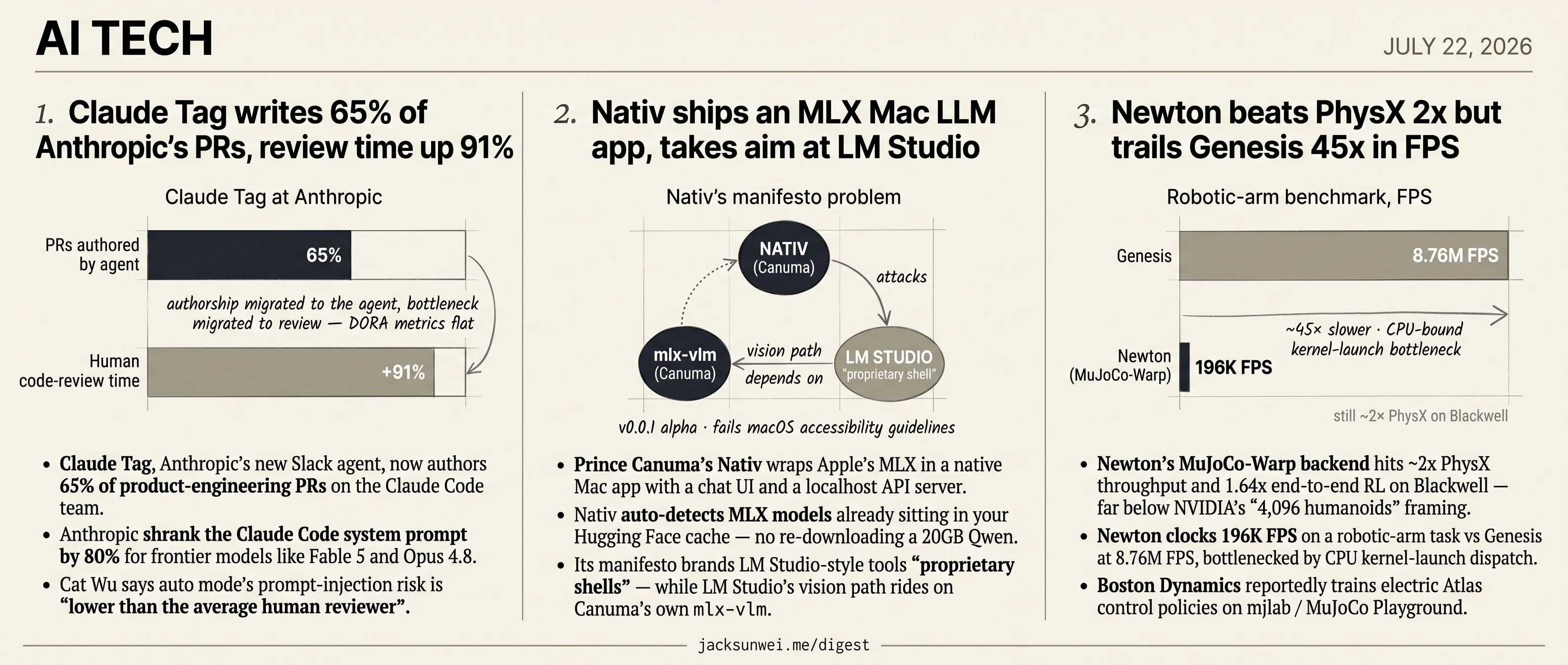
Claude Tag targets reviewers, Nativ takes on LM Studio, Newton chases Genesis
Anthropic's PR agent, Prince Canuma's Mac MLX app, and NVIDIA's Newton simulator each pick an incumbent and land mixed on the comparison.
Claude Tag targets reviewers, Nativ takes on LM Studio, Newton chases Genesis
TL;DR
- Claude Tag authors 65% of Anthropic product-engineering PRs, with human review time up 91%.
- Red teams contradict Anthropic’s auto-mode safety claim with working Slack-injection and RCE proofs.
- Nativ wraps Apple’s MLX in a native Mac app that auto-detects cached Hugging Face models.
- Nativ’s v0.0.1 alpha fails basic macOS accessibility guidelines per an independent teardown.
- Newton lands 196K FPS on a robotic-arm task, 45× behind Genesis on the same benchmark.
Today’s three AI-tech ships don’t share a domain, but each names an incumbent to unseat. Anthropic’s Claude Tag now writes most of the Claude Code team’s PRs, with Cat Wu arguing its prompt-injection risk is lower than the average human reviewer. Prince Canuma’s Nativ ships a native MLX Mac app whose manifesto brands LM Studio-style tools proprietary shells. NVIDIA’s Newton benchmarks itself against PhysX and Genesis on Blackwell.
The comparisons don’t land as cleanly as the pitches. Two red teams already have working exploits against Claude Tag’s auto mode, and DORA metrics haven’t moved while human review time is up 91%. Nativ’s v0.0.1 alpha fails macOS accessibility guidelines — and LM Studio’s vision path itself rides on Canuma’s mlx-vlm. Newton beats PhysX 2× but trails Genesis by 45× on a robotic-arm workload, bottlenecked on CPU kernel-launch dispatch.
Claude Tag writes 65% of Anthropic’s PRs, review time up 91%
Source: simon-willison · published 2026-07-21
TL;DR
- Claude Tag, Anthropic’s new Slack agent, now authors 65% of product-engineering PRs on the Claude Code team.
- Anthropic shrank the Claude Code system prompt by 80% for frontier models like Fable 5 and Opus 4.8.
- Cat Wu says auto mode’s prompt-injection risk is “lower than the average human reviewer”.
- Two independent red teams already contradict that claim with working Slack-injection and RCE proofs-of-concept.
- Outside data suggests the PR firehose hasn’t shipped faster: DORA metrics flat, human review time up 91%.
The internal playbook
Simon Willison’s fireside with Cat Wu and Thariq Shihipar is the clearest public statement yet of how Anthropic actually uses its own coding agents. Three numbers do the load-bearing work.
First, Claude Tag — a proactive, multiplayer Slack bot that monitors channels, opens PRs, and remembers team preferences in a per-channel markdown file — now lands 65% of the Claude Code team’s product-engineering PRs. Cat frames it as “the evolution of Claude Code”: Claude Code is where you interactively iterate on hard problems; Claude Tag is where routine bug reports turn into PRs without a human kicking anything off.
Second, the Claude Code system prompt is 80% smaller for frontier models. Thariq’s explanation is the interesting part: examples that helped Opus 4-era models now constrain Fable 5 and Opus 4.8, and blanket “do not do X” rules conflict badly with in-context user instructions. Cat’s rule of thumb — “your prompt should be 100% accurate, because you’re giving it to the model 100% of the time” — is a real shift from the give-it-examples orthodoxy. OpenAI’s GPT-5.6 guide reports the same effect: leaner prompts, 10–15% eval gains, 33–67% cost reduction.
Third, auto mode. A Sonnet classifier judges every tool call in context, handles dynamic permissions (“push this to GitHub” grants git-push for that turn), and gates the sandbox’s network escapes. Cat says thousands of evals plus commissioned red teams have “mitigated every single issue” they found, and that residual prompt-injection and exfiltration risk is now below a human reviewer’s.
Where the outside record pushes back
That last claim is the one to watch, because two independent findings already dent it. Tego AI showed Claude Tag fires on any literal @Claude string — including text posted by webhooks, RSS feeds, or other bots — which turns every writable Slack channel with the integration into a prompt-injection surface 1. Separately, an AI Now Institute PoC demonstrated remote code execution in Claude Code 2.1.116–2.1.199 via a poisoned third-party library review 2, exactly the “outer layer” workflow Thariq described as safe to delegate to the automated reviewer.
The 65% number deserves a second asterisk. Agora Intelligence’s analysis of Anthropic’s own operational data finds DORA metrics flat while human code-review time is up 91% 3. Authorship migrated to the agent; the bottleneck migrated to review. That reframes Cat’s line about “moving to a world where humans don’t need to be in the loop” from aspiration to necessity — without removing humans from review, the PR volume doesn’t translate into shipping velocity.
Thariq’s “rewrites are now good,” anchored on the Bun-in-Rust migration, has its own dissenter. Zig creator Andrew Kelley called the resulting codebase “unreviewed slop” and flagged roughly 13,000 unsafe blocks — about 4% of the code — arguing the port mostly launders manual memory management into Rust’s escape hatch rather than actually using the borrow checker 4.
What to watch
Two concrete things. Anthropic promised to publish the auto-mode evals “in the coming weeks” — those need to include the Tego and AI Now scenarios or the “lower than a human reviewer” claim stays marketing. And a leaked-prompt analysis suggests Fable 5 silently reroutes flagged queries to Opus 4.8 5, which would mean the 80%-smaller frontier prompt sometimes isn’t the one you’re actually running against. Worth pinning down before adopting the leaner-prompt gospel wholesale.
Nativ ships an MLX Mac LLM app, takes aim at LM Studio
Source: simon-willison · published 2026-07-21
TL;DR
- Prince Canuma’s Nativ wraps Apple’s MLX in a native Mac app with a chat UI and a localhost API server.
- Nativ auto-detects MLX models already sitting in your Hugging Face cache — no re-downloading a 20GB Qwen.
- Its manifesto brands LM Studio-style tools “proprietary shells” — while LM Studio’s vision path rides on Canuma’s own
mlx-vlm. - Canuma’s startup Neywa Labs took June 2026 seed funding from Atomico and Seedcamp.
- The v0.0.1 alpha fails basic macOS accessibility guidelines, per an independent teardown.
What Nativ actually ships
Nativ is a macOS desktop app that runs open-weight LLMs on Apple Silicon through the MLX framework. Shape-wise it’s LM Studio: a chat window plus a local API server you can point other tools at. The one detail that stands out on first launch is that it picks up MLX models already sitting in your Hugging Face cache — no re-downloading a 20GB Qwen just because you installed a new frontend.
The developer, Prince Canuma, is not a random hobbyist. His mlx-vlm library is load-bearing infrastructure for basically every vision-LLM workflow on Mac MLX, including the one shipping inside LM Studio itself.
The manifesto picks a fight
Canuma paired the release with a philosophy.txt attacking existing local-AI apps as closed-source UIs that wrap open-source engines like llama.cpp, then monetize through paywalls and telemetry while “profiting from community-driven research” 6. LM Studio is the obvious target (closed source); Ollama less so (MIT-licensed).
The framing landed badly on Hacker News for a separate reason: Nativ markets Qwen 3.6 and Gemma 4 as “frontier intelligence,” and commenters pushed back hard, arguing “frontier” should mean the largest proprietary systems and that these models are only class leaders at their weight 7. Combine the two moves — attack incumbents as unprincipled, then oversell your own model tier — and you get a rhetorical posture the alpha can’t yet back up.
Performance ceiling, maturity floor
Because Nativ is an MLX frontend, its ceiling is whatever MLX itself delivers. That’s genuinely high: independent testing put LM Studio’s MLX path ~46% faster than Ollama’s Metal backend at ~82% less power per token, and Ollama’s own 0.19 switch to MLX nearly doubled decode speed on an M5 Max, from 58 to 112 tok/s 8.
The floor is less flattering. Hannecke’s llama.cpp-vs-MLX comparison found MLX-VLM still lacks prompt caching and hits occasional crashes in long sessions, with llama.cpp “more mature for general-purpose inference” 9. Nativ inherits both sides of that trade.
Taylor Arndt’s teardown adds a separate concern: the alpha misses standard macOS accessibility guidelines, which Arndt flags as a “critical issue” to fix early 10. For an app whose pitch includes principled software craftsmanship, that’s an uncomfortable gap.
VC-backed, not a hobby project
The most useful reframe: Nativ is not a solo dev’s LM Studio clone. Canuma co-founded Neywa Labs, which raised seed funding from Atomico and Seedcamp in June 2026 around a thesis of on-device AI for connectivity-constrained regions, particularly Africa 11. Read in that light, the manifesto isn’t just posturing — it’s positioning for a company that needs to differentiate from LM Studio and Ollama in a market it plans to monetize.
Whether that ends in a better local-AI stack or another closed shell built on someone else’s inference engine is the actual open question. Right now Nativ is v0.0.1 with strong dependencies, real backing, and a rhetorical bill it hasn’t paid yet.
Newton beats PhysX 2x but trails Genesis 45x in FPS
Source: huggingface-blog · published 2026-07-21
TL;DR
- Newton’s MuJoCo-Warp backend hits ~2x PhysX throughput and 1.64x end-to-end RL on Blackwell — far below NVIDIA’s “4,096 humanoids” framing.
- Newton clocks 196K FPS on a robotic-arm task vs Genesis at 8.76M FPS, bottlenecked by CPU kernel-launch dispatch.
- Boston Dynamics reportedly trains electric Atlas control policies on mjlab / MuJoCo Playground.
- Differentiable simulators can produce gradients pointing away from the optimum in contact-heavy tasks like flipping or bouncing.
NVIDIA’s landscape survey of physical-AI simulation is directionally right — throughput is up, OpenUSD is spreading, Newton is real — but the vendor vantage smooths over three awkward facts the independent literature keeps surfacing.
The benchmarks NVIDIA didn’t cite
The strongest independent test of the Newton stack, a community physx-vs-newton benchmark on Blackwell hardware, found Newton’s MuJoCo-Warp backend delivered roughly 2x pure-stepping throughput over PhysX, a 1.64x end-to-end RL speedup, and VRAM drops exceeding 500% on some locomotion tasks 12. Genuine gains — and consistent with NVIDIA’s story. But the same story omits Genesis, which an Edstem teardown clocked at 8.76M FPS on a standard robotic-arm benchmark versus Newton’s 196K FPS, attributing Newton’s shortfall to a CPU-bound kernel-launch bottleneck where the GPU idles while the CPU fails to dispatch work fast enough 13.
Cross-engine FPS numbers deserve scrutiny in either direction — the 2025 Genesis controversy showed the field routinely benchmarks with self-collisions disabled — but a survey that names PyBullet and Drake as legacy baselines while leaving out its fastest current competitor is doing selection work.
| Engine | Role in NVIDIA’s survey | Independent finding |
|---|---|---|
| Isaac Sim (PhysX) | High-fidelity digital twins | Up to 20x per-env overhead vs MuJoCo 14 |
| MuJoCo Warp / Newton | New GPU-native default | 2x PhysX, but 45x slower than Genesis 1312 |
| MuJoCo (classic) | “Long-standing” research tool | Still gold standard for dexterous contact 14 |
| Genesis | Not mentioned | 8.76M FPS on arm benchmark 13 |
Fidelity is the quiet regression
The throughput arms race has a cost the survey underplays. vnrobo’s teardown notes Isaac Sim’s mandatory RTX rendering and OpenUSD scene format make it up to 20x slower per environment than MuJoCo, while MuJoCo’s soft-contact model remains the reference for dexterous manipulation 14. Aicadium goes harder, arguing modern simulators “see everything but feel nothing” — contact discontinuities are smoothed into ghosting, friction models ignore stiction, and tactile sensing is essentially unsimulated, so policies that walk cleanly in Isaac Lab still drop objects on real hardware 15.
OpenUSD-as-universal-scene-layer is similarly optimistic. URDF and MJCF remain the source of truth for the overwhelming majority of ROS 2 workflows; USD is a convergence bet, not a settled standard.
Differentiable physics has known failure modes
The survey’s closing bet on differentiable simulation is its weakest claim. Suh et al. at MIT CSAIL showed analytic gradients from DiffSim can be actively misleading: in tasks like Pinball or Bounce, gradients only exist at collision instants, and in flipping or swinging tasks the gradient sometimes points away from the global optimum 16. Zeroth-order RL, despite worse sample efficiency, frequently beats first-order DiffSim on these problems because stochastic exploration escapes the flat regions that break gradient descent.
What’s actually working
The independent signal that most validates NVIDIA’s narrative isn’t Isaac Lab — it’s mjlab on MuJoCo Playground. Boston Dynamics reportedly uses mjlab to train electric Atlas policies, and community demos converge Unitree G1 locomotion in roughly two minutes on a single RTX 5090 17. That’s the thread worth following: MuJoCo Warp on consumer GPUs, governed by the Linux Foundation, with the Omniverse dependency finally decoupled in Isaac Lab 3.0. The rest of the stack is still catching up to its own marketing.
Footnotes
-
Cybersecurity Insiders — Tego AI research — https://www.cybersecurity-insiders.com/tego-ai-finds-claude-tag-slack-integration-can-trigger-unauthorized-enterprise-actions/
↩Claude Tag can be activated by literal text containing ‘@Claude’ even if it isn’t a structural Slack mention, allowing external bots, webhooks, or automated feeds to potentially hijack the agent to exfiltrate data or delete resources.
-
Developer-Tech — AI Now Institute PoC — https://www.developer-tech.com/news/developers-face-rce-via-claude-code-auto-mode-exploit/
↩A proof-of-concept for a remote code execution (RCE) vulnerability in Claude Code (versions 2.1.116 to 2.1.199), where a third-party library review could be weaponized to compromise the host machine.
-
Agora Intelligence — RSI production analysis — https://agora-intelligence.com/en/blog/mira-anthropic-rsi-production-2026
↩While individual PR volume and authorship speed have skyrocketed, organizational DORA metrics such as deployment frequency and lead time have remained stagnant… code review times have increased by a staggering 91%.
-
YouTube analysis of Bun-in-Rust migration — https://www.youtube.com/watch?v=hOl8IhYZw_I
↩Zig creator Andrew Kelley labeled the AI-generated codebase ‘unreviewed slop’, highlighting over 13,000 unsafe Rust blocks — roughly 4% of the total codebase — suggesting the rewrite merely translated Zig’s manual memory management into an ‘unsafe’ Rust equivalent.
-
ExplainX — Fable 5 system prompt leak analysis — https://explainx.ai/blog/claude-fable-5-system-prompt-leak-analysis-2026
↩When Fable 5’s cybersecurity classifiers flag a prompt — even a benign one — it automatically reroutes the query to the less capable Opus 4.8… users paying for Fable’s premium rate receive Opus-tier results due to over-sensitive safety triggers.
-
Neura.market coverage of Nativ manifesto — https://www.neura.market/news/nativ-local-ai-mac-open-source
↩Many existing apps are essentially closed-source wrappers built on top of open-source inference engines (like llama.cpp) that the developers do not actually own… hide their inner workings behind paywalls or ‘vibe-coded’ landing pages while profiting from community-driven research.
-
Hacker News commenters (via hackyournews.com) — https://hackyournews.com/
↩Critics argued that the term ‘frontier’ should be strictly reserved for the absolute state-of-the-art models from major labs… models like Gemma 4 or Qwen 3.6 are leaders in their respective ‘weight classes,’ [but] do not yet match the raw reasoning power of the largest proprietary systems.
-
Towards AI benchmark (‘I Tested Ollama vs LM Studio on the Same Mac’) — https://pub.towardsai.net/i-tested-ollama-vs-lm-studio-on-the-same-mac-one-quietly-doubled-its-speed-ad8dcb6a89f7
↩LM Studio’s MLX implementation was approximately 46% faster than Ollama in token generation while drawing 82% less power per token… Ollama 0.19 replaced its Metal backend with MLX, decode speeds nearly doubling — from 58 to 112 tokens per second on an M5 Max.
-
Michael Hannecke, ‘llama.cpp vs MLX on Apple M-series’ (Medium) — https://medium.com/@michael.hannecke/llama-cpp-vs-mlx-on-apple-mx-775ee59df0ee
↩MLX-VLM faces stability issues, including occasional crashes and missing prompt caching features that can lead to inconsistent performance in long-form interactions… llama.cpp remains more mature for general-purpose inference tasks.
-
Taylor Arndt, ‘Taylor’s Teardowns: Nativ’ (Substack) — https://taylorarndt.substack.com/p/taylors-teardowns-nativ
↩While the technical foundation is strong, the UI requires refinement to meet standard macOS accessibility guidelines… a ‘critical issue’ that needs to be addressed early in development.
-
Kotrotsos, ‘The Local AI Stack for Apple Silicon’ (Medium) — https://kotrotsos.medium.com/the-local-ai-stack-for-apple-silicon-now-with-superpowers-c6038147eb1a
↩Canuma is co-founder of Neywa Labs, an AI startup that secured seed funding in June 2026 from Atomico and Seedcamp… supporting his vision of ‘on-device AI for global accessibility,’ specifically targeting regions like Africa where unreliable internet makes cloud-based AI impractical.
-
GitHub — yusufdxb/physx-newton-bench — https://github.com/yusufdxb/physx-newton-bench
↩ ↩2Newton backend leveraging MuJoCo-Warp can achieve nearly 2x the pure-stepping throughput of the traditional PhysX backend on consumer-grade Blackwell GPUs … End-to-end RL training saw a 1.64x speedup, while VRAM usage dropped by over 500% in some locomotion tasks.
-
Edstem — ‘A Deep Dive into NVIDIA Newton’ — https://www.edstem.com/blog/a-deep-dive-into-nvidia-newton
↩ ↩2 ↩3Genesis reportedly achieved 8.76M FPS compared to Newton’s 196K FPS in a standard robotic arm benchmark … a CPU-bound kernel-launch bottleneck where the GPU finishes tasks quickly but the CPU fails to dispatch new work at a matching pace.
-
vnrobo.com — ‘MuJoCo vs Isaac: A Deep Dive’ — https://vnrobo.com/en/blog/mujoco-vs-isaac-deep-dive
↩ ↩2 ↩3Isaac Sim suffers from high single-environment overhead—sometimes up to 20x slower than MuJoCo—and remains resource-heavy due to its mandatory RTX rendering and OpenUSD scene format … MuJoCo’s soft-contact model remains the ‘gold standard’ for dexterous manipulation.
-
Aicadium.ai — ‘The Real Bottleneck in Physical AI’ — https://aicadium.ai/the-real-bottleneck-in-physical-ai/
↩Robots trained in simulation ‘see’ everything but ‘feel’ nothing … simulators often use simplified coefficients that ignore real-world ‘stiction’ and unpredictable surface micro-textures, causing robots to drop objects that were easily grasped in simulation.
-
Suh et al., MIT CSAIL — ‘Do Differentiable Simulators Give Better Policy Gradients?’ — https://groups.csail.mit.edu/robotics-center/public_papers/Suh22b.pdf
↩In tasks like ‘Pinball’ or ‘Bounce’, gradients may only exist when a collision occurs … some simulators have been found to produce gradients in the opposite direction of the actual global optimum in highly dynamic tasks like flipping or swinging.
-
GitHub — google-deepmind/mujoco_playground — https://github.com/google-deepmind/mujoco_playground
↩mjlab demonstrated the ability to converge locomotion tasks for the Unitree G1 humanoid in approximately two minutes on an NVIDIA RTX 5090 … Boston Dynamics confirmed that it utilizes mjlab to train the control policies for its new electric Atlas humanoid.