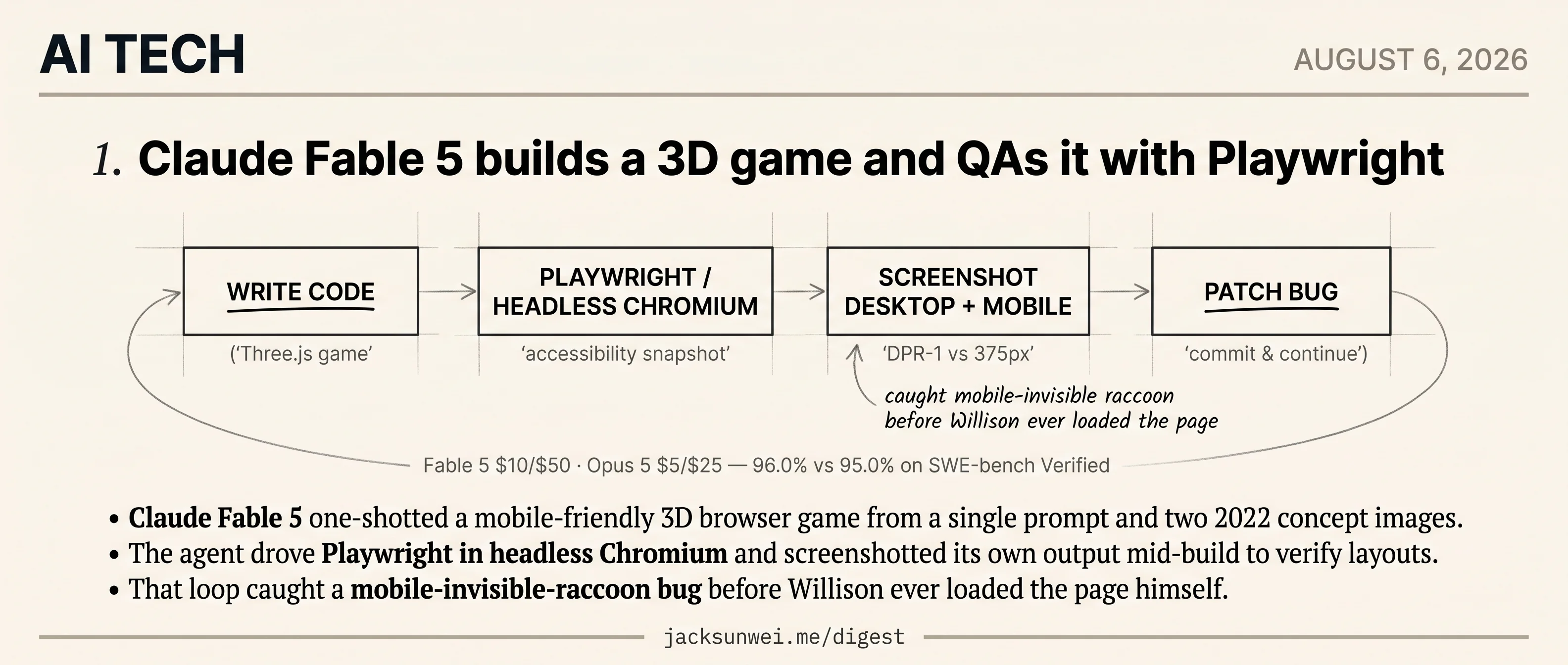
Claude Fable 5's Playwright loop catches bugs before the developer sees them
Claude Fable 5 built a 3D game from one prompt and used Playwright screenshots to catch a mobile bug before the developer opened the page.
Claude Fable 5’s Playwright loop catches bugs before the developer sees them
TL;DR
- Claude Fable 5 one-shotted a mobile-friendly 3D browser game from a single prompt.
- The agent ran Playwright in headless Chromium and screenshotted its own output mid-build.
- That loop caught a mobile-invisible-raccoon bug before Willison loaded the page.
- Opus 5 ($5/$25) nearly matches Fable 5 ($10/$50) on SWE-bench Verified.
Only one tech feature today, but it’s a worked example of where agent scaffolding is actually moving. Claude Fable 5 didn’t just generate a 3D browser game from a prompt and two old concept images — it drove Playwright in headless Chromium, screenshotted its own rendered output, and used those screenshots to notice a raccoon was invisible on mobile before the developer ever loaded the page. The verification loop is the story; the game is the demo.
The pricing footnote matters too. Anthropic’s cheaper Opus 5 ($5/$25 per million tokens) lands within striking distance of Fable 5 ($10/$50) on SWE-bench Verified — which means the interesting question isn’t which model wins the benchmark but which one you’d wire into a self-checking agent when the loop runs a dozen times per task.
Claude Fable 5 builds a 3D game and QAs it with Playwright
Source: simon-willison · published 2026-08-05
TL;DR
- Claude Fable 5 one-shotted a mobile-friendly 3D browser game from a single prompt and two 2022 concept images.
- The agent drove Playwright in headless Chromium and screenshotted its own output mid-build to verify layouts.
- That loop caught a mobile-invisible-raccoon bug before Willison ever loaded the page himself.
- Anthropic’s cheaper Opus 5 ($5/$25) nearly matches Fable 5 ($10/$50) on SWE-bench Verified.
The demo, minus the marketing
Simon Willison handed Claude Fable 5 (via Claude Code for web) two four-year-old images — a GPT-3 game description and a DALL-E concept sketch — plus a single prompt telling it to build a 3D browser game, work independently, and commit often. Seven commits later the branch held a working Three.js game with procedural low-poly characters, gpt-image-2-generated textures, a jazz WebAudio soundtrack, a touch joystick, and a three-night difficulty ramp culminating in a scent-tracking hound that ignores line-of-sight.
The finished artifact is, by Willison’s own assessment, mediocre. The “team” of raccoons is decoration. Levels have fixed durations, so you finish collecting and then wait for dawn. That verdict lines up with the wider vibe-coded-games consensus: LLMs scaffold quickly but hit a “complexity wall,” producing what one practitioner survey calls a “patchwork quilt” of logic that needs a human to enforce architectural milestones 1.
The actual news is the QA loop
The interesting thing isn’t the game. It’s that Claude wrote its own smoke tests. Mid-build, the agent spun up Playwright, loaded the page in headless Chromium at both desktop and mobile widths, took screenshots, noticed the raccoon was invisible on mobile, and fixed it. Later it teleported the player next to the newly-added dog and asserted the wander → track → caught state machine before declaring the feature done. It also caught two real bugs a human would likely have shipped: a cssText assignment that wiped Three.js’s canvas sizing (masked entirely on desktop DPR-1) and a .stars CSS rule from the title screen that silently swallowed taps on the “next night” button.
This is a clean instance of what browser-automation folks have started calling the “Planner → Generator → Healer” loop — agents consuming accessibility-tree snapshots rather than raw HTML, then auto-patching broken locators 2. Willison’s greenfield project shows the loop closing end-to-end without human babysitting, which is the capability worth pulling out of the demo.
Fable 5 is expensive for what it does
Vellum pegs Fable 5 at 80.3% on SWE-bench Pro priced at $10/$50 per million tokens — roughly double the previous frontier 3. But DataCamp notes an awkward wrinkle: Anthropic’s cheaper Opus 5 ($5/$25) hits 96.0% on SWE-bench Verified vs Fable’s 95.0% 4. Raccoon Heist reads less like a Fable-specific milestone and more like a showcase for the agent harness around it — the same harness Opus 5 gets to use for half the money.
Two caveats worth amplifying
Willison praises gpt-image-2 for texture generation, but the model has documented hallucination failures in adjacent tests, including inventing objects that weren’t in the source image 5. His own “the metal texture looks great but wasn’t applied right” aside hints at the same asset-integration gap.
Second, the auto-committing, auto-deploying GitHub Pages workflow that makes weekend projects fun is the exact surface area a mid-2026 vulnerability in the official Claude Code GitHub Action targeted — attackers could hijack repos via specially crafted issues 6. Fine for a raccoon game. A real liability the day this pattern moves inside a company.
Designing games that are fun remains a uniquely human trait.
Willison’s closing line is honest. The rest of the stack — planning, coding, texture prompting, browser-driven QA, deployment — is now something one prompt and one API key can chain together on a phone.
Footnotes
-
Creator Economy — opinionated guide to AI coding tools — https://creatoreconomy.so/p/opinionated-guide-on-the-best-ai-coding-prototyping-tools-in-2025
↩LLMs lack an inherent understanding of game architecture, often leading to a ‘stuck state’… ‘vibe coding’ often favors momentum over structure, resulting in a ‘patchwork quilt’ of logic.
-
ByteTunnels — Playwright for AI agents — https://bytetunnels.com/posts/playwright-for-browser-automation-in-ai-agents/
↩Agents provide the LLM with a structured ‘snapshot’ of the page—often using the accessibility tree rather than raw HTML to remain token-efficient… a ‘Planner → Generator → Healer’ loop… automatically patching broken locators.
-
Vellum AI — Fable 5 benchmarks explainer — https://www.vellum.ai/blog/claude-fable-5-and-mythos-5-benchmarks-explained
↩Claude Fable 5 achieved a top-tier pass rate of 80.3% on SWE-bench Pro… priced at $10 per million input tokens and $50 per million output tokens.
-
DataCamp — Claude Opus 5 vs Fable 5 — https://www.datacamp.com/blog/claude-opus-5-vs-claude-fable-5
↩The cheaper Opus 5 ($5/$25 pricing) actually surpasses [Fable 5] on certain benchmarks, including a 96.0% score on SWE-bench Verified compared to Fable’s 95.0%.
-
DayaAI — Raccoon Heist community roundup — https://dayaai.com/news/story/1032
↩When asked to draw a red circle around a ‘raccoon with a ham radio’ that was not present in the original image, [gpt-image-2] hallucinated both the raccoon and the circle in the new output.
-
UpGuard — Claude Code GitHub Action vulnerability — https://www.upguard.com/blog/ai-github-agents-issue-leaked-private-repos
↩A critical vulnerability was disclosed in the official Claude Code GitHub Action that allowed attackers to hijack repositories by submitting specially crafted GitHub issues.