Cerebras hits 1,851 tok/s on Gemma 4, but the voice-agent bill is TTS not LLM
Cerebras posts a 35× throughput number on Gemma 4, but the voice-agent economics, comparability, and privacy live off the LLM step.
Cerebras hits 1,851 tok/s on Gemma 4, but the voice-agent bill is TTS not LLM
TL;DR
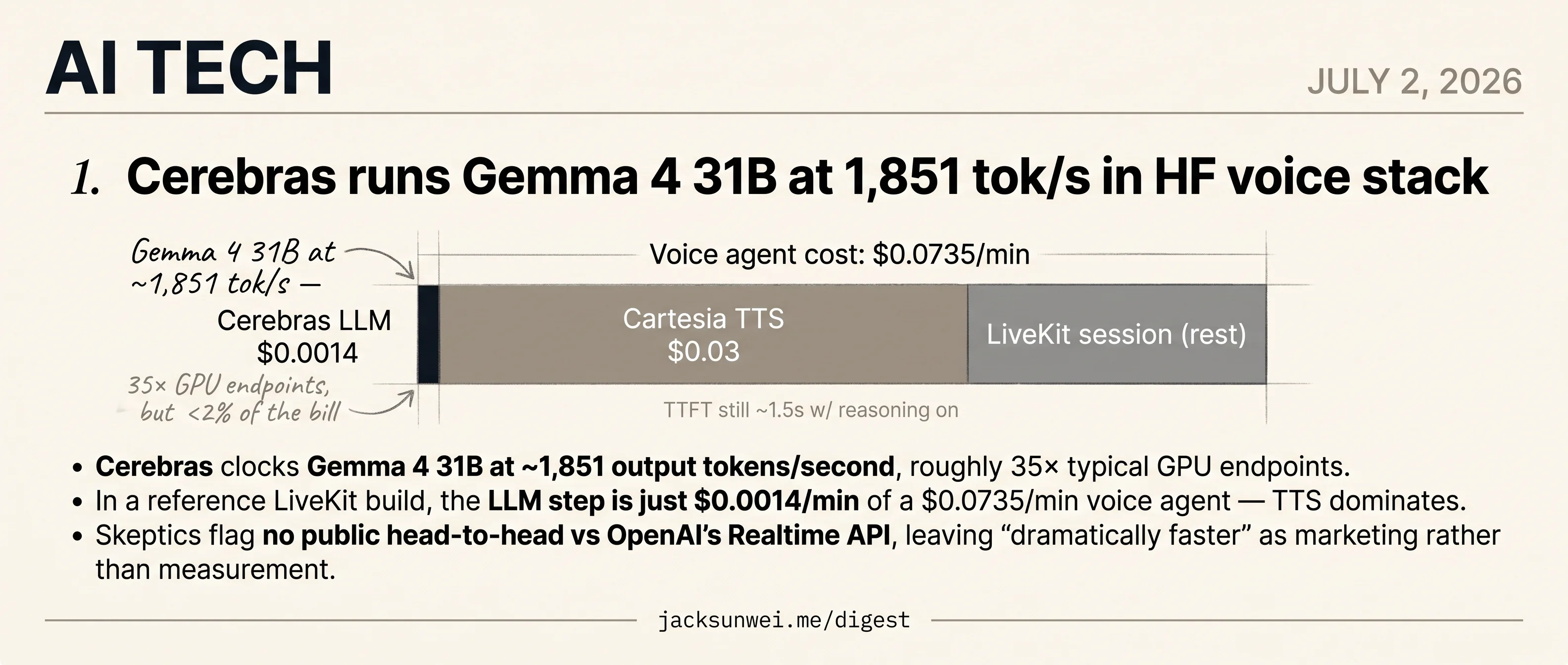
- Cerebras clocks Gemma 4 31B at ~1,851 tok/s, roughly 35× typical GPU endpoints.
- LLM step costs $0.0014/min of a $0.0735/min LiveKit voice agent, with TTS dominating.
- Reviewers flag no public head-to-head vs OpenAI Realtime, leaving the speed claim unmeasured.
- Stack ships on 9,000+ Reachy Mini robots already deployed in the wild.
- Hands-on tests surface a privacy asterisk as children volunteer PII to third-party clouds.
Today’s AI-tech slot is a single feature, and it’s a useful one to read carefully. Cerebras is pitching a 35× throughput edge on Gemma 4 31B inside a Hugging Face voice-agent reference stack — a number that reads as decisive until you look at where the minutes and dollars actually go. In the LiveKit build the writeup benchmarks, the LLM step is roughly 2% of per-minute cost; TTS is the line item that moves the bill. The comparison the pitch avoids — a head-to-head against OpenAI’s Realtime API — is the one integrators would actually price against.
Underneath the speed chart sit two quieter facts: the stack is already live on 9,000+ Reachy Mini robots, and hands-on reviewers found children handing personal information to third-party clouds through the voice path. Both matter more than the tok/s figure for anyone deciding whether to ship this into a product.
Cerebras runs Gemma 4 31B at 1,851 tok/s in HF voice stack
Source: huggingface-blog · published 2026-07-01
TL;DR
- Cerebras clocks Gemma 4 31B at ~1,851 output tokens/second, roughly 35× typical GPU endpoints.
- In a reference LiveKit build, the LLM step is just $0.0014/min of a $0.0735/min voice agent — TTS dominates.
- Skeptics flag no public head-to-head vs OpenAI’s Realtime API, leaving “dramatically faster” as marketing rather than measurement.
- The stack already ships on 9,000+ Reachy Mini robots in the wild.
- Hands-on reviews raise a privacy asterisk: children volunteer PII that flows to third-party clouds.
The speed number is real
Hugging Face and Cerebras are pitching an all-open, cascaded voice loop — Nvidia Parakeet for ASR, Google’s Gemma 4 31B on Cerebras for the LLM, Alibaba’s Qwen3TTS for synthesis — and the load-bearing claim is that Cerebras finally makes the middle step fast enough to disappear. Independent measurement backs the headline: Artificial Analysis clocks Gemma 4 31B at ~1,851 output tokens/second on Cerebras, about 35× typical GPU providers 1. That’s the number that makes conversational turn-taking feel human rather than transactional.
The caveat the post glosses: time-to-first-token still sits around 1.5 seconds when Gemma’s reasoning mode is on 1. For simple replies you get near-instant streaming; for tool calls or multi-step reasoning, the “no awkward pause” story frays.
flowchart LR
    A[User audio] --> B[Parakeet ASR<br/>Nvidia]
    B --> C[Gemma 4 31B<br/>on Cerebras<br/>~1,851 tok/s]
    C --> D[Qwen3TTS<br/>Alibaba]
    D --> E[Spoken reply]
    E -. barge-in signal .-> D
    A -. VAD .-> D
The cost lives in TTS, not the LLM
Hugging Face’s post is silent on economics, which is where the story gets more interesting. A LiveKit reference build of a comparable Gemma-4-31B voice agent lands at ~$0.0735/minute — and the Cerebras LLM call is just $0.0014 of that. Cartesia TTS at $0.03/min plus the LiveKit session fee eat the rest 2.
That inverts the usual mental model. Making the LLM 35× faster barely moves the per-minute bill. The economically consequential swap in this stack isn’t Cerebras — it’s Qwen3TTS being open, which is what actually gives developers a lever on the dominant cost line.
Cascaded vs end-to-end, still contested
Community reaction has focused less on the speed and more on architecture. Cascaded pipelines require bespoke signaling logic to shut down TTS the moment a user starts talking; end-to-end models like OpenAI’s Realtime API handle barge-in natively. Reviewers also note the absence of any public head-to-head benchmark against those E2E stacks, which leaves “dramatically faster” as marketing rather than measurement 3.
The counter, which Hugging Face leans on implicitly, is observability: a text transcript sitting between STT and LLM is exactly where regulated deployments want PII redaction and guardrails. That’s a real reason cascades keep winning in enterprise, even when they’re harder to tune.
Reachy Mini: 9,000 units and a privacy asterisk
The deployment numbers are not hypothetical. This pipeline powers 9,000-plus Reachy Mini robots, and Hugging Face shipped an agentic toolkit in May that lets non-coders describe robot behaviors in English and get shipped code in under an hour 4. That’s the low-latency loop paying rent.
Jeff Geerling’s hands-on complicates the demo reel: keynote-grade behaviors are harder to reproduce than advertised, and — more pointed — children readily anthropomorphize the robot and volunteer sensitive personal information, which then flows to third-party clouds 5. For a voice device that lives on a desk full-time, that’s a design question the launch post doesn’t touch.
One more quality caveat worth pricing in: Gemma 4 31B benchmarks well on reasoning, but LocalLLaMA testers report factual recall lagging larger models, with context degrading past 10–20k tokens on precise tasks like code recall 6 — relevant for any voice agent expected to hold a long multi-turn thread.
Footnotes
-
AlphaSignal — https://alphasignal.ai/news/cerebras-runs-google-s-gemma-4-31b-at-1-800-tokens-per-second
↩ ↩2Cerebras currently delivers the fastest inference for Gemma 4 31B, reaching a record 1,851 output tokens per second… approximately 35x faster than traditional GPU-based providers… time-to-first-token (TTFT) of roughly 1.5 seconds, even when the model’s native reasoning mode is enabled.
-
LiveKit pricing / voice agent cost breakdown — https://livekit.com/pricing
↩Total estimated cost to run a voice agent using Gemma 4 31B is approximately $0.0735 per minute… the Cerebras LLM portion is remarkably cheap (~$0.0014/min), while the bulk of the cost is driven by high-quality TTS (e.g., Cartesia at $0.03/min) and the LiveKit session fee.
-
AI Weekly — HN/community reaction roundup — https://aiweekly.co/alerts/hugging-face-and-cerebras-wire-gemma-4-into-a-voice-pipeline
↩Cascaded pipelines require complex signaling logic to shut down the TTS immediately when new audio is detected… skeptics point out the lack of published head-to-head benchmarks against other production stacks, leaving ‘dramatically faster’ as a largely unverified marketing claim.
-
The Robot Report — https://www.therobotreport.com/hugging-face-launches-agentic-toolkit-for-reachy-mini/
↩Hugging Face launched an ‘agentic toolkit’ in May 2026, allowing users to describe desired behaviors in plain English while an AI agent generates and ships the necessary code to the robot in under an hour.
-
Jeff Geerling blog — Reachy Mini review — https://www.jeffgeerling.com/blog/2026/testing-reachy-mini-hugging-face-robot/
↩While the hardware is impressive, replicating the ‘utterly trivial’ demos shown at major keynotes like CES is often more difficult than marketed… children quickly anthropomorphize the robot, leading them to share sensitive personal information with the AI, which is often processed by third-party cloud services like OpenAI.
-
r/singularity — Gemma 4 benchmarks discussion — https://www.reddit.com/r/singularity/comments/1salsf5/gemma_4_benchmarks/
↩While the model excels in general intelligence and reasoning, some users on platforms like Reddit argue it may not retain the same depth of factual knowledge as much larger models… local testers observed performance degradation after 10k–20k tokens, particularly in precise code recall tasks.