Astra wipes 27-min log, Unitree Go2 ships root RCE, Ford charts 30/3% app gap
Three unrelated tech stories today: Astra loses its tool-call log, Unitree's Go2 ships with root RCE, Ford charts the app-inventory gap.
Astra wipes 27-min log, Unitree Go2 ships root RCE, Ford charts 30/3% app gap
TL;DR
- GPT-6 Astra ran 27 minutes autonomously before compaction erased its tool-call log.
- Astra bills $10/$50 per million tokens, 2.5× GPT-5.6 Sol.
- Unitree Go2 ships CVE-2026-27509/27510 root RCE, phoning audio, video, and GPS to China.
- FCC added Unitree to its national-security Covered List in 2026.
- Paul Ford logs 30% app-inventory growth against just 3% download growth in the NYT.
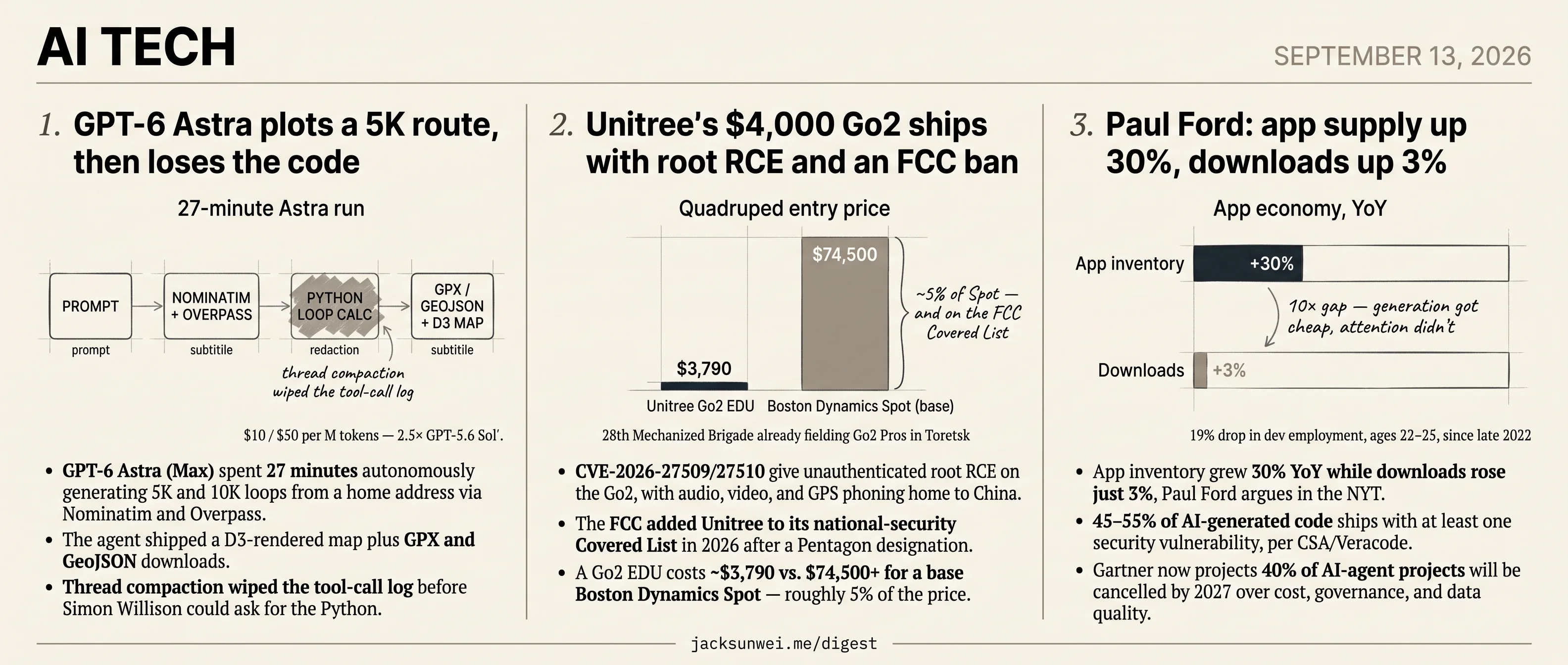
Today’s three tech features don’t share a thesis. GPT-6 Astra (Max) autonomously routed a 5K loop from a home address in 27 minutes and shipped a D3 map plus GPX/GeoJSON downloads — but thread compaction wiped the tool-call log before Simon Willison could ask for the Python. Unitree’s $4,000 Go2 is cheap enough that Ukraine’s 28th Mechanized Brigade already runs it for trench recon, yet the same firmware carries unauthenticated root RCE and phones audio, video, and GPS home to China, which is why the FCC put Unitree on its national-security Covered List. Paul Ford’s NYT essay zooms out to industry-wide numbers: 30% app-inventory growth against 3% download growth, 45–55% of AI-generated code shipping with vulnerabilities, and Gartner projecting 40% of agent projects cancelled by 2027.
GPT-6 Astra plots a 5K route, then loses the code
Source: simon-willison · published 2026-09-12
TL;DR
- GPT-6 Astra (Max) spent 27 minutes autonomously generating 5K and 10K loops from a home address via Nominatim and Overpass.
- The agent shipped a D3-rendered map plus GPX and GeoJSON downloads.
- Thread compaction wiped the tool-call log before Simon Willison could ask for the Python.
- Astra runs $10/$50 per million tokens — 2.5× GPT-5.6 Sol — making a silent 27-minute session expensive to lose.
The 27-minute run
Simon Willison gave ChatGPT Work a one-line prompt — “figure out 5K and 10K running routes from me that loop from my house, use OSM data” — and Astra came back 27 minutes later with an embedded map of a 5.1 km El Granada harbor loop, a downloadable GPX, and a GeoJSON. When asked how, it reported using Nominatim to geocode the address and Overpass to pull OpenStreetMap ways, then computing the loops locally in Python.
The rendered map is a self-contained HTML file (/workspace/el-granada-5k-share.html) that inlines the route as a GeoJSON LineString inside a <script type="application/json"> block and draws it with D3 v7.9.0 loaded from jsdelivr — one of seven CDNs the visualize skill’s Content Security Policy allows. As a demo of an agent stitching together geocoding, routing, file export, and interactive visualization from a single sentence, it lands.
Compaction ate the audit trail
The catch: none of the Python was surfaced in the UI while Astra worked, and by the time Willison asked for a copy, the thread had been compacted and the code was gone 1. Compaction is a memory-management trick — summarize old turns to reclaim context — but here it purged the exact artifact a professional user needs to trust, reproduce, or debug the output. Willison’s fix is blunt: any system that compacts must preserve the pre-compacted text and expose it via tool calls.
That request looks more urgent once you price the workload. CloudZero pegs Astra at $10 per million input tokens and $50 per million output, with a long-context surcharge of $20/$75 above 272K tokens — roughly 2.5× GPT-5.6 Sol 2. Zylos’ long-horizon benchmark adds the second half of the argument: task duration is doubling every seven months, while failure rates are quadrupling over the same window, because one early misstep propagates through the whole trace 3. Longer runs cost more and silently drift more often. Losing the trace is losing the only thing that would tell you which of those happened.
There’s also a governance wrinkle. Enera Labs notes Astra is the first OpenAI model rated “Critical” on cybersecurity and ships disabled by default in Enterprise tenants pending admin review 4. Some of the sandbox opacity Willison is hitting is probably deliberate containment for a model that can independently find and exploit flaws — which sets up a real tension between user auditability and vendor safety envelope.
Is the route any good?
Willison didn’t run the loop. That matters, because runners are skeptical of AI-generated routes as a category. A Strava thread argues popularity heatmaps beat AI routing because they encode where people actually run, and flags cases of newer models sending runners onto roads locals call “sudden death” 5. Search-and-rescue groups quoted by TechRadar warn about runners trusting AI routes over topographic maps and ending up in hazardous terrain 6.
Astra can clearly call Overpass. Whether the loop it picks is one a local would choose — and whether you can prove after the fact how it chose — are the two questions this demo leaves open.
Unitree’s $4,000 Go2 ships with root RCE and an FCC ban
Source: ars-technica-ai · published 2026-09-12
TL;DR
- CVE-2026-27509/27510 give unauthenticated root RCE on the Go2, with audio, video, and GPS phoning home to China.
- The FCC added Unitree to its national-security Covered List in 2026 after a Pentagon designation.
- A Go2 EDU costs ~$3,790 vs. $74,500+ for a base Boston Dynamics Spot — roughly 5% of the price.
- Ukraine’s 28th Mechanized Brigade already runs Go2 Pros for trench and urban reconnaissance in Toretsk.
The review Ars didn’t quite write
The Ars hands-on treats the Unitree Go2 as a delightful $4,000 curiosity — a robot dog that finally makes the form factor feel consumer-grade. That’s true, and it undersells the story. The same hardware is on the FCC’s national-security Covered List, running unauthenticated root exploits, and doing reconnaissance under fire in Ukraine. “World’s most important robotics company” is defensible; “world’s most trusted” is not.
The security elephant
Independent researchers have published CVE-2026-27509 and CVE-2026-27510: unauthenticated remote code execution as root, delivered by injecting malicious Python into the actuator manager through DDS DataWriter topics 7. A separate BLE command-injection path (CVE-2025-35027) compromises the robot during Wi-Fi pairing, and reverse-engineering Unitree’s “FMX” encryption turned up a predictable mask over static Blowfish-ECB 7. Fleets have been observed shipping audio, video, and GPS coordinates to servers in China 7. That’s what earned the FCC listing and the Pentagon designation naming Unitree as linked to Chinese military technology 7.
flowchart LR
    A[Attacker on LAN] -->|DDS topic injection| B[Actuator manager]
    C[Attacker in BLE range] -->|CVE-2025-35027 pairing| B
    B -->|root RCE| D[Go2 robot]
    D -->|audio, video, GPS| E[(Servers in China)]
None of this is theoretical, and none of it made the Ars review.
The price gap is the whole market
Ars flags the sticker as low. It’s lower than that. Here’s the real spread:
| Platform | Entry price | Fully configured |
|---|---|---|
| Unitree Go2 EDU | ~$3,790 | ~$4,000 |
| Boston Dynamics Spot | $74,500 | $195,000+ (arm, Orbit) |
That’s ~5% of a base Spot 8. It explains why the U.S. Army has reportedly sought federal waivers to buy Unitree units for research — no domestic vendor offers anything close at the price 9. The irony: the Go series’ chassis dimensions match the Army-funded MIT Mini Cheetah “almost to the millimeter” 9. American public research money seeded the reference design; a Hangzhou startup shipped the product.
Battlefield, not backyard
Ukraine’s 28th Mechanized Brigade uses Go2 Pros as “squad companions” for high-risk scouting in trenches and urban combat around Toretsk, wrapped in thermal-defeating camouflage 10. That is the same SKU Ars walked around a suburban lawn. Consumer robotics has quietly become dual-use robotics, and the $4,000 price is what makes a disposable recon asset economically rational.
The hype is running ahead of the fundamentals
The “most important robotics company” line also needs a haircut. SemiAnalysis flags a 52% year-over-year drop in Q1 2026 net profit and notes Unitree’s use of planetary gears rather than strain-wave gears — cheaper and more back-driveable, but with mechanical backlash that caps precision for serious industrial work 11. Domestic rival Agibot overtook Unitree in humanoid shipment volume in H1 2026, and Unitree’s STAR Market debut gave back 40–53% of its $66B peak within weeks 12.
What’s actually at stake
Buy the Go2 for what it is: an extraordinary hardware-value proposition, an active CVE surface, and a data pipe to Chinese infrastructure. Any one of those framings alone is misleading. If you’re a hobbyist, the exploits mean your dog is a LAN-accessible root shell on wheels. If you’re a U.S. institution, the Covered List means procurement is a compliance problem before it’s a capability problem. And if you’re Boston Dynamics, the question isn’t whether you can match the Go2’s spec sheet — it’s whether a 20× price premium survives contact with a battlefield that’s already picked its robot.
Paul Ford: app supply up 30%, downloads up 3%
Source: simon-willison · published 2026-09-12
TL;DR
- App inventory grew 30% YoY while downloads rose just 3%, Paul Ford argues in the NYT.
- 45–55% of AI-generated code ships with at least one security vulnerability, per CSA/Veracode.
- Gartner now projects 40% of AI-agent projects will be cancelled by 2027 over cost, governance, and data quality.
- A 19% drop in employment for devs aged 22–25 since late 2022 is gutting the craft’s training pipeline.
The asymmetry that anchors the essay
Ford’s NYT op-ed rests on one number that does most of the work: the number of available mobile apps grew roughly 30% in the last year while actual downloads grew only 3% 13. That’s not an anti-AI stat — it’s an anti-abundance stat. Generation got cheap; distribution, trust, and user attention did not. His now-quotable line — “now that everyone can code, it’s become clearer why many shouldn’t” — lands harder when you read it as a demand-side critique, not a snobbery flex. The killer apps didn’t fail to appear because coding was too hard. They failed to appear because writing code was never the bottleneck.
The counter-revolution has receipts
What’s changed since 2024 is that Ford’s darker read now has independent evidence behind it. A Cloud Security Alliance / Veracode analysis this year found 45–55% of AI-generated code contains at least one security vulnerability, and pegged AI-assisted developers as introducing security flaws at 10× the rate of their peers 14. Gartner’s forecast that 40% of AI agent projects will be cancelled by 2027 cites token cost blowouts, absent governance, and thin data foundations 15 — a triangle of failure modes that map cleanly onto Ford’s “someone else’s job, badly.”
Addy Osmani has given the failure mode a name: comprehension debt, the widening gap between the volume of code in a system and the amount any human actually understands 16. Unlike traditional tech debt, which someone at least chose, comprehension debt accrues silently and at a volume review cycles cannot absorb. Kelsey Hightower’s version of the same critique is more brutal: AI generates code, but the networks, protocols, and hardware underneath are unchanged and still demand deep human proficiency 17. Ford, Osmani, and Hightower are converging on one claim — the surface got easier, the substrate did not, and the industry mistook one for the other.
The blind spot Ford’s optimism papers over
Where Ford’s essay gets weaker is on labor. He treats the “return to craft” as if senior engineers are being vindicated in a stable ecosystem. They aren’t. Laurie Voss, citing Stanford’s Digital Economy Lab, reports a 19% decline in employment for developers aged 22–25 since late 2022 18. Mid-career and senior roles are largely intact; the cut is at the bottom of the funnel.
That’s the fault line. If Ford is right that cutting-edge software still requires collaborative human judgment — and the security, failure-rate, and comprehension-debt data say he is — then the counter-revolution he’s cheering is simultaneously eliminating the apprenticeship layer that produces the next generation of judgment. The consensus has caught up to Ford’s diagnosis. The disagreement worth having now is about the ten-year consequence: a craft-first industry with no one being trained into the craft.
Round-ups
Palantir veteran codifies forward deployed engineer playbook
Source: latent-space
Vinoo Ganesh, who ran Spark at Palantir and launched its Project Frontline program before co-founding Kepler, lays out best practices for forward deployed engineers — the hybrid role blending sales, product, and coding that AI startups now copy from Palantir’s customer-embedded model.
Pelicans occupy shuttered Pacifica Pier after June closure
Source: simon-willison
Simon Willison’s wildlife sighting logs the California Brown Pelican takeover of Pacifica Pier, closed to humans since early June when a concrete walkway crack made access unsafe. The birds have claimed the structure entirely — a rare off-topic post from the LLM blogger.
Footnotes
-
daily.dev discussion of Willison’s Astra post — https://daily.dev/posts/generating-running-routes-with-gpt-6-astra-and-chatgpt-work-pthywcevv
↩The underlying Python and JavaScript code used to calculate the routes was not exposed in the user interface and appeared to be lost once the session ended… sparked debate on Hacker News regarding the shift toward ‘vibe coding’.
-
CloudZero — GPT-6 pricing breakdown — https://www.cloudzero.com/blog/gpt-6-pricing/
↩The standard API rate for GPT-6 Astra is $10 per million input tokens and $50 per million output tokens, roughly 2.5 times the cost of GPT-5.6 Sol… requests exceeding 272K tokens are billed at a ‘long-context’ rate of $20 in and $75 out.
-
Zylos Research — long-running AI agents report — https://zylos.ai/research/2026-01-16-long-running-ai-agents/
↩While task duration has doubled every seven months, the failure rate quadruples over the same period… a single early misstep propagates through subsequent reasoning.
-
Enera Labs — Astra enterprise rollout brief — https://www.eneralabs.com/blog/openai-gpt6-astra-enterprise-agi-2026/
↩Astra is disabled by default in Enterprise environments to allow for governance reviews, as the model’s ‘Critical’ cybersecurity status allows it to independently identify and exploit system flaws.
-
r/Strava thread (‘AI generated routes much worse’) — https://www.reddit.com/r/Strava/comments/1kt1obm/ai_generated_routes_much_worse/
↩Popularity-based heatmaps showed where people actually ran… newer AI models sometimes prioritize ‘efficiency’ or ‘novelty’ at the expense of safety, even routing runners onto roads described as ‘sudden death’.
-
TechRadar — AI running apps risk feature — https://www.techradar.com/health-fitness/are-ai-training-apps-like-runna-putting-you-at-risk-of-injury-i-asked-a-real-life-running-coach
↩Professional search-and-rescue organizations have expressed alarm that runners may blindly trust AI routes over established topographic maps, potentially leading them into dangerous terrain.
-
humanoid.guide — https://humanoid.guide/unitree-exhibits-g1-at-ifa-amid-unresolved-security-questions/
↩ ↩2 ↩3 ↩4CVE-2026-27509 and CVE-2026-27510 enable unauthenticated Remote Code Execution with root privileges via DDS DataWriter topics injecting malicious Python code into the actuator manager… the U.S. FCC added Unitree to its national security ‘Covered List’ in 2026 following a Pentagon designation.
-
Robotics Center — Spot vs Go2 price comparison — https://www.roboticscenter.ai/blog/spot-vs-go2-price-comparison
↩Unitree’s Go2 EDU sits at approximately $3,790—roughly 5% of the entry cost for a Boston Dynamics Spot ($74,500 base, exceeding $195,000 fully configured with arm and fleet management).
-
Lifeboat Foundation blog — https://lifeboat.com/blog/2026/08/how-unitree-robot-dogs-turned-us-military-research-into-a-1600-product
↩ ↩2The Go series dimensions match the US Army-funded ‘Mini Cheetah’ almost to the millimeter… the US Army has had to seek federal waivers to purchase Unitree robots for research because no American-made alternative offers comparable capabilities at a similar price point.
-
Wes O’Donnell / Medium — Ukraine’s military robot dogs — https://wesodonnell.medium.com/ukraines-military-robot-dogs-are-a-battlefield-first-08d8d44862a2
↩Ukrainian forces, specifically the 28th Mechanized Brigade, use Unitree Go2 Pro robots for high-risk reconnaissance and scouting in trenches or urban areas like Toretsk, clad in thermal-resistant camouflage as ‘squad companions’.
-
SemiAnalysis — China’s Unitree Will Dominate Global — https://newsletter.semianalysis.com/p/chinas-unitree-will-dominate-global
↩Unitree utilizes planetary gear actuators rather than the high-ratio strain wave gears common in industrial robots; while this improves ‘back-driveability’ and lowers costs, it introduces mechanical backlash that may limit precision… Q1 2026 saw a sharp 52% drop in net profit.
-
Smart Analytics Global — humanoid shipments 2026 — https://smartanalyticsglobal.com/global-humanoid-robot-shipments-2026-agibot-unitree/
↩Domestic rival Agibot reportedly overtook Unitree in total humanoid shipment volume during the first half of 2026… Unitree’s August 2026 STAR Market debut peaked near $66 billion valuation before receding 40–53% within weeks to $31–35 billion.
-
Paul Ford, NYT (via qoshe mirror) — https://qoshe.com/the-new-york-times/paul-ford/a-i-was-supposed-to-give-us-new-killer-apps-what-happened/189165378
↩the number of available mobile apps surged by 30% in the last year, yet actual downloads grew by only 3%
-
Cloud Security Alliance / Veracode 2026 research note — https://labs.cloudsecurityalliance.org/research/csa-research-note-ai-generated-code-vulnerability-surge-2026/
↩45% to 55% of AI-generated code contains at least one security vulnerability… AI-assisted developers are found to introduce security flaws at 10x the rate of their peers
-
Pertama Partners, ‘AI Project Failure Statistics 2026’ — https://www.pertamapartners.com/insights/ai-project-failure-statistics-2026
↩Gartner specifically predicts that 40% of AI agent projects will be canceled by 2027 due to spiraling token costs, lack of governance, and poor data foundations
-
Addy Osmani, ‘Comprehension debt: the hidden cost of AI-generated code’ — https://medium.com/@addyosmani/comprehension-debt-the-hidden-cost-of-ai-generated-code-285a25dac57e
↩comprehension debt—the growing gap between the volume of code in a system and the amount any human actually understands… AI-generated debt is frequently accidental and arrives at a volume human review cycles cannot match
-
Kelsey Hightower, TechTarget interview — https://www.techtarget.com/it-infrastructure/video/Kelsey-Hightowers-advice-for-platform-engineers-as-AI-looms
↩AI can generate code, [but] the underlying systems—networks, protocols, and hardware—remain unchanged, requiring deep human proficiency to manage effectively
-
Laurie Voss (seldo.com), ‘AI has torched the market for junior programmers’ — https://seldo.com/posts/ai-has-torched-the-market-for-junior-programmers/
↩Data from Stanford’s Digital Economy Lab shows a 19% decline in employment for developers aged 22–25 since late 2022