Patel: real AR glasses need cloud-streamed cameras as bystanders push back
Nilay Patel argues true AR glasses demand continuous cloud video, with silicon limits and bystander backlash both confirming the constraint.
Patel: real AR glasses need cloud-streamed cameras as bystanders push back
TL;DR
- Nilay Patel argues true AR glasses require an eye-level camera streaming video to the cloud continuously.
- No temple-sized chip can run the scene processing locally at real-time latency.
- 0.5B-parameter models on shipping glasses fall back to cloud inference under load.
- Meta is patching LED-tamper mods on shipping Ray-Ban camera glasses.
- New York bans recording eyewear from state courtrooms.
Today’s single AI-tech read is Nilay Patel making the case that the AR glasses everyone keeps promising can’t actually work without a camera at your eyes streaming video to the cloud all day. The interesting part isn’t the claim itself — it’s that two independent constraints line up behind it. On the silicon side, no chip small enough to fit in a temple can do real-time scene processing locally; even 0.5B-parameter models on shipping glasses punt to cloud inference. On the social side, the bystander backlash is already arriving ahead of the product: Meta is patching LED-tamper mods on Ray-Bans, and New York has banned recording eyewear from state courtrooms. The hardware ceiling and the public-acceptance floor are closing on the same design space.
Patel: real AR glasses can’t avoid cloud-streamed cameras
Source: simon-willison · published 2026-07-10
TL;DR
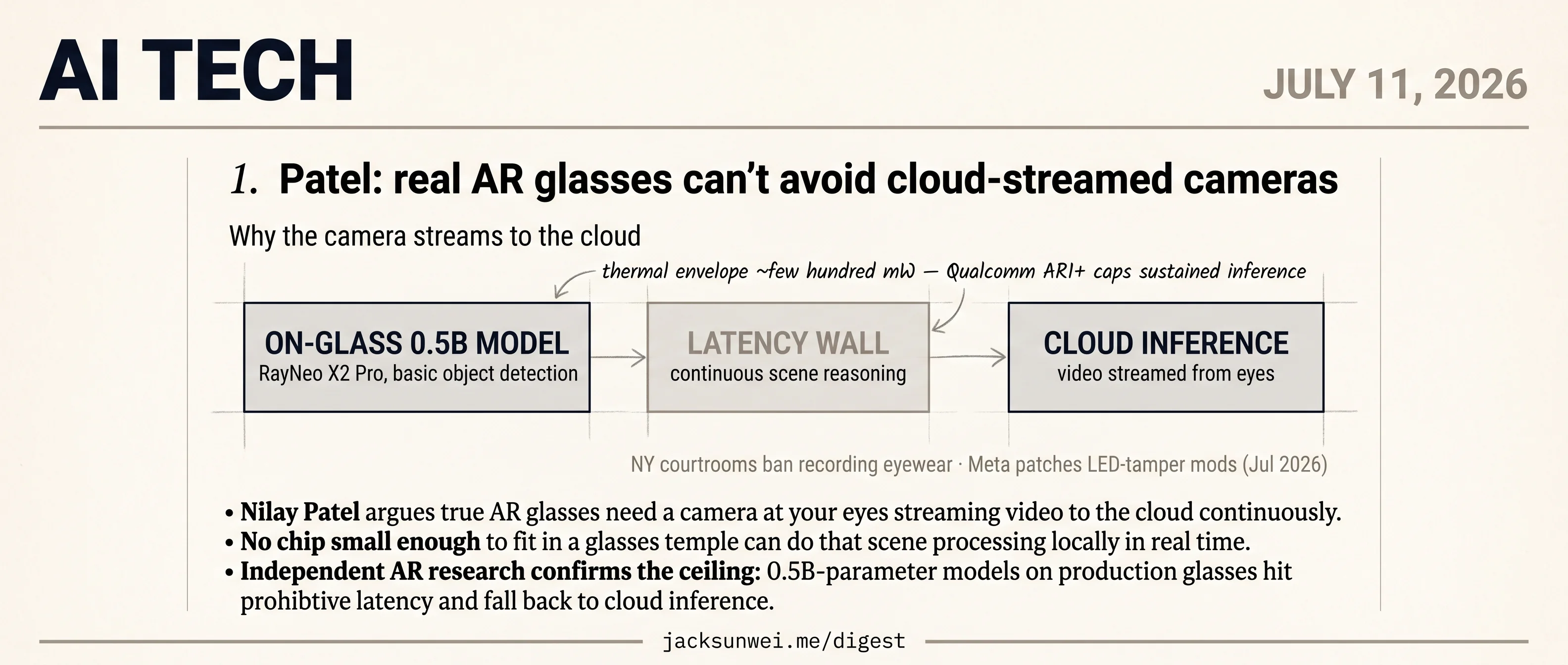
- Nilay Patel argues true AR glasses need a camera at your eyes streaming video to the cloud continuously.
- No chip small enough to fit in a glasses temple can do that scene processing locally in real time.
- Independent AR research confirms the ceiling: 0.5B-parameter models on production glasses hit prohibitive latency and fall back to cloud inference.
- The bystander backlash is already here — Meta is patching LED-tamper mods while New York bans recording eyewear from state courtrooms.
The silicon ceiling is real
On The Vergecast, Nilay Patel laid out a hardware argument dressed as an ethical one: to build the AR glasses “everyone thinks is the next thing,” you need a camera next to the eyes recording continuously, and no chip small enough to sit in the stem can process that stream in real time. So the data goes to the cloud. The only alternative is a Vision Pro-class brick with a tethered battery.
The technical premise holds up. A 2025 arXiv paper testing Egocentric Co-Pilot on the RayNeo X2 Pro found that even 0.5-billion-parameter models could manage basic object detection, but continuous scene understanding and “deep reasoning” produced prohibitive latency and forced a return to cloud architectures 1. Qualcomm’s AR1+ Gen 1 can run a 1B Llama on-glass, but only in short bursts before the thermal envelope of a few hundred milliwatts caps sustained inference. Patel’s “silicon can’t do it yet” is the current state of the art, not a rhetorical flourish.
The bystander problem is already in the courts
Patel frames the privacy trade as hypothetical — maybe you shouldn’t build this. It isn’t hypothetical. Meta shipped a July 2026 firmware update for Ray-Ban Meta that disables the camera entirely if the recording LED is covered or destroyed, a direct response to owners drilling out the indicator 2. In the same month, Tom’s Guide reported Meta is also weighing whether to disable that LED for its “super-sensing” always-on prototypes, citing “LED fatigue” — the theory that a permanent light stops registering 3. Vendor and user are pulling in opposite directions on the same piece of plastic.
Institutions are moving faster than either. New York banned recording eyewear from all state courtrooms in July 2026 to prevent secret taping of proceedings 4. That is the empirical answer to Patel’s “maybe you shouldn’t” — a jurisdiction saying no while Meta ships firmware to keep the camera on.
The counter-example Patel skips
Patel presents two options: cloud-connected camera-glasses or a Vision Pro. There’s a third. The Even Realities G1 is strictly camera-less, projecting monochrome text into the wearer’s field of view and recording nothing 5. Critics on r/augmentedreality argue this makes them “essentially just a remote screen for a phone,” which paradoxically strengthens Patel’s underlying point 5: strip the camera and you don’t have AR, you have notifications on glass. But it complicates his framing. Consumers who reject the trade already have a shipping product; the market didn’t wait for permission.
What’s actually at stake
The load-bearing part of Patel’s argument may not be the hardware claim, which is a 2-3 year problem eroding under Moore’s law and better on-device models. It’s the framing John Gruber amplified separately — Patel’s “software brain” critique of an industry that treats human experience as databases to optimize 6. The silicon ceiling will fall. The question of whether a camera on every face is a product category society consents to won’t be settled by a smaller chip.
Footnotes
-
arXiv: Egocentric Co-Pilot (2025) — https://arxiv.org/html/2502.14780v2
↩Experiments with 0.5-billion parameter models on the RayNeo X2 Pro revealed that while basic object detection is possible, the ‘continuous’ and ‘deep reasoning’ aspects of scene understanding lead to prohibitive latency, forcing a return to cloud-based architectures.
-
BGR — Ray-Ban Meta LED tamper block — https://www.bgr.com/2191890/ray-ban-meta-led-block-mod/
↩A mandatory software update in July 2026 attempts to detect tampering; if the system senses the LED is covered or destroyed, it disables the camera entirely.
-
Tom’s Guide — Meta ‘super-sensing’ AI glasses — https://www.tomsguide.com/computing/smart-glasses/meta-smart-glasses-super-sensing-ai
↩To combat ‘LED fatigue’—the theory that people stop noticing a light that is always on—Meta has reportedly considered disabling the indicator light for these features.
-
The Next Web — NY courthouse smart-glasses ban — https://thenextweb.com/news/smart-glasses-privacy-new-york-courthouse-ban-meta-recording-light
↩As of July 2026, New York has banned recording eyewear in all state courtrooms to prevent the secret taping of legal proceedings.
-
r/augmentedreality discussion of Even Realities G1 / Brilliant Labs Frame — https://www.reddit.com/r/augmentedreality/comments/1dy6j6a/interesting_smart_glasses_coming_in_august_frame/
↩ ↩2The Even Realities G1 is strictly camera-less, positioning itself as a socially acceptable wearable that avoids the ‘privacy creep’ stigma — critics counter that without visual input, ‘AI glasses’ are essentially just a remote screen for a phone.
-
Daring Fireball — Gruber on Patel’s ‘software brain’ — https://daringfireball.net/linked/2026/04/23/patel-software-brain
↩Patel’s ‘software brain’ framing describes the tech industry’s tendency to view the human experience as a series of databases to be optimized — a ‘superb’ insight into why AI products face public backlash despite high usage numbers.