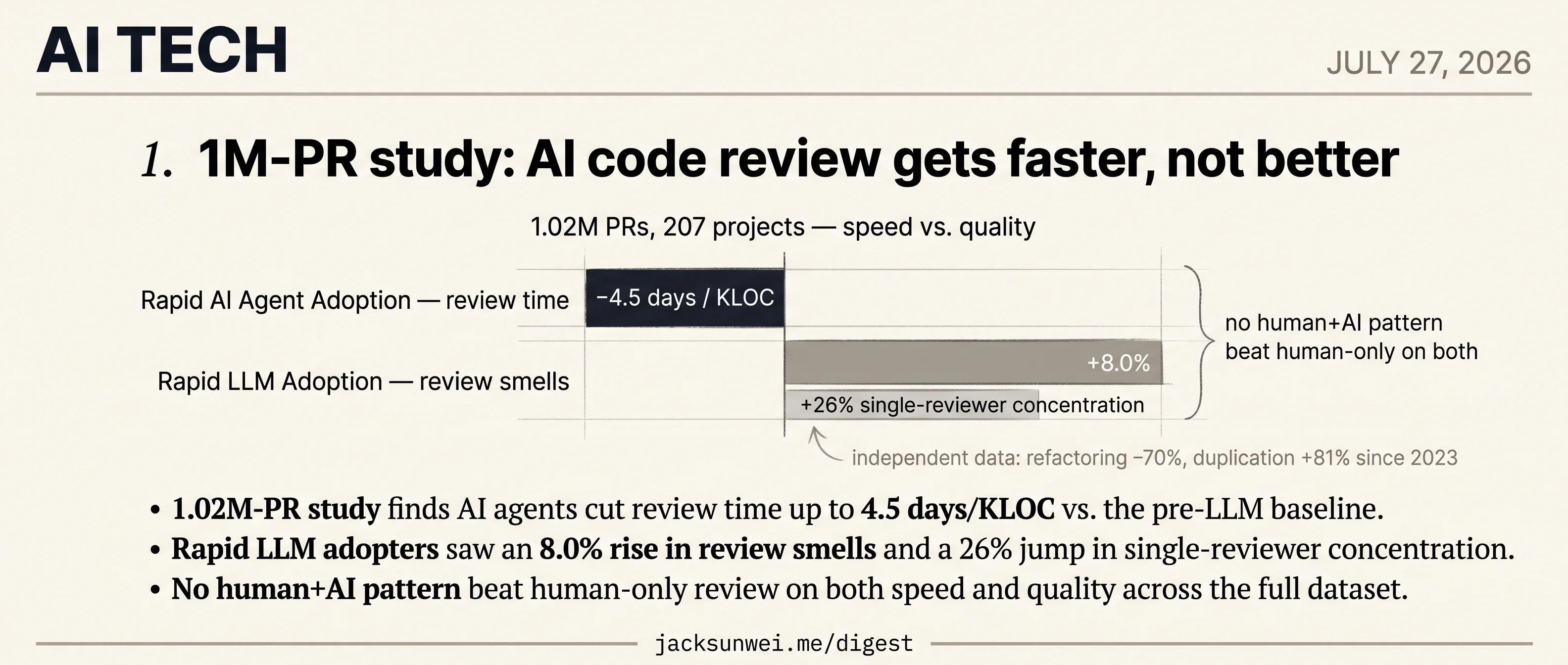
1.02M-PR audit: AI code review cuts days per KLOC, adds 8% more smells
The largest empirical study of AI code review to date finds it saves days per KLOC while raising review smells and concentrating reviewers.
1.02M-PR audit: AI code review cuts days per KLOC, adds 8% more smells
TL;DR
- 1.02M-PR study finds AI agents cut review time up to 4.5 days/KLOC vs pre-LLM baseline.
- Rapid adopters logged an 8% rise in review smells and 26% more single-reviewer PRs.
- No human+AI pattern beat human-only review on both speed and quality across the dataset.
- Independent code-health data shows refactoring down 70% and duplication up 81% since 2023.
Today’s ai-tech section is a single feature, and it’s the kind of measurement the field has been waiting for: a 1.02-million-pull-request audit of what AI code review actually does to a codebase. The speed win is real — up to 4.5 days per KLOC shaved off review latency versus the pre-LLM baseline — but the quality column is where the study earns its weight. Rapid adopters log an 8% rise in review smells, a 26% jump in single-reviewer PRs, and cross-referenced code-health data shows refactoring down 70% and duplication up 81% since 2023. No human+AI configuration in the dataset beat human-only review on both axes. Read it as the first empirical anchor for a debate that’s been running mostly on vibes.
1M-PR study: AI code review gets faster, not better
Source: hf-daily-papers · published 2026-07-13
TL;DR
- 1.02M-PR study finds AI agents cut review time up to 4.5 days/KLOC vs. the pre-LLM baseline.
- Rapid LLM adopters saw an 8.0% rise in review smells and a 26% jump in single-reviewer concentration.
- No human+AI pattern beat human-only review on both speed and quality across the full dataset.
- Independent data points to a worse quality picture: refactoring down 70% and duplication up 81% since 2023.
The headline finding
A new longitudinal study slices the last four years of open-source code review into three eras — Pre-LLM, LLM-Assisted, and Agentic — and asks a blunt question: does letting AI into the review loop actually help? Across 1.02M reviewed PRs from 207 GitHub projects active from May 2022 through February 2026, the answer splits cleanly. Efficiency: yes, sometimes dramatically. Quality: no, and sometimes worse.
Projects clustered into three adoption paths via soft-DTW on reviewer time-series. Gradual AI Adoption (46% of projects) shaved 2.5 days per 1,000 lines of churn once agents arrived. Rapid AI Agent Adoption (32%) hit 4.5 days/KLOC in savings — the biggest win in the dataset. Rapid LLM Adoption (22%) is the cautionary tale: a statistically significant 8.0% increase in “review smells,” a 26% rise in Review Buddies (one reviewer dominating an author’s PRs), and no efficiency gain to show for it.
Why efficiency and quality decouple
The authors’ review-smell taxonomy — sleeping reviews, ping-pong iterations, missing context, review buddies, oversized changesets, lack of review — is a proxy for defect risk, not defects themselves. That’s the paper’s most-hedged limitation, and it’s where independent data makes the picture darker, not lighter. GitClear’s 623M-change corpus shows refactoring activity down 70% and duplicated code up 81% since 2023 1. Wessel et al.’s earlier bot-era study already documented the pattern in miniature: rule-based bots raised merged-PR throughput but suppressed human-to-human discussion 2. The agentic era is that trend with the volume knob turned up.
Two mechanisms the paper underplays help explain why no collaboration pattern beat human-only review on quality. First, the self-review blind spot: when the same model family writes and reviews code, vulnerability miss rates hit ~64.5% because reviewer and author share training-distribution gaps 3. Second, precision on real PRs is genuinely poor — SWRBench found four of five LLM reviewers scored below 10% precision across 1,000 GitHub PRs 4. Faster decisions may partly reflect humans rubber-stamping low-signal AI comments rather than reviewing better.
What this reframes
Once AI reviewers join a project, human-AI collaboration pattern becomes the strongest predictor of review speed — outweighing project experience, PR size, and author tenure. Agents are also disproportionately assigned to larger changesets, which is exactly where humans burn out. That’s a real workflow win. But practitioners are already arguing the PR abstraction itself is buckling: SoftwareSeni’s position is that oversight should move upstream to specification review rather than line-by-line diff inspection of agent output 5, a structural critique review-smell counting can’t capture.
The takeaway isn’t “AI review is bad.” It’s that the industry has spent two years optimizing the metric — time-to-merge — that AI most easily moves, while the metric that matters — post-integration defect rate — is drifting in the wrong direction. The paper’s conservative proxies already flag it. The independent defect data suggests we’re underestimating the bill.
Footnotes
-
GitClear 2026 AI Code Quality Research — https://www.gitclear.com/recent_ai_developer_productivity_code_quality_research
↩AI accelerates code production [but] refactoring activity has dropped by 70% and code duplication has risen by 81% since 2023
-
Wessel et al., EMSE 2022 (TU Eindhoven mirror) — https://aserebre.win.tue.nl/EMSE2022Mairieli.pdf
↩bot adoption is associated with an increase in the number of monthly merged pull requests and a corresponding decrease in non-merged PRs [and] a significant reduction in human-to-human communication
-
daily.dev — ‘AI Code Review Limits: Why AI Reviewing AI Fails’ — https://daily.dev/posts/ai-code-review-limits-why-ai-reviewing-ai-fails-snebwlmvx
↩LLMs often fail to catch vulnerabilities in code they generated themselves — failing roughly 64.5% of the time — because they share the same training distribution blind spots as the generator
-
DeepSource — AI Code Review Benchmarks — https://deepsource.com/blog/ai-code-review-benchmarks
↩SWRBench tested five LLM-based tools across 1,000 GitHub pull requests and found that four out of five had a precision rate below 10%
-
SoftwareSeni — ‘Why Agent-Generated Code is Breaking the PR Review Model’ — https://www.softwareseni.com/why-agent-generated-code-is-breaking-the-pull-request-review-model/
↩traditional PRs are viewed as a noisy, blocking formality… human oversight [should move] upstream — focusing on rigorous review of the initial specifications rather than line-by-line inspection of agent-generated artifacts