Qwen-Robot withholds weights, PAT meets ICML ban, ConvFill breaches safety cap
Three research leads post strong numbers, then hit governance limits — withheld weights, an ICML AI-review ban, and a breached voice-safety cap.
Qwen-Robot withholds weights, PAT meets ICML ban, ConvFill breaches safety cap
TL;DR
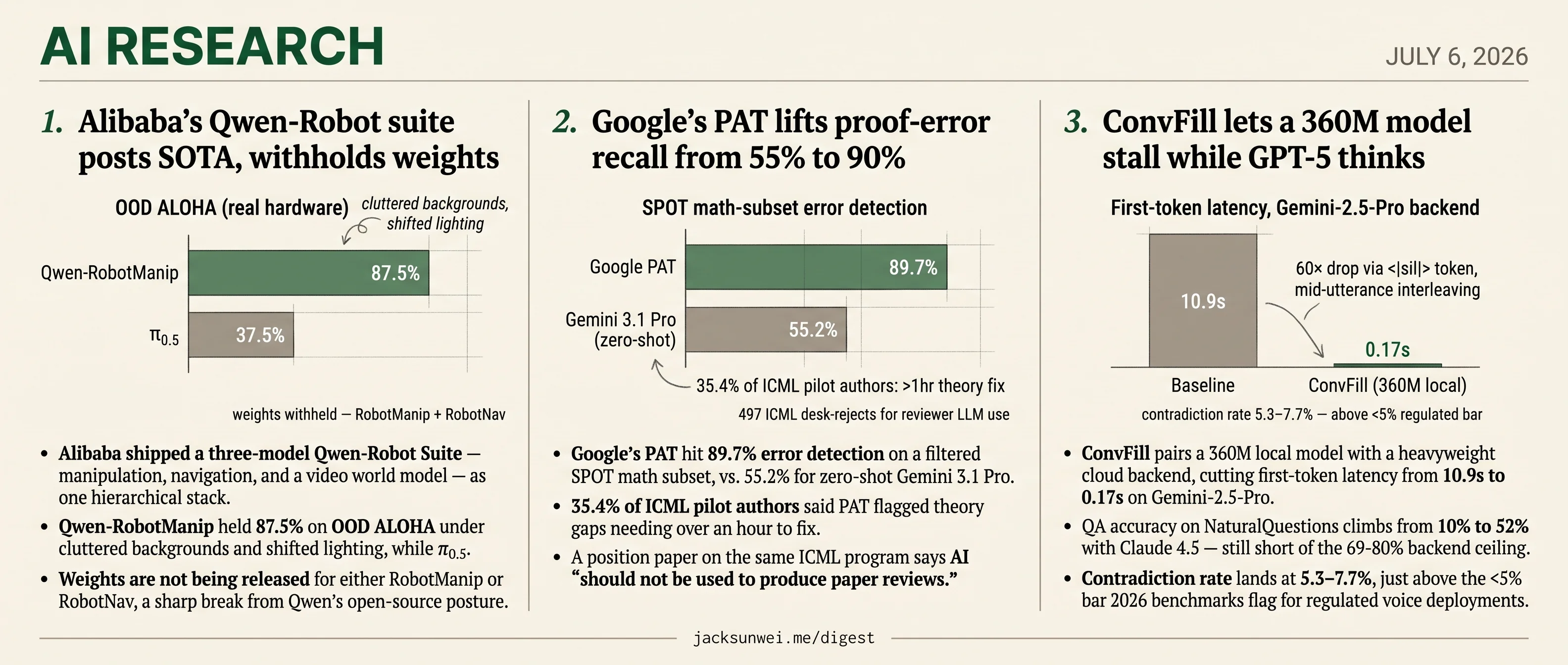
- Alibaba’s Qwen-Robot Suite withheld weights while posting 87.5% OOD ALOHA accuracy on both robot models.
- Google’s PAT flagged 89.7% of proof errors on filtered SPOT math, vs. 55% zero-shot Gemini 3.1 Pro.
- ConvFill hit 5.3-7.7% contradictions, above the <5% cap 2026 regulated-voice benchmarks flag.
- ICML desk-rejected 497 papers for LLM reviewer use, muddying PAT’s 92-97% author-satisfaction figures.
- Four axioms exposed open-weight LLMs failing causality, minimality, separability, and stability at every scale.
Today’s three research leads each post a strong headline number and then hit a boundary the metric doesn’t cover. Alibaba’s Qwen-Robot suite tops out-of-distribution manipulation but holds back weights on both robot models, breaking its own open-source posture as China’s anthropomorphic-AI rules land 15 July. Google’s PAT catches nearly 90% of proof errors — inside an ICML program whose own position paper says AI shouldn’t produce reviews and that just desk-rejected 497 papers for LLM reviewer use. ConvFill cuts first-token latency by two orders of magnitude by parking a 360M local model in front of a frontier backend, then sits above the <5% contradiction rate that 2026 regulated-voice benchmarks flag.
The pattern isn’t capability — it’s the layer above it. Weight release, review policy, and safety thresholds are doing more to shape what these systems actually ship than the leaderboard deltas the papers lead with.
Alibaba’s Qwen-Robot suite posts SOTA, withholds weights
Source: hf-daily-papers · published 2026-06-16
TL;DR
- Alibaba shipped a three-model Qwen-Robot Suite — manipulation, navigation, and a video world model — as one hierarchical stack.
- Qwen-RobotManip held 87.5% on OOD ALOHA under cluttered backgrounds and shifted lighting, while π₀.₅ dropped to 37.5%.
- Weights are not being released for either RobotManip or RobotNav, a sharp break from Qwen’s open-source posture.
- The drop lines up with China’s 2027 humanoid mass-production push and new anthropomorphic-AI rules landing 15 July 2026.
A suite, not a paper
Reading the RobotManip technical report on its own misses the event. Independent coverage confirms this was a coordinated launch of a three-model Qwen-Robot Suite: RobotManip for vision-language-action manipulation, RobotNav for agentic navigation, and RobotWorld — a Double-Stream MMDiT video world model trained on 8.6M video-text pairs across 20+ embodiments, reported as #1 on EWMBench and DreamGen Bench 1. The pieces are designed to compose: RobotWorld is the plausible answer to the sim-to-real gap RobotManip’s own authors flag as their biggest limitation, and RobotNav explicitly exposes a “controllable observation protocol” so an upstream Qwen3.7-Plus planner can retune visual-token budget, temporal decay, and per-camera weights at inference 2. That’s the agentic thesis in concrete form — a general LLM orchestrating specialist embodied tools.
flowchart LR
    P[Qwen3.7-Plus planner] --> M[RobotManip<br/>VLA + DiT action expert]
    P --> N[RobotNav<br/>~196ms on Jetson Thor]
    W[RobotWorld<br/>video world model] -. synthetic rollouts .-> M
    M --> R[Robot embodiment<br/>15 platforms]
    N --> R
The numbers are real; the artifacts aren’t
RobotManip’s headline claim — that alignment across representation, motion, and behavior is what unlocks scale, not raw data volume — is backed by a 38,100-hour corpus and a canonical 80-dim state-action vector that lets one model absorb data from 15 robot platforms plus human video. The OOD results are the interesting part: 91.4% on LIBERO-Plus vs 84.4% for π₀.₅, 69.4% on RoboTwin-Clean2Rand (Hard) versus 47.9% for the prior SOTA, 45.6% on EBench versus 27.1% for π₀.₅, and a #1 generalist finish at RoboChallenge Table30-v1 with 45% success. On real hardware, in-domain ALOHA reached 88.6% (vs 42.9% for π₀.₅), and the OOD variant held 87.5% while π₀.₅ collapsed to 37.5%.
None of it is independently reproducible. The GitHub README states plainly there is “currently no plan to release the model weights” for either RobotManip or RobotNav 3. That is the dissent thread running through Reddit and HN reactions:
You cannot take Chinese models as open source for granted anymore — the Robot Suite is closed and the general LLM is just a harness that calls the specialist tools. 4
The recipe (architecture, alignment tricks, data curation pipeline) is public. The artifact is not. For a subfield where sim benchmarks are widely acknowledged to overstate real-world capability, “trust our OOD numbers” is a heavy ask.
Why closed, why now
The closed-weights choice reads differently once you overlay the commercial context. SCMP frames the suite as Alibaba’s bid to be the software backbone for China’s 2027 humanoid mass-production mandate, with Ant Group investments in Unitree and Zeroth consolidating hardware alignment and industrial partners like BYD and Leju already in the frame 5. This is a platform play dressed as a research release.
Regulation cuts the same direction. Alibaba and ByteDance are disabling humanlike AI agent features by 15 July 2026 under new Interim Measures on anthropomorphic AI 6. The pressure is to steer embodied AI toward warehouses and factories rather than consumer companions — which is exactly where the RobotManip evaluation suite (bin-picking, table manipulation, mobile bases) already points.
What’s at stake
If the alignment thesis holds up under third-party scrutiny, Qwen-RobotManip is a meaningful architectural claim: that VLA foundation models have been bottlenecked on representation harmonization, not tokens. But with weights withheld and evaluations dominated by simulation, the field is being asked to grade a strategy deck. The next test is whether Unitree, BYD, or any independent lab reproduces the ALOHA OOD numbers on hardware they control.
Further reading
- Qwen-RobotNav Technical Report: A Scalable Navigation Model Designed for an Agentic Navigation System — hf-daily-papers
Google’s PAT lifts proof-error recall from 55% to 90%
Source: hf-daily-papers · published 2026-06-25
TL;DR
- Google’s PAT hit 89.7% error detection on a filtered SPOT math subset, vs. 55.2% for zero-shot Gemini 3.1 Pro.
- 35.4% of ICML pilot authors said PAT flagged theory gaps needing over an hour to fix.
- A position paper on the same ICML program says AI “should not be used to produce paper reviews.”
- ICML desk-rejected 497 papers for reviewers using LLMs, muddying PAT’s 92–97% satisfaction figures.
What PAT actually does
The Paper Assistant Tool is not a bigger prompt. It’s a four-stage pipeline built on Gemini 2.5/3.1 Deep Think: a segmenter chops the manuscript into semantically coherent chunks (Theory, Methods, Experiments), an adaptive budgeter hands each segment a “thinking-token” allocation matched to its difficulty, parallel review agents each get the full paper as context but only verify their assigned section, and a synthesis agent de-duplicates findings and grounds cited theorems against Google Search.
The design choice worth noting is compute allocation. A zero-shot reviewer spreads its reasoning budget across the whole paper; PAT spends it disproportionately on proofs. That’s what produces the SPOT delta — 55.2% → 89.7% on the equation/proof subset, including one case where PAT constructed an explicit counterexample to a false claim the baseline had waved through.
The dissent lives inside the same conference
The most pointed critique is Baumann et al., “Stop Automating Peer Review Without Rigorous Evaluation” — on the ICML 2026 program alongside the PAT pilot 7. Its two named failure modes, “hivemind” convergence and “paper laundering” (stylistic LLM rewrites gaming AI scorers), attack the upper rungs of Google’s proposed four-role taxonomy directly, even if they mostly spare PAT’s current Role 1 use.
The enforcement climate around the pilot muddies the satisfaction numbers. ICML embedded hidden prompt-injection watermarks in submitted PDFs and desk-rejected 497 papers after catching 506 reviewers who had pledged not to use LLMs; Sören Auer argued the traps “corrode the relationship the whole system depends on” 8. Authors choosing between an officially sanctioned Google tool and formal sanctions for reaching elsewhere are not a clean preference signal.
Reading the benchmark honestly
PAT’s headline gain looks even larger against the original SPOT paper, where frontier models topped out at 21.1% recall and 6.1% precision with poor run-to-run reproducibility 9. But the 89.7% number comes from a mathematical subset carve-out, not the multimodal image and statistics errors SPOT was built to stress. Adjacent systems make the ceiling clearer: OpenReviewer, an 8B Llama fine-tuned on 79k reviews, hits 75–79% F1 on accept/reject — and once recommended rejecting Goodfellow’s original GAN paper 10. Classifier-style automation captures conventionality, not insight.
Meanwhile, the well PAT is meant to filter is already contaminated: a GPTZero audit found 100+ hallucinated citations in papers accepted to NeurIPS 2025, including invented DOIs and “John Doe” author strings 11. If pre-submission tooling like PAT catches even half of that class of error before review, the case for Role 1 is close to unarguable regardless of what one thinks about Roles 2–4.
What’s actually at stake
PAT demonstrably improves proof verification. The unresolved question isn’t the technology — it’s whether normalizing a Google-owned pre-vetting layer across STOC, ICML, and NeurIPS is compatible with a community that just desk-rejected hundreds of its own for the adjacent behavior. ICML has walled PAT’s output off from program committees 12; whether that boundary holds when a “Role 3” independent AI reviewer becomes the next pilot is the fight to watch.
ConvFill lets a 360M model stall while GPT-5 thinks
Source: hf-daily-papers · published 2026-06-30
TL;DR
- ConvFill pairs a 360M local model with a heavyweight cloud backend, cutting first-token latency from 10.9s to 0.17s on Gemini-2.5-Pro.
- QA accuracy on NaturalQuestions climbs from 10% to 52% with Claude 4.5 — still short of the 69–80% backend ceiling.
- Contradiction rate lands at 5.3–7.7%, just above the <5% bar 2026 benchmarks flag for regulated voice deployments.
- ConvFill’s real delta over DeepMind’s 2024 Talker/Reasoner paper is mid-utterance interleaving via a
<|sil|>token.
What ConvFill actually does
The paper’s core trick is a training format that teaches a small model to talk through the gaps in a bigger model’s thinking. A user utterance goes to two models in parallel: a lightweight ConvFill (SmolLM2-360M-Instruct) that owns the microphone, and a reasoning-tier backend (GPT-5, Claude Sonnet 4.5, Gemini-2.5-Pro) that streams factual “knowledge chunks” into a shared queue. If the queue is empty when ConvFill needs to speak, a <|sil|> token is injected every second, prompting a contextually appropriate holding phrase. When knowledge arrives, ConvFill splices it into the next sentence.
sequenceDiagram
    participant U as User
    participant C as ConvFill (360M, local)
    participant Q as Shared queue
    participant B as Backend (GPT-5/Claude/Gemini)
    U->>C: utterance
    U->>B: utterance
    C->>Q: poll
    Q-->>C: <|sil|> (empty)
    C->>U: "Let me check on that..."
    B->>Q: knowledge chunk
    Q-->>C: fact
    C->>U: grounded sentence
The architectural point is that TTFT becomes independent of backend depth. In the reported runs, ConvFill held steady at 160–170ms (±40ms) whether the backend was GPT-5 (0.74s baseline) or Gemini-2.5-Pro (10.9s baseline).
Where the win is real, and where it isn’t
The 60× latency reduction against Gemini-Pro is the eye-catching number, but the honest comparison is against native speech-to-speech systems. Kyutai’s Moshi already hits ~200ms end-to-end with a single full-duplex model that also preserves paralinguistic signal the cascaded ConvFill pipeline throws away at the STT step 13. Gemini 3.1 Flash Live and GPT-Realtime-2 sit in the 200–500ms band natively 14. ConvFill only wins the latency race when the backend is a reasoning-tier text model — which is the whole point, but worth naming.
The framing also isn’t new. DeepMind’s October 2024 Talker/Reasoner paper formalized the same System 1 / System 2 split, using a shared “belief state” to synchronize a fast dialogue module with a slow planner 15. ConvFill’s genuine delta is narrower: the <|sil|> protocol and a 46k-turn synthetic corpus that trains mid-utterance interleaving, rather than swapping in a fully-computed reasoner reply between turns.
The trust tax
Two numbers deserve more scrutiny than the paper gives them. First, the intelligence gap: 46–52% NQ accuracy vs. 69–80% for the backends alone means roughly a third of the reasoner’s knowledge doesn’t survive the hand-off. Second, the 5.3–7.7% contradiction rate sits above the <5% threshold regulated deployments target, and per-step errors compound — 95% single-turn reliability collapses to ~59% over ten turns 16.
The filler mechanism itself carries a UX cost the paper waves off. Task-oriented users rate agents that lean on conversational fillers as less intelligent and less likable 17. That squares uncomfortably with ConvFill’s own finding that 59–64% of responses are only “Neutral” under NLI because the small model adds embellishments like “impressive” or “amazing.” The mechanism designed to hide latency also drifts the agent toward chattier, less-grounded output.
Where it fits
ConvFill’s real niche is RAG and tool-call latency masking on cascaded stacks that need observability and swappable backends — not general knowledge distillation, and not head-to-head against native S2S. The user study preferring it on retrieval-heavy tasks across 21 Talker/Reasoner pairs 18 is the honest positioning. Read that way, this is a pragmatic engineering wrapper on a known pattern, not a new floor.
Round-ups
Vesta folds navigation, planning, and grounding into one robot model
Source: hf-daily-papers
Vesta is a single embodied foundation model handling localization, spatial reasoning, navigation, and long-horizon planning, backed by multimodal memory. It beats task-specialized baselines on both benchmarks and real robot deployments, suggesting generalist embodied policies now match narrow experts.
Qwen-Image-2.0 uses GRPO and on-policy distillation for sharper edits
Source: hf-daily-papers
Alibaba’s diffusion image model gains a GRPO-based RLHF stage plus on-policy distillation, with vision-language pointwise scoring and chain-of-thought reasoning driving the reward. Hybrid classifier-free guidance and per-category reward calibration lift instruction-following and visual quality across generation and editing.
Four axioms expose broken latent thoughts in open-weight LLMs
Source: hf-daily-papers
An axiomatic framework tests whether LLM latent representations satisfy causality, minimality, separability, and stability across spatial reasoning and factual QA. Open-weight models fail consistently regardless of scale, revealing a structural gap between benchmark accuracy and the internal thought quality those scores are assumed to reflect.
Static analysis anchors stabilize LLM code agents across runs
Source: hf-daily-papers
Feeding code agents deterministic structural hints — call graphs, inheritance trees, and configuration dependencies — sharpens function-level localization and cuts run-to-run variance versus keyword search. The study argues navigation reliability, not raw model capability, is the current bottleneck in software exploration.
Code execution often costs more than it fixes in LLM repair agents
Source: hf-daily-papers
Program-repair agents lean on execution-based testing, but a SWE-bench study of agent traces finds the token and wall-clock overhead frequently exceeds any resolve-rate gain. The generate-run-revise loop pays off only on select bug classes, arguing for selective rather than default execution.
Gist tokens cut long-context attention to log-linear decoding
Source: hf-daily-papers
Simplified Sparse Attention trains gist tokens during continued pretraining via an attention mask over next-token loss, then uses them to select chunks at inference with no architecture change. A hierarchical gist-of-gist variant delivers log-linear decoding and holds up on LongBench and RAG workloads.
Cascaded routing sends easy LLM queries to cheaper models first
Source: hf-daily-papers
The Cluster-Route-Escalate framework groups incoming queries, dispatches them to the smallest adequate model, and escalates only when a quality estimator flags weak responses. The cascade preserves accuracy while cutting Time Per Output Token, targeting production serving costs rather than benchmark leaderboards.
Footnotes
-
↩Meet Qwen-RobotSuite: Three Embodied AI Models for VLA Manipulation, Video World Modeling and Navigation
-
Qwen-RobotNav technical report (PDF) — https://qianwen-res.oss-accelerate.aliyuncs.com/qwenrobot/papers/Qwen_RobotNav.pdf
↩A controllable observation protocol exposes visual-token budget, temporal decay, per-camera weights and frame-sampling mode, allowing an upper-level Qwen3.7-Plus planner to reconfigure the navigator at inference time; deployment on a Unitree Go2 via Jetson Thor reaches ~196 ms (5.1 Hz) with a single low-res camera.
-
r/Qwen_AI discussion — https://www.reddit.com/r/Qwen_AI/comments/1uim6wm/where_are_qwen37_open_weights_models/
↩There is currently no plan to release the model weights for either Qwen-RobotManip or Qwen-RobotNav; only technical reports, demos and report resources will be publicly shared.
-
Hacker News thread on Qwen-Robot Suite — https://news.ycombinator.com/item?id=48580209
↩You cannot take Chinese models as open source for granted anymore — the Robot Suite is closed and the general LLM is just a harness that calls the specialist tools.
-
South China Morning Post — https://www.scmp.com/tech/big-tech/article/3357260/alibaba-eyes-physical-world-its-first-suite-ai-models-robots
↩Alibaba eyes the physical world with its first suite of AI models for robots, positioning the Qwen-Robot series as the software backbone for China’s push to mass-produce humanoids by 2027.
-
SCMP — regulatory context — https://www.scmp.com/tech/big-tech/article/3359482/bytedance-and-alibaba-disable-humanlike-ai-custom-agents-new-rules-loom
↩ByteDance and Alibaba are disabling humanlike AI custom agents ahead of new ‘Interim Measures’ on anthropomorphic AI that take effect 15 July 2026.
-
Baumann et al., ‘Stop Automating Peer Review Without Rigorous Evaluation’ (arXiv:2605.03202) — https://arxiv.org/html/2605.03202v1
↩today’s AI systems should not be used to produce paper reviews
-
The Transmitter — ‘Scientists decry conferences’ use of hidden prompts to snare AI peer reviews’ — https://www.thetransmitter.org/publishing/scientists-decry-conferences-use-of-hidden-prompts-to-snare-ai-peer-reviews/
↩497 papers were desk-rejected because their authors were linked to these violations through reciprocal reviewing agreements… critics like computer scientist Sören Auer argued that such ‘traps’ presume bad faith and ‘corrode the relationship the whole system depends on’
-
SPOT benchmark paper (Son et al., arXiv:2505.11855) — https://arxiv.org/abs/2505.11855
↩even the strongest models fail to surpass 21.1% recall and 6.1% precision… models rarely identifying the same errors across independent runs
-
ResearchGate — ‘OpenReviewer: A Specialized Large Language Model for Generating Critical Scientific Paper Reviews’ — https://www.researchgate.net/publication/392505504_OpenReviewer_A_Specialized_Large_Language_Model_for_Generating_Critical_Scientific_Paper_Reviews
↩OpenReviewer (a Llama-8B model fine-tuned on 79,000 expert reviews) report F1 scores between 75% and 79% for ‘accept/reject’ classifications… the system even recommended rejecting Ian Goodfellow’s seminal GAN paper, labeling it ‘not good enough’
-
Medium — ‘100 Fake Citations Just Slipped Through NeurIPS 2025 Peer Review’ — https://medium.com/@ljingshan6/100-fake-citations-just-slipped-through-neurips-2025-peer-review-5f34f4436560
↩GPTZero identified over 100 hallucinated citations in papers accepted to the prestigious NeurIPS 2025 conference, ranging from invented DOIs to citations of non-existent authors like ‘John Doe’
-
ICML 2026 Blog — ‘ICML Experimental Program Using Google’s Paper Assistant Tool (PAT)’ — https://blog.icml.cc/2026/01/14/icml-experimental-program-using-googles-paper-assistant-tool-pat/
↩authors were given the option to receive private, automated feedback… PAT feedback was never accessible to the program committee
-
MarkTechPost on Kyutai Moshi — https://www.marktechpost.com/2024/09/18/kyutai-open-sources-moshi-a-breakthrough-full-duplex-real-time-dialogue-system-that-revolutionizes-human-like-conversations-with-unmatched-latency-and-speech-quality/
↩Kyutai’s Moshi achieves a theoretical latency of 160ms, with real-world performance typically landing around 200ms… Moshi is a full-duplex system, meaning it models its own speech and the user’s speech as parallel streams.
-
Webscraft 2026 voice API benchmarks — https://webscraft.org/blog/gptrealtime2-vs-gemini-live-api-scho-obrati-dlya-golosovogo-agenta-u-2026-rotsi?lang=en
↩Gemini 3.1 Flash Live is currently measured as the speed leader… approximately 200ms to 300ms… OpenAI’s Realtime API typically records slightly higher latencies, averaging around 300ms to 500ms.
-
SyncedReview on Google DeepMind Talker-Reasoner — https://syncedreview.com/2024/10/21/thinking-fast-and-slow-google-deepminds-dual-agent-architecture-for-smarter-ai/
↩The framework decomposes agent functionality into a Talker (System 1) and a Reasoner (System 2)… communicating through a shared ‘belief state’ that acts as a sufficient statistic of the agent’s knowledge.
-
DigitalApplied 2026 hallucination benchmarks — https://www.digitalapplied.com/blog/ai-model-hallucination-rate-benchmarks-2026-study
↩A voice agent with 95% reliability at each conversational step may drop to roughly 59% total success across a 10-turn dialogue… regulated sectors like finance and healthcare often target hallucination rates below 5%.
-
Forbes / Hutcheson on filler-word neuroscience — https://www.forbes.com/sites/scotthutcheson/2025/01/23/the-neuroscience-of-filler-words-and-how-they-can-erode-credibility/
↩In task-oriented scenarios (e.g., booking a flight), users perceive agents using frequent fillers like ‘um’ or ‘uh’ as less intelligent and less likable… excessive filler usage can erode credibility, as the amygdala may trigger a subtle ‘threat’ response.
-
OpenTrain paper summary — https://www.opentrain.ai/papers/thinking-while-speaking-inference-time-knowledge-transfer-for-responsive-and-int—arxiv-2511.07397/
↩Evaluated across 21 different configuration pairs of Talker and Reasoner models on an Apple M2 SoC… users preferred ConvFill for retrieval-heavy tasks, as the Talker could immediately provide contextually appropriate fillers while the Reasoner performed the background search.