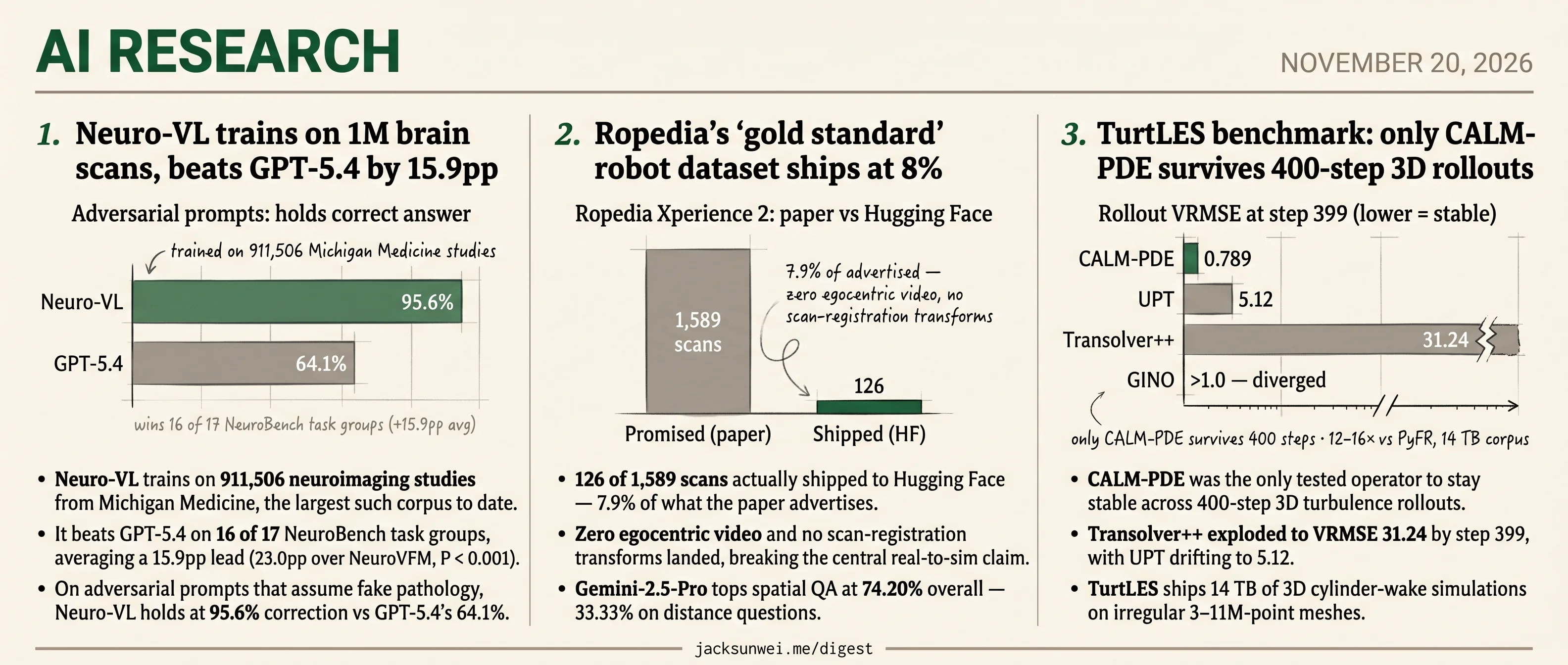
Neuro-VL trains on 911k scans, Ropedia ships 8%, TurtLES breaks surrogates
Three AI research features where the dataset is the story: Neuro-VL assembles 911k scans, Ropedia ships 8%, TurtLES breaks most surrogates.
Neuro-VL trains on 911k scans, Ropedia ships 8%, TurtLES breaks surrogates
TL;DR
- Neuro-VL trains on 911,506 Michigan neuroimaging studies, beating GPT-5.4 by 15.9pp on NeuroBench.
- Ropedia ships 126 of 1,589 scans — 8% of advertised — with zero egocentric video.
- CALM-PDE is the only surrogate to survive TurtLES’s 400-step 3D turbulence rollouts.
- Neuro-VL’s 2.4:1 report-preference win runs on an in-house LLM judge, not clinicians.
- Transolver++ explodes to VRMSE 31.24 by step 399 on the new 14 TB benchmark.
Today’s AI research stories each put the dataset at the center of the result, not the model. Michigan’s Neuro-VL earns its 15.9pp lead over GPT-5.4 by assembling 911,506 neuroimaging studies — the biggest medical VL corpus to date — though the headline preference win still rides on an in-house LLM judge rather than clinician acceptance. Ropedia’s advertised ‘gold standard’ robot dataset ships at 7.9% of what the paper describes, with zero egocentric video and no scan-registration transforms, breaking the central real-to-sim claim. And NVIDIA-adjacent TurtLES flips the frame: its 14 TB of 3D cylinder-wake simulations exists precisely to break neural surrogates, and it does — only CALM-PDE stays stable across 400-step rollouts while Transolver++ drifts to VRMSE 31.24.
The round-up briefs stay on architecture and reliability — FOAM halves optimizer-state memory at Muon speed, encoder-free multimodal LLMs match pretrained-vision pipelines, and DeepStress shows search agents answering confidently on degraded retrieval.
Neuro-VL trains on 1M brain scans, beats GPT-5.4 by 15.9pp
Source: hf-daily-papers · published 2026-11-10
TL;DR
- Neuro-VL trains on 911,506 neuroimaging studies from Michigan Medicine, the largest such corpus to date.
- It beats GPT-5.4 on 16 of 17 NeuroBench task groups, averaging a 15.9pp lead (23.0pp over NeuroVFM, P < 0.001).
- On adversarial prompts that assume fake pathology, Neuro-VL holds at 95.6% correction vs GPT-5.4’s 64.1%.
- The 2.4:1 report-preference win runs on NeuroJudge, an in-house LLM judge — no prospective clinician-acceptance number is reported.
- Commercial rival Aidoc already has FDA Breakthrough Device Designation for the same report-drafting task.
A specialist built on a very specific pipeline
Neuro-VL is a Qwen3-8B-based vision-language model wired to a ViT-Large encoder with hierarchical attention that reasons at slice, scan, and full-study level — the shape a radiologist actually works in, not the flat 2D crop a general VLM sees. The Michigan team trained it on 911,506 neuroimaging studies from 450,000 patients spanning 1995–2025, then fine-tuned on 740k instruction examples plus 230k paired prior-current studies for the longitudinal variant.
It’s worth reading the result as the latest step in a lineage rather than a cold start. The MLiNS lab’s stack has evolved HLIP → ItemizedCLIP → NeuroVFM → Prima → Neuro-VL, each step layering hierarchical attention, structured report supervision, and volumetric self-supervision onto the same institutional data 1. Prima, the direct predecessor, already reported 92% mean diagnostic AUC across 52 neurologic conditions and 97.5% accuracy on urgent findings in prospective testing 2. Neuro-VL is the interactive, language-generating wrapper on a pipeline that was already clinically validated at a smaller scale.
One detail the paper underplays: the Qwen3-VL family uses DeepStack, which injects ViT features across multiple LLM layers rather than at a single projector 3. Teams trying to swap in a different backbone should expect the image-text alignment to degrade non-trivially.
The headline numbers, and what they don’t measure
On the authors’ NeuroBench suite, Neuro-VL beats GPT-5.4 by 15.9pp on average and shows a lopsided 89.2% vs 61.8% advantage on pediatric cases, where general VLMs tend to collapse. Longitudinal change characterization lands at 87.5% (vs 81.6% for GPT-5.4), disease-trajectory assessment at 96.9%. The red-teaming result is the most interesting single number: when prompted with a question that falsely presupposes pathology on a normal scan, Neuro-VL refuses the premise 95.6% of the time versus GPT-5.4’s 64.1% — a direct answer to the hallucination failure mode that has kept general models out of radiology workflows.
The report-generation claim needs more squinting. “Preferred 2.4:1 over GPT-5.4” uses NeuroJudge, an LLM-as-judge the same team built. That’s useful as a relative signal but not a substitute for clinician acceptance. For external calibration: Harrison.rad.1.5, another specialist radiology model, hit 65.4% clinician-report acceptance against 79.6% for human-written reports in a Mass General Brigham evaluation 4. Neuro-VL reports no comparable number.
The regulatory and governance gap
The clinically deployed competition is already further along the regulatory path than an arXiv preprint.
Aidoc’s First Read just received FDA Breakthrough Device Designation — an expedited-review status, not clearance — for drafting preliminary radiology report text, the same task Neuro-VL targets, citing the fact that interpretation delays have more than doubled since 2014 5. A preprint with released weights does not clear the same bar.
And the training corpus itself carries baggage the paper barely engages with. A single health system’s 30-year archive of 450k patients is exactly the secondary-use pattern that triggered scrutiny in the I-MED/Harrison.ai case in Australia, which regulators ultimately cleared on de-identification grounds but flagged as an unresolved ethical fault line 6. The authors acknowledge regional bias and retrospective-only evaluation; they don’t engage with consent lineage.
Net: Neuro-VL is a strong research artifact and a useful public benchmark. It is not yet a deployment-ready system, and the most important missing number is a prospective clinician-acceptance rate.
Ropedia’s ‘gold standard’ robot dataset ships at 8%
Source: hf-daily-papers · published 2026-11-11
TL;DR
- 126 of 1,589 scans actually shipped to Hugging Face — 7.9% of what the paper advertises.
- Zero egocentric video and no scan-registration transforms landed, breaking the central real-to-sim claim.
- Gemini-2.5-Pro tops spatial QA at 74.20% overall — 33.33% on distance questions.
- CC BY-NC 4.0 plus bystander capture in private homes leaves commercial robotics teams in a legal gray zone.
The paper and the download describe different datasets
Ropedia Xperience 2 is pitched as a “gold standard” for physical-AI scaling: 1,589 metric-scale 3D scans paired with 4,230 egocentric recordings (131 hours, 74 tasks), joined by a registration pipeline that drops human motion into the scene’s metric frame so it can be retargeted to robots without a robot ever being on-site.
That’s the paper. The artifact is smaller. BLO LAB’s audit of the Hugging Face release found 126 scenes — 7.9% of the headline number — roughly 8.33 hours of recordings against the claimed 131, and, critically, no egocentric video files and no recording-to-scan registration transforms 7. The task data currently ships as estimated MANO/SMPL-H motion only; the alignment that makes the “environment + behavior” pitch coherent is “not part of these files yet” 7.
That is the headline. The arXiv abstract and the downloadable .tar describe two different datasets, and the methodological claim most reviewers would want to kick the tires on — human trajectories registered into metric 3D — is not yet reproducible from the public release.
What the benchmarks actually show
Where the paper is on firmer ground is in benchmarking frontier models against the data it does have. On 500 spatial-QA pairs, Gemini-2.5-Pro tops the chart at 74.20%, with GPT-6 Astra High at 71.80%. The uniform number hides a cliff: both models crater on precise metric questions — Gemini scores 33.33% on distance — confirming the now-familiar pattern that VLMs reason well about ordinal spatial relations and badly about centimeters.
3D object detection is worse. The lifting-based Boxer baseline hits 24.69% AP25 and 6.09% AP50; end-to-end models like LLaVA-3D and SceneScript sit near 0% AP50 in cluttered scenes. The authors’ own phrasing — “far from practical deployment” — is the right read.
Crowded field, narrower moat
The “one human with a head rig instead of a robot fleet” pitch is no longer differentiating. Figure’s Index app pulled 16M+ task videos from 108 countries in months on a $1B+ compute commitment, with a reported 6× jump in chore success across unfamiliar homes 8. 1X runs VR teleoperation on deployed NEOs; Physical Intelligence ingests roughly 1,000 hours/day. Against those flywheels, 131 hours is a rounding error. Ropedia’s actual moat is the registered 3D geometry — which is precisely the piece not yet in the public download.
The stack underneath is shaky
Two upstream dependencies deserve skepticism. EgoAllo, which supplies body and hand pose, assumes a flat floor and hallucinates occluded leg motion from head trajectory via diffusion sampling that is “computationally prohibitive for real-time deployment” 9. The 3D Gaussian Splatting representation, meanwhile, is widely described as “ready for looks, but not for measurement” 10 — a problem for contact-rich manipulation that needs sub-millimeter geometry.
Passive video lacks the “action channel” — the actual forces and motor commands required for control 11.
And then there’s consent. 87.4% of scans are private home interiors; bystanders and visitors are captured passively, and the CC BY-NC 4.0 license sits in a gray zone commercial training teams can’t safely cross 12. Interesting as a registration pipeline and as a benchmark. Premature as a “gold standard.”
TurtLES benchmark: only CALM-PDE survives 400-step 3D rollouts
Source: hf-daily-papers · published 2026-11-05
TL;DR
- CALM-PDE was the only tested operator to stay stable across 400-step 3D turbulence rollouts.
- Transolver++ exploded to VRMSE 31.24 by step 399, with UPT drifting to 5.12.
- TurtLES ships 14 TB of 3D cylinder-wake simulations on irregular 3–11M-point meshes.
- Surrogate speedups land at just 12–16× over PyFR — well below what 2D surrogates deliver.
What TurtLES actually is
Most “turbulence” benchmarks in ML are either 2D, steady-state, or run on periodic boxes at modest resolution. TurtLES instead releases 400 trajectories of 400 snapshots each, generated with the high-order Flux Reconstruction solver PyFR on unstructured 3D meshes, sampling a four-dimensional parameter space (Lamé-curve geometry, aspect ratio, Reynolds number 1,000–3,900, angle of attack) via Sobol’ sequences. The headline number is 14 TB of raw fields; a mini-TurtLES at 0.8 TB and a 5 GB debug subset bring the barrier down for smaller labs. A reproducible CLI (turtles-data, turtles-train, turtles-eval, turtles-gen) ships with two zero-parameter baselines — persistence and mean-field — as a sanity floor 13.
Where the operators broke
The benchmark’s most useful contribution is negative: it shows today’s SOTA neural operators are not ready for industrial 3D turbulence.
| Model | One-step VRMSE | Rollout VRMSE (step 301–399) | Speedup vs PyFR |
|---|---|---|---|
| CALM-PDE | 0.073 | 0.789 | ~12× |
| UPT | 0.089 | 5.12 | ~16× |
| Transolver++ | >1.0 | 31.24 | — |
| GINO | >1.0 | — | — |
Two of four models fail to beat a mean-field predictor on a single step. UPT is competitive one-shot but accumulates error aggressively. Only CALM-PDE — a hierarchical operator using continuous convolutions — maintains both field-level accuracy and spectral fidelity across the full 400-step horizon. Even it loses high-wavenumber energy over time, the classic spectral-smoothing failure mode the TurtLES authors are explicitly trying to surface 14.
These failures are not new discoveries. They line up with a growing literature on spectral bias in operator learning: adversarial training against energy spectra has been shown to cut spectrum error up to 15× versus vanilla operators 15, and the CALM-PDE lineage itself notes that physics-enhanced variants like PENO beat pure data-driven ones on stability 16. TurtLES confirms those concerns at industrial mesh resolution.
The iLES-as-truth problem
The most pointed critique of the benchmark targets its ground truth. Implicit Large Eddy Simulation computes the energetic scales directly but models unresolved scales through the solver’s own truncation error rather than an explicit subgrid-scale model. Multiple reviewers argue this risks biasing any surrogate trained on TurtLES toward the specific numerical dissipation signature of Flux Reconstruction 17. A separate audit assigns the release a “low confidence” verdict on production readiness, citing cross-hardware reproducibility and thin AI-core implementation signals 18.
Neural operators often introduce ‘unintended regularization effects,’ causing predicted solutions to appear smoother than the ground truth — a phenomenon that misses essential physical features like vortex stretching and shock waves. 14
That is precisely the pathology TurtLES exposes. Whether the exposed smoothing reflects a true model deficit or a mismatch to the solver’s own dissipation profile is the open question.
Why it matters
The honest read is that TurtLES is a stress test, not a leaderboard. It concretely demonstrates that scaling from 2D to 3D turbulence is not a matter of bigger GPUs — it exposes architectural failures (Transolver++ exploding, GINO underperforming the mean) that smaller benchmarks hide. The 12–16× surrogate speedup is also a reality check: at 10M points per frame, the inference bottleneck is mesh handling, not FLOPs. Expect the next round of operator research to focus on spectral-aware losses and physics-informed regularization rather than yet another attention variant.
Round-ups
FOAM halves optimizer state while matching SOAP on LLM pretraining
Source: hf-daily-papers
The new FOAM optimizer applies input-only preconditioning and a factored Adam-moment estimator, matching strong second-order and Muon baselines on LLM pretraining. It runs at Muon-class speed while using half the optimizer-state memory of SOAP, easing a key bottleneck in large transformer training.
Multimodal LLMs ditch pretrained vision encoders for joint training
Source: hf-daily-papers
Controlled experiments find multimodal language models gain nothing from a pretrained vision encoder, but do benefit from dedicated vision capacity trained jointly with the backbone. Placing those vision modules in early backbone layers rather than before fusion yields the best results at matched compute.
SimpleHC strips hyper-connections down without losing performance
Source: hf-daily-papers
A systematic study of Hyper-Connections architectures lands on SimpleHC, which drops residual mixing and uses shared memory access across layers. The simplified design matches full mHC performance with minimal training overhead and better stability, offering a cleaner building block for frontier and MoE models.
DeepStress shows search agents trust bad evidence confidently
Source: hf-daily-papers
The DeepStress framework injects degraded retrieval into multi-step QA agents across HotpotQA and BrowseComp-Plus, scoring them with reliability-aware metrics like RAS and CoPRAS. Open-weight agents keep answering confidently on unreliable documents and fall back on memorized parametric knowledge when retrieved facts are wrong.
AI humanizers quietly corrupt facts while evading detectors
Source: hf-daily-papers
An audit of all 11 commercial tools on October 2026’s public humanizer leaderboard checks whether numbers, dates, names, and quoted spans survive each rewrite. A rule-based checker, validated against two AI annotators at 0.84-1.00 precision, finds checkable details routinely broken even as detectors score the text human.
PixVid lifts latent video diffusion back to pixel-space generation
Source: hf-daily-papers
Frontier video models compress in VAE latent space, which blocks high-resolution and interactive generation because doubling resolution quadruples tokens and conditions bind to frame groups. PixVid adapts a pretrained latent video model to generate directly in pixel space, enabling per-frame control and streaming output.
NVIDIA’s BirdDreams jointly generates perspective and BEV driving video
Source: hf-daily-papers
NVIDIA’s BirdDreams is a driving world model that generates perspective footage and bird’s-eye-view video together, disentangling vehicle motion from appearance without requiring future trajectories as input. The joint BEV channel supplies precise ego-trajectory control and plausible, reactive motion for surrounding cars under occlusion.
Footnotes
-
MLiNS Lab — Neuroimaging research overview — https://mlins.org/research/neuroimaging/
↩The lineage runs HLIP → ItemizedCLIP → NeuroVFM → Prima → Neuro-VL, each step adding hierarchical attention, structured radiology supervision, volumetric self-supervision (Vol-JEPA), and finally interactive language generation on health-system-scale data.
-
MLiNS Lab — Prima project page — https://apps.mlins.org/prima/
↩Prima was trained on ~220,000 studies from Michigan Medicine and achieved a mean diagnostic AUC of 92% across 52 neurologic conditions, with reported accuracy up to 97.5% on urgent life-threatening findings in prospective evaluation.
-
Qwen team — Qwen3-VL blog — https://qwen.ai/blog?id=qwen3-vl
↩Qwen3-VL introduces DeepStack, which fuses multi-level ViT features and injects them across multiple LLM layers rather than at a single token-injection site, sharpening image-text alignment — the same backbone family Neuro-VL adopts as its reasoning engine.
-
RT Medical — Foundation models for brain MRI comparison — https://rtmedical.com.br/en/ai-foundation-models-brain-mri/
↩Harrison.rad.1.5 scored a median 86.5 on mock FRCR exams vs 44 for GPT-5.4; in Mass General Brigham evaluation 65.4% of its reports were clinician-accepted vs 79.6% for human-written — setting an external bar that Neuro-VL’s NeuroJudge-based claims do not directly meet.
-
ITN Online — Aidoc ‘First Read’ Breakthrough Device Designation — https://www.itnonline.com/content/fda-grants-breakthrough-device-designation-ai-drafts-radiology-reports
↩Aidoc’s First Read received FDA Breakthrough Device Designation for drafting preliminary radiology report text, targeting interpretation delays that have more than doubled since 2014 — positioning commercial report-generation tools directly against academic VLMs like Neuro-VL.
-
RSM Global — I-MED/Harrison.ai privacy case analysis — https://www.rsm.global/australia/insights/what-health-organisations-can-learn-i-med-privacy-case
↩Harrison.ai faced scrutiny after partner I-MED shared millions of patient images for AI training without explicit consent; regulators ultimately found no breach due to de-identification, but the case highlights the secondary-use risk that also applies to Michigan Medicine’s 1995–2025 archive.
-
BLO LAB audit (Blomega Lab) — https://blomegalab.com/blog/ropedia-xperience-2-paper-1589-scans-hugging-face-first-batch-126-no-task-video-cc-by-nc
↩ ↩2The Hugging Face repository contained only 126 scenes—representing just 7.9% of the promised scans… the task recordings currently ship as estimated hand and body motion but contain zero egocentric video files, and recording-to-scan registration is ‘not part of these files yet’.
-
Figure AI ‘Introducing Index’ — https://www.figure.ai/news/introducing-index
↩Figure’s Index crowdsourcing app amassed over 16 million videos from 108 countries within months, backed by a $1B+ commitment to data and compute — enabling a reported 6x jump in robot chore success rates across unfamiliar homes.
-
EgoAllo project page (MPI-INF) — https://vcai.mpi-inf.mpg.de/projects/globalegomocap/
↩EgoAllo currently relies on a ‘flat floor assumption’ to maintain stability in the allocentric frame… the model does not ‘see’ the legs; it only predicts them from head motion, and diffusion-based sampling is computationally prohibitive for real-time deployment.
-
The Future 3D — State of Gaussian Splatting 2026 — https://www.thefuture3d.com/blog/state-of-gaussian-splatting-2026/
↩3DGS is ‘ready for looks, but not for measurement’. Because 3DGS represents scenes as ‘fuzzy’ ellipsoids rather than rigid geometry, it remains inferior to traditional photogrammetry for tasks requiring precise sub-millimeter measurements.
-
Archie Sengupta — Embodied Scaling Laws — https://archiesengupta.com/blog/embodied-scaling-laws-robot-data-wars
↩Passive video lacks the ‘action channel’—the actual forces and motor commands required for control—leading to a ‘pseudo-action’ math problem that still limits high-precision tasks like cable insertion.
-
OpenTrain.ai commentary — https://www.opentrain.ai/papers/ropedia-xperience-2-a-gold-standard-for-scaling-physical-ai-environments-and-beh—arxiv-2611.17060/
↩In residential settings, visitors or non-consenting household members are often captured passively without explicit authorization… NC licenses create ‘hidden liabilities’ because they create significant legal gray areas for AI startups that might inadvertently use the data for commercial model training.
-
GitHub itsakk/TurtLES repository — https://github.com/itsakk/TurtLES
↩CLI tools: turtles-data for management, turtles-train for model training, turtles-eval for autoregressive evaluation, and turtles-gen for data regeneration using the PyFR solver… two zero-parameter baselines: ‘persistence’ and ‘mean field’
-
TheMoonlight.io review of TurtLES — https://www.themoonlight.io/en/review/turtles-a-large-scale-benchmark-for-turbulent-3d-neural-pde-surrogates
↩ ↩2neural operators often introduce ‘unintended regularization effects,’ causing predicted solutions to appear smoother than the ground truth—a phenomenon that misses essential physical features like vortex stretching and shock waves
-
arXiv 2505.12944 (adversarial neural operators) — https://arxiv.org/abs/2505.12944
↩adversarial training (adv-NO) to specifically recover high-frequency spectral components, reducing energy-spectrum error by up to 15x compared to vanilla operators
-
TheMoonlight.io review of CALM-PDE — https://www.themoonlight.io/en/review/calm-pde-continuous-and-adaptive-convolutions-for-latent-space-modeling-of-time-dependent-pdes
↩purely data-driven operators can still face stability challenges compared to physics-enhanced variants like PENO
-
DimensionLab paper summary — https://dimensionlab.org/papers/2611.09567
↩some researchers argue [iLES] relies too heavily on numerical dissipation of the solver rather than explicit subgrid-scale modeling, potentially biasing the benchmark toward specific numerical schemes
-
OpenTrain.ai audit of TurtLES — https://www.opentrain.ai/papers/turtles-a-large-scale-benchmark-for-turbulent-3d-neural-pde-surrogates—arxiv-2611.09567/
↩‘low confidence’ verdict regarding its readiness as a production-level benchmark… concerns often stem from the complexity of reproducing results across different hardware and the lack of strong ‘AI-core implementation signals’