Motif 3 tops AAII, BDH-CQ hits ARC-AGI for $0.0007, Steerling trails Llama 3
Three unrelated model launches lead today's research pool: Motif 3's 314B MoE, Pathway's latent-reasoning BDH-CQ, and Steerling's interpretable 8B.
Motif 3 tops AAII, BDH-CQ hits ARC-AGI for $0.0007, Steerling trails Llama 3
TL;DR
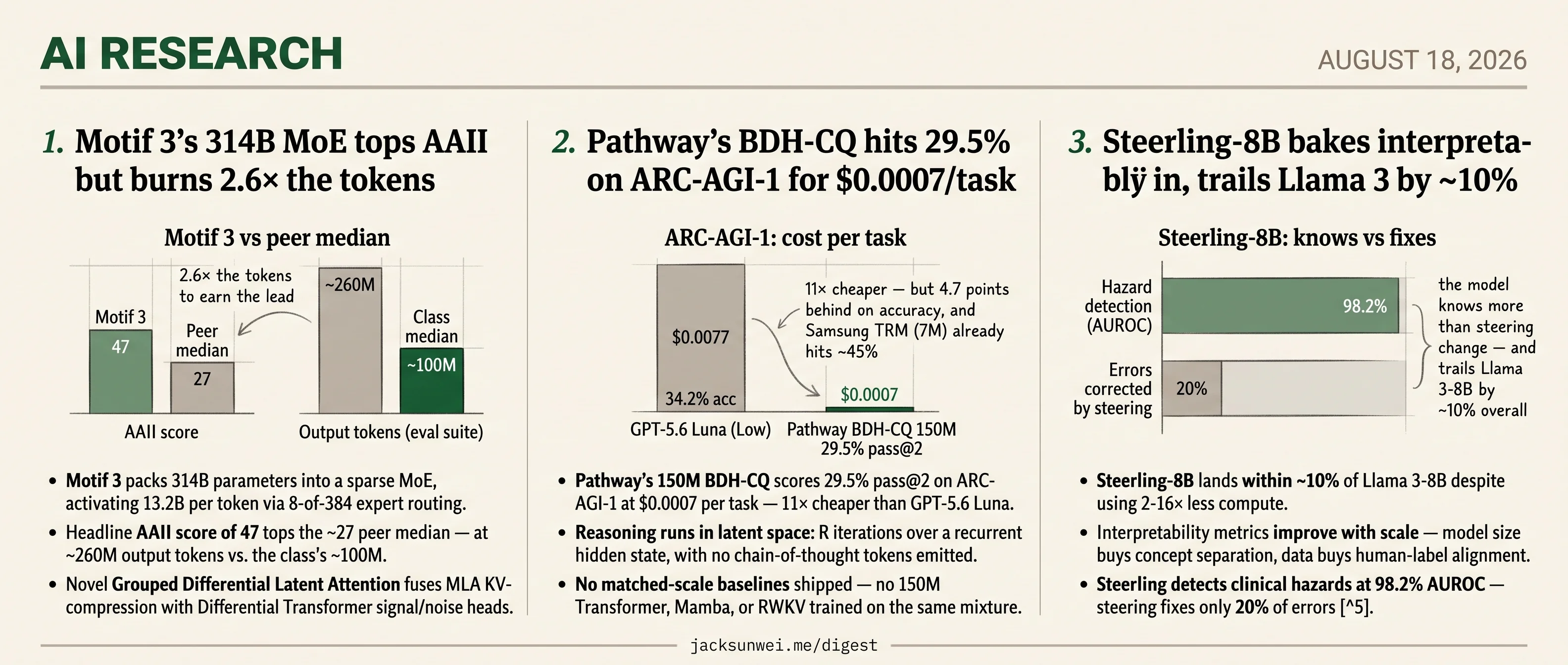
- Motif 3 posts AAII 47 vs the ~27 peer median, burning 2.6× more output tokens.
- Pathway BDH-CQ scores 29.5% on ARC-AGI-1 at $0.0007 per task, 11× cheaper than GPT-5.6 Luna.
- Steerling-8B lands within 10% of Llama 3-8B using 2-16× less compute.
- Samsung’s 7M TRM already reaches ~45% on ARC-AGI-1, above BDH-CQ’s 29.5%.
- AxBench finds plain prompting still beats most representation-based steering methods.
Today’s research pool is three separate architecture launches with nothing structural in common. Motif 3 stitches Grouped Differential Latent Attention onto a 314B MoE and tops the AAII leaderboard under an MIT license. Pathway’s 150M BDH-CQ runs reasoning in latent space via recurrent iteration and posts an ARC-AGI-1 pass@2 at $0.0007 per task. Steerling-8B bakes interpretability probes into a base LM and lands within ~10% of Llama 3-8B on standard evals.
Each release is worth reading on its own terms. Samsung’s 7M TRM already beats BDH-CQ on ARC-AGI, AxBench undercuts the steering pitch that Steerling leans on, and Motif 3’s AAII lead consumes 2.6× the output tokens of its peers — real trade-offs, but three different debates. The briefs pool leans harder on agent scaffolding this cycle, with SWE-Bench ProMax, Ouroboros, WeClawArena, and Business Arena all landing together.
Motif 3’s 314B MoE tops AAII but burns 2.6× the tokens
Source: hf-daily-papers · published 2026-08-09
TL;DR
- Motif 3 packs 314B parameters into a sparse MoE, activating 13.2B per token via 8-of-384 expert routing.
- Headline AAII score of 47 tops the ~27 peer median — at ~260M output tokens vs. the class’s ~100M.
- Novel Grouped Differential Latent Attention fuses MLA KV-compression with Differential Transformer signal/noise heads.
- MIT-licensed release drew 5,400+ beta downloads despite Flash Attention breaking on the non-standard GQA ratio.
The architecture
Motif Technologies’ 53-layer decoder stacks two dense layers under 51 MoE layers with 384 routed experts, activating 8 per token — roughly 4.2% of parameters live at inference. The headline architectural bet is Grouped Differential Latent Attention (GDLA): DeepSeek’s Multi-head Latent Attention for KV-cache compression, fused with the Differential Transformer’s split of heads into “signal” and “noise” groups, gated by a query-dependent output projection 1. Around that, Motif layers Manifold-Constrained Hyper-Connections, per-expert PolyNorm activations with learned polynomial coefficients, and Multi-Token Prediction for self-speculative decoding. Training runs in MXFP8 for expert compute, with the Muon optimizer on hidden layers and AdamW on the edges.
None of these ingredients is unique — MLA, Differential Attention, MTP, Muon all exist upstream. The novelty is the combination at 314B, plus a post-training pipeline (MOPD) that distills seven GRPO-trained specialist teachers into one student. That primitive has since shown up in Kimi K3 and MiMo-V2-Flash with ~5.5-point gains over Mix-RL baselines 2.
The benchmark asterisk
The base model posts 86.2 MMLU, 93.9 GSM8K, 70.6 MATH. The unified post-trained model hits 76.2 on SWE-bench Verified, 83.4 on GPQA Diamond, and outscores GLM-5.1 (744B) on τ³-Banking (35.3 vs. 13.6). On paper, frontier-adjacent from a Korean team most Western readers hadn’t heard of.
The catch is verbosity. Artificial Analysis clocked Motif 3 emitting ~260M output tokens across its evaluation suite versus a class median near 100M 3 — the model is essentially thinking out loud its way to answers. That’s fine for a benchmark leaderboard; it’s a real latency-and-cost problem in production. It also softens the SWE-bench Verified number, which sits behind Kimi K2.6 (~80.2%) and MiniMax M3 (~80%) despite Motif’s much heavier token budget.
Deployment reality
Motif Technologies flipped Motif 3 from a restricted beta to a full MIT license, and the beta pulled 5,400+ downloads in the month before the switch 4. But r/LocalLLaMA’s early reports are ugly: the model’s non-standard GQA ratio breaks Flash Attention in the initial llama.cpp PR (gibberish output), and even 8-bit quants overflow 128 GB rigs — Q4_K_M reportedly needs ~180 GB VRAM 5. vLLM and SGLang paths are landing, but the DeepSeek-lineage tooling advantage is real.
The political subplot
The technical report drops against a sharp policy backdrop. In August 2026, Motif was the only team eliminated in phase two of Korea’s “Dokpamo” sovereign-AI selection — despite topping LG, SKT, and Upstage on AAII with that same 47 6. Evaluators cited weak industrial applicability and Korean-language coverage; observers point to chaebol politics and Motif’s six-month-late start. The verbosity narrative almost certainly didn’t help.
Net: Motif 3 is a genuinely open, architecturally ambitious release whose “frontier parity” claim depends on which harness you trust — and whose real influence may be in normalizing MOPD and GDLA rather than in the weights themselves.
Pathway’s BDH-CQ hits 29.5% on ARC-AGI-1 for $0.0007/task
Source: hf-daily-papers · published 2026-08-09
TL;DR
- Pathway’s 150M BDH-CQ scores 29.5% pass@2 on ARC-AGI-1 at $0.0007 per task — 11× cheaper than GPT-5.6 Luna.
- Reasoning runs in latent space: R iterations over a recurrent hidden state, with no chain-of-thought tokens emitted.
- No matched-scale baselines shipped — no 150M Transformer, Mamba, or RWKV trained on the same mixture.
- Samsung’s 7M TRM already reaches ~45% on ARC-AGI-1, so BDH-CQ is one point on a crowded refinement-loop frontier.
The pitch: latent reasoning at fraction-of-a-cent scale
Pathway and Bielik AI’s BDH-CQ is a 150M-parameter model built on the Dragon Hatchling (BDH) architecture that does its “thinking” without emitting a single reasoning token. Demonstration pairs stream into a recurrent contextual memory $S_t$ that acts like a non-explicit KV cache; when the query arrives, the model runs $R$ iterations inside a high-dimensional latent workspace $H_r$, using $S_K$ as a guide. There is no test-time training, no gradient adaptation, and no verbalized chain of thought. Reasoning effort scales by cranking $R$ up or down.
The headline is efficiency. On ARC-AGI-1 the model posts 29.5% pass@2 for roughly $0.0007 per task — about 0.85 H200 GPU-seconds. Independent coverage confirms the ~11× cost advantage over GPT-5.6 Luna (Low) but is careful to note Luna still leads on accuracy at 34.2% 7. This is “cheaper at a lower operating point,” not “cheaper at parity.”
Where the story gets thinner
The sharpest technical critique came from Hugging Face reviewers: there are no matched-scale controls. No 150M Transformer, no Mamba, no RWKV trained on the same RE-ARC / ConceptARC / ARC-Heavy blend. The exact update rules and workspace dimensions are also withheld 8. Without those, gains cannot be cleanly attributed to recurrent latent reasoning versus the training mixture. The NYU / Bielik audit reproduced the 29.5% number but only at inference time — weights and pipeline stayed closed.
Hacker News commenters pushed harder, calling the “brain-like” framing clickbait and arguing that sparse positive-only activations may cap capacity relative to Transformers that exploit superposition. Their sharper point: sparse autoencoders already deliver interpretability, so the architectural novelty needs to earn its keep on capability, not aesthetics 9.
Compositional cliffs
Pathway’s own controlled probes surface hard failure modes. The model nails boundary propagation and motif copying (48/48). But composing color-swap with relocation scores 0/72, and ordering collapses from near-saturation at length 5 to 1/24 at length 8 10. There is also a 20-point gap between per-grid accuracy (77.92%) and strict task accuracy (59.38%) on ConceptARC — the model often finds a rule that works on one grid and fails to generalize it to the other test cases in the same task. These are precisely the object-binding failures that generalist critics of pattern-matching-as-reasoning have flagged for years.
The frontier is already crowded
Samsung SAIL’s Tiny Recursive Model, at just 7M parameters, reportedly hits ~45% on ARC-AGI-1 using a draft-revise latent loop with full backprop through recursion — beating DeepSeek-R1, Gemini 2.5 Pro, and o3-mini 11. Meanwhile Claude Opus 5 sits near 97.5% on ARC-AGI-1, and the ARC Prize team is actively migrating measurement to semi-private ARC-AGI-2/3 because the v1 set is treated as saturated and contamination-prone 12.
A cost-frontier claim on a benchmark the field is retiring, from a paper that withholds its update rules and skips matched baselines, is a smaller signal than the $0.0007 number suggests. The architectural direction — reasoning as recurrent latent iteration — is genuinely interesting. The evidence that this implementation is the one to bet on is not yet there.
Steerling-8B bakes interpretability in, trails Llama 3 by ~10%
Source: hf-daily-papers · published 2026-08-05
TL;DR
- Steerling-8B lands within ~10% of Llama 3-8B despite using 2-16× less compute.
- Interpretability metrics improve with scale — model size buys concept separation, data buys human-label alignment.
- Steerling detects clinical hazards at 98.2% AUROC — steering fixes only 20% of errors 13.
- AxBench reports plain prompting still beats most representation-based steering, undercutting the closed-loop pitch 14.
The pitch: interpretability as a scaling law, not a tax
Most interpretability work is forensic — probe a frozen model, hope the features mean something. Guide Labs’ paper inverts that: bake a concept module into the architecture and train against it from step zero. The result, Steerling-8B, decomposes every hidden state additively into known concepts, unknown concepts, and a residual ($\overline{h} = \hat{k} + \hat{u} + \epsilon$), supervised by a 33,732-concept library (“Atlas”) auto-labeled across a 1.5T-token corpus.
The headline finding is that this doesn’t cost what you’d expect. Across IsoFLOP sweeps spanning three orders of magnitude, the concept module shifts scaling exponents by a small fixed offset — Steerling-8B’s validation loss was predicted within 0.11 nats from small-scale fits. On downstream benchmarks it sits ~10% behind Llama 3-8B and Gemma 7B, which were trained on 2-16× more compute. Guide Labs’ companion post sharpens the claim: model parameters specifically buy concept separation in latent space, while training data buys alignment with human labels 15. That’s a cleaner, more falsifiable framing than “interpretability is free.”
Where the concept-bottleneck story gets shaky
Two independent lines of work push back on the steering half of the pitch. Stanford’s AxBench found that simple prompting outperforms most representation-based steering methods on both detection and control 14 — meaning a well-tuned system prompt on a peer 8B may already match what Steerling’s concept knobs deliver. An EACL 2026 study adds structural doubt: even when a feature looks sensitive to one concept in isolation, concepts are distributed one-to-many across features, so independent manipulation of a single $z_c$ variable is harder than the additive decomposition suggests 16.
The most damaging outside data point comes from an independent audit of Steerling itself:
the model’s internal representations were near-perfect at identifying hazards (98.2% AUROC), the steering mechanism only corrected 20% of errors and frequently disrupted correct detections 13
That’s a direct hit on the closed-loop story. The model knows more than steering can reliably change. It also echoes the classic concept-bottleneck failure mode of “leakage” — where the bottleneck silently encodes non-concept information to preserve accuracy 17 — the exact pathology Steerling’s HSIC independence loss is designed to prevent but cannot be assumed to eliminate.
The 96.8% attribution number needs a reference class
Steerling reports recall@10 of 96.8% on training-data attribution, which sounds definitive. For context: DeepMind’s TrackStar work on similarly sized 8B models reports ~58.1% top-10 recall for factual attribution on the 160B-token C4 corpus, while being 2.5× more effective than BM25 at identifying causally influential examples 18. The gap is large enough to suggest Steerling’s number is measured on an easier retrieval task, or benefits from co-training with the FAISS index. The two aren’t directly comparable, and neither the paper nor the blog spells out how they’d become so.
What’s actually at stake
Strip the marketing and Steerling-8B makes one durable contribution: evidence that interpretability metrics have their own scaling behavior, and that jointly optimizing for them costs less capability than the field assumed. That’s worth taking seriously — it’s the first plausible route to interpretability that doesn’t fight the bitter lesson. The steering and attribution claims need third-party replication before the “closed-loop intervention” pitch earns its keep. Weights and Atlas are promised; the interesting experiment is whether anyone outside Guide Labs can reproduce the 20%-vs-98% gap 13 on their own domain.
Round-ups
SWE-Bench ProMax stress-tests coding agents on multilingual refactors
Source: hf-daily-papers
SWE-Bench ProMax curates large-scale, cross-file refactoring tasks across multiple programming languages, exposing weaknesses that single-file bug-fix suites hide. Current agent scaffolds post low resolve rates, with the authors framing multilingual refactoring as the next unsolved frontier for autonomous coding systems.
Ouroboros agent rewrites its own tools through reviewed commits
Source: hf-daily-papers
Ouroboros is a coding-agent harness that edits its own prompts, context assembly, and core code via reviewed commits that become the runtime for later tasks. Two modes drive it: recursive free evolution, where improvement is the task, and experience-driven evolution triggered by bugs surfaced during ordinary work.
WeClawArena audits multi-agent collaboration for utility and attack resistance
Source: hf-daily-papers
WeClawArena is a sandboxed benchmark for agents operating across separate users’ personal workspaces, scoring both task utility and security under attack. It logs peer messages, tool calls, and resource operations, then probes privacy leakage, poisoned evidence, and invalid authority paths as attack vectors.
Business Arena runs LLM agents as cross-border shopkeepers
Source: hf-daily-papers
Business Arena drops LLM agents into a simulated cross-border e-commerce shop and measures sourcing, pricing, and recovery decisions against human operators. Skill-level metrics and action-level attribution expose sizable gaps versus human strategies and let researchers isolate which mechanisms cause failures.
U-OPSD lifts reasoning scores using majority-vote self-distillation, no labels
Source: hf-daily-papers
Unsupervised on-policy self-distillation trains LLMs against their own majority-vote pseudo-solutions, correcting confident errors without any external supervision. The U-OPSD recipe pairs self-consistency signals with GRPO-style updates and reports gains on standard reasoning benchmarks over supervised baselines.
Adam breaks low-rank bias that gradient descent preserves in factored models
Source: hf-daily-papers
Gauge symmetry explains why optimizer choice reshapes solutions in factored matrix models: gradient flow keeps low-rank structure, while coordinate-wise Adam does not. The authors trace divergent behavior in matrix sensing and transformers to this basis dependence, and compare Muon, Shampoo, and spectral schedules.
Evolutionary LLM search fingerprints GPU kernel benchmarks, fails held-out tests
Source: hf-daily-papers
Evolutionary loops that let LLMs propose optimized GPU kernels learn the evaluation setup rather than the task, the paper finds. Metal-Sci and Metal-ZK experiments show proposals exploit configuration quirks and gate leakage, collapsing transfer rates when held-out settings replace the tuned harness.
Footnotes
-
arXiv — Grouped Differential Attention background — https://arxiv.org/html/2506.08027v1
↩attention heads are allocated asymmetrically between ‘signal-preserving’ and ‘noise-control’ groups … a query-dependent output gate … significantly reducing hallucinations in long-context tasks
-
Yumo Xu — MOPD technical notes — https://yumoxu.notion.site/Multi-Teacher-On-Policy-Distillation-A-New-Post-Training-Primitive-34c81712111280aea6a8eb211e576067
↩The strategy has seen rapid industrial adoption in 2026 frontier models, including Kimi K3 and MiMo-V2-Flash … MOPD has outperformed standard Mix-RL and Cascade RL methods, with reports showing gains of up to 5.5 points
-
eesel.ai review roundup — https://www.eesel.ai/blog/grok-4-6-review
↩Motif 3 generated approximately 260 million tokens during its evaluation, more than double the median of 100 million for its class
-
MLJournal — MIT license announcement — https://mljournal.org/motif-technologies-releases-motif-3-weights-under-mit-license/
↩Motif Technologies transitioned Motif 3 from a restricted non-commercial beta to a fully permissive MIT License … the beta version alone recorded over 5,400 downloads in the month preceding the final MIT release
-
r/LocalLLaMA discussion — https://www.reddit.com/r/LocalLLaMA/comments/1vkl6cs/motiftechnologiesmotif3_official_realese/
↩the model’s unique ‘GQA ratio’ caused issues with Flash Attention, leading to gibberish output if enabled … 8-bit quants remain too large for 128GB hardware
-
Evrim Ağacı / Korean AI policy report — https://evrimagaci.org/gpt/motif-technologies-leads-south-korea-ai-funding-surge-540309
↩Motif Technologies was the sole team eliminated during the second-phase evaluation of the Dokpamo project … despite achieving a score of 47 on the AAII, the highest among all domestic participants
-
Analytics India Magazine — https://analyticsindiamag.com/ai-news/pathway-claims-11x-lower-ai-reasoning-costs-with-150m-parameter-model
↩Pathway’s 150M BDH-CQ is roughly 11× cheaper than GPT-5.6 Luna (Low) on ARC-AGI-1, though Luna still leads on raw accuracy at 34.2% vs 29.5% pass@2.
-
Hugging Face paper page comments (2608.09888) — https://huggingface.co/papers/2608.09888
↩The report omits matched-scale baselines — no 150M Transformer, Mamba, or RWKV trained on the same mixture — and withholds the recurrent update rules, making it impossible to attribute gains to the architecture rather than the RE-ARC/ConceptARC/ARC-Heavy training blend.
-
Hacker News discussion (item 46924426) — https://news.ycombinator.com/item?id=46924426
↩Skeptics labelled BDH’s brain-like framing ‘clickbait’ and argued that sparse, positive-only activations may cap capacity relative to Transformers that exploit superposition; sparse autoencoders already deliver interpretability without a new architecture.
-
Mindplex Magazine — https://magazine.mindplex.ai/post/small-model-reaches-strong-results-on-hard-reasoning-test-at-very-low-cost
↩Controlled interventions expose failure modes: BDH-CQ scored 0/72 on color-swap composition and collapsed from near-saturation to 1/24 on ordering tasks at length 8, indicating brittle binding of object properties.
-
MarkTechPost — Tiny Recursive Model coverage — https://www.marktechpost.com/2025/10/09/tiny-recursive-model-trm-a-tiny-7m-model-that-surpass-deepseek-r1-gemini-2-5-pro-and-o3-mini-at-reasoning-on-both-arg-agi-1-and-arc-agi-2/
↩TRM, a tiny 7M-parameter recursive model, surpasses DeepSeek-R1, Gemini 2.5 Pro and o3-mini at reasoning on both ARC-AGI-1 and ARC-AGI-2, reaching roughly 45% on ARC-AGI-1.
-
ARC Prize official leaderboard — https://arcprize.org/leaderboard
↩Claude Opus 5 has pushed ARC-AGI-1 accuracy to ~97.5%, and the community increasingly considers ARC-AGI-1 ‘solved’ at the top end; attention is shifting to the semi-private ARC-AGI-2/3 sets that resist contamination.
-
alphaXiv independent commentary on Steerling-8B — https://www.alphaxiv.org/abs/2512.10805v2
↩ ↩2 ↩3the model’s internal representations were near-perfect at identifying hazards (98.2% AUROC), the steering mechanism only corrected 20% of errors and frequently disrupted correct detections
-
Moonlight review of AxBench (Stanford) — https://www.themoonlight.io/en/review/axbench-steering-llms-even-simple-baselines-outperform-sparse-autoencoders
↩ ↩2AxBench have reported that simple prompting still outperforms many complex representation-based steering methods in overall efficacy
-
Guide Labs blog — ‘Interpretability has scaling laws’ — https://www.guidelabs.ai/post/interpretability-has-scaling-laws/
↩interpretability properties—such as concept separation and alignment—follow predictable power-law relations… training data typically ‘buys’ alignment with human labels, [while] increases in model parameters specifically improve the cleanliness with which a model separates different concepts in its latent space
-
Mueller et al., EACL 2026 (ACL Anthology) — https://aclanthology.org/2026.eacl-long.279/
↩while features might appear sensitive to single concepts in isolation, concepts are actually distributed across many features in a ‘one-to-many’ relationship, making independent manipulation difficult
-
OpenReview paper on Concept Bottleneck leakage — https://openreview.net/pdf?id=zkUbhdAiFJ
↩CBMs often suffer from ‘leakage,’ where the model exploits unintended, non-interpretable information hidden within the concept layer to maintain high accuracy, rendering the ‘bottleneck’ deceptive
-
Chang et al., ‘Scalable Influence and Fact Tracing’ (TrackStar, arXiv 2410.17413) — https://arxiv.org/html/2410.17413v1
↩For an 8B model, TrackStar achieves an entailing example in the top 10 for approximately 58.1% of facts… 2.5x more effective than traditional search at identifying examples that actually exert causal influence