Molt, Synap, Interactive Training 2: agent-infra ships without the comparison
Three agent-infrastructure papers land — an RL framework, a memory lifecycle, a training protocol — each without the baseline that would justify its design bets.
Molt, Synap, Interactive Training 2: agent-infra ships without the comparison
TL;DR
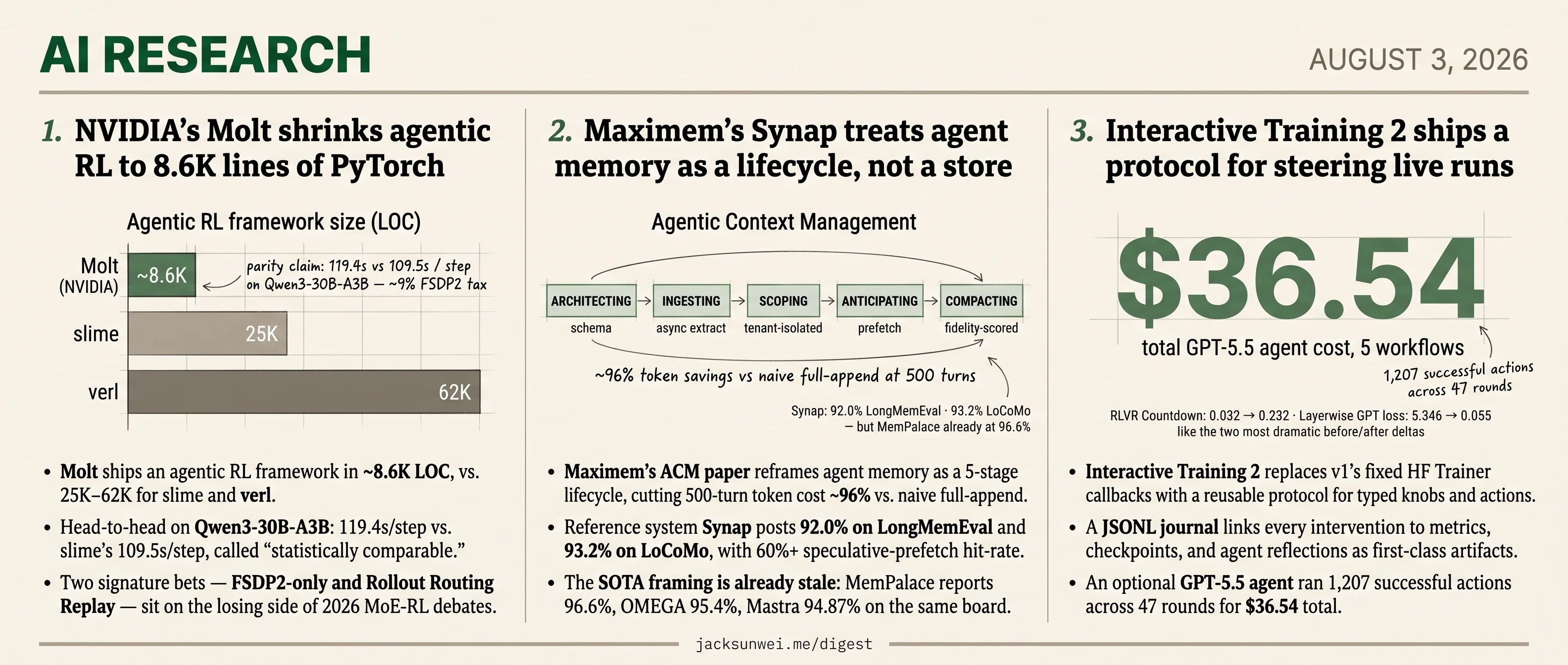
- NVIDIA’s Molt ships agentic RL in 8.6K LOC, minus convergence curves against slime or verl.
- Maximem’s Synap posts 92.0% on LongMemEval, already trailing MemPalace’s 96.6%.
- Interactive Training 2 replaces HF Trainer callbacks with a typed knob protocol, no static-schedule baseline included.
- A GPT-5.5 agent logged 1,207 interventions across 47 rounds for $36.54 in the IT2 run.
Today’s three research leads are all agent-infrastructure releases — a lean RL framework from NVIDIA, an agent-memory lifecycle from Maximem, and a v2 protocol for steering live training runs. None of them claims a capability record. All of them ship plumbing: fewer lines of code, cheaper long-context memory, a typed vocabulary for mid-run interventions.
The pattern worth naming is what each paper doesn’t include. Molt ships in 8.6K LOC but skips convergence curves against slime and verl, the frameworks it’s positioned against. Synap posts 92.0% on LongMemEval — a number MemPalace already beat weeks ago at 96.6%. Interactive Training 2 ships a clean protocol and a $36.54 agent-driven run, but no head-to-head against a tuned static schedule. Three design bets, three missing baselines. The scaffolding is real; the case that it wins is deferred.
NVIDIA’s Molt shrinks agentic RL to 8.6K lines of PyTorch
Source: hf-daily-papers · published 2026-07-21
TL;DR
- Molt ships an agentic RL framework in ~8.6K LOC, vs. 25K–62K for slime and verl.
- Head-to-head on Qwen3-30B-A3B: 119.4s/step vs. slime’s 109.5s/step, called “statistically comparable.”
- Two signature bets — FSDP2-only and Rollout Routing Replay — sit on the losing side of 2026 MoE-RL debates.
- No convergence curves and no sandboxing story for tool-using agents.
The pitch: a codebase you can hold in your head
Molt’s thesis is that agentic RL research is bottlenecked by framework complexity, not GPUs. Every new estimator or rollout scheme has to thread through trainer, distributed backend, and rollout glue in stacks like verl (~62K LOC) or slime (~25K LOC). Molt collapses that to ~8.6K LOC by picking exactly one training backend (NeMo AutoModel on FSDP2) and one serving engine (vLLM), then composing them with Ray into a “four concepts, one loop” architecture: Agent, Generator, Trainer, Estimator.
The design gimmick that actually matters is token-exact transport: the rollout engine ships token IDs and per-token log-probs directly to the trainer, so the model never trains on a token it didn’t generate. That closes a real bug class — retokenization drift between vLLM sampling and the training forward — that has silently corrupted RL runs in other stacks.
The parity claim is doing a lot of work
Molt’s headline benchmark is a single Qwen3-30B-A3B run at 16K context: 119.4 ± 2.3 seconds per optimizer step vs. slime’s 109.5 ± 10.3. The paper frames this as parity. Independent framework analysis suggests it’s actually the expected FSDP2 tax showing up on schedule — Megatron-FSDP runs roughly 15% faster than native FSDP2 at frontier scale, because DTensor per-parameter sharding forces shard permutation into communication buffers on every collective, costing ~10% on models like Llama 3 405B 1. Molt’s ~9% gap sits squarely inside that band.
More concerning: the 30B benchmark is “throughput-only.” The authors flag an upstream MoE forward mismatch between actor and reference log-probs and gate affected batches out for correctness — meaning there’s no convergence curve backing the parity claim. Critics on the community roundup have already flagged that the report omits which MoE models and tasks anchor the parity story 2.
Rollout Routing Replay is a contested bet
For MoE consistency, Molt adopts Rollout Routing Replay (R3): the rollout engine records its expert selections, and the trainer replays them so sparse graphs match. This is the choice that may age worst. Concrete measurements show routing metadata — which of 128+ experts fired for each token across dozens of layers — can consume up to 97% of the rollout-to-trainer payload in disaggregated setups 3. Router-replay-free alternatives like Router Shift Policy Optimization and Online IcePop skip the transfer entirely, using sequence-level masking or soft reweighting to correct for router drift 4.
Molt’s two most distinctive technical choices — FSDP2-only and R3 — both sit on the wrong side of active debates.
What’s missing
The ChatAgent loopback lets existing OpenAI/Anthropic-SDK agents train unmodified — genuinely useful. But there’s no sandboxing story for tool execution. Adjacent work like Dressage bolts Paddock/Sandbox layers onto slime specifically because untrusted code in rollouts is an attack surface, and even those authors report thousands of ephemeral Docker instances becoming the dominant bottleneck 5. Anyone running Molt on real browser or code-execution agents inherits that problem. Meanwhile RLinf reports 1.07–1.7× speedups over verl and slime on math and up to 2.43× on embodied RL through “macro-to-micro” flow transformations — a reminder that the throughput frontier is still moving 6.
Molt is a credible research-ergonomics play. It is not, on the current evidence, a throughput leader — and the paper would be stronger if it stopped pretending otherwise.
Maximem’s Synap treats agent memory as a lifecycle, not a store
Source: hf-daily-papers · published 2026-07-22
TL;DR
- Maximem’s ACM paper reframes agent memory as a 5-stage lifecycle, cutting 500-turn token cost ~96% vs. naive full-append.
- Reference system Synap posts 92.0% on LongMemEval and 93.2% on LoCoMo, with 60%+ speculative-prefetch hit-rate.
- The SOTA framing is already stale: MemPalace reports 96.6%, OMEGA 95.4%, Mastra 94.87% on the same board.
- Security and multi-tenant poisoning — the obvious next attack surface — get no serious treatment.
Memory-as-storage is the wrong abstraction
The paper’s core argument is that production agents don’t fail because they can’t reason — they fail because nobody manages what’s in the context window turn by turn. Treating memory as a RAG-style store optimizes only the read/write moments and leaves the hard decisions (what to retain, how to compact, how to fit a budget) unowned. The proposed alternative, Agentic Context Management (ACM), decomposes the problem into five primitives running across a User → Customer → Client scope hierarchy.
flowchart LR
    A[Turn input] --> B[Architecting<br/>bespoke schema]
    B --> C[Ingesting<br/>async extract + entity resolve]
    C --> D[Scoping<br/>narrowest-first, tenant-isolated]
    D --> E[Anticipating<br/>speculative prefetch]
    E --> F[Compacting<br/>verified, fidelity-scored]
    F -.retry on loss.-> F
The economically load-bearing claim is the shift from O(n²) to O(n) token cost. For a 500-turn conversation with a 4k window, ACM saves roughly 96% of tokens against the naive append pattern — and Chroma’s independent “context rot” work backs the premise: two-hop reasoning accuracy on frontier models drops from ~99% to ~70% purely by inflating surrounding context, even inside advertised windows 7. “Just buy a bigger window” is not a real answer.
The benchmark story is messier than the abstract admits
Synap’s 92.0% on LongMemEval and 93.2% on LoCoMo are strong in isolation, but the mid-2026 leaderboard has moved: MemPalace claims 96.6% raw (100% with a hybrid rerank), OMEGA 95.4%, Mastra 94.87%, and Mem0 sits at ~94.4% 8. Letta’s own numbers show Zep’s Graphiti at 94.8% on DMR with 18.5-point gains and 90% lower latency over summarization baselines on LongMemEval 9. “State of the art” here depends heavily on which week you cite.
The evaluations themselves are also under fire. Zep has publicly argued that on LoCoMo “simple full-context baselines often outperform complex retrieval systems” 10 — a challenge that lands on every memory vendor, Synap included. A Penfield Labs proposal notes that LongMemEval questions rarely need more than ~115K tokens of history, so million-token models can “cheat” by stuffing everything into a single prompt 11. Synap compounds the concern by using GPT-5-mini as both answerer and judge.
Simple full-context baselines often outperform complex retrieval systems. 10
Where the paper is more defensible is the retrieval-regime study: vector search wins on semantic gaps (NL→Code MRR@10 of 0.91 vs 0.29 for keyword), keyword wins on entity-heavy science queries (SciQ 0.81 vs 0.61), and vector indexing runs 60–100× slower than keyword. That justifies both the hybrid design and the async ingestion pipeline on grounds independent of the leaderboard.
The gap: memory as attack surface
The scoping primitive is pitched as multi-tenant isolation, but the paper does not seriously engage with what shared, persistent memory does to the threat model. Community write-ups are already flagging that a single poisoned note can compromise an entire multi-agent system through shared memory 12, and the paper’s public treatment of memory poisoning, embedding inversion, and GDPR erasure over embedded inferences stops at TLS/AES boilerplate. The lifecycle framing and cost math are the durable contributions here; the next round of criticism will land on governance, not accuracy.
Interactive Training 2 ships a protocol for steering live runs
Source: hf-daily-papers · published 2026-07-16
TL;DR
- Interactive Training 2 replaces v1’s fixed HF Trainer callbacks with a reusable protocol for typed knobs and actions.
- A JSONL journal links every intervention to metrics, checkpoints, and agent reflections as first-class artifacts.
- An optional GPT-5.5 agent ran 1,207 successful actions across 47 rounds for $36.54 total.
- The paper is a system release, not a comparison — no head-to-head against tuned static schedules.
From callbacks to a protocol
The v1 demo shipped at EMNLP 2025 was essentially a control panel for Hugging Face Trainer: a fixed vocabulary of commands hard-wired to callback hooks 13. Interactive Training 2 throws that out. Now training code declares its own typed knobs (learning rate, data-mix weights, per-layer LRs) and actions (checkpoint, evaluate, curriculum step), and the framework brokers requests between them and any controller — a human clicking in Aim, a script, or an LLM agent — over one shared protocol.
The mechanism that makes this safe is the control point. Instead of asynchronously mutating a running loop, the trainer calls session.step() at declared boundaries; the session drains a request queue, validates and applies the changes, then resumes. That lets the same protocol cover a HF Trainer callback, a raw PyTorch loop patched at optimizer.step(), a two-optimizer Muon–AdamW setup, and an RL loop. Five workflows, one interface:
| Workflow | Round 0 | Best (LLM-guided) | Metric |
|---|---|---|---|
| Sentiment (BERT/IMDB) | 0.354 | 0.220 | loss ↓ |
| Sentiment Mixing (SST-5+) | 0.568 | 0.656 | macro-F1 ↑ |
| Layerwise GPT (27 LRs) | 5.346 | 0.055 | loss ↓ |
| Muon–AdamW GPT | 4.797 | 4.429 | loss ↓ |
| RLVR Countdown (Qwen3-0.6B) | 0.032 | 0.232 | accuracy ↑ |
The journal is the actual product
The durable contribution is not the LLM agent — it’s the auditable journal. Every metric, request, execution result, and agent reflection lands in a chronological JSONL log tied to specific checkpoints. That is exactly the substrate HITL research says you need: structured approval gates and traceable interventions have been shown to drop critical error rates from ~23% to ~5% in analogous agentic pipelines 14. Until now, “we bumped the LR at step 40k because loss plateaued” lived in someone’s Slack. IT2 makes it a diffable artifact.
The optional agent runs a Plan → Act → Reflect loop. The reflection step is where it earns its keep: on RLVR Countdown, a stalled Round 5 produced a written diagnosis (wider clipping, more exploration) that fed Rounds 6–7 and pushed accuracy from 0.032 to 0.232. Across all five workflows the agent cost $36.54 total, negligible against the compute it steered.
Where the story wobbles
Independent reviewers flag the obvious gap: this is a system release, not a controlled study. IT2 shows live steering can work; it does not show it beats a well-tuned static schedule with the same compute budget 15. That matters because the broader agentic-HPT debate is unsettled — proponents argue LLM controllers can modify code and adapt serially in ways Bayesian sweeps cannot 16, while budget-matched comparisons often shrink the gap to sub-1%.
The paper’s own limitations are more concrete. The training loop blocks waiting for the agent, which is bad economics at scale, and there is no handling for stale requests that arrive after the relevant step has passed 17. Neither issue is trivial under FSDP or DeepSpeed. And an exposed REST-style steering interface is a new attack surface: production ML-security guidance calls for multi-signal authorization and step-up auth on any endpoint that mutates training parameters 18, which IT2’s current threat model does not obviously satisfy.
Read IT2 as infrastructure to watch, not yet infrastructure to point at a billion-dollar pretraining run. The protocol and the journal are the parts worth stealing today.
Round-ups
Multi-Head Latent Control unifies 5 LLM agent decisions
Source: hf-daily-papers
A new interface lets an LLM agent decide in one pass whether to keep reasoning, defer to a stronger model, ask for more information, call a tool, or abstain. The method replaces prompt routing and task-specific fine-tuning with parallel latent control heads over a shared backbone.
Skill Self-Play co-evolves LLM skills to escape narrow domains
Source: hf-daily-papers
Qwen researchers frame agent skills as the middle ground between environment-bound self-training and open-ended self-generation. Paired skills co-evolve during interaction, widening the task distribution while keeping verification reliable enough to block the misleading rewards that pollute open self-play loops.
IDEAgent optimizes research ideas for quality and diversity together
Source: hf-daily-papers
Prior LLM ideation systems chase either novelty or soundness, producing clusters of near-duplicates or piles of trivial concepts. IDEAgent runs a quality-diversity search that treats the two objectives jointly, aiming for a Pareto front of distinct, defensible research proposals.
Study charts scaling laws for native multimodal pretraining
Source: hf-daily-papers
Training multimodal models from scratch, rather than bolting vision onto a text LLM, avoids the optimization asymmetries of late fusion. The paper maps how loss scales with compute, data, and modality mix under this native regime, filling a gap left by text-first scaling laws.
SceneActBench tests VLM agents on 5 multi-object 3D tasks
Source: hf-daily-papers
Most 3D benchmarks grade text answers or single-object edits. SceneActBench runs VLM agents through a unified action loop over full scenes from PNG images, video frames, or supplied assets, scoring whether they can actually manipulate the environments they perceive.
Training-free trick keeps autoregressive world models 3D-consistent
Source: hf-daily-papers
Chunk-by-chunk video generators with bounded KV caches forget earlier frames, so revisited locations drift. The Close-the-Loop method restores prior context at revisit time without retraining, keeping a persistent 3D world stable across long-horizon renders for gaming and immersive content.
ID-V2V restyles video while preserving faces and performance
Source: hf-daily-papers
Eyeline Labs propagates scene, lighting, and style edits from a single keyframe across a source video while locking facial likeness, expressions, and eye gaze. The formulation targets storytelling workflows where generative restylization typically breaks actor identity between shots.
Footnotes
-
hanifleo.com — ‘Anatomy of RL Frameworks’ — https://www.hanifleo.com/anatomy-of-rl-frameworks/
↩Megatron-FSDP is approximately 15% faster than native PyTorch FSDP2 when training frontier-scale models… FSDP2 uses per-parameter sharding via PyTorch DTensor, which requires permuting shards into communication buffers for every collective operation… a 10% performance overhead in models like Llama 3 405B
-
AI Weekly (community roundup) — https://aiweekly.co/alerts/nvidia-nemo-open-sources-molt-a-lean-pytorch-agentic-rl-stack
↩the vLLM team publicly endorsed the project on X… critics point out that the initial technical report lacks specific details, such as the exact MoE models used in benchmarks or the specific tasks behind the parity claims
-
zoeyli.com — ‘The Cost of Routing Replay’ — https://zoeyli.com/reinforcement%20learning/The-Cost-of-Routing-Replay/
↩the routing data itself—detailing which of the 128+ experts were selected for every token across dozens of layers—can account for up to 97% of the generation payload
-
Online IcePop (Notion technical note) — https://hijkzzz.notion.site/Stabilizing-MoE-RL-Without-Router-Replay-The-Online-IcePop-Seq-level-Mask-TIS-Solution-2cbd9a33ecc9806e80d9f746d4edebad
↩‘router-replay-free’ methods… Router Shift Policy Optimization (RSPO) and Online IcePop use soft adjustment mechanisms or sequence-level masking to quantify routing deviations without the need for expensive data transfers
-
Northflank — ‘RL agents in secure sandboxes’ — https://northflank.com/blog/reinforcement-learning-agents-in-secure-sandboxes
↩Dressage… introduces a ‘Paddock’ and ‘Sandbox’ architecture to handle tool use and code execution within isolated Docker or Kubernetes containers… the system overhead of spinning up thousands of ephemeral Docker instances can become a primary bottleneck
-
Spheron — RLinf deployment writeup — https://www.spheron.network/blog/deploy-rlinf-gpu-cloud-reinforcement-learning-embodied-agentic-ai/
↩RLinf reportedly outperforms both [verl and slime] by 1.07x to 1.7x in math-reasoning tasks and up to 2.43x in embodied RL, primarily through more efficient ‘macro-to-micro’ flow transformations
-
Chroma ‘Context Rot’ report (W&B write-up) — https://wandb.ai/byyoung3/ml-news/reports/Chroma-Research-Warns-of-Context-Rot-as-LLMs-Falter-with-Long-Inputs—VmlldzoxMzczMjQ4MQ
↩every model experienced performance decay as context grew…while models maintain near 99% accuracy on short inputs, two-hop reasoning tasks can drop to 70% accuracy simply by increasing the surrounding text
-
MemPalace GitHub leaderboard issue — https://github.com/MemPalace/mempalace/issues/314
↩MemPalace reports 96.6% raw accuracy for local-only storage and a 100% hybrid score…OMEGA at 95.4% and Mastra at 94.87%…Mem0 also remains a top-tier contender with a reported 94.4% accuracy
-
Letta blog — benchmarking AI agent memory — https://www.letta.com/blog/benchmarking-ai-agent-memory/
↩In the Deep Memory Retrieval (DMR) benchmark, Zep’s graph-based approach outperformed MemGPT (94.8% vs. 93.4%)…On the more rigorous LongMemEval, accuracy improvements reached up to 18.5% with a 90% reduction in latency compared to baseline summarization
-
Mem0 blog (Mem0 vs Zep) — https://mem0.ai/blog/mem0-vs-zep
↩ ↩2Zep has publicly criticized Mem0’s claims of state-of-the-art performance on the LoCoMo benchmark, arguing the evaluation is flawed and that simple full-context baselines often outperform complex retrieval systems
-
Penfield Labs Substack — proposal for new long-memory benchmark — https://penfieldlabs.substack.com/p/proposal-a-new-benchmark-for-long
↩individual questions in LongMemEval often only require ~115K tokens of context, [so] frontier models with 1M+ token windows can ‘cheat’ the benchmark by stuffing the entire history into a single prompt, bypassing the need for a sophisticated memory system entirely
-
Micheal Lanham / Medium — shared memory as attack surface — https://medium.com/@Micheal-Lanham/your-ai-agents-shared-memory-is-their-best-coordinator-and-their-biggest-attack-surface-900f1e5571b1
↩a single ‘poisoned note’ or contaminated document can compromise an entire multi-agent system
-
ACL Anthology - Interactive Training v1 (EMNLP 2025 demo) — https://aclanthology.org/2025.emnlp-demos.65.pdf
↩The original 2025 version was built around a fixed vocabulary of commands specifically tailored for Hugging Face Trainer callbacks; Version 2 introduces a reusable protocol where training applications can register custom settings and actions.
-
Witness.ai - Human-in-the-Loop patterns — https://witness.ai/blog/human-in-the-loop-ai/
↩Moving from full autonomy to structured HITL patterns—such as Approval Gates and Confidence-Based Routing—has been shown to reduce critical error rates from 23% to approximately 5.1%.
-
ResearchGate summary of IT2 (independent review) — https://www.researchgate.net/publication/410698349_Interactive_Training_2_Auditable_Control_Plane_for_Live_Model_Training
↩The project is a system release rather than a controlled comparative study… the interface makes live tuning possible, [but] it does not yet prove that human intervention consistently outperforms well-tuned static schedules.
-
Hacker News discussion (Karpathy-cited thread on agentic HPT) — https://news.ycombinator.com/item?id=47293311
↩Agents offer a distinct advantage by exploring serially, modifying code arbitrarily, and using tools to adapt based on intermediate results… sequential agents can use binary search to narrow down optimal U-shaped parameter settings more efficiently than parallelized sweeps.
-
arXiv HTML of IT2 paper (limitations section) — https://arxiv.org/html/2607.18314v1
↩The training loop currently pauses while waiting for the LLM agent to respond… the system does not yet handle stale requests—if a response arrives after the training process has already moved past the relevant step, it might no longer be applicable.
-
Cycle.io - Securing ML Pipelines — https://cycle.io/learn/securing-ml-pipelines-and-models
↩Real-time control channels are susceptible to session hijacking. Defenders recommend multi-signal authorization and step-up authentication for privileged actions, such as modifying production infrastructure or shifting high-impact training parameters.