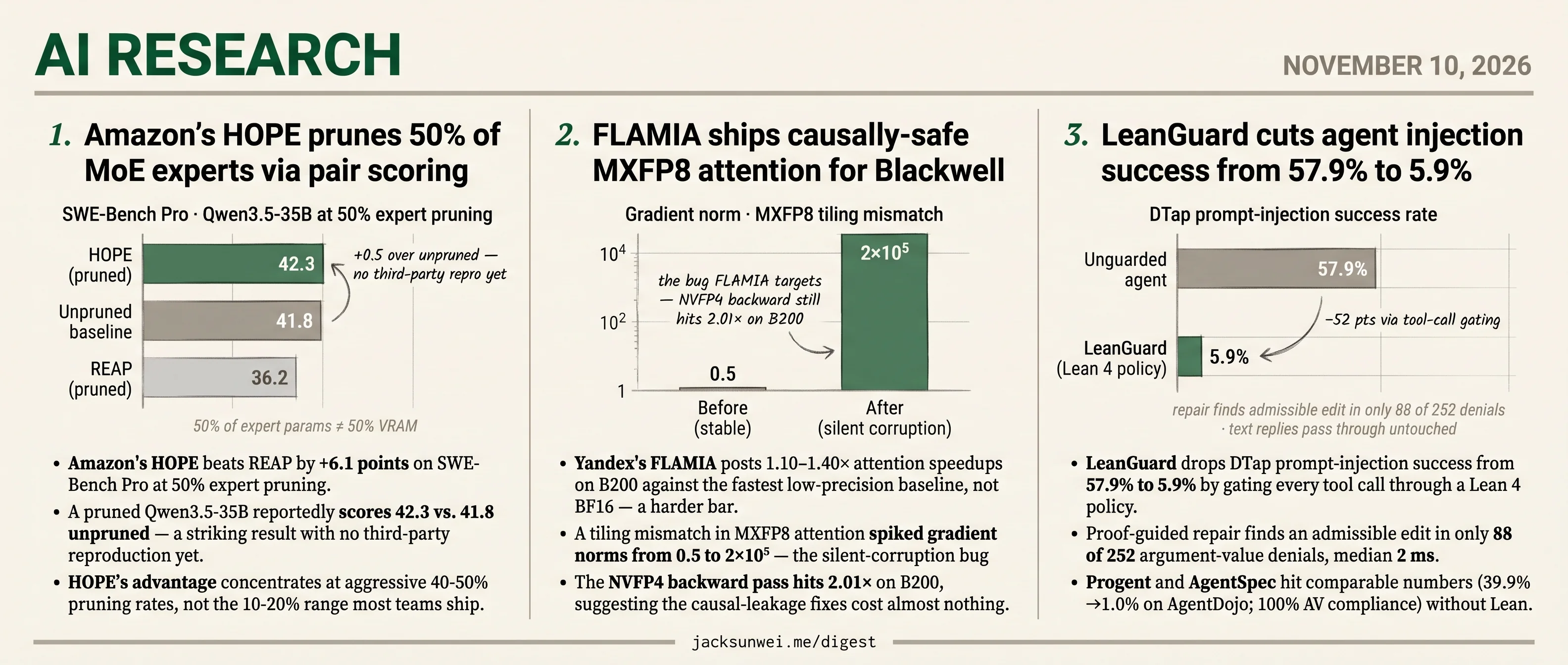
HOPE prunes MoE 50%, FLAMIA speeds MXFP8 attention, LeanGuard gates tools
Three unrelated systems-research wins today: HOPE prunes MoE experts, FLAMIA accelerates MXFP8 attention, LeanGuard gates agent tool calls via Lean 4.
HOPE prunes MoE 50%, FLAMIA speeds MXFP8 attention, LeanGuard gates tools
TL;DR
- Amazon’s HOPE beats REAP by 6.1 points on SWE-Bench Pro at 50% MoE expert pruning.
- Yandex’s FLAMIA posts 1.10–1.40× MXFP8 attention speedups on B200 against low-precision baselines.
- LeanGuard drops DTap prompt-injection success from 57.9% to 5.9% via Lean 4 tool-call gating.
- Meta’s lp_fa4 posts a louder 1.6× over BF16 in the same low-precision attention race.
- Text-only jailbreaks still pass LeanGuard untouched because gating only covers tool arguments.
Three systems-side research results land today and they don’t rhyme. Amazon’s HOPE uses pair scoring to prune 50% of MoE experts and reports a 6.1-point lead over REAP on SWE-Bench Pro — concentrated at aggressive 40-50% rates most teams don’t actually ship, and without third-party reproduction yet. Yandex’s FLAMIA targets a silent-corruption bug in MXFP8 attention on Blackwell and measures its 1.10-1.40× speedups against the fastest low-precision baseline rather than BF16 — a harder bar, even as Meta’s lp_fa4 posts a louder 1.6× over BF16 in the same crowded kernel race. LeanGuard gates every agent tool call through a Lean 4 policy and drops DTap prompt-injection success from 57.9% to 5.9%, while Progent and AgentSpec hit comparable numbers without the proof machinery, and text-only replies walk straight past the gate.
The round-up pool runs wider: Library of Layers reorders transformer blocks per task without retraining, BYOD converts autoregressive LLMs into diffusion models via LoRA, and two coding-agent benchmarks (CrossSWE, self-evolving harnesses) expose blind spots single-repo SWE-Bench never surfaced.
Amazon’s HOPE prunes 50% of MoE experts via pair scoring
Source: huggingface-blog · published 2026-11-09
TL;DR
- Amazon’s HOPE beats REAP by +6.1 points on SWE-Bench Pro at 50% expert pruning.
- A pruned Qwen3.5-35B reportedly scores 42.3 vs. 41.8 unpruned — a striking result with no third-party reproduction yet.
- HOPE’s advantage concentrates at aggressive 40-50% pruning rates, not the 10-20% range most teams ship.
- 50% of expert params ≠ 50% VRAM — attention, embeddings, and shared layers stay resident regardless.
From independent scoring to pairwise interaction
Mixture-of-Experts models hide an awkward bill: only ~8 of 256 experts fire per token, but the full set must sit in RAM. In Qwen3.5-122B, expert MLPs eat 95% of a 250 GB footprint. First-order pruners — REAP, MAN, EAN — rank each expert independently against calibration data and delete the bottom half.
Amazon’s HOPE rejects the independence assumption. It builds an $E \times E$ interaction matrix $F$ whose diagonal recovers REAP-style per-expert importance and whose off-diagonals capture gate-weighted output products between co-activated expert pairs. Pruning becomes a quadratic program — $\min_p p^\top F p$ under a cardinality constraint — solved via continuous relaxation in 1-2 seconds per layer. The output is a standard Hugging Face checkpoint that drops into vLLM or SGLang unchanged.
The core bet: experts form stable cooperative clusters, and first-order methods tear those clusters apart under aggressive compression.
Where the advantage actually lives
At 50% pruning, HOPE posts the best average rank (1.58 vs. REAP’s 2.42) across Qwen3.5-122B, Qwen3.5-35B, and GLM-4.5-Air. The headline result is agentic coding: on Qwen3.5-35B, HOPE hits 42.3 on SWE-Bench Pro against the unpruned model’s 41.8, while REAP collapses to 36.2.
Context matters. Cerebras’s REAP (ICLR 2026) already claimed 50% expert removal with 97.6% of coding ability retained on Qwen3-480B-Coder 1, and it’s already integrated into vLLM’s LLM-Compressor as a one-shot, training-free pipeline 2. HOPE isn’t opening a new deployment path — it’s competing on the quality frontier inside infrastructure REAP shipped first.
And the advantage is rate-dependent. An independent writeup notes HOPE’s lead shrinks sharply at 10-20% pruning, where the added 6-7% calibration time gets hard to justify 3. If you’re trimming modestly to fit a specific GPU bucket, first-order methods remain competitive.
The calibration caveat nobody is selling
The “pruned model beats unpruned” claim is partly a calibration-matching artifact. Forkast’s review reproduced the author pattern — coding-calibrated runs (Evol-CodeAlpaca) exceed baseline, but swapping in SWE-Bench Verified calibration pushes the same pruning method below baseline 4. NVIDIA’s own REAP guide generalizes the warning: a C4-calibrated prune can hollow out legal or medical capability because different workloads route to disjoint expert subsets 5.
The pruned checkpoint’s identity is locked to the calibration domain, regardless of which saliency objective produced it.
Translated: HOPE doesn’t give you a smaller general-purpose model. It gives you a smaller domain-specialized model whose domain is whatever you calibrated against.
What’s actually freed
The r/openagi discussion flags a framing issue the Amazon post glosses: removing 50% of expert parameters doesn’t halve VRAM, because attention, embeddings, and shared layers remain resident 6. For the “fit GLM-4.5-Air on a smaller card” pitch the numbers imply, the real memory delta is meaningfully smaller than “95% of 250 GB is experts” suggests.
HOPE is a genuine methodological step — pairwise co-activation is a real advance over independent-expert scoring, and the limitation that it ignores cross-layer and higher-order interactions is honestly disclosed. But the production story needs three asterisks: the win concentrates at aggressive pruning, the “lossless” results are calibration-bound, and the VRAM math is softer than the headlines. The Qwen3.5-35B result that beats its own baseline deserves a third-party reproduction before anyone plans capacity around it.
FLAMIA ships causally-safe MXFP8 attention for Blackwell
Source: hf-daily-papers · published 2026-11-02
TL;DR
- Yandex’s FLAMIA posts 1.10–1.40× attention speedups on B200 against the fastest low-precision baseline, not BF16 — a harder bar.
- A tiling mismatch in MXFP8 attention spiked gradient norms from 0.5 to 2×10⁵ — the silent-corruption bug FLAMIA targets.
- The NVFP4 backward pass hits 2.01× on B200, suggesting the causal-leakage fixes cost almost nothing.
- Meta’s
lp_fa4and TLX-JFA post bigger headline numbers (1.6× over BF16; 50% backward gains) in a crowded race.
The speedup is modest on purpose
FLAMIA’s reported 1.10–1.40× on B200 and 1.06–1.42× on B300 look unimpressive next to Meta’s lp_fa4, which claims 2.85 PFLOPS forward and roughly 1.6× over BF16 on standard LLM shapes 7, or Meta’s TLX-based Jagged Flash Attention, which beats the May 2026 FA4 by 13% forward and 50% backward in ~3.2K lines of code 8. The gap is a framing choice: Meta benchmarks against BF16, Yandex against already-optimized low-precision kernels — probably FA4-class. Beating an FA4 baseline by 40% is a very different claim than beating BF16 by 60%.
That reframing matters because it tells you what FLAMIA is actually selling: not peak FLOPs, but a kernel you can drop into a packed variable-length training run without the thing silently diverging.
Causal leakage is the real story
Shared per-block scales in MXFP8 can leak information across the causal mask — future tokens influence the scale factor used on past tokens’ quantized operands. In one FLAMIA stress test, a tiling mismatch caused gradient norms to jump from 0.5 to 2×10⁵, effectively breaking training 9. That’s not a hypothetical numerical wobble; it’s the kind of silent corruption that makes a run look fine on loss curves for hours before collapse.
FLAMIA’s response is three-part: token-block scaling that reuses quantized operands across matrix orientations, targeted safeguards against scale-induced leakage, and forward/backward numerical consistency. The NVFP4 backward path still clocks 2.01× on B200 9, so the safety work doesn’t tax throughput much. One unusual disclosure: the kernels were co-written with Claude and Codex under human review 9 — rare transparency for a low-level CUDA/PTX artifact.
flowchart LR
    Q[Query block] --> S{Shared MXFP8 scale}
    K[Key block, future tokens] -.leaks via scale.-> S
    S --> A[Attention scores]
    A --> M[Causal mask]
    M --> O[Output]
    style K stroke:#c33,stroke-width:2px
Does the stability claim scale?
FLAMIA validates on Llama-style pretraining, but the abstract doesn’t disclose model or token scale — a gap worth flagging given what the surrounding literature has already shown. NVIDIA’s own NVFP4 run on a 12B model over 10T tokens reached MMLU-pro 62.58 vs. 62.62 for FP8, with 1.59× BF16 throughput 10 — parity is achievable at frontier scale. But LMSYS’s RL-focused post-mortem found that OCP’s default rounding modes diverge at 15T tokens and that round-to-infinity for scale factors is required to converge Llama 3 8B 11. Whether FLAMIA’s recipe matches that detail is worth checking against the paper.
SageAttention3 provides the sharpest dissent: its 8-bit SageBwd is lossless on GSM8K/DROP fine-tunes but the authors concede slower pretraining convergence from scratch, with error concentrated in the backward-pass score gradient (dS) 12 — exactly the path FLAMIA is quantizing most aggressively.
Takeaway
Low-precision Blackwell attention is a three-way race between Meta’s lp_fa4, Meta’s TLX-JFA, and Yandex’s FLAMIA, and the headline PFLOPS numbers favor Meta. FLAMIA’s bet is that correctness engineering — causal-safe shared scales, consistent forward/backward numerics, packed variable-length scheduling without repacking — is where the practical wins sit once you’re already past FA4. If that bet holds at frontier scale, the 1.4× becomes the floor, not the ceiling.
LeanGuard cuts agent injection success from 57.9% to 5.9%
Source: hf-daily-papers · published 2026-11-01
TL;DR
- LeanGuard drops DTap prompt-injection success from 57.9% to 5.9% by gating every tool call through a Lean 4 policy.
- Proof-guided repair finds an admissible edit in only 88 of 252 argument-value denials, median 2 ms.
- Progent and AgentSpec hit comparable numbers (39.9%→1.0% on AgentDojo; 100% AV compliance) without Lean.
- Text-only replies pass through untouched — a jailbroken model can still give dangerous advice.
The pitch: a theorem prover in the request path
LeanGuard sits between a tool-using agent and its environment, checks each proposed call against a policy written in Lean 4, and fails closed. Policies combine state predicates with scoped past-time temporal operators, and the runtime decision procedure is proved equivalent to a LeanLTL semantics — that kernel-level guarantee is the paper’s actual novelty, not the headline attack-success numbers. On Tau-Bench with five Qwen models (0.8B–27B), unguarded agents make at least 33 forbidden calls; LeanGuard makes zero, and benign task success doesn’t move significantly. On DTap, direct prompt-injection success collapses from 57.9% to 5.9% 13.
flowchart LR
    A[Agent] -->|proposed call| B{Lean4 policy check}
    B -->|admitted| C[Environment]
    B -->|denied| D[Feedback to agent]
    B -->|denied| E[Proof-guided repair search]
    E -->|admissible edit| C
    F[Harmful text reply] -.bypasses guard.-> G((User))
    A --> F
The repair claim is narrower than the abstract suggests
The paper markets a “proof-guided repair” path where Lean metaprogramming searches for a nearby call that satisfies the policy, without invoking the model. The appendix is more honest: of 252 denials traceable to argument values, repair found a provably admissible edit in 88 cases — about 35% — in a median of 2 ms and a max of 70 ms 13. The agent then has to choose to re-issue the repaired call, which happened 16 of 22 times in replay. That’s a fast suggestion layer on one narrow failure class, not general recovery. Feedback (returning the violated rule and a hint) is the more broadly useful mechanism, improving task success for four of five models over a bare denial.
The crowded field makes the Lean premium hard to justify
LeanGuard arrives in an active 2025–26 cohort of agent policy enforcers, and the comparisons sharpen the question of what you’re paying for.
| System | Approach | Headline result |
|---|---|---|
| LeanGuard | Lean4 + LeanLTL kernel | DTap 57.9%→5.9% 13 |
| Progent | Symbolic rules, monotonic confinement | AgentDojo 39.9%→1.0% 14 |
| AgentSpec | Lightweight DSL, triggers + predicates | 100% AV compliance; >90% code-agent 15 |
| Invariant / Snyk | NL→SMT-LIB-2.0, inline Gateway/MCP-scan | Industrial MCP packaging 16 |
Progent hits a deeper attack-success reduction without a theorem prover 14. AgentSpec’s DSL is far cheaper to author 15. Invariant’s SMT route already ships as inline infrastructure 16. The distinctive LeanGuard bet — formal equivalence between runtime and semantics — matters for high-assurance domains, but the attack-success delta over symbolic competitors is small.
Where the guard isn’t looking
Two caveats will shape where this lands. First, LeanGuard only inspects tool calls; harmful or deceptive text replies pass through untouched 1718. A model that’s been jailbroken into giving dangerous advice is still jailbroken. Second, the policy itself becomes the attack surface:
“The weak point moves from the model’s judgment to the written policy.” 17
Policies are hand-written in Lean 4, and tools with opaque effects — arbitrary shell commands, for example — get auto-blocked under a “Not Modeled” category 18, which is safe but shrinks the usable tool surface.
The honest read: LeanGuard is the strongest formal guarantee in a field where lighter symbolic tools are already hitting similar numbers. Telecom and finance teams with formal-methods headcount will care. Most agent builders will reach for Progent or an SMT gateway first.
Round-ups
Library of Layers reorders transformer blocks per task at inference
Source: hf-daily-papers
Library of Layers treats a transformer’s blocks as a reusable pool and routes through them in task-specific orders at inference time. The approach yields interpretable routing and sparsity across reasoning, multilingual, and safety benchmarks without retraining the underlying parameters.
BYOD converts autoregressive LLMs into diffusion models via LoRA
Source: hf-daily-papers
BYOD turns pretrained autoregressive language models into diffusion language models using LoRA adapters and bidirectional attention over masked sequences. The parameter-efficient conversion preserves base-model knowledge while unlocking parallel generation, reaching competitive perplexity at a fraction of full-training cost.
History Forcing keeps few-step video diffusion consistent over long horizons
Source: hf-daily-papers
History Forcing distills autoregressive video diffusion models by injecting residuals from long historical context into the student’s targets. The trick cuts drift in few-step generation, letting fast samplers maintain scene consistency across horizons where prior on-policy distillation collapses.
DR Pixel runs deep research directly on rendered PDF pages
Source: hf-daily-papers
DR Pixel is an open-source vision-language agent that skips text extraction and reasons over document page images instead. On the authors’ DRPixelBench, counterfactual credit reweighting during agentic finetuning lifts retrieval recall and multi-hop reasoning across scientific papers.
CrossSWE benchmark shows LLMs stumble across linked repositories
Source: hf-daily-papers
CrossSWE evaluates coding agents on joint development spanning multiple repositories, where changes must propagate through shared interfaces and dependencies. Current frontier LLMs post weak Pass@1 scores, exposing a blind spot that single-repo benchmarks like SWE-Bench never surfaced.
Self-evolving coding agents forget earlier tasks, THU study finds
Source: hf-daily-papers
When coding agents iteratively rewrite their own harness across new software-engineering tasks, performance on earlier SWE-Bench and FeatureBench datasets drops sharply. The empirical study frames harness self-evolution as a catastrophic-forgetting problem and proposes Meta-Harness as a mitigation.
Collaborative Intelligence Benchmark exposes teamwork gaps in top LLM agents
Source: hf-daily-papers
A new 240-task suite scores AI agents as teammates rather than solo problem-solvers, and finds that even frontier closed- and open-weight models falter on collaboration dimensions like handling interpersonal pressure and avoiding unsafe shortcuts, with weaknesses uncorrelated to raw capability.
Footnotes
-
Cerebras blog — REAP announcement — https://www.cerebras.ai/blog/reap
↩REAP achieved a 50% reduction in experts while retaining 97.6% of its original coding ability and 96.7% on the agentic SWE-Bench [on Qwen3-480B-Coder]
-
vLLM LLM-Compressor docs — REAP MoE sparsity ablations — https://docs.vllm.ai/projects/llm-compressor/en/latest/research/reap-moe-sparsity-ablations-soyr-redhat/
↩REAP is a one-shot method, requiring no additional fine-tuning or training after the experts are removed … integrated into vLLM and llm-compressor
-
Extrapolator.ai — independent HOPE writeup — https://extrapolator.ai/2026/11/09/amazon-hope-prunes-moe-experts-using-second-order-interactions/
↩At lower pruning rates (10–20%), the advantage over simpler first-order methods diminishes, making the added 6–7% calibration time harder to justify for less aggressive compression needs
-
Forkast — ‘Amazon’s HOPE … why calibration matters’ — https://forkast.news/amazons-hope-pruning-method-shows-why-calibration-matters-for-agentic-coding/
↩When calibrated with coding-focused data (Evol-CodeAlpaca), the pruned model actually surpassed its unpruned baseline on certain benchmarks. However, using a different calibration set (SWE-Bench Verified) resulted in scores below the baseline
-
NVIDIA Developer Forums — ‘Why you should REAP it yourself’ — https://forums.developer.nvidia.com/t/why-you-should-reap-it-yourself-live-moe-expert-pruning-in-vllm/364098
↩A model pruned using generic benchmarks (like C4) may fail in specialized domains such as legal or medical processing because different workloads activate entirely different expert subsets
-
Reddit r/openagi discussion of HOPE — https://www.reddit.com/r/openagi/comments/1xrxsbk/amazon_shares_hope_research_and_code_reports/
↩although HOPE can remove 50% of expert parameters, this does not translate to a 50% reduction in total VRAM usage, as the base model architecture and attention mechanisms still occupy significant memory
-
n1n.ai — Low-Precision FlashAttention-4 on Blackwell — https://explore.n1n.ai/blog/low-precision-flashattention-4-block-scaled-attention-blackwell-2026-09-17
↩Meta’s lp_fa4 achieves 2.85 PFLOPS in forward passes on standard LLM shapes, representing a 1.6× improvement over BF16 baselines — a stronger peak than FLAMIA’s 1.10–1.40× over its fastest baseline.
-
PyTorch Blog — Optimizing Jagged FlashAttention with TLX — https://pytorch.org/blog/optimizing-jagged-flash-attention-with-tlx-the-road-toward-sota-fa4-on-blackwell/
↩Meta’s TLX-based Jagged Flash Attention is approximately 3× more concise (3.2K lines vs 10K for FA4) and outperforms the May 2026 version of FA4 by 13% in forward and 50% in backward passes for ‘jagged’ variable-length sequences.
-
AI Weekly summary of FLAMIA release — https://aiweekly.co/alerts/yandex-research-opens-flamia-attention-kernels-for-blackwell
↩ ↩2 ↩3The NVFP4 backward pass reaches a 2.01x speedup on B200… In one stress test, a tiling mismatch caused gradient norms to jump from 0.5 to 2×10^5, effectively breaking the training process… kernels were co-developed with AI assistance from Claude and Codex under strict human review.
-
NVIDIA Developer Blog — NVFP4 pretraining — https://developer.nvidia.com/blog/using-nvfp4-low-precision-model-training-for-higher-throughput-without-losing-accuracy/
↩A 12B model trained on 10 trillion tokens with NVFP4 achieved MMLU-pro of 62.58%, nearly identical to the 62.62% achieved by the FP8 baseline, with up to a 1.59x throughput boost over BF16.
-
LMSYS blog on MXFP8/NVFP4 for RL — https://www.lmsys.org/blog/2026-07-29-mxfp8-nvfp4-rl/
↩The default OCP rounding modes can cause divergence; round-to-infinity for scale factors is required to converge Llama 3 8B on 15T tokens… and sampler/learner must use identical precision contracts to prevent policy divergence.
-
SageAttention3 (NeurIPS 2025) — https://proceedings.neurips.cc/paper_files/paper/2025/file/4db397e0f760cc573c681e81a01a3dba-Paper-Conference.pdf
↩SageBwd 8-bit training is lossless on fine-tuning benchmarks like GSM8K and DROP, but authors acknowledge slower convergence during pretraining from scratch, with error primarily from the backward-pass score gradient (dS).
-
LeanGuard paper (arXiv 2611.02332) — https://arxiv.org/html/2611.02332v1
↩ ↩2 ↩3For denials caused by argument values, the repair search found a provably admissible edit for 88 of 252 cases, in a median of 2 ms and a maximum of 70 ms, operating entirely without the language model.
-
Progent paper (arXiv 2504.11703) — https://arxiv.org/html/2504.11703v3
↩ ↩2Progent reduces the Attack Success Rate from 39.9% to 1.0% on AgentDojo while maintaining task utility, using symbolic rules over tool names and arguments under a monotonic confinement principle.
-
AgentSpec (ICSE’26 preprint, Poskitt et al.) — https://cposkitt.github.io/files/publications/agentspec_llm_enforcement_icse26.pdf
↩ ↩2A lightweight domain-specific language with structured triggers and predicates achieved 100% compliance in autonomous-vehicle simulations and prevented unsafe actions in over 90% of code-agent test cases.
-
Snyk Labs (Invariant Labs acquisition page) — https://labs.snyk.io/resources/snyk-labs-invariant-labs/
↩ ↩2Invariant’s SMT-aided analyzer translates natural-language policies into SMT-LIB-2.0 constraints checked at runtime, and its Gateway/MCP-scan tools sit inline to intercept actions before they occur.
-
learnagentic Substack — ‘What is a proof-checked guardrail?’ — https://learnagentic.substack.com/p/what-is-a-proof-checked-guardrail
↩ ↩2It stops forbidden actions but does not prevent harmful text-only replies, and its efficacy remains dependent on the quality of the manually drafted Lean policies — the weak point moves from the model’s judgment to the written policy.
-
ResearchPod episode on LeanGuard — https://researchpod.app/episode/fc2b0eff-349d-41b9-b853-7f9b1306f5a9
↩ ↩2The current proof-checked guards only apply to tool calls; they do not filter harmful text replies, and the system cannot model the effect of tools with opaque outcomes such as arbitrary shell commands, which are automatically blocked as ‘Not Modeled’.