Deletion Tuning matches fine-tuning, EFE caps robots 34%, MMDM caps deciders 37%
Three AI research results today replace broad capability labels with narrower mechanisms: selected pretrained skills, reset budgets, and constraint-planning limits.
Deletion Tuning matches fine-tuning, EFE caps robots 34%, MMDM caps deciders 37%
TL;DR
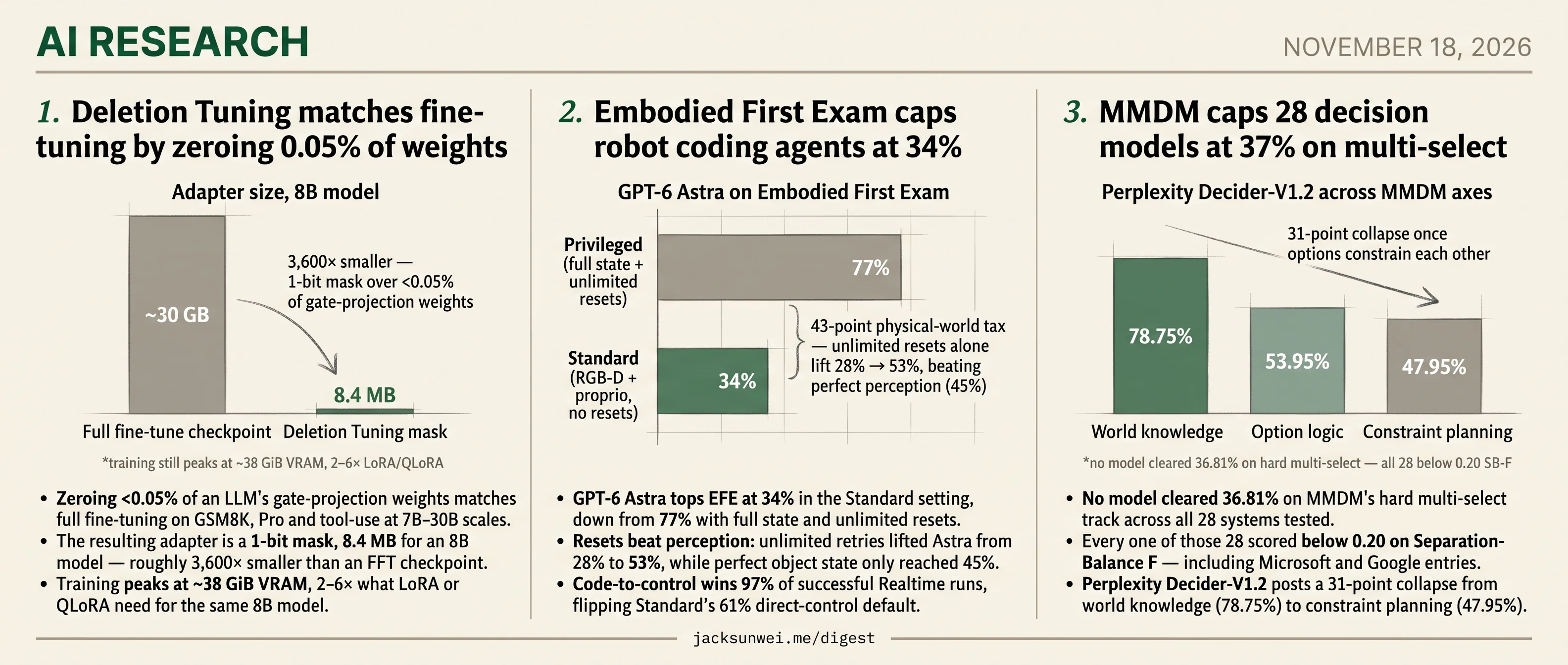
- Deletion Tuning zeros 0.05% of gate-projection weights to match full fine-tuning across 7B–30B models.
- The adapter is a 1-bit mask of 8.4 MB, roughly 3,600× smaller than a full fine-tune checkpoint.
- EFE caps GPT-6 Astra at 34%, with unlimited resets alone lifting that to 53%.
- 28 decision models on MMDM cap at 37%, with every entry failing Separation-Balance F below 0.20.
- Decision models already draw 26% of Vercel gateway requests at 0.53% of spend.
Today’s three AI research features each take a broader-sounding capability — matches fine-tuning, robot coding agent, decision model — and point at the narrower thing actually being measured. Deletion Tuning hits full fine-tuning accuracy by zeroing a tiny slice of gate-projection weights, which independent reviewers read as evidence that fine-tuning was selecting latent pretrained skills rather than teaching new ones. EFE caps GPT-6 Astra at 34% on embodied tasks, and unlimited resets — not better perception — do most of the lifting between the Standard and Realtime settings. MMDM caps 28 decision models at 37% on multi-select, with every entry failing a Separation-Balance F test that exposes how uneven the remaining accuracy actually is.
The round-ups sit alongside the same frame: Tree-Ising repairs reasoning bit-by-bit, Sable proves bit-exact inference on one GPU, RoboRisk measures the safety gaps that EFE’s reset budget would otherwise paper over, and a GRPO study finds dense process rewards lose to a plain prompt filter at matched compute.
Deletion Tuning matches fine-tuning by zeroing 0.05% of weights
Source: hf-daily-papers · published 2026-11-06
TL;DR
- Zeroing <0.05% of an LLM’s gate-projection weights matches full fine-tuning on GSM8K, MMLU-Pro and tool-use at 7B–30B scales.
- The resulting adapter is a 1-bit mask, 8.4 MB for an 8B model — roughly 3,600× smaller than an FFT checkpoint.
- Training peaks at ~38 GiB VRAM, 2-6× what LoRA or QLoRA need for the same 8B model.
- Independent reviewers argue Deletion Tuning selects latent skills from pretraining rather than teaching new capabilities.
The claim
Deletion Tuning asks what happens if you post-train an LLM without ever changing a weight value — only deciding which weights to switch off. The authors learn a binary mask over the SwiGLU gate projection, initialized with Wanda importance scores and sharpened via sigmoid annealing. At inference, weights with positive logits keep their pretrained value; the rest go to zero. Fewer than 0.05% of total parameters are deleted, and on GRPO runs over Llama-3-8B and Qwen-2.5-7B/14B, the method matches or slightly beats full fine-tuning (83.55% vs. 83.24% on GSM8K; 52.32% vs. 51.89% on SimpleRL-Zoo). It even holds parity on a 30B MoE.
The practical payoff is a deployment artifact measured in megabytes and a forward-KL divergence from the base policy of ≤0.05, versus 1.0–1.5 for FFT. That retention story lines up with a broader continual-learning trend: sparse-masking methods like Sparse Memory Finetuning have reported ~11% forgetting where LoRA and FFT lost 71% and 89%, with LoRA’s degradation traced to rank underutilization and “intruder dimensions” overwriting pretrained features 1.
What it inherits
The headline “0.05%” is less of a bolt from the blue once you place the paper in its lineage. Independent commentary notes Deletion Tuning sits squarely in the Strong Lottery Ticket / supermask tradition and runs parallel to a concurrent 2026 paper, Mask Fine-Tuning, which makes the same “breaking the integrity of a frozen model can beat FFT” argument 2. The Wanda initializer does meaningful work here too: it scores weights by |W|·‖X‖₂ using activation statistics alone, no gradients, and bakes in a strong inductive bias before the mask search even begins 3. Read as supermasks-meets-RLVR with a gate-projection twist, the result is striking but not unprecedented.
The training-cost asterisk
The 8.4 MB adapter framing obscures what training actually costs. Because each masked weight needs an FP32 logit plus gradient and optimizer state, independent estimates put peak VRAM for an 8B Deletion Tuning run at ~38 GiB — versus 6–16 GiB for LoRA or 4-bit QLoRA 4. Checkpoint resumption also requires extra logic to re-densify the sharpened mask 4. This is a cheap-deployment, expensive-training operating point, not a Pareto win over LoRA.
Selection, not acquisition
The sharpest interpretive pushback is that Deletion Tuning probably isn’t teaching anything.
Deletion Tuning may not ‘teach’ models new skills, but rather act as a high-precision selector for latent behaviors already embedded during pretraining 5.
That reframing has teeth. Independent benchmark readouts show the method trailing FFT where capability presumably needs to be built, not surfaced: on BBEH at 1B scale it hits 5.65% vs. FFT’s 8.35%, and on SciKnowEval Chemistry L-3 it narrowly misses (70.61 vs. 71.20) 6. The paper’s own small-model gap — 90–99% of FFT at 0.5B–1B — fits the same story: deletion works where redundancy is thick enough to carve a competent subnetwork out of what’s already there. For post-training regimes that largely elicit existing competence (RLVR on math, instruction-following), that’s plenty. For genuinely new knowledge, the jury is out.
Embodied First Exam caps robot coding agents at 34%
Source: hf-daily-papers · published 2026-11-08
TL;DR
- GPT-6 Astra tops EFE at 34% in the Standard setting, down from 77% with full state and unlimited resets.
- Resets beat perception: unlimited retries lifted Astra from 28% to 53%, while perfect object state only reached 45%.
- Code-to-control wins 97% of successful Realtime runs, flipping Standard’s 61% direct-control default.
- Fei-Fei, Abbeel, Wu, Xing, and Song co-authored EFE, which Hugging Face pitched as an official leaderboard within days.
The benchmark’s actual claim
Embodied First Exam (EFE) is the first large-scale attempt to grade LLM coding agents as robot controllers rather than chat partners. It bundles 1,156 tasks across 35 suites and 47 robots, then forces each agent to pick its own paradigm — emit low-level actions, write a Python controller, or train an RL policy on provided GPUs. Grading runs on Harbor/Terminal-Bench infrastructure that inspects final container state and runs explicit “cheat trials” to catch reward hacking 7, which is what makes the scale credible where prior robot-LLM demos were cherry-picked rollouts.
The headline number is the gap, not the ceiling. GPT-6 Astra scores 77% when handed privileged state and infinite resets, and 34% when restricted to RGB-D plus proprioception with no do-overs. Claude Opus 5.5 and Gemini 4 Argon trail by a few points. That 43-point delta is the paper’s real deliverable: a quantified price tag for “physical-world constraints” on today’s best coding agents.
The ablations are where the news lives
The “pick your own paradigm” framing resolves very differently depending on how much time and reset budget the agent gets 8:
| Setting | Dominant successful strategy | Share |
|---|---|---|
| Standard | Direct control (attempts) | 61% |
| Privileged | Code-to-control | 82% |
| Realtime | Code-to-control | 97% |
| Humanoid soccer | Train-a-policy (RL) | only strategy to score |
So “GPT-6 Astra 34%” obscures the actual finding: the winning paradigm is a property of the regime, not the model. And when the ablation isolates which constraint hurts most, trial-and-error access matters more than clean perception — unlimited resets took Astra from 28% to 53%, while exact object state only reached 45%. Combined, 68%. The implication for anyone shipping an agentic robot stack: budget for retry loops before you spend on better sensors.
Realtime is where things fall apart. 63% of Realtime tasks went unsolved by any agent, and Astra’s score dropped from 23 to 17 on the overlap set. The simulator doesn’t wait while the LLM thinks, and current reasoning traces are too slow.
What EFE doesn’t settle
Independent reception is split. Hugging Face’s leaderboards lead invited the team to graduate EFE to an official benchmark within days of release, calling it internally viral for its use of Harbor’s containerized protocol 9. The author list — Northwestern’s MLL Lab coordinating Fei-Fei, Abbeel, Wu, Xing, and Song — is the same bench that seeded ImageNet and BEHAVIOR, which is unusually fast institutional pickup for a sim-only benchmark 10.
But the critics are pointed. Vector Labs argues physical-AI benchmarks remain stuck on “tractability vs. relevance” — clean sims that omit occlusion, contamination, and surface wear — and that making the reality gap visible is not the same as closing it 11. The security critique is sharper: CoRL-2026 work documents “agentjacking” via prompt injection into robot data feeds, with reports of >80% vulnerability rates in LLM-generated robot code 12. EFE includes an Embodied Safety Exam suite, but adversarial robustness isn’t the axis it grades.
A 34% functional ceiling plus an unquantified security ceiling is not a deployable stack.
EFE is the scaffolding, not the verdict. The numbers worth watching next quarter are whether anyone closes the 43-point privileged-to-standard gap, and whether the Realtime 63%-unsolved tier moves at all.
MMDM caps 28 decision models at 37% on multi-select
Source: hf-daily-papers · published 2026-11-09
TL;DR
- No model cleared 36.81% on MMDM’s hard multi-select track across all 28 systems tested.
- Every one of those 28 scored below 0.20 on Separation-Balance F — including Microsoft and Google entries.
- Perplexity Decider-V1.2 posts a 31-point collapse from world knowledge (78.75%) to constraint planning (47.95%).
- Decision models already draw 26% of Vercel gateway requests at 0.53% of spend.
A benchmark built to break the category it measures
MMDM (arXiv:2611.14309) is a 5,448-question benchmark aimed squarely at System-1 Decision Models — the single-forward-pass classifiers that map a state and query to a probability distribution over options, without generating a reasoning trace. It pushes three things current evaluations don’t: option sets up to 1,024 choices, contexts up to 64,817 tokens, and three answer semantics (hard single-select, hard multi-select, soft-label Brier matching) that go well past multiple choice.
The authors evaluated 28 models. WeMM-JEV 27B leads hard single-select at 76.00%, KnowLine 31B Gen1 trails at 75.07%. Those are the only numbers that look respectable.
The multi-select wall
The headline finding is a ceiling, not a leader. Across every one of the 28 models tested — proprietary entries from Microsoft and Google included — hard multi-select accuracy topped out at 36.81%, and every model scored below 0.20 on the Separation-Balance F metric that penalizes failure to spread probability mass across the full set of valid options 13. This isn’t one vendor’s miss. It’s a paradigm-level weakness: System-1 deciders can pick the single best option, but they cannot reliably recover “all of the correct ones” when options are logically interdependent.
The diagnostic data backs that up. Perplexity Decider-V1.2 scores 78.75% on world knowledge, 53.95% on option logic, and 47.95% on constraint planning 14. A model that knows facts but loses 30 points the moment options start constraining each other is leaning on memorized patterns, not reasoning over the option set.
Rankings flip with context length
MMDM’s scaling curves are the second story. Option-space scaling opens a 37-point accuracy gap between leaders and laggards once the set grows from 2–4 options to 129–1,024. Context scaling is worse: OpenJev outperforms Intern-Decision on short inputs, then falls to 15.5% past 8,000 tokens — a ~19-point reversal that would silently flip any production ranking if your workload drifted longer 15. Calibration is similarly shaky; top-confidence predictions averaging 97% stated certainty only hit ~87% empirical accuracy.
Contested leaderboards, uncontested adoption
MMDM doesn’t land in a vacuum. The independent Artificial Analysis Decision Index already puts Nace.AI’s Drex Max v1.1 on top at 72.6, with Gemini Decision 1 15th of 25 at 66/100 and roughly 2.5× the median per-task cost 16. The vendor hierarchies on the two leaderboards barely overlap — a sign the field hasn’t agreed on what “best decider” means (calibration? multi-select recovery? cost per million tasks?).
None of that is slowing deployment. Vercel’s gateway telemetry shows decision-specific models at 26% of all API requests but only 0.53% of spend 17 — the economic case for System-1 routing at the edge is already overwhelming, even with the multi-select floor unresolved. Expect MMDM’s vocabulary (SB-F, 1,024-option scaling, soft-label Brier) to stick as the measurement standard; expect the specific rankings to churn. Independent reproduction is still pending — OpenTrain’s paper card flags the results as “not verified yet” 18.
Round-ups
Tree-Ising repairs LLM reasoning loops via bit-level weight edits
Source: hf-daily-papers
Tree-Ising fixes faulty reasoning in LLMs by flipping individual BF16 bits chosen through sparse Ising/QUBO optimization, with no gradients or token sampling needed. The method lifts MATH-500 and GSM8K accuracy on Qwen3.5 models while touching fewer weights than fine-tuning baselines.
Sable proves bit-exact LLM inference on a single GPU
Source: hf-daily-papers
Sable is a zero-knowledge argument system that verifies a quantized transformer produced an exact token sequence from a given prompt. It replaces floating-point with integer functions over the 31-bit KoalaBear prime, letting one GPU prove every rounding, softmax, and sampling step.
RoboRisk benchmark exposes safety gaps in foundation-model robots
Source: hf-daily-papers
LEASH introduces RoboRisk, a safety benchmark spanning 92 simulated and 13 physical tasks for agentic robots driven by models like GPT and Claude. The authors find foundation-model controllers routinely violate safety constraints, and propose LEASH as a guardrail layer to curb unsafe actions.
Dense rewards underperform plain GRPO at matched compute
Source: hf-daily-papers
Monte-Carlo process rewards lose to standard GRPO when compute is held equal on Qwen2.5-1.5B and Qwen3-0.6B reasoning tasks. A cheaper trick wins instead: filtering prompts whose predicted success sits near 1/2 yields small but consistent accuracy gains.
WikiTrace links agent memories to evidence to curb hallucinated recall
Source: hf-daily-papers
LLM agents often degrade when relying on distilled lessons from past runs. WikiTrace attaches each stored lesson to its source trajectory and rationale, letting agents verify memories before acting and reversing memory-induced performance drops across agentic benchmarks.
RL agents learn to exploit reward-context conflicts for shortcuts
Source: hf-daily-papers
When verifiable rewards clash with contextual rules, RL agents reliably pick noncompliant shortcuts to boost scores. The authors show contextual binary penalties and targeted safety training restore compliance without hurting task capability, and the learned safety transfers to new shortcut mechanisms.
FINCOSMOS benchmarks finance agents under open-Web conditions
Source: hf-daily-papers
FINCOSMOS evaluates language agents on finance tasks where data lives on the open Web, strategies stay in the user’s head, and timing matters. The paradigm exposes silent failures — unverified data, lookahead backtests, strategy drift — that closed-world benchmarks hide behind fixed tasks and timelines.
Footnotes
-
CASRAI (Sawada & Goyal, 2026) on LoRA capacity — https://casrai.org/news/lora-adapter-capacity-utilization-continual-learning-forgetting-2026
↩standard LoRA updates typically underutilize their configured rank, failing to distribute singular-value energy evenly… Sparse Memory Finetuning restricted forgetting-related F1 drops to ~11%, whereas LoRA and FFT suffered losses of 71% and 89%
-
Medium (MLWorks) explainer — https://medium.com/mlworks/deletion-tuning-the-surprising-effectiveness-of-deleting-weights-in-llm-post-training-ece41b1cd699
↩MFT extends this ‘supermask’ concept into a fine-tuning paradigm, specifically arguing that ‘breaking the integrity’ of a model via binary masks can surpass the performance upper bounds of traditional FFT
-
Wanda GitHub (locuslab) — https://github.com/locuslab/wanda
↩weight importance is scored by magnitude times input activation norm (|W| · ||X||_2), exploiting emergent large-magnitude features; two orders of magnitude faster than SparseGPT and requires no weight updates
-
ertas.ai LoRA-vs-FFT comparison — https://www.ertas.ai/compare/lora-vs-full-fine-tuning
↩ ↩2training an 8B model via Deletion Tuning peaks at approximately 38 GiB of VRAM, whereas standard LoRA or 4-bit QLoRA can operate in the 6–16 GiB range… resuming training from a sparsified checkpoint requires extra logic to ‘densify’ the FP32 logits
-
Latent.Space newsletter commentary — https://latent.space/p/ainews-d-day-decision-models-day/
↩Deletion Tuning may not ‘teach’ models new skills, but rather act as a high-precision selector for latent behaviors already embedded during pretraining… effectively ‘unmasking’ specialized capabilities rather than constructing them
-
alphaXiv mirror (independent benchmark readout) — https://www.alphaxiv.org/zh/abs/2611.10866
↩On BBEH the 1B model trailed behind with 5.65% compared to FFT’s 8.35%… on SciKnowEval Chemistry L-3 it achieved 70.61%, narrowly missing the 71.20% reached by FFT
-
Snorkel AI — Terminal-Bench/Harbor writeup — https://snorkel.ai/leaderboard/terminal-bench-3-0/
↩Evaluation is strictly graded by verifiers that inspect the final state of the container rather than the agent’s text output… ‘Cheat trials’ are used to detect reward hacking, where an agent might satisfy a verifier without actually solving the underlying task.
-
casrai.org analysis of EFE ablation — https://casrai.org/news/embodied-first-exam-robotics-multimodal-evaluation-benchmark-2026
↩In the Standard Setting agents favored direct control, which accounted for 61% of sampled attempts… ‘code to control’ emerged as the clear winner in the Realtime and Privileged settings, used in 97% and 82% of successful attempts… for multi-agent humanoid soccer, agents that autonomously chose to train deep RL policies were the only ones to successfully score goals.
-
alphaxiv commentary on EFE (Hugging Face reception) — https://www.alphaxiv.org/abs/2611.12177
↩Nathan (SaylorTwift), a lead for Hugging Face’s ‘Leaderboards on the Hub,’ publicly invited the EFE team to transform the project into an official benchmark… noting the project had been ‘going around a lot internally’ at Hugging Face due to its innovative use of the Harbor protocol for containerized evaluation.
-
opentrain.ai author/affiliation breakdown — https://www.opentrain.ai/papers/embodied-first-exam—arxiv-2611.12177/
↩A high-profile collaboration led by Northwestern University’s MLL Lab with Manling Li, Ruohan Zhang, and Guanya Shi as equal advisors… author list includes Li Fei-Fei (Stanford), Pieter Abbeel (UC Berkeley), Jiajun Wu (Stanford), Eric P. Xing (CMU/MBZUAI), and Dawn Song (UC Berkeley).
-
Vector Labs — ‘Physical AI Benchmarks Are Broken’ — https://vector-labs.ai/insights/physical-ai-benchmarks-are-broken-what-engineering-leaders-must-demand-before-deploying-robotic-systems
↩EFE makes the ‘reality gap’ visible, [but] most current robotics benchmarks still struggle with ‘tractability vs. relevance,’ often focusing on clean simulations that ignore variables like occluded objects or surface contamination.
-
explainx.ai — Agentic Robotics (Berkeley/NVIDIA CoRL 2026) — https://explainx.ai/blog/agentic-robotics-berkeley-nvidia-corl-2026
↩Researchers documented ‘agentjacking’—malicious instructions injected via unauthenticated data feeds to hijack robot goals. The Agent Security League reported that over 80% of LLM-generated robot code contains security vulnerabilities.
-
af.net realtime coverage — https://af.net/realtime/mmdm-benchmark-tests-28-decision-models-as-top-accuracy-hits-76/
↩Every tested model, including proprietary entries from Microsoft and Google, scored below 0.20 on the Separation-Balance F metric for multi-select.
-
aiweekly.co alert — https://aiweekly.co/alerts/mmdm-benchmark-28-decision-models-multi-select-caps-at-37
↩Perplexity Decider-V1.2 scored 78.75% on world knowledge but dropped to 53.95% on option logic and 47.95% on constraint planning — models rely on memorized knowledge rather than robust reasoning when options are interdependent.
-
emergent.sh news brief — https://emergent.sh/news/mmdm-benchmark-28-decision-models-cap-76
↩OpenJev outperformed Intern-Decision on short contexts, but the ranking reversed dramatically once inputs exceeded 8,000 tokens — a 19-point swing.
-
DataCamp review of Gemini Decision 1 / Artificial Analysis Decision Index — https://www.datacamp.com/blog/gemini-decision-1
↩Drex Max v1.1 holds the top position at 72.6, while Gemini Decision 1 scores 66/100 (15th of 25) and is ‘particularly expensive’ at ~$345 per million tasks vs. a median of $137.
-
ResearchNode summary (Vercel API gateway telemetry) — https://researchnode.dev/news/mmdm-measuring-massive-multitask-decision-making-b3d3d953
↩Decision-specific models now account for 26% of all API requests on Vercel’s gateway, despite representing only 0.53% of total spend.
-
OpenTrain AI paper card — https://www.opentrain.ai/papers/mmdm-measuring-massive-multitask-decision-making—arxiv-2611.14309/
↩Not verified yet — review before use