DeepSeek v4.1-Flash buys #12 rank by moving a 196B Engram off HBM
DeepSeek v4.1-Flash lands at rank #12 by shrinking KV cache 437× and pushing a 196B N-gram table into DDR5.
DeepSeek v4.1-Flash buys #12 rank by moving a 196B Engram off HBM
TL;DR
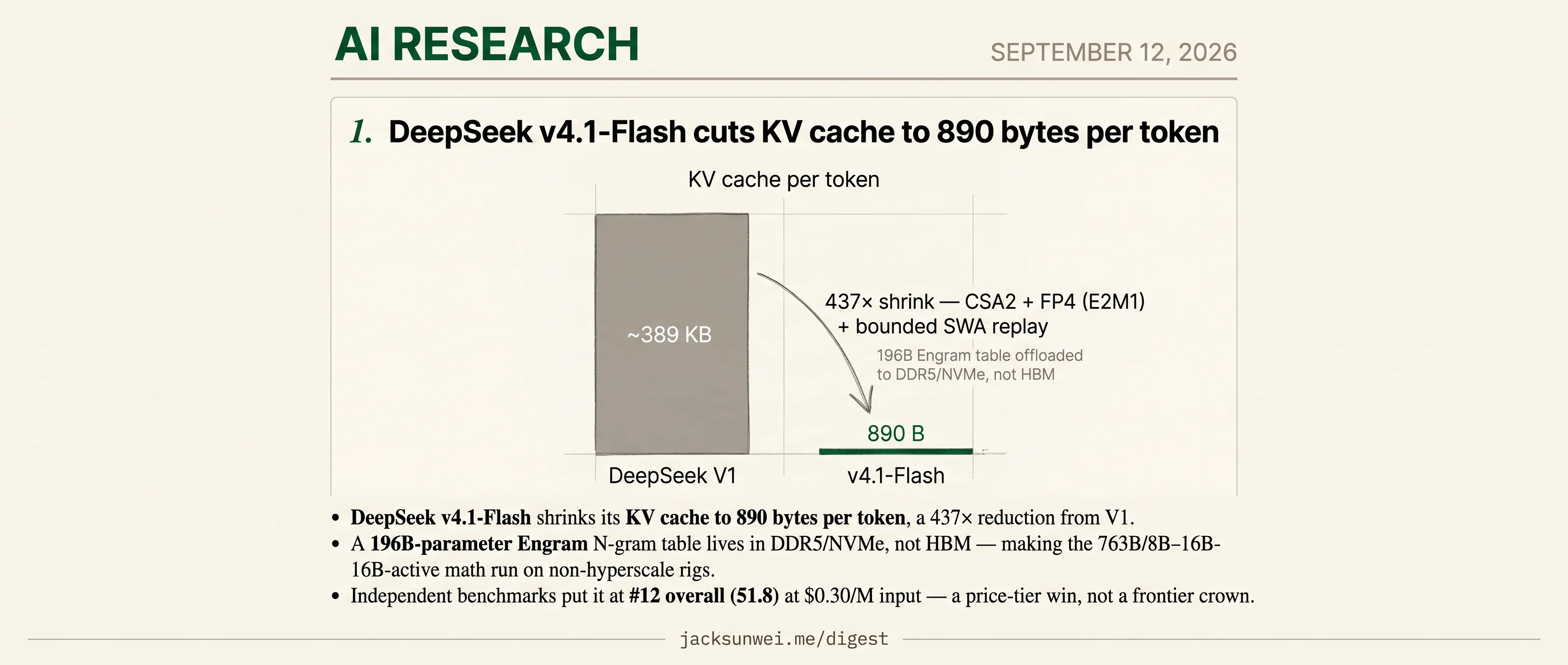
- DeepSeek v4.1-Flash shrinks KV cache to 890 bytes per token, a 437× drop from V1.
- A 196B-parameter Engram table sits in DDR5/NVMe, keeping HBM off the critical path.
- Independent benchmarks place it at #12 overall (51.8) at $0.30/M input tokens.
- Users report linguistic drift and reasoning-token bloat that erode the price advantage.
- Anthropic alleges ~12M Claude queries from ~24,000 DeepSeek-linked fraudulent accounts in July.
Today’s research slate is a single feature, and its interest is architectural rather than competitive. DeepSeek v4.1-Flash does not chase the frontier — it lands at rank #12 on independent benchmarks — but it gets there by rewriting where the model’s memory lives. A 437× KV cache reduction to 890 bytes per token, plus a 196B-parameter Engram N-gram table pushed into DDR5 and NVMe, mean the 763B/8B–16B-active math runs on rigs that are not hyperscale.
The catch is that the same relocation surfaces in production as linguistic drift and reasoning-token bloat, chewing back into the $0.30/M input price advantage. And Anthropic’s claim of ~12M Claude queries from ~24,000 DeepSeek-linked fraudulent accounts hangs over the release as a reminder that model economics and account-abuse economics are increasingly the same story.
DeepSeek v4.1-Flash cuts KV cache to 890 bytes per token
Source: latent-space · published 2026-09-12
TL;DR
- DeepSeek v4.1-Flash shrinks its KV cache to 890 bytes per token, a 437× reduction from V1.
- A 196B-parameter Engram N-gram table lives in DDR5/NVMe, not HBM — making the 763B/8B–16B-active math run on non-hyperscale rigs.
- Independent benchmarks put it at #12 overall (51.8) at $0.30/M input — a price-tier win, not a frontier crown.
- Practitioners flag linguistic drift and reasoning-token bloat that erode the price advantage in production.
- Anthropic alleges ~12M Claude queries from ~24,000 DeepSeek-linked fraudulent accounts over two weeks in July.
The 437× cache shrink is the real story
The version bump undersells what shipped. An independent teardown by local-ai-zone documents three stacked tricks behind v4.1-Flash’s 890-byte-per-token KV footprint: Compressed Sparse Attention 2 assigns each layer a static Full / Reindex / Reuse mode so KV data and sparse indices are shared across layers; FP4 (E2M1) caching applies per-16-channel scaling; and a sliding-window “bounded replay” pass reconstructs SWA state instead of persisting it 1. Together that’s a 437× cache shrink from DeepSeek V1 1 — the kind of number that changes what fits on a single node, not just what fits in a slide.
The other half of the “763B total, 8B–16B active” claim (the P8B-D16B in the launch title) comes from Engram, the conditional-memory module. Introl’s write-up notes that because Engram is accessed via deterministic hashing rather than learned routing, its 196B parameters don’t need to live in HBM — they can be memory-mapped to host DDR5 or local NVMe 2. That’s the detail that makes the parameter budget honest: only the dense trunk and active experts actually touch GPU memory.
flowchart LR
    Q[Token / query] --> R{Deterministic hash}
    R --> H[HBM: dense trunk + active MoE experts ~8-16B]
    R --> D[DDR5 / NVMe: Engram 196B N-gram table]
    H --> A[Attention w/ FP4 KV cache · 890B/token]
    D --> A
    A --> O[Output]
Price-tier win, not a frontier crown
LLM-Stats’ aggregate has v4.1-Flash at #12 overall with a composite score of 51.8, ahead of Qwen 3.7 Max (45.5) but well shy of the proprietary frontier — at $0.30 per million input tokens, roughly 5.7× cheaper than Qwen, with an additional 50% off-peak discount 3. That explains DeepSeek retiring the Pro tier by routing traffic to Flash, but the “Return of the Whale” framing needs an asterisk. Coursiv’s industry survey argues the market has bifurcated: Mamba/SSM hybrids like AI21’s Jamba, NVIDIA’s Nemotron-Flash and Microsoft’s SambaY own streaming and edge, while the MoE-Transformer CED stack only wins clearly on genuinely asymmetric agentic reasoning 4.
Live failure modes practitioners keep hitting
Developer reviews surface two ergonomics regressions vendor benchmarks don’t. The first is linguistic drift — reasoning chains that flip between English and Chinese mid-turn 5. The second is more expensive: an “annoyingly overthinking” mode that burns reasoning tokens on trivial prompts, which matters a lot if you’re not on the off-peak discount 5. Both are the kind of thing that make a 5.7× price advantage evaporate in production.
The distillation cloud
The launch also lands mid-controversy. Anthropic’s September 2026 threat-intel report alleges roughly 12 million Claude exchanges from ~24,000 fraudulent accounts routed through proxy “transfer stations” tied to DeepSeek over a two-week July window 6. DeepSeek credits v4.1’s jump to CED plus a 45T-token corpus heavy on synthesized agent trajectories, but the provenance question now sits on top of every Claude- or GPT-relative comparison. The architecture is genuinely novel and unusually well-documented 12; whether the training data is equally clean is a separate — and unresolved — question.
Footnotes
-
local-ai-zone deep dive (github.io) — https://local-ai-zone.github.io/blog/deepseek-v4-1-flash-deep-dive.html
↩ ↩2 ↩3Compressed Sparse Attention 2 (CSA2)… Each layer is assigned a static mode — Full, Reindex, or Reuse — allowing the model to share KV data and reuse sparse-attention indices across layers… FP4 KV Caching uses an E2M1 format with per-16-channel scaling, shrinking the global KV cache to just 890 bytes per token, a 437x reduction from DeepSeek V1.
-
Introl blog on Engram conditional memory — https://introl.com/blog/deepseek-engram-conditional-memory-architecture-january-2026
↩ ↩2Because the Engram module is sparsely accessed via deterministic hashing, the 196B parameters do not need to reside on GPU HBM; they can be memory-mapped and offloaded to host DDR5 RAM or local NVMe storage.
-
LLM-Stats comparison page — https://llm-stats.com/models/compare/deepseek-v4.1-flash-vs-qwen3.7-max
↩v4.1 Flash ranks #12 overall with a composite score of 51.8, outperforming Qwen 3.7 Max (45.5)… priced at $0.30 per million input tokens, roughly 5.7x cheaper than Qwen 3.7 Max, with an additional 50% off-peak discount.
-
Coursiv industry-trend piece — https://coursiv.io/blog/deepseek-v4-1-flash
↩The market has bifurcated: Mamba/SSM hybrids from AI21 (Jamba), NVIDIA (Nemotron-Flash) and Microsoft (SambaY) offer superior throughput for streaming and edge, while DeepSeek’s optimized MoE-Transformer CED stack remains more competitive for complex, multi-step agentic reasoning.
-
YouTube developer review — https://www.youtube.com/watch?v=Weom9fQnnJ0
↩ ↩2Linguistic drift where the model’s thinking chain unpredictably switches between English and Chinese… a vocal subset labeled the model ‘annoyingly overthinking,’ burning excessive reasoning tokens on simple tasks and driving up cost for users not on off-peak pricing.
-
BigGo finance / Anthropic threat report coverage — https://finance.biggo.com/news/2f97922b-45b6-4f7c-9d6d-adcf66696602
↩Anthropic’s September 2026 threat intelligence report detailed over 12 million exchanges linked to DeepSeek in a two-week window in July 2026, using approximately 24,000 fraudulent accounts and proxy ‘transfer stations’ to query Claude for step-by-step reasoning.