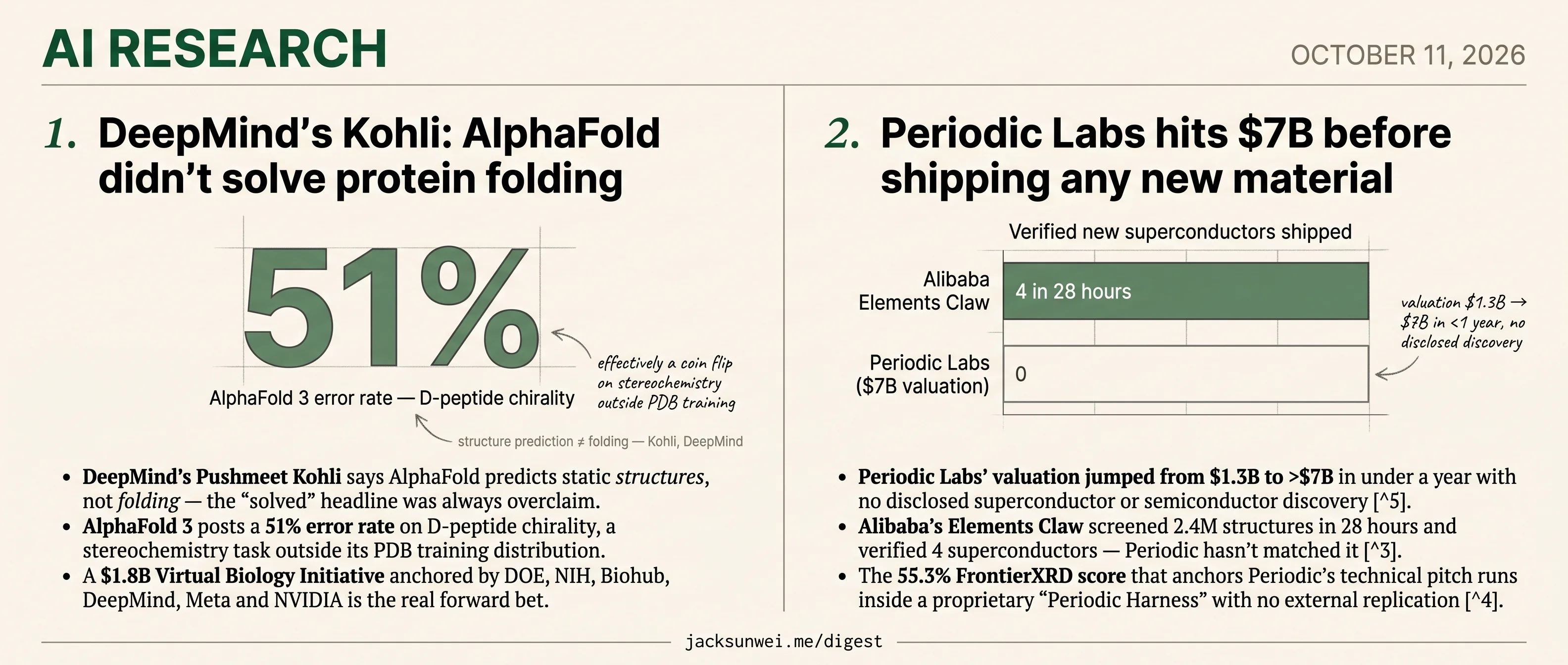
DeepMind walks back AlphaFold claim, Periodic Labs hits $7B pre-shipping
DeepMind's Kohli rolls back the AlphaFold solved-folding framing, and Periodic Labs hits $7B without shipping any new material.
DeepMind walks back AlphaFold claim, Periodic Labs hits $7B pre-shipping
TL;DR
- DeepMind’s Kohli says AlphaFold predicts static structures, not folding — the solved headline was overclaim.
- AlphaFold 3 posts a 51% error rate on D-peptide chirality outside its PDB training distribution.
- Periodic Labs jumped from $1.3B to >$7B with no disclosed superconductor or semiconductor discovery.
- Alibaba’s Elements Claw screened 2.4M structures in 28 hours and verified 4 superconductors.
- $1.8B Virtual Biology Initiative anchored by DOE, NIH, Biohub, DeepMind, Meta and NVIDIA is the forward bet.
Today’s two research features sit in science-AI and point the same direction: the headline claim is running well ahead of what the system actually delivers. DeepMind’s Pushmeet Kohli — speaking from inside the lab that owns the AlphaFold franchise — says the solved protein folding framing was always overclaim; AlphaFold predicts static structures, and AlphaFold 3 still posts a 51% error rate on D-peptide chirality once you step outside the PDB training distribution. The forward bet is a $1.8B Virtual Biology Initiative and reasoning models like Biohub’s rBio, not better coordinates.
The second feature is the market mirror of the same story. Periodic Labs has gone from $1.3B to over $7B inside a year without disclosing a single new superconductor or semiconductor, while Alibaba’s Elements Claw screened 2.4M structures and verified 4 superconductors in 28 hours. Periodic’s technical pitch — a 55.3% FrontierXRD score — lives inside a proprietary harness with no external replication, and co-founder Ekin Dogus Cubuk is relitigating GNoME, the DeepMind project whose crystals claim already required a 2026 Nature correction.
DeepMind’s Kohli: AlphaFold didn’t solve protein folding
Source: latent-space · published 2026-10-10
TL;DR
- DeepMind’s Pushmeet Kohli says AlphaFold predicts static structures, not folding — the “solved” headline was always overclaim.
- AlphaFold 3 posts a 51% error rate on D-peptide chirality, a stereochemistry task outside its PDB training distribution.
- A $1.8B Virtual Biology Initiative anchored by DOE, NIH, Biohub, DeepMind, Meta and NVIDIA is the real forward bet.
- Biohub’s rBio reasoning model targets mutation effects via virtual-cell simulations, not better coordinates.
The “solved” claim is quietly retreating
On the Latent Space episode, Google DeepMind’s Pushmeet Kohli and Biohub’s Sal Candido spend most of their time dismantling the headline AlphaFold earned in 2021. Their reframing — structure prediction is not folding — is no longer contrarian. The teaching literature now routinely draws the same line: AlphaFold emits a single static snapshot and tends to default to closed conformations even for apo proteins, which hides the cryptic pockets drug discovery actually cares about 1. The Briefings in Bioinformatics survey goes further, arguing that because AF leans on Multiple Sequence Alignments, it collapses on “orphan” proteins with no homologs — making it closer to industrial-strength homology modeling than a physics solver 2.
What’s actually broken
The concrete failure modes are more damning than the philosophical ones. Independent reviews document that AlphaFold frequently predicts the same native structure for sequence variants known to misfold in vivo, and “hallucinates” structured loops where disordered tethers actually exist 3. A 2025 peer-reviewed benchmark pins down the training-distribution problem with a number: AF3 gets D-peptide chirality wrong 51% of the time — effectively a coin flip on a stereochemistry task the PDB barely covers 4.
| Failure mode | What breaks | Source |
|---|---|---|
| D-peptide chirality | 51% error rate on mirror-image stereochemistry | 4 |
| Apo-state bias | Defaults to closed conformation, hides binding pockets | 1 |
| Mutation blindness | Misfolding variants predicted as native structure | 3 |
| Disorder hallucination | Flexible tethers rendered as structured loops | 3 |
| Orphan proteins | Accuracy collapses without MSA depth | 2 |
None of this is a repudiation of AF — it’s an argument that the next decade of progress won’t come from a better folder.
The $1.8B pivot to virtual cells
The podcast is best read as a pitch for what replaces it. A week before the episode, DOE, NIH, CZ Biohub, Google DeepMind, Isomorphic, Meta and NVIDIA signed an MoU committing nearly $2 billion to a Virtual Biology Initiative that generates foundational datasets for AI models of disease 5. Notably, commercially generated datasets carry a one-year embargo before public release — a tension point the hosts glide past.
Biohub is already shipping in that direction. rBio is a reasoning model trained on virtual-cell simulations that lets biologists ask plain-language questions about mutations and gene interactions and get logic-based predictions back 6. The output isn’t coordinates; it’s mechanism-adjacent inference over a simulated cell.
Fault-lines the episode under-plays
Two debates get short shrift. First, the Bitter Lesson in biology is contested: AF2’s hand-coded biophysical priors beat pure scaling for years, and Kohli himself concedes scaling laws “don’t emerge automatically” here — biology simply doesn’t have the token volume to recapitulate evolution via compute. Second, interpretability is being traded for calibrated uncertainty. That’s defensible for an API, but bench scientists running wet-lab follow-ups want mechanism, not just confidence intervals.
The honest headline from the conversation isn’t that AlphaFold failed. It’s that the field’s center of gravity has moved from protein coordinates to cellular dynamics — and the money is already there.
Periodic Labs hits $7B before shipping any new material
Source: latent-space · published 2026-10-08
TL;DR
- Periodic Labs’ valuation jumped from $1.3B to >$7B in under a year with no disclosed superconductor or semiconductor discovery 7.
- Alibaba’s Elements Claw screened 2.4M structures in 28 hours and verified 4 superconductors — Periodic hasn’t matched it 8.
- The 55.3% FrontierXRD score that anchors Periodic’s technical pitch runs inside a proprietary “Periodic Harness” with no external replication 9.
- Co-founder Ekin Dogus Cubuk is relitigating GNoME, the DeepMind project whose “2.2M novel crystals” claim required a 2026 Nature correction 10.
The subtext of the pitch
The Latent Space episode with Liam Fedus and Ekin Dogus Cubuk is pitched as a “Science pod × Engineering pod” crossover about lab-in-the-loop reinforcement learning. The actual subtext is narrower: Cubuk is answering critics of his previous project. GNoME and the Berkeley A-Lab claimed 2.2 million “new” crystals, but independent chemists — Palgrave, Cheetham, Seshadri — showed much of that rested on structural duplicates and misidentified XRD traces, forcing DeepMind to clarify in a 2026 correction that “novel” meant “new to our internal platform,” not undiscovered by human science 10.
Periodic’s founding thesis — that nature, not literature, must be the reward signal — reads as the technical answer to that embarrassment. Build the characterization pipeline. Log the negative results. Don’t trust the paper corpus. It’s a defensible pivot. But listeners should hear the pod as a public rebuttal, not a neutral explainer.
The competition already shipped
Periodic is not the only serious entrant. Microsoft Research’s MatterGen attacks the inverse-design problem directly, generating crystals conditioned on target properties rather than screening databases 11. More awkwardly for Periodic’s pedigree pitch, Alibaba DAMO’s “Elements Claw” agent reported in mid-2026 that it screened 2.4M structures in 28 hours and physically synthesized four verified new superconductors: Hf21Re25, Zr4VRe7, HfZrRe4, Zr3ScRe8 8.
That is the exact deliverable Periodic has not produced. The company’s own profile notes zero announced discoveries in its target fields despite the valuation surge 7.
The benchmark doesn’t travel
The surrounding Neon launch’s flagship number — 55.3% on FrontierXRD, beating GPT-6 Astra and Claude Fable 5.1 — is a vendor-reported figure. The benchmark runs inside a proprietary “Periodic Harness” that external labs cannot access, and the model weights are not downloadable despite being built on open-weight Kimi K2.6 9. Periodic itself concedes its held-out set is “simpler” than the headline benchmark 9. That’s the classic contamination tell.
“Without third-party access to the same test environment… these figures should be treated as vendor-reported claims.” 9
The one bet worth watching
Fedus’s most interesting moment is a dissent: he rejects humanoid robotics as a scientific distraction, arguing that the decade of bipedal-dexterity engineering would only delay discoveries, and that Periodic should instead automate existing lab instruments directly 12. That’s a sharper, more falsifiable bet than the rest of the pitch. It also means the company’s progress will be legible: either the instrumented lab produces a verified novel material in the next 18 months, or it doesn’t.
The podcast is worth listening to for Fedus’s framing of forward-deployed engineering and Cubuk’s physics intuitions. Just keep the GNoME history, the Alibaba deliverable, and the harness opacity in the frame while you listen.
Footnotes
-
BonvinLab AlphaFold teaching materials — https://www.bonvinlab.org/education/molmod_online/alphafold/
↩ ↩2AlphaFold typically predicts a single static snapshot and often defaults to a closed conformation even for apo proteins, obscuring binding sites relevant to drug discovery.
-
Briefings in Bioinformatics (OUP) survey — https://academic.oup.com/bib/article/26/4/bbaf340/8202937
↩ ↩2Because AlphaFold relies on Multiple Sequence Alignments, its accuracy drops precipitously for ‘orphan’ proteins lacking known homologs, making it closer to advanced homology modeling than a de novo physical solver.
-
Hyper.ai review of AlphaFold limitations — https://hyper.ai/en/stories/d72106d37a27fe1c9a60e162826abdbf
↩ ↩2 ↩3AlphaFold frequently predicts the same native structure for variants known to cause misfolding in vivo and ‘hallucinates’ structured loops where flexible tethers actually exist.
-
PMC / peer-reviewed AF3 benchmark — https://pmc.ncbi.nlm.nih.gov/articles/PMC12956938/
↩ ↩2AlphaFold 3 showed a 51% error rate in predicting D-peptide chirality, suggesting it struggles with molecules outside its primary training data.
-
PR Newswire — Virtual Biology Initiative announcement — https://www.prnewswire.com/news-releases/international-cross-sector-collaboration-commits-nearly-2-billion-to-build-foundational-data-for-ai-models-to-predict-and-treat-disease-302901172.html
↩International cross-sector collaboration commits nearly $2 billion to build foundational data for AI models to predict and treat disease, anchored by DOE, NIH, CZ Biohub, Google DeepMind and Meta, with a one-year embargo on commercially generated datasets before open release.
-
CZ Biohub blog — rBio reasoning model — https://biohub.org/blog/rbio-reasoning-ai-model/
↩rBio is a reasoning model trained on virtual cell simulations, letting biologists ask mutation-related questions in plain language and receive logic-based predictions about gene interactions.
-
Daily Dropout — Periodic Labs profile — https://www.dailydropout.fyi/startup/periodic
↩ ↩2Valuation has reportedly surged from $1.3 billion to over $7 billion in less than a year, despite… the firm has yet to announce any significant discovery in its target fields of superconductors or semiconductors.
-
StartupFortune — Alibaba DAMO ‘Elements Claw’ — https://startupfortune.com/ai-agents-are-now-finding-and-verifying-new-superconductors-in-days/
↩ ↩2Elements Claw agent… screened 2.4 million structures in just 28 hours [and] led to the physical synthesis and experimental verification of four brand-new superconductors: Hf21Re25, Zr4VRe7, HfZrRe4, and Zr3ScRe8.
-
APNIC blog — ‘The case for open-weight models’ — https://blog.apnic.net/2026/09/16/the-case-for-open-weight-models-and-why-we-cant-trust-frontier-labs/
↩ ↩2 ↩3 ↩4FrontierXRD remains an internal, proprietary evaluation that has not yet undergone external peer review… without third-party access to the same test environment—specifically the proprietary ‘Periodic Harness’—critics argue these figures should be treated as vendor-reported claims.
-
The Stack — ‘Scant evidence: Google’s AI chemistry claims were misleading’ — https://www.thestack.technology/scant-evidence-googles-ai-chemistry-claims-were-misleading/
↩ ↩2Scant evidence for the required ‘trifecta of novelty, credibility, and utility’… DeepMind eventually clarified in a 2026 correction that ‘novel’ meant new to their internal platform, rather than undiscovered by human science.
-
Microsoft Research — MatterGen announcement — https://www.microsoft.com/en-us/research/blog/mattergen-a-new-paradigm-of-materials-design-with-generative-ai/
↩MatterGen, a generative AI model that directly designs crystalline materials based on target properties… bypassing the need to search through pre-existing databases.
-
AI Breaking Wire — Latent Space episode recap — https://aibreakingwire.com/news/periodic-labs-founders-explain-grounding-ai-in-physical-experiments
↩Fedus provided a notable dissent from the current trend toward general-purpose humanoid robotics in science… the decade-long engineering challenge of perfecting bipedal dexterity would only delay scientific progress. Instead, Periodic Labs focuses on automating scientific instruments directly.