CorrGRPO fixes GRPO math, HC-DLM diffusion decoding, Anthropic infers UV sky
CorrGRPO and HC-DLM lead convergent fixes on GRPO and diffusion-LM bottlenecks as Anthropic ships a UV sky with inferred pixels.
CorrGRPO fixes GRPO math, HC-DLM diffusion decoding, Anthropic infers UV sky
TL;DR
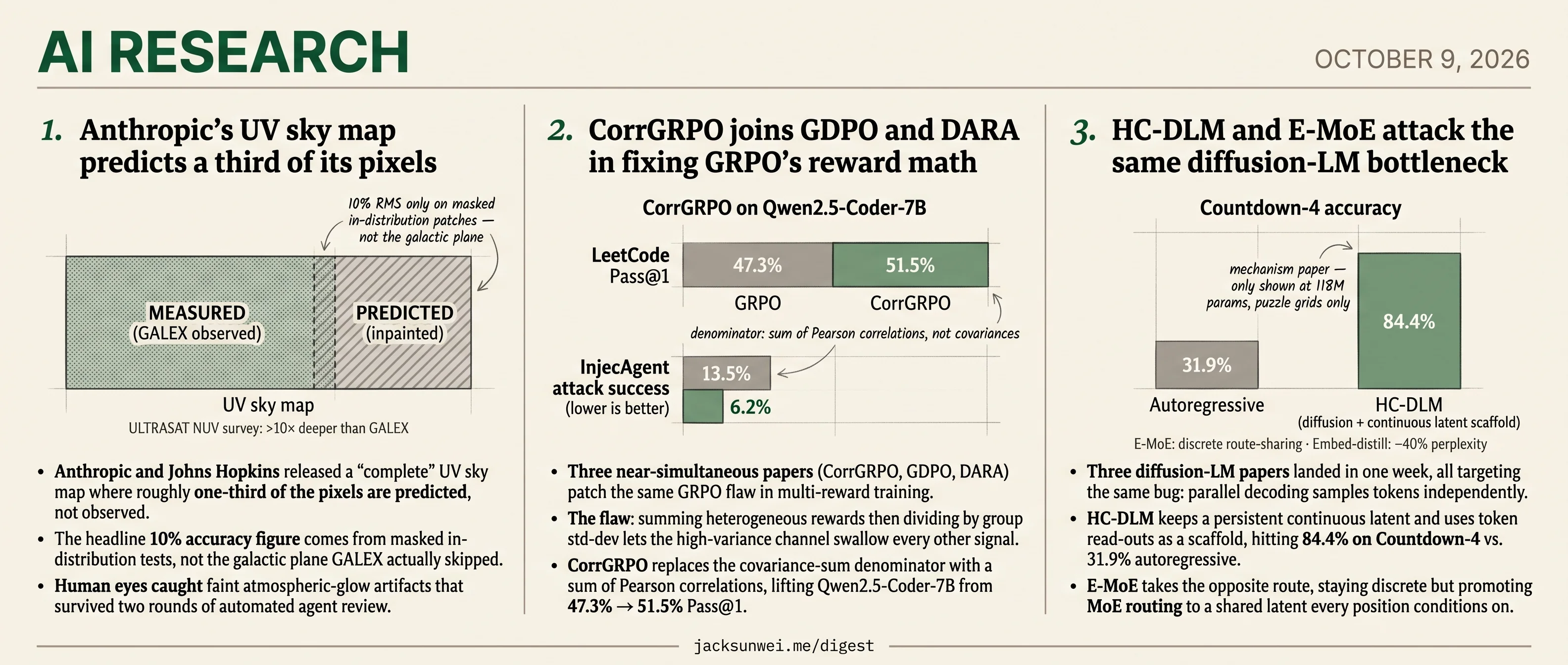
- Anthropic + Johns Hopkins release UV sky map with 1/3 of pixels predicted, not observed.
- CorrGRPO, GDPO, DARA land near-simultaneously on the same GRPO reward-math flaw.
- CorrGRPO lifts Qwen2.5-Coder-7B from 47.3% to 51.5% Pass@1 on code.
- HC-DLM hits 84.4% on Countdown-4 vs 31.9% autoregressive via a continuous latent.
- Rank-8 LoRA at one early layer lifts Qwen3-8B reference-chain accuracy from 15% to 99%.
Today’s research beat splits cleanly in two. The GRPO and diffusion-LM features are convergence stories — independent teams landing the same patch for the same bottleneck within a week of each other. CorrGRPO, GDPO, and DARA all notice that GRPO’s reward denominator lets the loudest channel swallow quieter signals. HC-DLM and E-MoE take opposite routes to the same diffusion-LM flaw: parallel decoding samples tokens independently, so you either hold a continuous latent across steps or you share routing state across positions. Bugs that only become visible once enough teams run into them, with fixes landing from multiple directions at once.
The UV sky map cuts the opposite way. Anthropic and Johns Hopkins shipped a ‘complete’ NUV sky in which roughly a third of the pixels are model-predicted rather than observed, with the headline 10% accuracy figure measured on in-distribution masks rather than the galactic plane GALEX actually skipped. Human eyes caught atmospheric-glow artifacts the agent review missed, and ULTRASAT is already flying a survey >10× deeper that will replace the inferred third with real photons.
Anthropic’s UV sky map predicts a third of its pixels
Source: anthropic-research · published 2026-10-08
TL;DR
- Anthropic and Johns Hopkins released a “complete” UV sky map where roughly one-third of the pixels are predicted, not observed.
- The headline 10% accuracy figure comes from masked in-distribution tests, not the galactic plane GALEX actually skipped.
- Human eyes caught faint atmospheric-glow artifacts that survived two rounds of automated agent review.
- ULTRASAT is already flying an all-sky NUV survey >10× deeper than GALEX, which will replace the inferred third with real photons.
What Claude actually did
Astrophysicist Brice Ménard and Anthropic used the Claude Science platform to orchestrate agents that cleaned, calibrated, and merged 38,000 GALEX exposures with Swift-UVOT, FIMS/SPEAR, TD-1, WISE, HI4PI, and Gaia catalogs onto a common grid. For the ~33% of the sky GALEX never imaged — mostly the bright Milky Way plane that would have fried its detectors — the agents ran a cross-wavelength inpainting model trained on the observed two-thirds, predicting UV intensity from infrared, radio, and visible-light correlations. Anthropic reports 10% agreement with ground truth on held-out patches.
As a feat of agentic data engineering on a decade-old archive, this is genuinely impressive. As a scientific dataset, it is more fragile than the announcement suggests.
The predicted third is the whole argument
The 10% RMS validation is measured by masking pieces of already-observed sky and asking the model to recover them. The regions Claude actually fills in — the dense, dusty galactic plane — are out of distribution by construction. SuperPowerDaily’s roundup of community pushback puts it bluntly: “successfully reconstructing observed sky does not guarantee accuracy in unobserved areas” 1. To its credit, the team labels each pixel “measured” or “predicted” with uncertainty estimates 1, and AlphaSignal notes the full paper is still in preparation and unpublished in peer-reviewed form 2.
There is also no flux-consistency metric reported. The STAR benchmark paper argues this is exactly the failure mode to worry about: deep models “prioritize perceptual quality over physical accuracy,” producing images that look clean while being photometrically wrong 3. Planetary imager Christopher Go has made the same critique more pointedly about AI processing fabricating “fake details” in astronomical images 4. A 10% brightness RMS is not the same thing as preserving the flux of a point source you can do science on.
The agent-review blind spot
The most instructive moment in the project cuts against the autonomous-science framing. Faint circular residuals from GALEX’s atmospheric glow survived two rounds of automated AI agent review and were only caught when Ménard noticed them by eye — after which Claude patched 38,000 observations in hours 5. Agent-on-agent review inherits the base model’s priors, so shared blind spots stay invisible until a domain expert looks. The speedup is real; the oversight layer is still human.
ULTRASAT is about to make this moot
The context Anthropic’s post omits: ULTRASAT, launched to begin science operations this cycle, is delivering an all-sky NUV survey more than ten times deeper than GALEX, reaching >23.5 AB mag 6. That reframes the Claude atlas as a short-lived bridge over the GALEX-era archive — a useful teaching artifact and a nice demo of what agentic pipelines can grind through — rather than the enduring map of the UV sky. The missing third is about to be observed, not predicted.
CorrGRPO joins GDPO and DARA in fixing GRPO’s reward math
Source: hf-daily-papers · published 2026-09-28
TL;DR
- Three near-simultaneous papers (CorrGRPO, GDPO, DARA) patch the same GRPO flaw in multi-reward training.
- The flaw: summing heterogeneous rewards then dividing by group std-dev lets the high-variance channel swallow every other signal.
- CorrGRPO replaces the covariance-sum denominator with a sum of Pearson correlations, lifting Qwen2.5-Coder-7B from 47.3% → 51.5% Pass@1.
- InjecAgent attack-success drops from 13.5% → 6.2% on the same 7B model once the safety reward stops being drowned out.
The shared diagnosis
GRPO estimates advantage by centering a trajectory’s reward and dividing by the within-group standard deviation. That’s fine for a single reward. For a sum of rewards it isn’t, because the denominator expands to the sum of every pairwise covariance — and Cov(R_l, R_m) = σ_l σ_m ρ_{lm}. A reward channel with a large σ dominates the normalizer, compressing every other channel’s advantage toward zero. Format rules, safety penalties, and brevity bonuses — exactly the auxiliary signals multi-reward RL is supposed to teach — effectively vanish from the gradient.
CorrGRPO’s fix is to keep the centered sum of rewards in the numerator (so user-chosen weights still matter) but replace the covariance-sum denominator with a sum of Pearson correlations. Every reward with non-zero variance contributes exactly 1 to the diagonal, and off-diagonals carry only directional information in [-1, 1]. Scale invariance falls out automatically.
The results are concrete: on Qwen2.5-Coder-7B, LeetCodeDataset Pass@1 jumps from 15.8% to 24.1%. On Qwen2.5-7B tool calling, RLLA-4K exact-match climbs from 63.4% to 67.6%. On Agent Security Bench, joint accuracy — being helpful and resisting prompt injection — rises from 31.4% to 47.9%.
Three different levers on one problem
CorrGRPO is not alone. NVIDIA’s GDPO frames the pathology as “advantage collapse” — distinct reward combinations mapping to identical scalar advantages — and fixes it by normalizing each reward channel independently before aggregation 7. It reports +6.3% AIME accuracy with 80% shorter responses, and ~4 points on the Berkeley Function Call Leaderboard 8. DARA attacks a residual issue neither addresses: reward density. A sparse format reward contributes less “advantage energy” than a dense correctness reward even after per-channel normalization. DARA’s inverse-sqrt density correction reportedly hits format-compliance targets 26% faster and length-compliance 65% faster than GDPO 9.
| Method | Lever | Keeps std-dev? |
|---|---|---|
| CorrGRPO | Correlation-matrix denominator | No (replaced) |
| GDPO | Per-channel normalize, then aggregate | Yes, per-channel |
| DARA | Density-weighted aggregation | Yes, plus density correction |
| Dr. GRPO | Delete the denominator 10 | No |
| MAD-GRPO | Median Absolute Deviation 11 | Replaced with MAD |
What’s missing
Two things stand out. First, none of the new papers prominently cite PopArt, which solved essentially the same multi-scale problem for value-based RL in 2018 by rescaling targets while preserving unnormalized outputs across 57 Atari games 12. The multi-reward literature is rediscovering a decade-old lineage without naming it. Second, there is no controlled bake-off. CorrGRPO, GDPO, and DARA report wins against vanilla GRPO on different base models, different reward sets, and different seeds. The practitioner question — which lever to pull first on a real multi-reward workload — is still answered by vendor rhetoric.
The field has not converged on whether to re-weight the normalizer, decouple it, or remove it.
The useful read of this cluster is not “CorrGRPO wins.” It’s that by late 2026, three independent groups published within weeks of each other saying the same thing: vanilla multi-reward GRPO is broken, and the fix lives in the denominator.
Further reading
- Adaptive Reward Routing: Dynamic Multi-Reward Optimization for Joint Audio-Video Diffusion via Forward-Process RL — hf-daily-papers
- Make Sparse Rewards Count: Density-Aware Reward Aggregation for Multi-Reward RL — hf-daily-papers
HC-DLM and E-MoE attack the same diffusion-LM bottleneck
Source: hf-daily-papers · published 2026-09-30
TL;DR
- Three diffusion-LM papers landed in one week, all targeting the same bug: parallel decoding samples tokens independently.
- HC-DLM keeps a persistent continuous latent and uses token read-outs as a scaffold, hitting 84.4% on Countdown-4 vs. 31.9% autoregressive.
- E-MoE takes the opposite route, staying discrete but promoting MoE routing to a shared latent every position conditions on.
- Independent reviewers call HC-DLM a mechanism paper, not a product: nothing shown past 118M parameters or outside puzzle grids.
One diagnosis, three cures
The diffusion-language-model community spent 2026 converging on a single diagnosis. When you denoise a sequence in parallel, each position samples from its own marginal, which severs the statistical dependencies between tokens being generated at the same step. Sander Dieleman’s August blog crystallized the framing — the continuous-diffusion tax is “a habit, not a limitation” of language, caused by designs that pull latent trajectories back to token space at every step 13. The three papers dropping together this week are three different cures for that single illness, which is the only reason to read them as a cluster rather than as isolated arXiv posts.
HC-DLM is the headline entry. It runs a two-level hierarchical chain: a continuous latent carries global state across denoising steps, and discrete tokens are “read out” at each step not as outputs but as a structural scaffold that re-couples positions for the next latent update 14. On Sudoku’s hard split it reaches 72.4% (vs. 70.7% for the CCDD hybrid baseline); on Countdown-5 it hits 37.5% where masked-diffusion sits at 21.3%. The results are strongest exactly where you’d expect — tasks with hard global constraints that factorized decoders mangle.
E-MoE attacks from the opposite direction. Instead of adding a continuous latent, it stays fully discrete and repurposes mixture-of-experts routing decisions as the shared latent variable, letting every position condition on the same routing choices 15. The pitch is explicitly that this sidesteps the posterior collapse that plagues continuous-latent VAE approaches — a jab at exactly the design space HC-DLM lives in.
The embedding-distillation paper attacks one layer lower. Its claim is that scaled-up text encoders become too discriminative: the latent manifold gets sparse and un-diffusible, so denoisers can’t interpolate. Soft-label distillation from a T5Gemma-2 teacher pulls semantically similar words together and cuts generative perplexity by roughly 40% versus the ELF baseline 16. Practitioners on r/LocalLLaMA flag this as the kind of trick that could be a “trade secret” for scaling non-autoregressive models, because it attacks encoder geometry rather than architecture 17.
Where the consensus is shaky
The abstracts are more confident than the independent commentary. Ken Ashe labels HC-DLM “a mechanism paper rather than a production-ready model” and notes the hierarchical coupling has not been demonstrated past the 118M-parameter LM1B configuration 14. The CCDD baseline HC-DLM narrowly edges on Sudoku carries its own tax — concatenating an embedding chain and a token chain roughly doubles sequence length and inflates both memory and FLOPs, which undermines the parallelism argument that motivates diffusion LMs in the first place 18. And HC-DLM’s headline wins are on Sudoku and Countdown, which is awkward given a live developer-circle argument that arbitrary-order bidirectional training actively hurts the causal structure needed for reasoning.
What to watch
Read the cluster as the field triangulating on one bottleneck from three angles — hierarchy, discrete-latent routing, embedding geometry — not as three independent breakthroughs. Every reviewer raises the same open question: does any of this survive past the ~118M-parameter ceiling demonstrated so far, and does it hold on open-ended language rather than puzzle grids? Nothing in this week’s drop answers either.
Further reading
- E-MoE: Enhanced Mixture-of-Experts for Non-Factorized Diffusion Language Models — hf-daily-papers
- Scaling and Distilling Text Embeddings for Better Diffusibility — hf-daily-papers
Round-ups
Rank-8 LoRA lifts Qwen3-8B reference-chain accuracy from 15% to 99%
Source: hf-daily-papers
Pretrained transformers burn only a fraction of their depth tracking in-context references, following just 1.4-3.6 lines across 13 base models. Inserting a task-trained rank-8 LoRA at one early layer, with all other weights frozen, extends Qwen3-8B to 24-line chains at 99% exact accuracy and Ouro-1.4B past 160 lines after eight loops.
RL post-training sharpens base models but taxes agentic coverage
Source: hf-daily-papers
The sharpening hypothesis says RL post-training trades solution coverage for single-shot accuracy, a pattern seen in math and code. New work finds the same tax holds in agentic tool-use settings, where pre-trained LLMs equipped with scaffolding already cover many behaviors that post-training then narrows rather than adds.
PoS gives long-horizon LLM agents explicit belief states at inference
Source: hf-daily-papers
Long-horizon agents store interaction history as raw memory, which rarely yields a coherent view of the current world. PoS maintains an explicit belief state at inference, fusing an estimate of world state with unresolved task requirements so the agent tracks what it still needs to learn and act on.
IntentFlux benchmark exposes intent drift in multi-turn LLM agents
Source: hf-daily-papers
When users change their minds mid-dialogue, superseded intent keeps leaking into agent actions. IntentFlux converts verifiable tasks into dialogues with controlled intent changes while reusing original graders; across 627 calibration cases, mean task score drops from 0.476 to 0.384 once drift is introduced.
World Observer decouples observing from acting for persistent world models
Source: hf-daily-papers
Video world models stay actor-centric and lose track of objects once they leave view, failing to restore state on re-entry. World Observer jointly generates an agent-centric actor perspective with a separate observer stream, letting the model keep watching regions beyond the actor’s current field of view.
AutoDataBench isolates data intelligence in auto-research agents
Source: hf-daily-papers
Auto-research benchmarks mix training frameworks, hyperparameters, compute, and data, muddying why one agent beats another. AutoDataBench strips those confounds to test data intelligence alone: an agent’s ability to understand, manipulate, and improve the datasets that shape model capabilities, built on a controlled testbed with fixed training recipes.
RouteFM pretrains a foundation router that generalizes across LLM pools
Source: hf-daily-papers
Today’s LLM routers are fit locally to one query workload and candidate pool, needing retraining when either shifts. RouteFM reframes routing as a foundation-model problem, pretraining once so a single router assigns queries to the best model across heterogeneous pools without extra supervision when the environment changes.
Footnotes
-
SuperPowerDaily — https://superpowerdaily.com/posts/astrophysicist-uses-claude-to-complete-a-uv-sky-map-with-a-third-predicted
↩ ↩2approximately one-third of the map is statistically predicted rather than observed… successfully reconstructing observed sky does not guarantee accuracy in unobserved areas
-
AlphaSignal — https://alphasignal.ai/news/anthropic-s-claude-science-fills-the-sky-s-missing-uv-third
↩the project remains unpublished in peer-reviewed form and the full technical paper is still in preparation… its utility as a research dataset depends on future independent benchmarks against new UV observations
-
arXiv 2507.16385 (STAR benchmark / Flux Error) — https://arxiv.org/html/2507.16385v1
↩deep learning models frequently prioritize perceptual quality over physical accuracy… novel metrics such as Flux Error (FE) ensure that reconstructed images do not just look ‘clean’ but remain mathematically faithful to the original photometry
-
Christopher Go (planetary imager, Facebook post) — https://www.facebook.com/login/?next=https%3A%2F%2Fwww.facebook.com%2Fchristopher.go.16%2Fposts%2Fit-was-become-popular-to-some-to-use-ai-in-processing-their-planetary-images-ai-%2F29030660739875287%2F
↩AI-driven processing can create ‘fake details’ that compromise planetary research — ‘less is more’
-
CellCog.ai — https://cellcog.ai/blog/claude-science-uv-sky-map/
↩AI agent loops can share ‘blind spots’ with the models that produced the work, making domain-expert review essential — Ménard identified faint circular artifacts that two rounds of automated AI agent reviews had failed to catch
-
arXiv — ULTRASAT mission status 2026 — https://arxiv.org/abs/2304.14482
↩ULTRASAT is currently providing an all-sky NUV image more than ten times deeper than the previous GALEX map, reaching >23.5 AB mag
-
NVIDIA GDPO project page (nvlabs.github.io) — https://nvlabs.github.io/GDPO/
↩GDPO decouples the normalization of individual reward components before aggregation, preventing the advantage collapse that occurs when distinct reward combinations map to identical advantage values in standard GRPO.
-
GoPenAI blog — ‘GDPO: The hidden flaw in multi-reward RLHF’ — https://blog.gopenai.com/gdpo-the-hidden-flaw-in-multi-reward-rlhf-thats-been-sabotaging-your-llm-training-de3625b9f7df
↩GDPO improves AIME accuracy by 6.3% while reducing excessive response lengths by 80%, and raises correct-format ratio on the Berkeley Function Call Leaderboard by roughly 4 points over GRPO.
-
RoboticsCenter.ai summary of DARA (Make Sparse Rewards Count) — https://www.roboticscenter.ai/research/papers/make-sparse-rewards-count-density-aware-reward-aggregation-for-multi-reward-rl-2610
↩DARA applies an inverse-square-root density correction so that sparse reward components contribute comparable ‘advantage energy’ to dense ones, reaching format-compliance targets in up to 26% fewer steps than GDPO and length-compliance in up to 65% fewer steps.
-
Medium — Jenwei, ‘Evolution of Policy Optimization: GRPO, DAPO, Dr. GRPO’ — https://medium.com/@jenwei0312/the-evolution-of-policy-optimization-understanding-grpo-dapo-and-dr-3e758c54b2c6
↩Dr. GRPO removes the standard-deviation denominator entirely because dividing by group std introduces a length and difficulty bias — groups with low variance get inflated updates and the model learns to produce longer, verbose answers even when wrong.
-
Hugging Face blog — ‘MAD-GRPO’ (javadtaghia) — https://huggingface.co/blog/javadtaghia/mad-grpo
↩Replacing standard deviation with Median Absolute Deviation gives a more robust group scale that is less sensitive to outlier rollouts, mitigating the exploding-update problem seen when one sample in a group dominates the variance estimate.
-
DeepMind blog — PopArt (2018) — https://deepmind.google/blog/preserving-outputs-precisely-while-adaptively-rescaling-targets/
↩PopArt adaptively rescales value targets using running mean and standard deviation while correcting the output layer weights so that unnormalized predictions are preserved — enabling a single agent to learn 57 Atari games with wildly different reward scales.
-
Sander Dieleman blog, ‘Continuous diffusion language models’ (Aug 2026) — https://sander.ai/2026/08/24/continuous-dlms.html
↩Continuous diffusion language models were held back by a habit, not a limitation — the practice of pulling trajectories back to token space at every step.
-
Ken Ashe, ‘What HC-DLM fixes about diffusion language models’ — https://kenashe.ai/blog/2026-10-02-what-hc-dlm-fixes-about-diffusion-language-models/
↩ ↩2HC-DLM should be read as a mechanism paper rather than a production-ready model; the scaffold fix addresses a real failure mode in parallel decoding, but its scalability to billion-parameter models remains unproven.
-
AI Weekly brief on E-MoE — https://aiweekly.co/alerts/e-moe-turns-moe-routing-into-shared-latent-for-diffusion-lms
↩E-MoE repurposes expert-routing decisions as a discrete shared latent variable, letting all positions condition on the same routing choices and avoiding the posterior collapse that plagues continuous-latent VAE approaches.
-
alphaXiv page for ‘Scaling and Distilling Text Embeddings for Better Diffusibility’ — https://www.alphaxiv.org/abs/2610.01016
↩As embeddings become more discriminative through scaling they become less diffusible; soft-label distillation from a T5Gemma-2 teacher pulls semantically similar words closer and cuts generative perplexity by roughly 40% versus the ELF baseline.
-
r/LocalLLaMA discussion, ‘Why are diffusion-encoder LLMs not more popular?’ — https://www.reddit.com/r/LocalLLaMA/comments/1mmen16/why_are_diffusionencoder_llms_not_more_popular/
↩Diffusion-encoder models theoretically solve the Goldilocks problem of context-window noise, but they have historically struggled with discrete token mapping — the distilled-embedding trick looks like a trade secret for scaling non-autoregressive models.
-
OpenReview, CCDD (Coevolutionary Continuous Discrete Diffusion) — https://openreview.net/challenge?redirect=%2Fforum%3Fid%3DmwAkJJ4NBD
↩CCDD concatenates an embedding chain and a discrete-token chain denoised in parallel; the dual representation roughly doubles input sequence length and substantially increases memory and FLOP demands at both training and inference time.