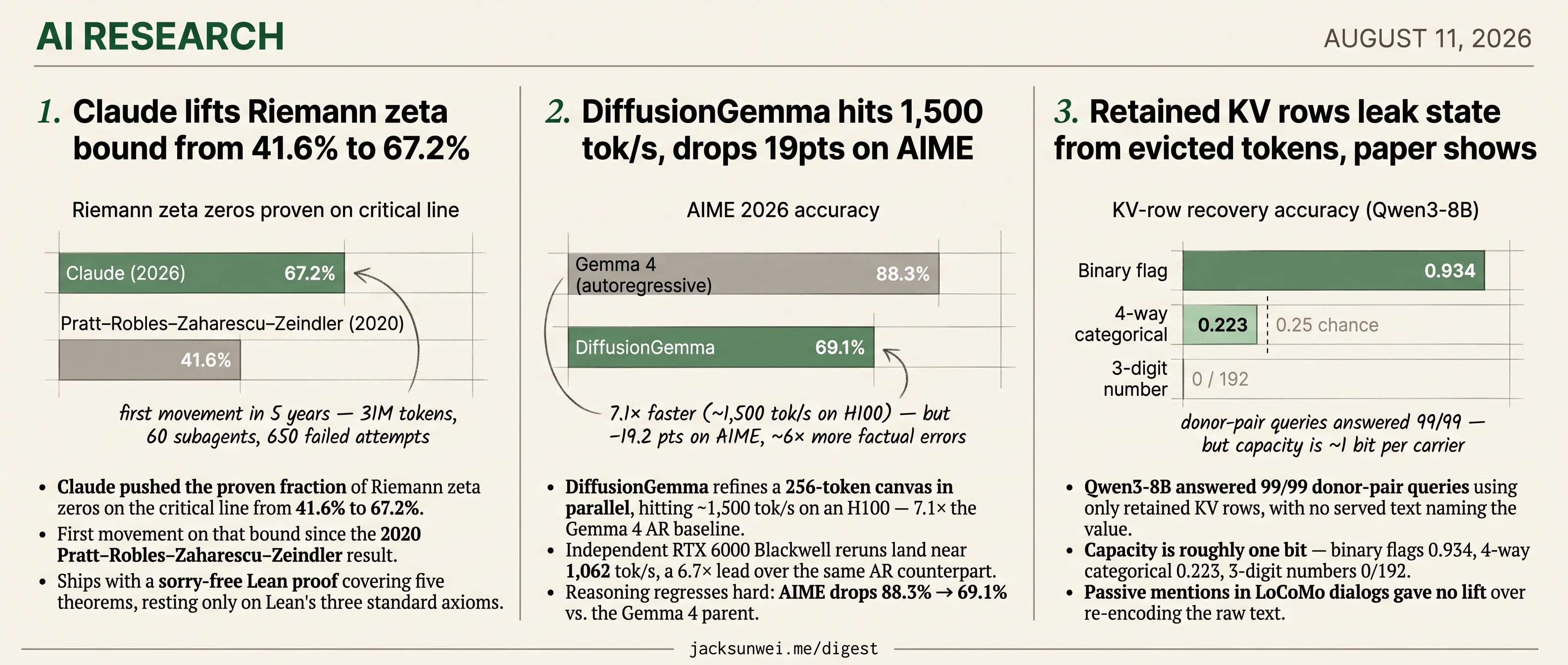
Claude clears 67% zeta, DiffusionGemma slips 19pts, Qwen3 leaks evicted tokens
Claude lifts the Riemann zeta bound to 67.2%, DiffusionGemma trades reasoning for parallel-decode speed, and Qwen3 exposes KV-cache leakage.
Claude clears 67% zeta, DiffusionGemma slips 19pts, Qwen3 leaks evicted tokens
TL;DR
- Claude lifted the proven Riemann zeta bound from 41.6% to 67.2%, first movement since 2020.
- DiffusionGemma hits ~1,500 tok/s parallel decode, drops AIME 88.3% → 69.1% vs Gemma 4.
- Qwen3-8B answered 99/99 donor-pair queries from retained KV rows after eviction, exposing hidden carryover.
- LongHorizon-Harness stores verified subtask state externally, drawing 166 upvotes on Hugging Face.
- SWE-Touch shows coding agents miss human edits to shared files under shared-workspace conditions.
Today’s research features sit side by side without a shared theme. Claude pushed the proven fraction of Riemann zeta zeros on the critical line from 41.6% to 67.2% — the first movement on that bound since the 2020 Pratt–Robles–Zaharescu–Zeindler result — though the checkpoint and full agent transcripts are withheld and the external review was a short-notice read. DiffusionGemma clears 1,500 tok/s by refining a 256-token canvas in parallel, at the cost of 19 AIME points and a new jailbreak family (DIJA) that hits 100% keyword-ASR on diffusion LLMs. And a memory-attribution paper on Qwen3-8B shows that KV eviction ‘with no accuracy loss’ can still carry an evicted token’s content forward in a retained downstream row.
The briefs run agent-heavy: a failure taxonomy that separates model from harness, a long-horizon state-tracking harness that drew 166 upvotes, and three benchmarks that catch agents editing dead code, ignoring human co-edits, and re-searching tools they’ve already mapped.
Claude lifts Riemann zeta bound from 41.6% to 67.2%
Source: anthropic-research · published 2026-08-10
TL;DR
- Claude pushed the proven fraction of Riemann zeta zeros on the critical line from 41.6% to 67.2%.
- First movement on that bound since the 2020 Pratt–Robles–Zaharescu–Zeindler result.
- Ships with a sorry-free Lean proof covering five theorems, resting only on Lean’s three standard axioms.
- The run burned 31M output tokens across 60 subagents and 650 failed attempts in Claude Code.
- External reviewers “examined the paper on short notice” — an endorsement, not a peer review.
- The specific checkpoint and full agent transcripts are withheld, so the capability claim isn’t reproducible.
What actually got proved
An unreleased research Claude improved the lower bound on the proportion of Riemann zeta zeros lying on the critical line from 5/12 ≈ 41.66% (Pratt–Robles–Zaharescu–Zeindler, 2020) to greater than 2/3. The 41.6% figure had been a stagnation point for five years 1. This is not a proof of the Riemann hypothesis — that would require 100% — but it is real movement on a bound that specialists had stopped expecting near-term progress on.
The technical unlock came from a 2024–25 series by Baluyot, Goldston, Suriajaya, and Turnage-Butterbaugh that removed the RH assumption from Montgomery’s 1973 pair-correlation machinery. Claude’s contribution was a “linear-algebraic reading” — applying Sylvester’s law of inertia to a non-diagonal quadratic form and fusing BGSTB with Bombieri’s 2000 paper, treating positive- and negative-definite subspaces holistically rather than diagonalizing 1.
The Lean artifact is the load-bearing evidence
The anthropics/zeta-23-lean repository is the part of this story that isn’t marketing. It is sorry-free, depends only on propositional extensionality, classical choice, and quotient soundness, and proves five distinct theorems: the headline ≥2/3 bound (Theorem A), ≥1/2 simple-and-on-line (B), ≥3/4 distinct zeros (C), an explicit Montgomery–Taylor constant c₁* ≈ 0.75329 (D), and an extension to primitive Dirichlet L-functions (E) 2.
Reaching those statements required Claude to formalize a large slab of analytic infrastructure missing from Mathlib — Weil’s explicit formula, Riemann–von Mangoldt counting, Stirling estimates for Γ′/Γ, Montgomery–Vaughan inequalities. That engineering artifact is arguably more impressive than the numerical bound.
The capability claim is not reproducible
Anthropic’s process metrics are eye-catching: two Claude Code sessions, 31M output tokens, 60 coordinated subagents (2 leads, 13 brainstormers, 30 exploring dead ends, 13 validators), 2,400 shell commands, and 54 arXiv papers auto-refereed for novelty. The human contribution was mostly Jarred Sumner sending “keep going” and “believe in yourself” through 650 failed attempts 3.
The skeptics’ pushback is sharp and worth taking seriously. Hacker News commenters called 31M tokens “an improper metric of intelligence” and noted that with the checkpoint and full agent transcripts withheld, the capability claim is “anecdotal marketing” even though the Lean proof itself is rigorous 4. Anthropic’s own language — Brian Conrey and Dan Goldston “generously examined the paper on short notice” 5 — is an endorsement, not months-long journal refereeing.
Where this sits in the 2026 AI-math wave
Placed alongside DeepMind’s AlphaProof Nexus (nine Erdős problems, two open more than 50 years) and Gemini Deep Think’s certified IMO gold 6, the zeta result reads less as a singular event than as Anthropic’s entry in an ongoing AI-math arms race. The novelty is narrower than the headline suggests — Claude recombined recent human machinery 3 — but the combination of a hard analytic-number-theory bound and a machine-checkable Lean proof is a genuinely new shape of artifact.
The interesting question isn’t whether Claude “did math.” It’s whether frontier labs will now routinely ship Lean-formalized results as the default proof-of-capability, and what that does to how the mathematics community assesses claims of AI contribution.
DiffusionGemma hits 1,500 tok/s, drops 19pts on AIME
Source: hf-daily-papers · published 2026-07-30
TL;DR
- DiffusionGemma refines a 256-token canvas in parallel, hitting ~1,500 tok/s on an H100 — 7.1× the Gemma 4 AR baseline.
- Independent RTX 6000 Blackwell reruns land near 1,062 tok/s, a 6.7× lead over the same AR counterpart.
- Reasoning regresses hard: AIME drops 88.3% → 69.1% vs. the Gemma 4 parent.
- Community tests find ~6× more factual errors than Gemma 4, often smooth-sounding but wrong.
- A new jailbreak family (DIJA) hits 100% keyword-ASR on dLLMs by abusing bidirectional denoising.
The speed headline reproduces
Google DeepMind’s pitch is that discrete diffusion breaks the token-by-token bottleneck: a bidirectional decoder denoises a 256-token canvas in ~20 tokens per forward pass, versus the 3–6 that state-of-the-art speculative decoding manages. On a single H100, that’s ~1,500 tok/s — 7.1× the Gemma 4 autoregressive baseline and 4.8× Gemma 4 with multi-token prediction.
Community benchmarking backs the order of magnitude. A Docker/vLLM setup on an RTX 6000 Blackwell measured 1,062 tok/s and a 6.7× throughput lead over the AR counterpart 7. The caveat both DeepMind and reproducers agree on: this is a low-batch story. Above batch 32, per-token compute costs let standard AR serving reclaim throughput, and local-inference tooling isn’t ready — Ollama and LM Studio don’t recognize the diffusion-gemma architecture, and vLLM’s mixed causal-prefill / bidirectional-denoise attention path has broken early tensor-parallel support 8.
The accuracy gap is worse than “noticeable”
The report calls the capability delta a “noticeable absolute performance gap” and blames a short SFT phase. Outside reruns are blunter.
| Benchmark | Gemma 4 (AR) | DiffusionGemma | Delta |
|---|---|---|---|
| GPQA-Diamond | 82.3% | 73.2% | −9.1 |
| AIME 2026 | 88.3% | 69.1% | −19.2 |
| HumanEval | 98.8% | 94.5% | −4.3 |
| GSM8K | 96.4% | 96.3% | ~0 |
An r/LocalLLaMA head-to-head found DiffusionGemma made roughly 6× more factual mistakes than Gemma 4 on matched prompts, often hallucinating smooth-sounding but wrong names and dates 9. That’s consistent with theoretical work on masked diffusion showing that while token-level perplexity can match AR in constant steps, achieving low sequence error rate — the thing chained reasoning needs — requires denoising steps that scale linearly with length, largely erasing the speed advantage in reasoning-heavy contexts 10. The 19-point AIME gap may be structural to the paradigm, not a training artifact.
A jailbreak class AR alignment doesn’t cover
The bidirectional canvas opens an attack surface AR models don’t have. The DIJA framework embeds harmful instructions inside masked spans and lets the model’s own contextual-consistency drive push it to complete them, reporting 100% keyword-attack success on Dream-Instruct and beating strong AR jailbreak baselines like ReNeLLM by more than 78 points 11. Neither the DiffusionGemma report nor Google’s developer materials address this family, and standard self-reminder / RPO defenses aren’t obviously sufficient.
Where the paradigm actually earns its place
The most durable framing from outside the report: DLMs aren’t better chatbots, they’re better editors 12. Escaping left-to-right early-token bias matters most on non-linear tasks — code refactoring, document infilling, JSON repair, Sudoku-style constraint satisfaction — where the paper itself notes canvases converge in as few as 2–3 denoising steps. Treat DiffusionGemma as a specialist edit engine that plugs into an AR reasoner, not as a Gemma 4 replacement, and the 7× number stops being in tension with the 19-point AIME regression.
Retained KV rows leak state from evicted tokens, paper shows
Source: hf-daily-papers · published 2026-07-25
TL;DR
- Qwen3-8B answered 99/99 donor-pair queries using only retained KV rows, with no served text naming the value.
- Capacity is roughly one bit — binary flags 0.934, 4-way categorical 0.223, 3-digit numbers 0/192.
- Passive mentions in LoCoMo dialogs gave no lift over re-encoding the raw text.
- Eviction with “no accuracy loss” can be illusory — the source’s state may land in a retained downstream row.
The claim: KV cache selection is not text selection
“Compute Globally, Materialize Locally” (arXiv:2607.23693) argues that when a transformer prefills a long sequence, downstream tokens causally absorb state from upstream ones into their hidden representations. If an eviction policy later drops the upstream span but keeps a downstream span that referenced it, the served row can still answer questions about the deleted text.
The authors isolate this with a donor-pair protocol: two agent histories that are byte-identical in every served token and position, differing only in an earlier “source” event that gets excluded from the final prompt 13. A downstream root event (“MM mirrors SS”) is retained. If the model’s answer tracks the omitted source, the root’s KV row must have materialized that state during prefill. On Qwen3-8B the donor-follow ratio is 99:0; on Gemma-4-12B it’s 80:0.
This sits directly on top of the “attention sink” lineage — StreamingLLM showed that four initial tokens carry enough state to stabilize million-token streams 14 — but reframes it as a programmable channel rather than a descriptive quirk. LMCache’s April 2026 essay made the same argument from serving infrastructure: the KV cache “behaves more like a persistent data pipeline with intrinsic semantic value that outlives the tokens that produced it” 15.
The capacity envelope is thin
The channel exists, but it is narrow. Reliable recovery holds for one bit — binary flags land at 0.934 vs. 0.50 chance. Push to 4-way categorical and accuracy drops to 0.223 (near the 0.25 floor); 8-way sits at 0.156. Exact recovery of 3-digit numbers fails outright: 0 out of 192.
Trigger phrasing also matters more than any deployable API should tolerate. On Qwen3, the verb “consist” writes through at 0.94; “write,” used in a structurally similar frame, only reaches 0.52. There is no portable syntax across model families — a construction that fires in Qwen3 can be silent in Gemma-4.
The LoCoMo problem
The most damaging caveat is the paper’s own: on LoCoMo’s 300-turn, 9k-token conversations 16, harvesting natural passive mentions produced no detectable benefit over just re-encoding the text from scratch 17. The 6% → 51% recovery lift required an explicit carrier (“determine the verdict now and record it here”). Outside contrived prompts, the primitive is dormant.
That gap matters because EpiCache-style episodic eviction, which already hits near-lossless behavior at 4–6× compression by clustering conversation into topical episodes 18, is the natural deployment target. Materialization only pays off if you know which downstream row to keep — and only if a developer wrote the upstream event as a deliberate carrier.
Why serving teams should read it anyway
The practical takeaway is inverted from the headline. The paper is less useful as a memory API than as a warning about eviction benchmarks. If dropping a source event doesn’t hurt accuracy, that isn’t evidence the source was redundant — it may mean the state successfully materialized into a retained row, and a different eviction pattern would expose the loss. Adding a single unrelated filler row to Qwen3’s serve set dropped root donor-sensitivity from 41% to 22%, so the channel is fragile to exactly the kind of churn production serving systems introduce.
One bit, reliably, per deliberately phrased carrier, per model checkpoint. That is the current contract.
Round-ups
LongHorizon-Harness tracks task state outside context for long agent runs
Source: hf-daily-papers
A manage-execute-audit loop stores verified subtask states externally, letting agents survive beyond a single context window. The AgentAdapter harness posts gains on WeaveBench, Terminal-Bench, and OSWorld, and drew 166 upvotes on Hugging Face’s daily papers.
New taxonomy pinpoints whether agent failures come from model or harness
Source: hf-daily-papers
The framework classifies agent failures by which component interaction broke — model, tools, or harness scaffolding — rather than lumping errors together. Annotators reach strong agreement (Cohen’s κ), letting teams target repairs across reasoning and multi-agent architectures instead of blaming the base model.
ScrambleToolBench finds agents keep searching after mapping the tool
Source: hf-daily-papers
By hiding tool behaviors behind trial-and-error interaction, the benchmark isolates behavioral reasoning from documentation lookup. Agents discover mappings but then ignore them under structural changes, exhibiting belief inertia and exhaustive re-search instead of applying deductive strategies from persistent memory.
AgentStream tests self-evolving agents on isolated, sequential, and interleaved streams
Source: hf-daily-papers
Benchmarking self-evolving LLM agents across three streaming regimes shows no method dominates universally. Reliability of self-evolution depends on base model capability and how tasks are composed in the stream, undercutting claims that continual self-improvement generalizes across settings.
SWE-Touch shows coding agents break when users edit the same files
Source: hf-daily-papers
The benchmark injects Counter-Edits from a User Patch Generator into SWE-bench Verified and SWE-Bench Pro tasks, simulating shared workspaces. Agents including DeepSWE fail to notice conflicting human changes, exposing weak workspace awareness and verification in current coding harnesses.
LLMs avoid deleting code, wrapping dead lines in guards instead
Source: hf-daily-papers
Code-repair models prefer adding guard patterns over removing unnecessary lines, a bias the authors call deletion avoidance. Measured on SWE-bench Verified and a new CanItDelete benchmark, targeted post-training reduces the behavior without hurting overall repair accuracy.
GPTQ-2D cuts two-sided quantization from quartic to cubic time
Source: hf-daily-papers
Extending GPTQ’s adaptive rounding to two-sided matrix quantization, the method processes anti-diagonals in parallel to reach cubic runtime while producing the same output as the quartic vectorized baseline, making Kronecker-structured quantization tractable at scale.
Footnotes
-
vibemathed.com — problem writeup — https://vibemathed.com/problem/more-than-67-of-riemann-zeta-zeros-are-on-the-critical-line
↩ ↩2The 41.66% (5/12) record set by Pratt, Robles, Zaharescu and Zeindler in 2020 had been a stagnation point; BGSTB’s 2024–25 work removed the RH assumption from Montgomery’s 1973 pair-correlation method, and Claude combined it with Bombieri (2000) via a ‘linear-algebraic reading’ using Sylvester’s law of inertia.
-
GitHub — anthropics/zeta-23-lean — https://github.com/anthropics/zeta-23-lean
↩The formalization is ‘sorry-free’ and rests only on Lean’s three standard axioms (propositional extensionality, classical choice, quotient soundness); it proves Theorem A (≥2/3 on the critical line), B (≥1/2 simple and on-line), C (≥3/4 distinct), D (Montgomery–Taylor constant c₁* ≈ 0.75329), and E (extension to primitive Dirichlet L-functions).
-
Reddit r/accelerate thread — https://www.reddit.com/r/accelerate/comments/1vks42g/claude_increased_the_lower_bound_for_the_fraction/
↩ ↩2Skeptics argued Claude ‘recombined’ existing Bombieri and BGSTB machinery rather than inventing new methods, and that Sumner’s contribution was largely sending ‘keep going’ and ‘believe in yourself’ messages through 650 failed attempts.
-
Hacker News discussion (item 49247070) — https://news.ycombinator.com/item?id=49247070
↩Commenters called the announcement ‘copium’, argued that burning 31M tokens is ‘an improper metric of intelligence’, and noted that because the checkpoint and full agent transcripts are withheld, the capability claim remains ‘anecdotal marketing’ even though the Lean proof itself is rigorous.
-
resultsense.com — https://www.resultsense.com/news/2026-08-11-claude-riemann-zeta-lower-bound/
↩Anthropic thanks Conrey and Goldston for ‘generously examining the paper on short notice’ — a rapid endorsement, but distinct from a formal months-long journal refereeing process.
-
seanbreeden.com — 2026 AI-math survey — https://www.seanbreeden.com/blog/google-deepmind-math-reinforcement-learning-alphaproof-gemini-deep-think-imo/
↩DeepMind’s AlphaProof Nexus solved nine Erdős problems (two open >50 years) via a Lean-scaffolded AlphaZero-style loop, and Gemini Deep Think earned a certified IMO gold — framing Claude’s zeta result as one entry in a broader 2026 wave rather than a singular event.
-
r/LocalLLM independent benchmark — https://www.reddit.com/r/LocalLLM/comments/1u8o45y/diffusiongemma_vs_gemma_4_over_6x_faster_on_a/
↩6.7x throughput advantage for DiffusionGemma over its autoregressive counterpart, averaging 1,062 tokens per second in a local Docker-based vLLM setup on an NVIDIA RTX 6000 Blackwell
-
google/hackable_diffusion GitHub / vLLM issue reports — https://github.com/google/hackable_diffusion
↩popular local inference tools like Ollama and LM Studio do not support the specific diffusion-gemma architecture, leading to crashes… implementing dynamic per-sequence causal attention within batching frameworks like vLLM has been cited as a major engineering challenge
-
r/LocalLLaMA — ‘Diffusion Gemma is 4x faster but makes 6x more mistakes’ — https://www.reddit.com/r/LocalLLaMA/comments/1u4bne8/diffusion_gemma_is_4x_faster_but_makes_6x_more/
↩DiffusionGemma was found to make roughly six times more mistakes than its autoregressive counterpart, Gemma 4, often hallucinating smooth-sounding but incorrect names and dates
-
‘Theoretical Benefit and Limitation of Diffusion Language Model’ (arXiv 2502.09992) — https://arxiv.org/abs/2502.09992
↩the number of steps required to ensure a low sequence error rate — crucial for logical chains and mathematical proofs — scales linearly with length, often negating the model’s speed advantages in reasoning-heavy contexts
-
DIJA paper (arXiv 2507.11097) — https://arxiv.org/abs/2507.11097
↩DIJA has achieved a keyword-based ASR of 100% on benchmarks like Dream-Instruct, outperforming strong autoregressive baselines such as ReNeLLM by over 78%
-
Medium — ‘Diffusion LLMs are not better chatbots, they may be better text editors’ — https://medium.com/data-science-collective/diffusion-llms-are-not-better-chatbots-they-may-be-better-text-editors-72da0f570df4
↩for non-linear tasks like code refactoring, document infilling, and bidirectional constraint satisfaction, diffusion models excel because they do not suffer from the ‘early token bias’ inherent in left-to-right prediction
-
oklen/Compute-Globally-Materialize-Locally GitHub repo — https://github.com/oklen/Compute-Globally-Materialize-Locally
↩donor pair = two agent histories byte-identical in every served token and position but differing strictly in the value written by an earlier donor event that is excluded from the final prompt
-
Xiao et al., ‘Efficient Streaming Language Models with Attention Sinks’ (arXiv:2309.17453) — https://arxiv.org/abs/2309.17453
↩we introduce StreamingLLM … keeping the KV of attention sink tokens (with just 4 initial tokens sufficing) together with the sliding window’s KV
-
LMCache blog — ‘Stop calling it KV cache, it’s something much bigger’ — https://blog.lmcache.ai/en/2026/04/28/stop-calling-it-kv-cache-its-something-much-bigger/
↩Calling it a ‘cache’ is misleading — it behaves more like a persistent data pipeline with intrinsic semantic value that outlives the tokens that produced it.
-
Maharana et al., LoCoMo benchmark (ResearchGate) — https://www.researchgate.net/publication/384220784_Evaluating_Very_Long-Term_Conversational_Memory_of_LLM_Agents
↩evaluates AI performance over extended multi-session dialogues averaging 300 turns and 9,000 tokens … single-hop, multi-hop, and temporal reasoning
-
OpenTrain.ai paper summary — https://www.opentrain.ai/papers/compute-globally-materialize-locally-the-memory-contract-of-sparse-event-kv—arxiv-2607.23693/
↩passive natural mentions in real dialogs (LoCoMo) yielded no detectable benefit over just re-encoding the text; the primitive is only dependable when developers deliberately phrase carrier events
-
EpiCache paper (huggingface.co/papers/2604.10098) — https://huggingface.co/papers/2604.10098
↩clusters conversation history into semantically coherent episodes and applies episode-specific KV cache eviction, achieving near-lossless performance at 4–6x compression