Claude skips lab science, 109M JEPA borrows 72B teacher, CMU unifies training
Anthropic's Claude audit, Balestriero and LeCun's 109M JEPA, and CMU's unified loss each win on a narrower base than claimed.
Claude skips lab science, 109M JEPA borrows 72B teacher, CMU unifies training
TL;DR
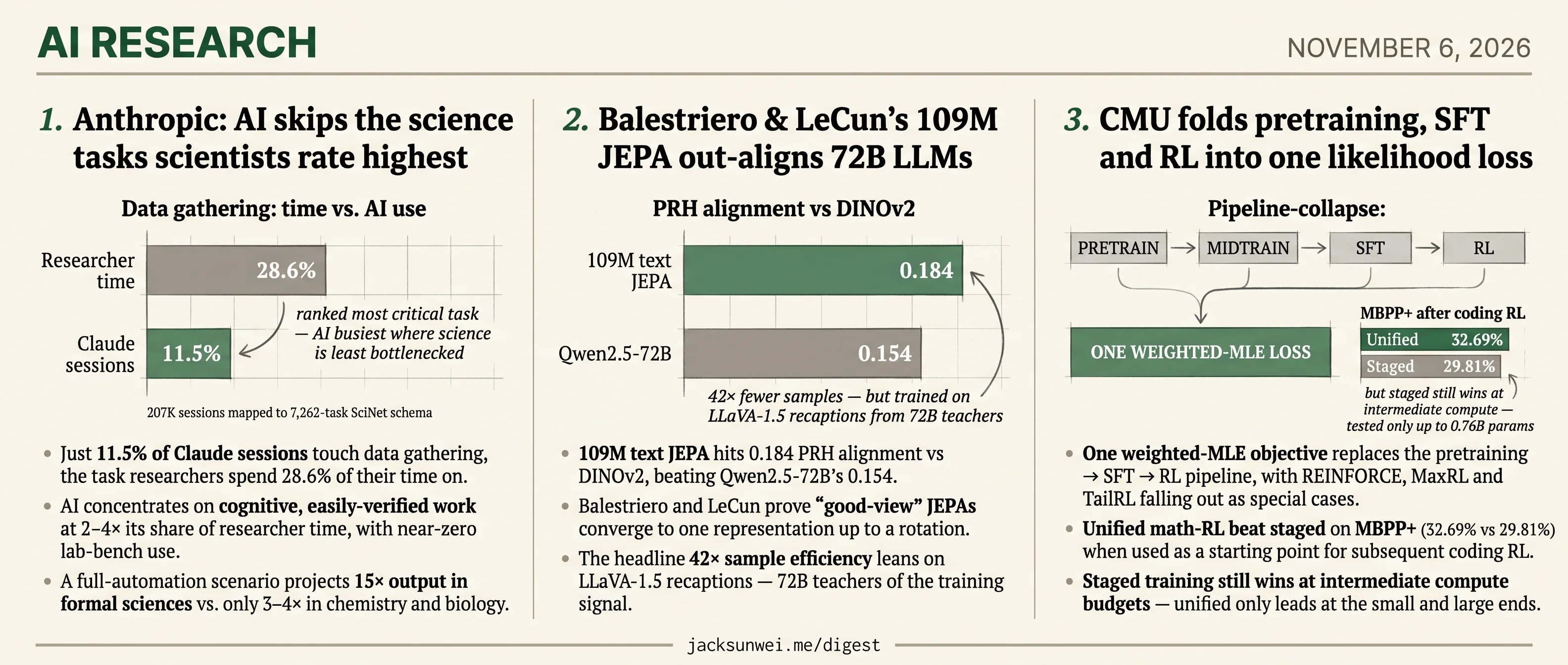
- Anthropic finds Claude touches data gathering in 11.5% of science sessions vs researchers’ 28.6% time share.
- Balestriero and LeCun’s 109M JEPA beats Qwen2.5-72B on PRH alignment, 0.184 vs 0.154.
- The paper’s 42× sample efficiency leans on LLaVA-1.5 recaptions written by 72B teachers.
- CMU folds pretraining, SFT and RL into one weighted-MLE loss, beating staged on MBPP+ at 32.69%.
- Staged training still wins at intermediate compute budgets, with unified only leading at the ends.
Three research results today each advertise a win and then quietly redraw the map of where the win actually sits. Anthropic’s Claude-in-science audit says AI usage concentrates on verifiable cognitive work at 2–4× researchers’ share of time, and barely touches the data gathering that dominates 28.6% of their calendar. A 109M-parameter JEPA from Balestriero and LeCun out-aligns Qwen2.5-72B on representation quality — and the headline 42× sample efficiency rests on recaptions written by a 72B teacher. CMU’s unified weighted-MLE loss collapses pretraining, SFT and RL into one objective and beats the staged pipeline on MBPP+, but staged still wins at intermediate compute, with experiments capped at 0.76B parameters.
Anthropic: AI skips the science tasks scientists rate highest
Source: anthropic-research · published 2026-11-05
TL;DR
- Just 11.5% of Claude sessions touch data gathering, the task researchers spend 28.6% of their time on.
- AI concentrates on cognitive, easily-verified work at 2–4× its share of researcher time, with near-zero lab-bench use.
- A full-automation scenario projects 15× output in formal sciences vs. only 3–4× in chemistry and biology.
- An independent Nature study pushes back: individual paper output rises 300% while collective scientific attention contracts ~4.6%.
The usage map
Anthropic’s Economics team ran its taxonomy classifier over 128,914 general Claude sessions and 78,135 Claude Code sessions from August–September 2026, mapped to the 7,262-task SciNet schema. The dominant pattern is concentration, not breadth: computer science takes 11.9% of Claude sessions and 32.7% of Claude Code sessions, while computational subfields (computational biology, robotics, bioinformatics) outperform their parent domains everywhere. Data analysis and writing together consume roughly a third of general sessions, and nearly half of Claude Code.
The more interesting number is the gap. Surveyed scientists rank ideation and data gathering as the most critical tasks for discovery. Researchers spend 28.6% of their time on data gathering — but only 11.5% of AI sessions touch it. The tools are busiest where the science is least bottlenecked.
The verifiability bias
Anthropic frames this cleanly: Claude is heavily used where tasks are “easy to verify and can be simulated” — exactly the regime where reinforcement learning works. Purely cognitive tasks like statistical testing and data visualization see usage ratios 2–4× higher than time-share would predict. Tasks with physical bottlenecks see essentially none. Claude Science, the life-sciences interface, pushes further up the expertise curve: 80%+ of its usage requires doctoral-level work, and it’s deployed at 5.6× the rate for complex tasks like mechanistic protein modeling, often running at >70% autonomy.
This is where the methodology starts to wobble. The Justified Posteriors reviewers note that only a sliver of those 207K sessions were human-verified; the SciNet labels come from an LLM classifying LLM traffic, and consumer-grade queries can get swept into “research” buckets 1. The “theoretical capability” scores Anthropic correlates against usage come from Bradley–Terry comparisons of Claude judging Claude — numerator and denominator share a bias.
The monoculture problem
Anthropic’s headline scenario — 15× productivity in formal sciences under full non-physical automation — treats concentration as a feature. The University of Chicago’s Evans group, analyzing 41M papers in Nature, treats it as the defect. AI boosts individual paper output by over 300% while the collective scope of scientific inquiry contracts by roughly 4.6%, as researchers migrate toward “data-rich domains where benchmarks are easily measured” and converge into “methodological monocultures” 23.
While AI boosts individual productivity—increasing paper output by over 300%—it may be inadvertently narrowing the scope of global science… leaving data-poor or genuinely novel areas unexplored. 3
Read against that, the bench-science “bottleneck” Anthropic laments is also a safety margin. NTI documents jailbreak attempts against Claude for chikungunya-related research and warns that Claude’s protein visualizations can be “highly confident… based on its internal logic rather than direct empirical evidence” 4. The physical gate isn’t just slowing productivity — it’s catching errors the model is confident about.
Who believes 2030
The report’s standout survey number — 40% of AI-using researchers expect AI to run entire projects autonomously by 2030 — sits inside a bimodal distribution. Anthropic’s own AI Expectations Gap work finds 91% of Anthropic staff expect a Nobel-level AI discovery by 2030, against 39% of the public 5. A 1,600-researcher Nature survey, by contrast, found >60% of scientists fear AI-driven misinformation and undetected errors, and 93% insist on human oversight as a condition of trust 6. The 40% figure is the midpoint between an evangelical inner circle and a field that still wants its hands on the pipette.
Balestriero & LeCun’s 109M JEPA out-aligns 72B LLMs
Source: hf-daily-papers · published 2026-10-28
TL;DR
- 109M text JEPA hits 0.184 PRH alignment vs DINOv2, beating Qwen2.5-72B’s 0.154.
- Balestriero and LeCun prove “good-view” JEPAs converge to one representation up to a rotation.
- The headline 42× sample efficiency leans on LLaVA-1.5 recaptions — 72B teachers of the training signal.
- A concurrent paper shows global Platonic convergence vanishes under permutation-null calibration.
The theorem and the number
Randall Balestriero and Yann LeCun’s new paper does two things at once: it upgrades the Platonic Representation Hypothesis from an empirical observation to a theorem for Joint-Embedding Predictive Architectures, and it drops a benchmark number designed to embarrass next-token prediction. The theorem says that two JEPAs trained on different modalities will learn the same representation — up to an orthogonal rotation — if they share a distribution of positive pairs (different observations of the same world state) and use second-order anti-collapse (whitening). The number: a 109M-parameter text JEPA trained on 940M web image-texts reaches a PRH alignment score of 0.184 against DINOv2, beating Qwen2.5-72B at 0.154 and Llama-3-70B, with roughly 42× fewer samples than next-token prediction to reach parity 7.
The conceptual lever is the authors’ “good views vs. bad views” split. Two different captions of the same scene are a good view — they share a world state and differ in modality nuisance. A prefix and its own continuation inside one document are a bad view — they share document-specific nuisances more than world states. In this framing, standard LLM pre-training is a JEPA with the wrong positive-pair distribution, and the softmax log-partition is just an expensive anti-collapse term.
What the benchmark actually measures
The 0.184 is a representation-alignment score — mutual-nearest-neighbor agreement between embedding spaces — not a downstream capability number. The JEPA is not answering GSM8K; it is sitting closer to DINOv2’s neighborhood structure than a 72B LLM is. Secondary coverage has mostly collapsed this into a “660× smaller model beats frontier LLMs” story 7, which the paper enables but does not quite claim.
Two caveats land hard. First, the web-scale training supplements noisy alt-text with two LLaVA-1.5-generated captions per image 8. The 72B models the JEPA beats are in the lineage that produced its training signal, so the efficiency win is partly a distillation win. Second, Gröger et al.’s concurrent “Aristotelian View” (arXiv:2610.20286) shows CKA-style similarity is mechanically inflated by model scale; after a permutation-based null calibration, global spectral convergence largely disappears and only local neighborhood agreement — not local distances — survives 9. That directly contests the “same representation up to a rotation” framing, which is a global geometric claim.
What’s actually new
Strip the headline and what remains is still substantive: a clean spectral proof that whitened JEPAs on shared world states are rotation-equivalent, a reframing of next-token prediction that makes its sample inefficiency predictable rather than mysterious, and a practical recipe — one learned linear map between a frozen DINOv2 encoder and the text JEPA yields a 0.838 CIDEr score on COCO captioning without training an image-to-text model. The authors concede the open end: DINOv2 is itself a bad-view JEPA trained on crops of one image, and scaling good-view image JEPAs via video frames of the same scene is deferred 10. Eric Xing and others continue to argue the whole family remains structurally prone to collapse, with VICReg and EMA stop-gradients as patches rather than fixes 11.
The theorem is real. The 660× headline is a distillation story wearing an architecture story’s clothes.
CMU folds pretraining, SFT and RL into one likelihood loss
Source: hf-daily-papers · published 2026-10-28
TL;DR
- One weighted-MLE objective replaces the pretraining → SFT → RL pipeline, with REINFORCE, MaxRL and TailRL falling out as special cases.
- Unified math-RL beat staged on MBPP+ (32.69% vs 29.81%) when used as a starting point for subsequent coding RL.
- Staged training still wins at intermediate compute budgets — unified only leads at the small and large ends.
- Experiments cap at 0.76B parameters with hand-tuned mixture weights, leaving the scaling story unresolved.
The unification
Song et al. (CMU, JHU, Aurora) argue that the four-stage training pipeline — pretraining, midtraining, SFT, RL — is an infrastructure artifact, not a mathematical necessity. Their paper rewrites binary-reward RL as maximum-likelihood fitting against a success-conditioned distribution, then shows REINFORCE and TailRL are reweightings of the same objective. Standard policy-gradient methods like REINFORCE and GRPO become “first-order approximations” of a true likelihood objective 12.
Operationally, every training example becomes a (prompt, completion) pair with token-level weights: pretraining tokens weight 1, SFT prompts masked and responses weight 1, RL completions weighted by an advantage term derived from reward and pass rate. A generator process samples and scores completions asynchronously; a trainer continuously mixes those traces with static corpora and updates weights. The design decision shifts from “which stage to run” to “which data to mix, and when” 13.
Where it wins
Two results do real work. First, retention: mixing 2–5% midtraining data into math RL kept held-out pretraining loss low and pushed pass@16 up on general benchmarks, while staged runs showed the usual catastrophic forgetting during the RL transition. KL-divergence regularization toward the base model — the standard trick — either preserved retention or let the model learn new math, but not both.
Second, continual learning: a 0.76B model trained with unified math-RL served as a better base for subsequent coding RL than its staged counterpart, hitting 32.69% on MBPP+ vs 29.81% after 4,000 coding updates 14. That direction of gain is independently supported by a September MIT study arguing on-policy RL updates are “naturally scaled by reward variance,” making them inherently more forgetting-resistant than SFT’s rigid gradients 15 — a different mechanism pointing the same way.
AlphaSignal’s writeup also surfaces a corollary the paper’s abstract underplays: reframing as MaxRL yielded up to 20× test-time scaling efficiency gains on Qwen3-4B math reasoning 12.
Where it doesn’t
The dissent is quantitative and comes from close readers. Unified training wins at the smallest and largest compute budgets tested, but staged training leads at intermediate budgets 14 — the regime covering most real post-training runs. CryptoBriefing’s critique is sharper: experiments are “deliberately small,” there are no scaling laws, mixture weights $f_s$ are set by trial and error, and the evaluation runs one RL task at a time rather than multi-objective alignment 16.
The paper is also candid about mixing-schedule sensitivity. Annealing midtraining data to zero halfway through training recovered coding accuracy but hurt general retention. Adding code during math RL sometimes hurt coding — negative transfer within the “static” mixture itself.
What actually got harder
The honest reading: the math is clean, the retention gains look robust, and the “single algorithm” framing is a useful reorganization. But the hard problem didn’t disappear — it moved. Pipeline orchestration becomes data-mixture scheduling 13, and nothing in the paper tells you what weights to pick. Frontier labs will keep leaning on “retention packs” of curated samples mixed into every batch 17 regardless of which loss they’re optimizing. Unified training is a better substrate for those tricks, not a replacement.
What’s at stake above 1B parameters is still an open bet.
Round-ups
EasyProver clears nearly all Putnam and IMO Lean benchmarks
Source: hf-daily-papers
EasyProver pairs recursive agents with asynchronous proof search to solve almost every Putnam and IMO problem in Lean. A companion system, Aegis, mines competitive programming for harder verification tasks, giving provers fresh benchmarks and reinforcement learning signal as the old sets saturate.
Benchmarks reframed as empirical measures over item difficulty
Source: hf-daily-papers
Treating benchmarks as empirical distributions over item difficulty exposes measure mismatch and coverage gaps that distort model rankings. Diagnostic metrics quantify the problem, and a rewriting algorithm called BenchFill generates targeted items to patch under-covered difficulty regions in existing test sets.
Audit finds many quantized LLMs on Hugging Face are broken
Source: hf-daily-papers
Many GGUF quantized small language models on public registries ship non-functional because uploaders skip calibration data when applying low-bit recipes. A screening tool, quantcheck, flags failures on HumanEval+ and recommends importance-matrix calibration before release to llama.cpp and Ollama users.
MCP and CLI agents diverge despite identical capabilities
Source: hf-daily-papers
Matched interface tests show language agents behave differently across MCP and CLI even when the underlying executable capabilities are identical. The MICA framework isolates interface-specific realization errors, and targeted DART repair raises task success while cutting interaction cost in closed-loop environments.
WISD distills reasoning models against their quantized selves
Source: hf-daily-papers
WISD trains reasoning models by contrasting their outputs with weakened versions created through low-bit quantization or magnitude pruning. The on-policy self-distillation signal needs no stronger teacher or privileged data, yet improves reasoning accuracy using only the model’s own degraded twin.
Soft-MTP fixes noisy gradients in multi-token prediction
Source: hf-daily-papers
Soft-MTP strips a noisy gradient residual from multi-token prediction using a straight-through KL self-distillation trick. The fix lifts perplexity, speculative decoding acceptance, and reasoning scores without extra compute, addressing a long-standing instability that has limited MTP’s gains over plain next-token training.
Affine inverse-sqrt schedule beats cosine for weight-normalized LLMs
Source: hf-daily-papers
Effective learning rate trajectories, not nominal ones, drive gains in weight-normalized pretraining. An affine inverse-square-root decay schedule derived from this view cuts large-scale pretraining loss and improves hyperparameter robustness across dense and Mixture-of-Experts models compared with standard cosine schedules.
Footnotes
-
Empiricrafting Substack / Justified Posteriors podcast critique — https://empiricrafting.substack.com/p/claude-just-refereed-the-anthropic
↩Only a tiny fraction of the millions of sessions were human-verified, raising concerns about the reliability of the automated SciNet classifier… common consumer queries (e.g., troubleshooting a video game) might be mislabeled as [economic activity].
-
UChicago Data Science Institute (on Evans et al., Nature) — https://datascience.uchicago.edu/insights/new-research-shows-how-ai-tools-are-expanding-individual-capabilities-while-contracting-scientific-attention/
↩Scientists using AI tend to migrate toward data-rich domains where benchmarks are easily measured, creating ‘methodological monocultures’ and ‘lonely crowds’… AI could lead to a contraction of scientific inquiry by roughly 4.6%.
-
UChicago/Evans — AI productivity vs. scope — https://datascience.uchicago.edu/insights/new-research-shows-how-ai-tools-are-expanding-individual-capabilities-while-contracting-scientific-attention/
↩ ↩2While AI boosts individual productivity—increasing paper output by over 300%—it may be inadvertently narrowing the scope of global science… leaving data-poor or genuinely novel areas unexplored.
-
NTI (Nuclear Threat Initiative) — biosecurity analysis — https://www.nti.org/risky-business/ai-can-design-new-proteins-its-time-to-build-real-biosecurity-guardrails/
↩Anthropic has documented instances where researchers attempted to bypass safeguards to conduct risky research on viruses like chikungunya… the model sometimes generates highly confident visualizations based on its internal logic rather than direct empirical evidence.
-
Anthropic ‘AI Expectations Gap’ survey — https://www.anthropic.com/research/ai-expectations-gap
↩91% of Anthropic’s own staff believe [a Nobel-level AI discovery by 2030] is imminent… 59% of Anthropic employees report that AI has reduced their task duration to a quarter of the time previously required, compared to just 26% of AI users in the broader workforce.
-
Nature survey of 1,600 researchers (DailyAI summary) — https://dailyai.com/2023/09/science-journal-nature-surveys-1600-researchers-about-ai/
↩Over 60% of researchers fear the proliferation of misinformation, facilitated plagiarism, and the introduction of undetected errors into the scientific record… 93% of survey participants agree that research requires human oversight to be considered trustworthy.
-
StartupFortune coverage of the 109M vs 72B result — https://startupfortune.com/yann-lecuns-tiny-109m-model-aligns-with-vision-better-than-72b-llms/
↩ ↩2The reported alignment score of 0.184 for a 109M BERT-Base text JEPA beats Qwen2.5-72B (0.154), Llama-3-70B and CLIP’s text encoder (0.124), with the authors claiming 42x fewer samples than next-token prediction to reach the same alignment.
-
Mehmet Özel, Medium (‘The LLM Behind LeCun’s 109M-Parameter JEPA’) — https://medium.com/@mehmet.ozel2701/the-llm-behind-lecuns-109-million-parameter-jepa-a290f485f7af
↩For web-scale training the authors supplement alt-text with two LLaVA-1.5-generated captions per image, raising the question of whether the 109M text JEPA’s win over 72B LLMs reflects the JEPA objective or the high-quality, pre-digested nature of the synthetic teacher data.
-
Gröger et al., ‘Revisiting the PRH: An Aristotelian View’ (arXiv:2610.20286) — https://arxiv.org/abs/2610.20286
↩Standard similarity metrics are confounded by model scale; once calibrated via a permutation-based null distribution, global spectral convergence largely disappears and only local neighborhood similarity — but not local distances — remains robust.
-
arXiv HTML of Balestriero & LeCun (2610.39302) — authors’ own limitations section — https://arxiv.org/html/2610.39302v1
↩Current image encoders like DINOv2 are themselves ‘bad-view’ JEPAs trained on crops of a single image; scaling ‘good-view’ image JEPAs (e.g., using video frames of the same scene) remains an open challenge, and the proof assumes injective renderings that rarely hold in practice.
-
MindStudio.ai analysis of LeCun/Balestriero JEPA paper — https://www.mindstudio.ai/blog/yann-lecun-jepa-world-model-paper
↩Critics including Eric Xing argue JEPA-style objectives remain prone to representation collapse; VICReg and EMA stop-gradient tricks are heuristics rather than principled solutions, and LLMs still dominate functional reasoning benchmarks like GSM8K where JEPA has no answer.
-
AlphaSignal (‘CMU collapses four AI training stages into one shared loss’) — https://alphasignal.ai/news/cmu-collapses-four-ai-training-stages-into-one-shared-loss
↩ ↩2standard policy-gradient methods like REINFORCE or GRPO are merely ‘first-order approximations’ of a true likelihood objective… MaxRL achieved up to 20x gains in test-time scaling efficiency
-
AIWeekly (‘CMU/Hopkins paper folds pretrain, SFT, RL into one loss’) — https://aiweekly.co/alerts/cmu-hopkins-paper-folds-pretrain-sft-rl-into-one-loss
↩ ↩2turns the training lifecycle into a strategic problem of data scheduling… rather than switching between disparate algorithms
-
daily.dev summary of the paper — https://daily.dev/posts/unified-training-one-likelihood-based-method-for-pretraining-fine-tuning-and-rl-krem5xfa4
↩ ↩2a model trained with a 5% midtraining data mix achieved a 32.69% score on MBPP+ after coding RL, whereas the staged model reached only 29.81%… unified training excelled at the smallest and largest compute budgets, [but] traditional staged training actually maintained a lead at intermediate budget levels
-
MarkTechPost on MIT catastrophic-forgetting study — https://www.marktechpost.com/2025/09/08/a-new-mit-study-shows-reinforcement-learning-minimizes-catastrophic-forgetting-compared-to-supervised-fine-tuning/
↩RL’s on-policy nature acts as a natural regularizer… RL updates are naturally scaled by reward variance, which inherently protects foundational knowledge better than the rigid gradient updates of SFT
-
CryptoBriefing coverage — https://cryptobriefing.com/carnegie-mellon-unified-ai-training-method/
↩experiments are ‘deliberately small,’ with models capped at 0.76 billion parameters… the paper lacks a principled or automated method for determining ‘mixture weights’… shifts the engineering burden from ‘pipeline management’ to ‘data scheduling,’ which remains a trial-and-error process
-
TheNewStack on continual-learning mitigations — https://thenewstack.io/techniques-for-tackling-catastrophic-forgetting-in-ai-models/
↩practitioners still rely on ‘retention packs’—small, curated datasets of essential safety and functional samples—mixed into every training batch to provide a constant signal for core capabilities