Canada 2nd on Claude use, Gemma 4 ditches encoder, Alibaba ships RynnWorld-4D
Anthropic maps Canada's Claude usage, Gemma 4 swaps its vision encoder for a 35M projector, and Alibaba pairs a 4D world model with a twin.
Canada 2nd on Claude use, Gemma 4 ditches encoder, Alibaba ships RynnWorld-4D
TL;DR
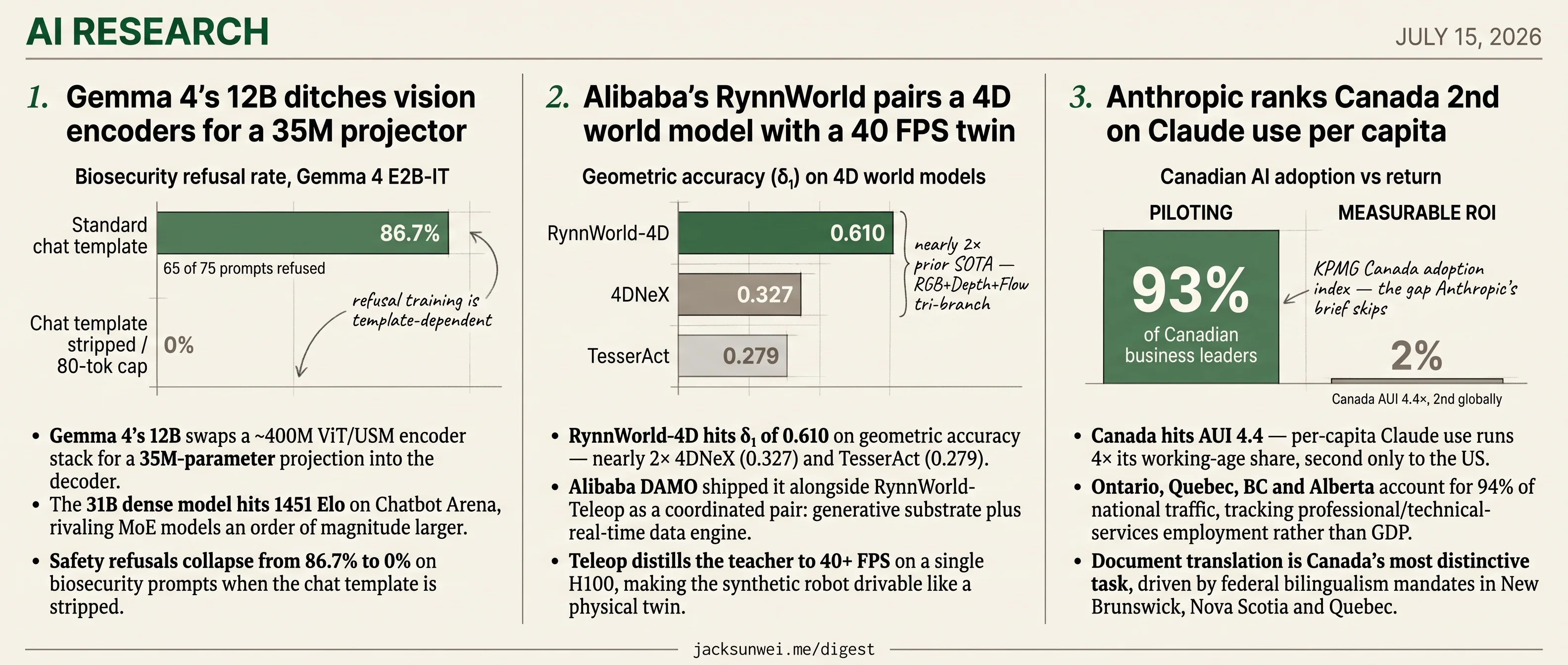
- Canada hits AUI 4.4 on Claude, second per-capita only to the US, per Anthropic’s Economic Index.
- Gemma 4’s 12B swaps a 400M vision encoder for a 35M projector into the decoder.
- Gemma 4 safety refusals on biosecurity prompts collapse from 86.7% to 0% without the chat template.
- Alibaba’s RynnWorld-4D hits δ₁ of 0.610 on geometric accuracy, nearly 2× 4DNeX.
- RynnWorld-Teleop distills the teacher to 40+ FPS on a single H100 for drivable synthetic robots.
Today’s research reads scatter across three unrelated lanes. Anthropic’s Economic Index puts Canada second per capita on Claude use — a geography-of-adoption story rather than a capability one, with Ontario, Quebec, BC and Alberta driving 94% of traffic and document translation showing up as the country’s most distinctive task. Google’s Gemma 4 takes the architectural swing of the day, replacing the ~400M ViT/USM encoder stack with a 35M projector into the decoder and posting a 1451 Elo on its 31B dense variant — impressive until the safety numbers collapse from 86.7% to 0% the moment the chat template is stripped. And Alibaba DAMO’s RynnWorld ships as a coordinated pair: a 4D world model that nearly doubles geometric accuracy over prior baselines, plus a distilled teleop twin at 40+ FPS, though world-model planning still lags real manipulation frequencies by two orders of magnitude.
Gemma 4’s 12B ditches vision encoders for a 35M projector
Source: hf-daily-papers · published 2026-07-01
TL;DR
- Gemma 4’s 12B swaps a ~400M ViT/USM encoder stack for a 35M-parameter projection into the decoder.
- The 31B dense model hits 1451 Elo on Chatbot Arena, rivaling MoE models an order of magnitude larger.
- Safety refusals collapse from 86.7% to 0% on biosecurity prompts when the chat template is stripped.
- The 26B-A4B MoE still needs ~15GB VRAM at Q4 despite activating only ~4B parameters per token.
The encoder-free bet
Gemma 4’s headline architectural move is confined to one SKU: the 12B model replaces the ViT vision encoder and USM/Conformer audio encoder used across the rest of the family with a single 35M-parameter projection module that ingests raw 48×48 RGB patches and 40ms audio chunks directly into the decoder 1. Independent write-ups frame this as a lineage step from Fuyu-8B and EVE rather than a fresh invention, and results are competitive — the 12B posts a 0.063 FLEURS ASR word-error rate on English, matching encoder-based baselines.
The open question is what a 35M embedder gives up. Reviewers flag adversarial robustness and noisy-input handling as untested territory: a frozen semantic encoder normally acts as a filter that catches edge cases before they hit the decoder, and it’s unclear whether the lightweight projector preserves that safety margin under distribution shift 1.
Efficiency wins that mostly check out
The QAT story survives third-party measurement. Google’s own writeup reports the E2B Q4_0 checkpoint achieves ~29× lower KL divergence than naive Q4_0 quantization — enough that a QAT-tuned 4-bit model beats a naive Q8_0 of double the size 2. That is a real shift in the size/quality frontier for on-device deployment.
The MoE variant tells a subtler story. The 26B-A4B activates ~4B parameters per token via 128 tiny experts (8 active) plus one shared expert, and reaches 88.3% on AIME 2026 versus 89.2% for the 31B dense flagship 3. Simon Willison singled it out as the sweet spot for laptop-class inference 4. The catch: all 25.2B weights must sit in VRAM to keep routing latency down, so the practical hardware bar is ~14.4–15GB at Q4 — much closer to the dense flagship than the “4B active” headline suggests 3.
| Model | AIME 2026 | Active params | Must load into VRAM |
|---|---|---|---|
| 31B dense | 89.2% | 31B | 31B |
| 26B-A4B MoE | 88.3% | ~4B | 25.2B (~15GB at Q4) 3 |
Where the report oversells
Day-one deployment surfaced concrete regressions the report doesn’t anticipate. LM Studio users saw the 31B checkpoint emit only --- regardless of prompt until a parser fix landed — a shipping-format bug, but a real friction point Willison flagged publicly 4. Hugging Face reports also caught the 12B-IT entering a “degenerate loop” that repeatedly emits the token thought under long agent-style system prompts, a direct hit on the flagship thinking-mode feature 5.
The safety picture is worse. The BioRefusalAudit paper (arXiv:2605.30162) reports that Gemma 4 E2B-IT refuses 65 of 75 biosecurity prompts (86.7%) under standard chat templates — but that number collapses to 0% when the chat template is stripped or output is capped at 80 tokens 6. Both configurations are common in low-latency production. The refusal training is real; it’s just template-dependent in a way that trivially unravels outside chat mode.
Refusal dropped to 0% when chat formatting was removed or an 80-token output cap was applied. 6
That is the sharpest independent contradiction of the report’s alignment claims, and it means anyone deploying Gemma 4 behind a non-chat API needs to layer their own guardrails — the weights alone won’t hold.
Alibaba’s RynnWorld pairs a 4D world model with a 40 FPS twin
Source: hf-daily-papers · published 2026-07-06
TL;DR
- RynnWorld-4D hits δ₁ of 0.610 on geometric accuracy — nearly 2× 4DNeX (0.327) and TesserAct (0.279).
- Alibaba DAMO shipped it alongside RynnWorld-Teleop as a coordinated pair: generative substrate plus real-time data engine.
- Teleop distills the teacher to 40+ FPS on a single H100, making the synthetic robot drivable like a physical twin.
- The catch: world-model planning runs at just 0.9 Hz, well below the 50–100 Hz stable manipulation needs.
A stack, not a paper
Read the two Rynn papers as one release. RynnWorld-4D is the generative substrate — a tri-branch diffusion transformer built on Wan 2.2 that emits synchronized RGB, depth, and optical flow (RGB-DF) so a policy can unproject scene flow into 3D geometry instead of guessing motion from pixels. RynnWorld-Teleop is the exploitation layer: streaming autoregressive distillation compresses the bidirectional teacher into a causal student that runs at 40+ FPS on a single H100, letting an operator “drive” the synthetic robot as if it were a physical twin 7. That real-time bar is what makes the pair interesting — it’s the difference between sampling a diffusion model and generating usable teleoperation trajectories at scale.
flowchart LR
    A[RGB-D image + language] --> B[RynnWorld-4D<br/>tri-branch DiT]
    B --> C[Synchronized<br/>RGB + Depth + Flow]
    C --> D[RynnWorld-4D-Policy<br/>9 Hz control]
    B -.distill.-> E[RynnWorld-Teleop<br/>40+ FPS causal]
    E --> F[Synthetic teleop<br/>rollouts]
    F -.train.-> D
The numbers hold up
Independent write-ups corroborate the structural-accuracy claims: the RGB-DF representation roughly doubles prior 4D world models on geometric accuracy and is credited with killing the shape-morphing that plagues 2D video predictors 8. On six bimanual real-world tasks with a TIANJI M6, RynnWorld-4D-Policy beats Diffusion Policy and π₀ across the board — 65.7% on lid placement and bowl stacking, 94–97% on dual picking and bimanual lifting. Hand-over lands at only 28.6%, but π₀ and π₀.₅ score 2.9% and 0% on the same task, suggesting the 3D-aware representation is doing real work on distance estimation.
The 0.9 Hz problem
The architecture’s cost lives in the tri-branch transformer, which eats 89.5% of inference latency and caps the world model’s “mental refresh” at ~0.9 Hz. Action chunking boosts effective control to 9 Hz, but OpenReview literature on 4D planners argues the whole class is stuck: stable manipulation typically demands 50–100 Hz control, and timing jitter from variable generative iteration times compounds the mismatch 9. A Substack analysis flags a related weakness — isolated skills like grasping hit 77–100%, but chained sequences degrade on “next-skill readiness” and target grounding, exposing a long-horizon composition gap the paper underplays 10.
Current 4D latent planners operate at 0.5–10 Hz… timing jitter caused by varying iteration times in generative planners remains a barrier to fluid, reactive movement. 9
Strategic frame and artifact reality
Regional coverage reads the Rynn stack — RynnBrain, RynnVLA, RynnRCP, RynnWorld — as Alibaba’s answer to Google’s Gemini Robotics and NVIDIA Cosmos: a vertically integrated, open-weight AI factory spanning silicon, cloud, and embodied foundation models 11. That framing raises the stakes and the scrutiny.
Reproducibility is uneven. The GitHub repo ships the Stage-3 checkpoint (~28 GB) plus EMA shadow weights and the full three-stage training recipe, but Issue #1 — the Hugging Face release of the 254M-frame Rynn4DDataset — is still open 12. You can run the model today; you cannot rerun the training. For a release pitched as an open-weight Cosmos alternative, that gap is the thing to watch next.
Further reading
Anthropic ranks Canada 2nd on Claude use per capita
Source: anthropic-research · published 2026-07-14
TL;DR
- Canada hits AUI 4.4 — per-capita Claude use runs 4× its working-age share, second only to the US.
- Ontario, Quebec, BC and Alberta account for 94% of national traffic, tracking professional/technical-services employment rather than GDP.
- Document translation is Canada’s most distinctive task, driven by federal bilingualism mandates in New Brunswick, Nova Scotia and Quebec.
- Only 2% see measurable ROI despite 93% of Canadian leaders piloting AI, per KPMG Canada’s adoption index.
The headline number
Sampled in February 2026, Canada pulled 2.6% of global Claude.ai traffic — eighth by volume, second by per-capita intensity behind the United States. Anthropic’s Usage Index (AUI) puts Canadian consumption at 4.4× what the country’s working-age population would predict. Provincial concentration is sharp: Ontario (43.9%), Quebec (20.8%), BC (18.9%) and Alberta (10.2%) make up roughly 94% of national usage, with BC leading per-capita at 1.4× parity and Newfoundland trailing at 0.2×.
The more interesting finding is what predicts adoption. Globally, national income is the dominant signal. Inside Canada, it’s the size of the professional, scientific and technical services sector — a labour-market fingerprint, not a wealth one. Anthropic reads this as capability-market fit: Claude’s strengths line up with what Canadian knowledge workers actually do.
Translation is the Canadian tell
Task-mix looks Anglosphere-standard at the top level (Personal 44–51%, Work 34–40%, Coursework 13–18%), but the distinctive slice is document translation, correlated with public-administration employment and concentrated in the bilingual provinces. Canadians also over-index on STEM coursework, coding help and résumé drafting versus US/UK/Australian peers, and under-index on workplace email polish, marketing copy, and legal or home-maintenance queries. It reads like a country where students and early-career technical workers are the heaviest hands on the keyboard.
The caveats Anthropic left out
Independent data broadly corroborates the adoption curve — Statistics Canada’s Q2 2026 business survey shows enterprise AI use jumping from 6.1% to 19.2% in two years, with Information & Cultural Industries leading at 42.3% 13. That’s a rare case of vendor telemetry lining up with a national statistical agency.
The productivity claim is where the brief gets ahead of the evidence. KPMG Canada’s own adoption index finds 93% of business leaders piloting AI, and only 2% reporting measurable ROI 14. Anthropic itself quietly halved its augmented-developer productivity forecast from 3× to 1.5× after benchmarking revealed a 63% first-try failure rate on mid-range agentic tasks 15. “Integration into the national economy” is doing a lot of work in the brief’s conclusion.
Two other Canadian-specific frictions go unmentioned. OSFI has formally warned the Big Six banks that frontier Claude variants can autonomously exploit zero-day vulnerabilities, compressing risk-mitigation windows to machine speed 16 — a direct headwind to the financial-services adoption the report highlights. And Cohere just shipped North Mini Code, a 30B open-weight coding model pitched explicitly at Canadian regulated industries that don’t want data leaving domestic perimeters 17. Canada’s Claude enthusiasm is real; so is the domestic push to route around it.
The ranking has also moved. By early July, Australia had taken the global top spot at 6.4× expected usage across 121 countries 18. Canada’s silver medal is a February snapshot in a leaderboard that reshuffles quarterly — a useful reminder that per-capita AUI is a race, not a moat.
Round-ups
Single transformer layer matches full-parameter RL fine-tuning
Source: hf-daily-papers
Reinforcement learning gains in transformers concentrate in a handful of middle layers, and training just one of them rivals full-parameter RL across math, code, and agentic decision tasks. The finding holds across GRPO, GiGPO, and Dr. GRPO, hinting at far cheaper RL post-training recipes.
Tencent’s HiLS attention learns chunk selection for infinite context
Source: hf-daily-papers
Hierarchical Landmark Sparse Attention from Tencent Hunyuan trains chunk selection end-to-end via language-modeling loss, matching dense attention quality while extrapolating past training context lengths. Sparse KV access keeps compute bounded, and the team has released code for the architecture on GitHub.
Nemotron-Labs-Diffusion fuses AR, diffusion, and self-speculation decoding
Source: hf-daily-papers
NVIDIA’s tri-mode language model trains a joint AR-diffusion objective with lookahead planning, letting one network switch decoding strategies for higher throughput. On SPEED-Bench running SGLang on GB200, it beats existing models on speed-of-light efficiency while scaling cleanly with parameters.
AlayaWorld open-sources real-time playable video world models
Source: hf-daily-papers
AlayaWorld packages autoregressive video world generation into a modular, reproducible pipeline supporting live user actions and long-horizon rollouts. The release ships reference implementations and evaluation tooling on GitHub, giving researchers a shared baseline for interactive generative worlds rather than closed demos.
DSpark uses confidence-scheduled verification to speed LLM decoding
Source: hf-daily-papers
DSpark pairs parallel semi-autoregressive drafters with adaptive verification tuned by prefix survival probabilities, cutting wasted tokens from acceptance decay. In high-concurrency serving, it pushes the throughput-latency Pareto frontier above standard speculative decoding baselines.
Signed MaxSim extends ColBERT-style retrieval to logical queries
Source: hf-daily-papers
MaxSim similarity exactly reproduces inner products over k-sparse vectors and supports soft-OR and CNF logical expressions, and a Signed MaxSim variant lifts the trick to real-valued embeddings. The extension raises nDCG@10 on complex query types over standard ColBERT late interaction.
HunyuanOCR-1.5 speeds lightweight vision-language OCR with DFlash
Source: hf-daily-papers
Tencent’s end-to-end OCR VLM pairs a DFlash inference stack with an Agentic Data Flow pipeline for pretraining and post-training, delivering faster inference and broader task coverage in a small model. The design targets deployment where full-scale VLMs are too costly.
Footnotes
-
oflight.co.jp analysis of encoder-free 12B — https://www.oflight.co.jp/en/columns/gemma-4-12b-encoder-free-multimodal-2026
↩ ↩2The primary innovation in Gemma 4 12B is the removal of heavy modality-specific encoders in favor of a 35M-parameter lightweight embedder… critics have questioned whether such a drastically smaller input layer can maintain the same level of feature extraction quality as traditional frozen encoders.
-
Google Developers Blog — QAT for Gemma 4 — https://blog.google/innovation-and-ai/technology/developers-tools/quantization-aware-training-gemma-4/
↩the Gemma 4 E2B variant demonstrates a Kullback–Leibler divergence roughly 29 times better than naive Q4_0 quantization… a QAT-optimized 4-bit model can often outperform a traditional 8-bit (Q8_0) model of double the size.
-
Roboflow model comparison: 26B A4B vs 31B — https://playground.roboflow.com/models/compare/gemma-4-26b-a4b-vs-gemma-4-31b
↩ ↩2 ↩3The 26B A4B activates only ~4B parameters per token via 128 tiny experts (8 active) plus one shared expert, reaching 88.3% on AIME 2026 versus 89.2% for the 31B flagship — but all 25.2B parameters must be loaded into VRAM (~14.4–15GB at Q4).
-
dev.to practical guide (citing Simon Willison) — https://dev.to/arshtechpro/gemma-4-a-practical-guide-for-developers-2co5
↩ ↩2Willison characterized Gemma 4 as ‘byte for byte, the most capable open models’… but noted the 31B Dense model was initially ‘completely broken’ in LM Studio, repeatedly outputting ’---’ regardless of the prompt.
-
Medium — reasoning mode evaluation on-device — https://medium.com/@saloni_garg/reasoning-mode-evaluation-in-on-device-transformers-gemma-4-9ccc9762a6df
↩Community reports on Hugging Face highlighted a ‘degenerate loop’ issue in the 12B instruction-tuned model: under certain long agent-style system prompts, the model enters a loop, repeatedly emitting the word ‘thought’ rather than completing the reasoning trace.
-
Stephen Turner blog on BioRefusalAudit (arXiv:2605.30162) — https://blog.stephenturner.us/p/five-things-june-5-2026-aixbio
↩ ↩2Gemma 4 E2B-IT refused 65 of 75 biosecurity prompts (86.7%) with standard chat templates, but refusal dropped to 0% when chat formatting was removed or an 80-token output cap was applied.
-
AIWeekly summary of RynnWorld-Teleop — https://aiweekly.co/alerts/rynnworld-teleop-replaces-the-robot-with-a-40-fps-world-model
↩streaming autoregressive distillation… compresses the bidirectional teacher into a causal student capable of 40+ FPS inference on a single H100 GPU, allowing an operator to ‘drive’ the synthetic robot as if it were a physical twin.
-
alphaXiv overview of RynnWorld-4D — https://www.alphaxiv.org/abs/2607.06559
↩In quantitative evaluations, RynnWorld-4D achieved a geometric accuracy (δ₁) of 0.610, nearly doubling the performance of 4DNeX (0.327) and TesserAct (0.279).
-
OpenReview critique of 4D world-model planners — https://openreview.net/pdf/d19b200c60835c287e29c6d20ec394f93038c007.pdf
↩ ↩2stable manipulation typically requires 50–100 Hz control, [but] current 4D latent planners operate at 0.5–10 Hz… timing jitter caused by varying iteration times in generative planners remains a barrier to fluid, reactive movement.
-
So Essentially (Substack) analysis of RynnWorld-4D — https://soessentially.substack.com/p/rynnworld-4d-robot-manipulation-the
↩isolated skills like grasping or door-opening achieve success rates of 77–100%, [but] chained sequences often stall due to errors in target grounding and ‘next-skill readiness’ — a substantial gap in long-horizon compositional robustness.
-
Business Times (Singapore) on Alibaba RynnBrain push — https://www.businesstimes.com.sg/international/global/alibaba-pushes-robotics-ai-open-source-rynnbrain
↩Alibaba is positioning itself as a vertically integrated ‘AI factory,’ owning every layer from proprietary silicon to cloud infrastructure and foundational robotic models — a direct challenge to Google’s Gemini Robotics and Nvidia’s Cosmos.
-
GitHub alibaba-damo-academy/RynnWorld-4D — https://github.com/alibaba-damo-academy/RynnWorld-4D
↩Stage-3 checkpoint includes both full trained weights (~28 GB) and recommended EMA shadow weights; Rynn4DDataset Hugging Face release is tracked in open Issue #1.
-
Statistics Canada — Canadian Survey on Business Conditions Q2 2026 — https://www150.statcan.gc.ca/n1/pub/11-621-m/11-621-m2026010-eng.htm
↩19.2% of Canadian businesses are actively using AI to produce goods or deliver services, up from 6.1% in 2024; Information & Cultural Industries lead at 42.3%
-
KPMG Canada Generative AI Adoption Index — https://assets.kpmg.com/content/dam/kpmg/ca/pdf/2025/11/ca-generative-ai-adoption-index-report-en.pdf
↩93% of business leaders claim to be piloting or using AI, but only 2% report seeing a measurable return on investment
-
Gnoppix Forum — coverage of Anthropic productivity revision — https://forum.gnoppix.org/t/anthropic-cuts-ai-productivity-forecasts-in-half-after-analyzing-claudes-real-world-failure-rates/4054
↩Anthropic halved its augmented developer productivity forecasts from 3x to 1.5x after internal benchmarking revealed a 63% failure rate for mid-range agentic tasks on the first try
-
Times of India / OSFI warning coverage — https://timesofindia.indiatimes.com/technology/tech-news/canada-government-warns-countrys-largest-financial-institutions-and-banks-on-anthropics-claude-mythos-and-other-ai-models-says-new-technology-can-/articleshow/132385518.cms
↩OSFI warned Canada’s Big Six banks that Claude Mythos is capable of autonomously exploiting zero-day vulnerabilities, compressing the window for risk mitigation to machine-speed
-
The New Stack — Cohere North Mini Code launch — https://thenewstack.io/cohere-sovereign-coding-model-north-mini-code/
↩Cohere launched North Mini Code, an open-weight 30-billion-parameter model designed for self-hosting on single-GPU hardware, catering to regulated industries that require data to remain within private perimeters
-
Mi-3 (Australia) — https://www.mi-3.com.au/07-07-2026/australia-ranks-first-our-121-countries-anthropic-usage-index-64x-expected-rate-less
↩Australia ranks first of 121 countries on the Anthropic Usage Index at 6.4x expected rate