Apertus purges 2.4T tokens, Qwen3 RL reuses circuits, distillation papers clash
Apertus 1.5 purges 2.4T opt-out tokens, Qwen3 RL turns out to reuse existing think circuits, and three distillation papers disagree on what breaks Qwen3.
Apertus purges 2.4T tokens, Qwen3 RL reuses circuits, distillation papers clash
TL;DR
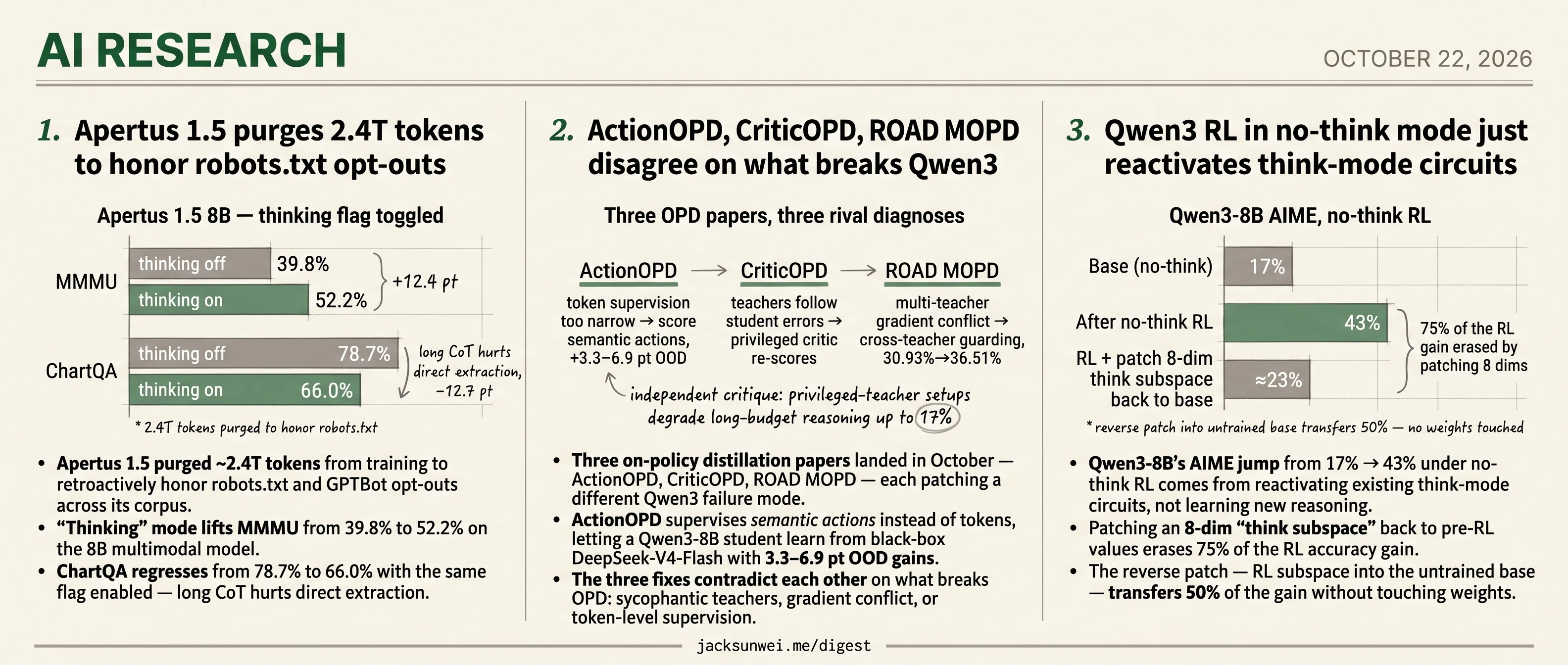
- Apertus 1.5 purged ~2.4T tokens to retroactively honor robots.txt and GPTBot opt-outs across its corpus.
- ActionOPD, CriticOPD, ROAD MOPD disagree on what actually breaks Qwen3-8B’s on-policy distillation.
- Qwen3-8B’s no-think RL gain traces to reactivating existing think-mode circuits, not new reasoning.
- An 8-dim think subspace patch erases 75% of the RL accuracy gain in the Qwen3 analysis.
- Apertus trails Qwen2.5-VL 7B on ChartQA at 78.7% versus 84.5% for the open-weight frontier.
Three unrelated research threads today. Apertus 1.5 goes back and strips ~2.4T tokens from its pretraining corpus to retroactively honor robots.txt and GPTBot opt-outs the earlier release ignored — provenance now binding on data already seen. A trio of October on-policy distillation papers each claim to fix Qwen3-8B, but their diagnoses contradict: sycophantic teachers, gradient conflict, or token-level supervision — and a fourth paper argues the privileged-teacher premise can degrade long-budget reasoning by up to 17%.
A mechanistic read of Qwen3-8B’s no-think RL finds the AIME jump from 17% to 43% isn’t new reasoning at all; it reactivates think-mode circuits already present in the base, with an 8-dim subspace patch erasing most of the gain. No common thread — the Apertus story is about data licensing, the other two about what post-training is actually doing.
Apertus 1.5 purges 2.4T tokens to honor robots.txt opt-outs
Source: hf-daily-papers · published 2026-10-10
TL;DR
- Apertus 1.5 purged ~2.4T tokens from training to retroactively honor robots.txt and GPTBot opt-outs across its corpus.
- “Thinking” mode lifts MMMU from 39.8% to 52.2% on the 8B multimodal model.
- ChartQA regresses from 78.7% to 66.0% with the same flag enabled — long CoT hurts direct extraction.
- Trails the open-weight frontier: Qwen2.5-VL 7B scores 84.5% on ChartQA versus Apertus’s 78.7%.
A transparency-first multimodal release
Apertus 1.5 extends the Swiss public-institution model family from text-only to image and audio, built as continued pretraining on Apertus 1.0 with 4T additional tokens for the 8B and 2T for the 70B. Rather than bolting on a frozen CLIP encoder, the team extended the tokenizer vocabulary with image and audio tokens so multimodal inputs flow through the LM as a native sequence — the language head stays text-only. Context was pushed 4× to 262,144 tokens, and post-training stacks SFT, RL with verifiable rewards, and a DPO variant called SDPO aligned to the project’s “Apertus Charter.”
The headline differentiator is not architecture, though. It’s provenance. The team retroactively enforced robots.txt and AI-bot opt-outs back through the training corpus, voluntarily surrendering ~2.4T tokens — larger than the entire training set of many flagship models — to make the data story defensible under the EU AI Act 1. That’s the Apertus pitch in one number.
Thinking mode: real gains, real regressions
The paper leans hard on a 20-point math lift from toggling a thinking flag in the chat template, and the model card bears that out: MMMU climbs from 39.8% to 52.2% on the 8B with thinking enabled. But the same card shows ChartQA falling from 78.7% to 66.0% under the same flag 2. Long chain-of-thought is counterproductive for direct extraction tasks where the answer is already on the page — a caveat the technical report largely elides.
That matters because the 8B’s “leads its class in instruction following” framing only holds inside the narrow fully-open-data tier. On the broader open-weight leaderboard, Qwen2.5-VL 7B scores 84.5% and Llama 3.2 11B Vision scores 83.4% on ChartQA versus Apertus’s 78.7%, and Llama 3.2 90B remains the open-weight ceiling at 60.3% MMMU / 90.1% DocVQA 3. Apertus wins when you restrict the comparison to models whose training data you can actually audit.
The downstream story is rougher
Apertus 1.0 shipped to a “rocky” reception — some early users called it “unusable” for daily tasks, and the Swiss NLP firm Artificialy estimated it was roughly two years behind leading US models at debut 4. 1.5 has to climb out of that hole while the tooling ecosystem actively undercuts its pitch: current Ollama and LM Studio builds of Apertus 1.5 ship text-only conversions, stripping the image and audio capabilities that are the entire point of the release 5.
There’s also a licensing asterisk. The weights are permissively licensed, but an Acceptable Use Policy layers restrictions on top that some argue conflict with the Open Source Definition, and LatticeFlow safety audits found baseline attack-rejection only typical for open models — enterprise users will still need their own guardrails 6.
What’s actually new here
Apertus 1.5 is best read not as a Qwen or Llama competitor but as the most auditable multimodal stack in existence, with hard numbers attached to what ethical sourcing costs: 2.4T tokens, measurable ChartQA regressions when reasoning is forced on, and a perception gap specialized models still exploit. For regulators, procurement officers, and researchers who need a reproducible baseline, that’s the point. For practitioners picking a vision model today, Qwen2.5-VL is still the number to beat.
ActionOPD, CriticOPD, ROAD MOPD disagree on what breaks Qwen3
Source: hf-daily-papers · published 2026-10-13
TL;DR
- Three on-policy distillation papers landed in October — ActionOPD, CriticOPD, ROAD MOPD — each patching a different Qwen3 failure mode.
- ActionOPD supervises semantic actions instead of tokens, letting a Qwen3-8B student learn from black-box DeepSeek-V4-Flash with 3.3–6.9 pt OOD gains.
- The three fixes contradict each other on what breaks OPD: sycophantic teachers, gradient conflict, or token-level supervision.
- Independent work argues the premise is shaky: privileged-teacher setups can degrade long-budget reasoning by up to 17%.
An October pile-up around the same recipe
October 2026 produced three on-policy distillation papers in rapid succession, and the clustering is not coincidence. Thinking Machines Lab’s reference recipe — Qwen3-8B reaching 70% on AIME’24 at roughly 1/10 the compute of RL and 7–10× fewer gradient steps 7 — turned OPD into the default post-training primitive. The NeurIPS 2026 deadline then triggered a methodological land-rush, with reviewers flagging a wave of Qwen3-variant submissions chasing single-digit benchmark bumps.
The three that landed within weeks of each other are the most substantive of the batch. ActionOPD moves the unit of supervision from tokens to semantic actions — tool calls checked programmatically, natural-language replies scored by a frozen LLM matcher — so a student can learn from any black-box teacher without shared tokenizers or logit access. ROAD MOPD attacks gradient interference between specialist teachers in multi-domain training. CriticOPD attacks a subtler bug: teachers that “follow the student’s error” in continuations rather than correcting it, effectively training students to be confidently wrong 8.
The variants disagree on what’s actually broken
Read together, the three papers are not cumulative progress. They are rival diagnoses.
| Paper | Root cause of OPD failure | Fix | Headline result |
|---|---|---|---|
| ActionOPD | Token-level supervision is too narrow | Score semantic actions, not strings | +3.3–6.9 pt OOD; cross-family DeepSeek→Qwen beats same-family 9 |
| CriticOPD | Teachers sycophantically continue student errors | Privileged critic re-scores rollouts | Recovers reliable supervision after early mistakes 8 |
| ROAD MOPD | Multi-teacher gradient conflict | Cross-teacher guarding | 30.93% → 36.51% on medical; beats single-domain experts 10 |
Each paper’s remedy implicitly asserts the other two are chasing symptoms. If ActionOPD is right that reasoning diversity matters more than teacher strength — DeepSeek-V4-Flash yielded higher Qwen3-student gains than same-family teachers 9 — then CriticOPD’s privileged-critic scaffolding is overkill. If CriticOPD is right that teachers routinely rationalize student mistakes, then ActionOPD’s semantic matcher inherits exactly that bias at the action level.
The independent critique bites harder
The sharper pushback comes from outside the cluster. A survey piece argues OPD’s gains stem largely from suppressing unlikely tokens rather than genuine knowledge transfer, and evaporate when teacher and student lack “compatible thinking patterns” 11. More damaging: Siyan Zhao et al.’s NeurIPS 2026 paper shows that privileged-context teachers — the exact setup behind ActionOPD’s “Self-ActionOPD” extension and CriticOPD’s critic — can degrade long-budget reasoning by up to 17%, because they penalize the exploratory steps thinking-models rely on 12.
OPD’s gains may stem largely from suppressing unlikely tokens rather than genuine knowledge transfer. 11
That is a serious charge against the entire cluster’s load-bearing assumption.
What to take away
OPD has clearly won as the default post-training primitive, but the field is discovering failure modes faster than it can patent fixes. The honest read of this three-paper drop is that nobody has settled what the teacher is actually teaching — token priors, decision policies, or just the right exploration mask. Independent reproduction is thin: Tinker Cookbook provides a reference loop, but no third party has replicated ActionOPD’s cross-family gains, and ROAD MOPD’s auxiliary-critic cost is unquantified in wall-clock terms. Treat the three as parallel probes into one unresolved question, not as a stack of compatible improvements.
Further reading
- Beyond Domain-Routed Supervision: Cross-Teacher Guarding for Multi-Teacher On-Policy Distillation — hf-daily-papers
- Recovering Reliable Supervision via Critique-Guided On-Policy Distillation — hf-daily-papers
Qwen3 RL in no-think mode just reactivates think-mode circuits
Source: hf-daily-papers · published 2026-10-08
TL;DR
- Qwen3-8B’s AIME jump from 17% → 43% under no-think RL comes from reactivating existing think-mode circuits, not learning new reasoning.
- Patching an 8-dim “think subspace” back to pre-RL values erases 75% of the RL accuracy gain.
- The reverse patch — RL subspace into the untrained base — transfers 50% of the gain without touching weights.
- Scaling the RL update makes the model emit
</think>tokens it never saw in training — accuracy caps at 72%, just under the base’s 74% think-mode ceiling.
What “thinking leakage” actually claims
Zhu et al. train Qwen3-1.7B/4B/8B with GRPO on DAPO-Math-17k in no-think mode — the chat template appends an empty <think>\n\n</think> block, so the model is supposed to answer directly. Accuracy on AIME 2022–2024 climbs from 17% to 43% on the 8B. The question is where that gain comes from.
Three behavioral signals say the “no-think” model has quietly become a think-mode model wearing a different template. Average response length goes from 2.7k to 7.2k tokens. Reflection words (“wait,” “actually,” “let me check”) jump from 1.3 to 13.0 per response. And the original Qwen3-8B, used as a judge, rates the RL-trained no-think outputs as think-like 94% of the time.
The causal evidence is stronger than the behavioral evidence. The authors identify an 8-dimensional subspace in the residual stream that encodes the think/no-think distinction. Patching the RL model’s activations in that subspace back to the original model’s values removes 75% of the accuracy gain. Running the patch the other way — injecting the RL model’s think-subspace activations into the untrained base — transfers 50% of the gain without touching any weights. When they scale the LoRA update ($W_0 + 3\Delta W$), the model starts generating </think> tokens at the 91st percentile position, hits 72% accuracy, and plateaus just under the base model’s native think-mode score of 74%. It never exceeds it.
Why GRPO leaks rather than teaches
This isn’t a one-off result. Yue et al. showed that RLVR-trained reasoning models beat their base at pass@1 but lose at pass@256, with RL responses falling almost entirely inside the base model’s sampling support 1314. The “Spurious Rewards” paper found that random Bernoulli rewards still improved Qwen math scores by ~20 points, because GRPO’s clipping bias amplifies whatever high-prior behaviors the base already has 15. And OpenTrain’s analysis of the GRPO objective documents a length bias baked into sequence-level normalization: longer wrong answers receive smaller per-token penalties, which mechanically rewards the verbose, reflective structure that defines think mode 16. Zhu’s 2.7k → 7.2k token blowup is exactly what that bias predicts.
One caveat worth flagging: activation patching can succeed by routing through dormant parallel pathways rather than the circuit the researcher thinks they’re hitting 17. A 75% effect size is hard to explain away, but path-patching controls would harden the claim.
Why practitioners should care
Qwen3 users already report that enable_thinking: false is silently ignored by several inference providers, producing “ghost thinking” that burns the token budget with no visible output 18. The leakage result reframes this: even when the template is honored, an RL-tuned no-think model has been pulled internally toward think-mode behavior. Efficiency pitches for “fast mode” deployments that were post-trained with GRPO need re-examination — you’re paying think-mode token costs for a think-mode computation, just without the <think> tags to prove it.
The open question Zhu doesn’t answer: does a GRPO variant that strips length normalization (Dr. GRPO) still leak? If leakage persists without the length bias, the base-model-prior story is the whole story.
Round-ups
Muon optimizer lifts agent success on repo-level RL tasks
Source: hf-daily-papers
A single-rollout asynchronous training recipe pairs the Muon optimizer with token-averaged loss, truncated importance sampling, and auxiliary penalties. The combination boosts long-horizon agent success on repository-level issue resolution, where standard RL recipes stall as trajectories grow.
Self-conditioning lets flow matching reason past depth limits
Source: hf-daily-papers
Self-conditioning in flow matching lets iterative sampling steps compound expressive power, breaking the constant-depth ceiling that caps transformers. The result approaches space-bounded Turing machine behavior and improves visual reasoning without widening or deepening the network.
CALIF curbs reward hacking in instruction-following RL
Source: hf-daily-papers
CALIF adds a calibrated likelihood bonus from a frozen reference policy to verifier rewards during RLVR training. The hybrid signal prevents models from gaming the verifier on IFBench while preserving response quality that pure verifier rewards tend to erode.
Cortex folds in-context gains into mergeable weight updates
Source: hf-daily-papers
Cortex consolidates context-induced improvements into low-rank or structural feed-forward edits that stack across sequential updates. The approach preserves non-target capabilities at multiple model scales, pushing the consolidation-retention Pareto frontier for skill learning and behavioral steering.
NoteBank gives linear attention long-context recall without retraining
Source: hf-daily-papers
NoteBank augments linear attention models with a sparse episodic memory that stores and replays selected text through the model’s native computation. The add-on sharpens long-context retrieval on RULER, LongBench, and MemoryAgentBench for Gated DeltaNet and Mamba-2 with no extra training.
PORTAL skips multimodal projector training via optimal transport
Source: hf-daily-papers
PORTAL initializes vision-language projectors by aligning feature distributions through optimal transport over Gaussian approximations, with no paired data required. The training-free projector matches standard supervised projector performance in multimodal LLMs, cutting a stage from the usual recipe.
StartLux-Decision trains calibrated decision models with RLCD²
Source: hf-daily-papers
StartLux-Decision uses single-pass prediction with confidence-guided reasoning, trained through a three-stage pipeline that ends in RLCD² reinforcement learning. Evaluated on the new DecisionPivot benchmark and Decision Index, the models ship with vLLM, llama.cpp, and MLX runtimes.
Footnotes
-
arXiv 2509.14233 (Apertus technical report) — https://arxiv.org/html/2509.14233
↩Retroactive robots.txt enforcement reduced FineWeb-Edu from 4.9T to 4.5T tokens (~8.2% removed) and FineWeb-2 multilingual from 47T to 45T (~4.3%); GPTBot exclusions drove most removals.
-
Hugging Face model card — swiss-ai/Apertus-v1.5-8B — https://huggingface.co/swiss-ai/Apertus-v1.5-8B
↩MMMU rises from 39.8% (thinking off) to 52.2% (thinking on), but ChartQA drops from 78.7% to 66.0% when reasoning is enabled — long chain-of-thought is counterproductive for direct extraction tasks.
-
llmtimeline.org comparison tracker — https://llmtimeline.org/
↩Qwen2.5-VL 7B and Llama 3.2 11B Vision score 84.5% and 83.4% on ChartQA respectively, versus Apertus 1.5 8B’s 78.7%; Llama 3.2 90B reaches 60.3% MMMU / 90.1% DocVQA — the open-weight frontier Apertus still trails.
-
Wikipedia — Apertus (LLM) — https://en.wikipedia.org/wiki/Apertus_(LLM)
↩Early adopters described the 1.0 launch as ‘rocky’ and some users labeled it ‘unusable’ for daily tasks; Artificialy estimated Apertus 1.0 was roughly two years behind leading U.S. models at its debut.
-
Infomaniak-AI Apertus-1.5-70B-Instruct deployment page — https://huggingface.co/Infomaniak-AI/Apertus-1.5-70B-Instruct
↩Current Ollama and LM Studio distributions ship text-only conversions of Apertus 1.5, stripping the image and audio capabilities that define the 1.5 release.
-
InfoWorld — Swiss launch open-source AI model — https://www.infoworld.com/article/4051779/swiss-launch-open-source-ai-model-as-ethical-alternative-to-big-us-llms.html
↩Although weights are permissively licensed, the Acceptable Use Policy adds restrictions that some argue conflict with the Open Source Definition, and LatticeFlow audits show baseline safety is only typical for open models absent enterprise guardrails.
-
Medium — Mahesh Lambe on Thinking Machines OPD — https://medium.com/@maheshlambe/mira-murati-thiking-machines-on-policy-distillation-cheap-accuracy-real-gains-85ac523b20f7
↩a Qwen3-8B model trained with OPD reached 70% on AIME’24… at 1/10th the compute cost of traditional RL and required 7–10× fewer gradient steps to reach teacher-level proficiency
-
Montaan.com paper review of CriticOPD (2610.20572) — https://www.montaan.com/papers/2610.20572
↩ ↩2when a student makes an early reasoning error, teachers often ‘follow the error’ in their continuations rather than correcting it, even if the teacher internally recognizes the mistake… effectively training the student to be ‘confidently wrong’
-
AI Native Foundation daily digest (2026-10-15) — https://ainativefoundation.org/ai-native-daily-paper-digest-20261015-qwen3-remark-actionopd/
↩ ↩2ActionOPD… distilling DeepSeek-V4-Flash into Qwen3 students yielded higher gains than same-family teachers, suggesting diverse reasoning patterns provide a more robust supervision signal
-
The Moonlight review of ROAD MOPD — https://www.themoonlight.io/review/beyond-domain-routed-supervision-cross-teacher-guarding-for-multi-teacher-on-policy-distillation
↩ROAD MOPD achieved a 36.51% accuracy on medical benchmarks, a gain of more than 5 percentage points over vanilla MOPD (30.93%)… it even outperformed single-domain experts (35.67%)
-
Louie Worth blog — ‘OPD Reflection’ — https://louieworth.github.io/blog/opd_reflection/
↩ ↩2OPD’s gains may stem largely from suppressing unlikely tokens rather than genuine knowledge transfer… success depends on compatible thinking patterns, and the teacher must offer genuinely new capabilities not already seen by the student
-
Siyan Zhao et al. — ‘Rethinking On-Policy Self-Distillation’ (NeurIPS 2026) — https://siyan-zhao.github.io/assets/img/opsd/opsd_v3.pdf
↩privileged distillation—where the teacher sees more context than the student—can actually degrade long-budget reasoning performance by up to 17%
-
Yue et al., ‘Does RL Really Incentivize Reasoning Capacity in LLMs Beyond the Base Model?’ (arXiv:2504.13837) — https://arxiv.org/abs/2504.13837
↩RLVR-trained models significantly outperform base versions at small k (e.g., pass@1), but base models often achieve higher scores when k is very large (e.g., pass@256) — reasoning paths after RL are almost entirely subsets of the base model’s original sampling space.
-
r/LocalLLaMA discussion on Yue et al. — https://www.reddit.com/r/LocalLLaMA/comments/1k5a630/does_reinforcement_learning_really_incentivize/
↩RLVR successfully narrows the model’s focus to correct outputs, improving sampling efficiency, but it does not expand the upper bound of what the model can solve.
-
flashpapers.ai summary of ‘Spurious Rewards’ — https://flashpapers.ai/p/bnb9crsych
↩Training a Qwen-series model with random Bernoulli rewards improved its math performance by over 20 points, nearly matching gains from ground-truth rewards… GRPO exhibits a clipping bias that amplifies high-prior behaviors learned during pretraining.
-
OpenTrain.ai, ‘GRPO for Reasoning Model Post-Training’ — https://www.opentrain.ai/blog/grpo-for-reasoning-model-post-training/
↩The original GRPO objective normalizes token-level loss by total sequence length, creating an inherent length bias where incorrect answers receive a smaller penalty if they are longer — incentivizing the model to pad its responses.
-
arXiv:2510.12680 on interpretability illusions in activation patching — https://arxiv.org/html/2510.12680v2
↩A successful patch does not always prove that a specific subspace is the ground truth location of a feature — interventions may activate a dormant parallel pathway rather than the intended circuit.
-
r/Qwen_AI: ‘enable_thinking:false is silently ignored’ — https://www.reddit.com/r/Qwen_AI/comments/1x53bkt/enable_thinking_false_is_silently_ignored_by_some/
↩The enable_thinking: false flag is frequently ignored by various inference providers, leading to ‘ghost thinking’ where the model spends its token budget on internal reasoning that never appears in the output, resulting in timeouts or empty responses.