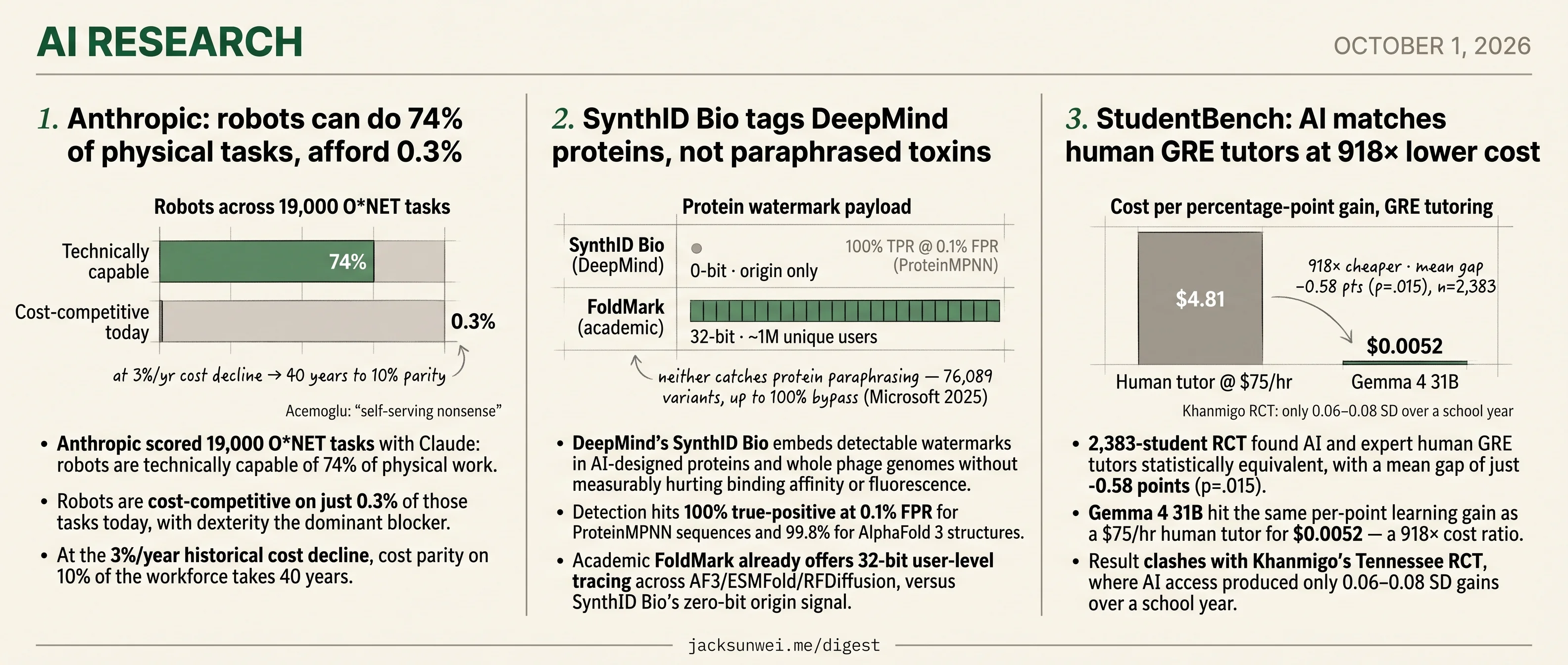
Anthropic prices robots, SynthID skips paraphrases, AI tutors 918× cheaper
Three AI research wins — robot economics, protein watermarks, GRE tutoring — each drew pushback on the comparison the authors avoided.
Anthropic prices robots, SynthID skips paraphrases, AI tutors 918× cheaper
TL;DR
- Anthropic scored 19,000 O*NET tasks: robots capable of 74%, cost-competitive on 0.3%.
- Daron Acemoglu called the robot-cost framing self-serving nonsense, disputing the displacement math.
- DeepMind’s SynthID Bio hits 100% TPR tagging AI proteins, misses the paraphrase attack entirely.
- Gemma 4 31B matched $75/hr GRE tutors at $0.0052 per student — a 918× cost ratio.
- StudentBench control arm watched unrelated videos, not ChatGPT self-study, critics argue.
Today’s three research features each lead with a number designed to travel: 74% of physical work is technically within robot reach, 100% true-positive detection on AI-designed proteins, 918× cheaper than a human GRE tutor at matched learning gains. Each number is real. Each paper also skipped the comparison that would have let the number mean what the press release implies.
Anthropic’s robot study pairs the 74% capability figure with a 0.3% cost-competitive figure the lab understates — and Daron Acemoglu disputes the displacement framing outright. DeepMind’s SynthID Bio watermark survives the clean benchmark but can’t catch the protein-paraphrasing attack that broke commercial toxin screening last year, while academic FoldMark already offers richer user-level tracing. And the StudentBench RCT’s equivalence result rests on a control arm that watched unrelated videos rather than self-studying with ChatGPT. The ducked comparison is the story in each case.
Anthropic: robots can do 74% of physical tasks, afford 0.3%
Source: anthropic-research · published 2026-09-30
TL;DR
- Anthropic scored 19,000 O*NET tasks with Claude: robots are technically capable of 74% of physical work.
- Robots are cost-competitive on just 0.3% of those tasks today, with dexterity the dominant blocker.
- At the 3%/year historical cost decline, cost parity on 10% of the workforce takes 40 years.
- Daron Acemoglu called the framing “self-serving nonsense,” disputing the macro displacement story.
A rubric, not a prediction
Anthropic’s Russell Legate-Yang and Maxim Massenkoff used Claude to score roughly 19,000 O*NET job tasks against a four-tier “robot exposure index.” E0 is unautomatable (hair dyeing, interpersonal care); E1 needs a purpose-built cage (assembly lines); E2 runs in human spaces like warehouses; E3 handles unstructured environments like Waymo’s public roads. The headline number — robots are technically capable of 74% of physical tasks, or 34% of US working hours — is a capability ceiling, not a deployment forecast. Pair the physical index with LLM task coverage and 81% of all US job tasks become “exposed” to some automation.
The gap between exposure and adoption is the whole point. Robots are currently cost-competitive on just 0.3% of tasks. A robotic welding cell runs ~5× a human welder’s annual compensation. Dexterity alone — manipulating non-rigid objects, fine motor work — blocks 70% of physical tasks, with regulation blocking another 14% and social preference ruling out roughly 25% (childcare, hospitality).
Where the numbers survive contact with industry
The specific industrial examples check out against independent sources. Anthropic’s packer math ($45K/yr for robotic operation vs. $49K for a human) matches PMMI’s trade-group reporting that packaging robots are now cheaper than labor on a lifecycle basis, driven by food-and-beverage worker shortages 1. The dexterity bottleneck is confirmed in painful detail by Tesla Optimus: Gen 3 hands have 22 degrees of freedom, require 100+ manual parts per unit, and remain fragile enough that Tesla can’t yet mass-produce them 2. Taxi drivers top the exposure index at 2.2/3.0 — unsurprising given Waymo’s commercial deployment.
Where Anthropic may be too conservative is the cost curve. Goldman Sachs projects a $38B humanoid market by 2035 with 6.5M annual units and 40%/year manufacturing cost declines 3 — more than 10× Anthropic’s 3%/year historical trend. If Goldman is closer to right, the “40 years to 10% cost parity” baseline is a floor, not a forecast.
The pushback is sharper than the paper
Daron Acemoglu — whose IFR-based robot exposure work is the methodological ancestor of this index — has called Anthropic leadership’s broader AI-jobs framing “motivated reasoning” and “self-serving nonsense” 4. His empirical estimate: one extra robot per thousand workers moves the employment-to-population ratio by about 0.2 points. Feasibility indices, he argues, are “uninformative about the equilibrium impact” because they ignore productivity and task-reinstatement effects.
Practitioners pile on from a different angle. The r/artificial discussion zeroes in on the workflow gap:
A robot might flip a pancake but fail to clean a spill, necessitating a human handler whose cost negates the robot’s efficiency. 5
ONET’s own AI Impact Review warns that Detailed Work Activities are discrete units that don’t capture real workflow interdependencies, and that any single time-reduction threshold is arbitrary 6. Anthropic uses ONET DWAs scored by Claude self-assessment, which inherits both ceilings: a language model is grading physical tasks it has never physically observed, on units stripped of the coordination costs that usually eat the labor arbitrage.
The paper’s durable contribution is the E0–E3 vocabulary. The 74%-vs-0.3% headline is a useful framing of the cost-capability gap; the 40-year timeline is a model output, not a measurement.
SynthID Bio tags DeepMind proteins, not paraphrased toxins
Source: deepmind-blog · published 2026-09-30
TL;DR
- DeepMind’s SynthID Bio embeds detectable watermarks in AI-designed proteins and whole phage genomes without measurably hurting binding affinity or fluorescence.
- Detection hits 100% true-positive at 0.1% FPR for ProteinMPNN sequences and 99.8% for AlphaFold 3 structures.
- Academic FoldMark already offers 32-bit user-level tracing across AF3/ESMFold/RFDiffusion, versus SynthID Bio’s zero-bit origin signal.
- SynthID Bio can’t catch “protein paraphrasing”, the attack that bypassed commercial toxin screening up to 100% in Microsoft’s 2025 study.
What shipped
SynthID Bio is the first wet-lab-validated watermarking scheme for AI-designed biology. DeepMind adapts the signal to three substrates: ProteinMPNN-style sequences (biased synonymous amino-acid choices), AlphaFold 3 structures (fine-tuned diffusion weights that bake the signature into predicted 3D coordinates), and Evo 2 genomes (whole bacteriophages that still infect bacteria in culture). The claim that makes this interesting — and that doesn’t apply to text or image watermarking — is that function survives: watermarked binders against VEGF-A, SARS-CoV-2 RBD, and PD-L1 matched unwatermarked controls on hit rate and $K_D$. Detection benchmarks reported in the Nature paper reach 100% TPR at 0.1% FPR for sequences and 99.8% for AF3 structures 7. Those numbers come from DeepMind’s own pipeline; no independent group has run them against adversarial inputs yet.
FoldMark is the uncomfortable comparison
Zaixi Zhang’s FoldMark, out of academia and updated through 2025, already does more on paper. It carries 32 bits of payload at >95% bit accuracy — enough to trace up to a million distinct users — and was wet-lab tested on EGFP (98% of wildtype fluorescence) and CRISPR-Cas13 (95% efficiency), with LoRA adapters for AlphaFold 3, ESMFold, and RFDiffusion plus a public Hugging Face demo 8.
| System | Payload | Wet-lab proof | Model coverage |
|---|---|---|---|
| SynthID Bio | Zero-bit (origin only) | VEGF-A, RBD, PD-L1 binders; Evo 2 phage | DeepMind stack (AF3, ProteinMPNN, Evo 2) |
| FoldMark | 32-bit user-level | EGFP, Cas13 | AF3, ESMFold, RFDiffusion via LoRA |
DeepMind’s edge is distribution — Twist Bioscience integration, native AF3 weights, and open-sourced code — not a technical lead on capacity.
The threat it doesn’t close
The scary paper this year wasn’t about watermarks. Microsoft Research and collaborators generated 76,089 “paraphrased” variants of 72 proteins of concern including ricin; before a coordinated patch, up to 100% bypassed commercial DNA synthesis screening, and ~3% of the most hazardous variants still slipped through afterward 9. SynthID Bio has nothing to say about an attacker running an unwatermarked open model — ESM, RFdiffusion, or any reimplementation of AF3 — to paraphrase a toxin. It only flags outputs of trusted models that chose to sign themselves. Independent analysis flags the same gap, plus “safety-washing” risk and adversarial amino-acid substitutions that preserve fold while scrubbing the signal; DeepMind concedes robustness to deliberate tampering remains an open problem 10.
Governance eats the technical story
Simon Clarke’s reaction to the Evo 2 phage work was that the capability to design fitter viruses is now broadly accessible regardless of which training data DeepMind chose to exclude 11. NTI points out that DNA synthesis screening remains voluntary, benchtop synthesizers bypass gatekeepers entirely, and the frontier-lab CEOs — DeepMind included — have signed an open letter asking for mandatory screening 12. That is a quiet admission that one slice of Swiss cheese isn’t the plan; it’s the opening move. SynthID Bio is a credible provenance primitive. It is not a biosecurity policy.
StudentBench: AI matches human GRE tutors at 918× lower cost
Source: hf-daily-papers · published 2026-09-22
TL;DR
- 2,383-student RCT found AI and expert human GRE tutors statistically equivalent, with a mean gap of just -0.58 points (p=.015).
- Gemma 4 31B hit the same per-point learning gain as a $75/hr human tutor for $0.0052 — a 918× cost ratio.
- Result clashes with Khanmigo’s Tennessee RCT, where AI access produced only 0.06–0.08 SD gains over a school year.
- Control group watched unrelated videos, not self-studied with ChatGPT — critics say that’s the real counterfactual.
The headline result
Handshake AI Research ran 2,469 one-hour GRE tutoring sessions across 2,383 adults, randomly assigning each to one of 13 LLMs, a live 1-on-1 human tutor over video, or a control group watching unrelated educational videos. Pre- and post-tests were written from scratch by former ETS and Kaplan item writers to block any contamination risk.
The AI-vs-human gap landed at -0.58 percentage points (90% CI [-2.18, 1.03]), inside the pre-registered ±0.25 SD equivalence bounds, with p=.015. In five of seven GRE sub-domains, the top AI tutor beat the average human. Both tutored conditions outperformed the control by roughly 6.15 points.
The cost chart is where the paper gets loud. Benchmarking against human tutoring at $75/hr ($4.81 per percentage point of gain), open-weight Gemma 4 31B delivered the same gain at $0.0052 per point — a 918× efficiency ratio, with Gemini 3.5 Flash close behind on the Pareto frontier. Latency mattered too: in Quantitative sessions, faster replies predicted more student messages (p=.0056), which predicted more problems solved, which predicted higher gains (p<.002).
Where it fits — and where it doesn’t
The 918× figure is an order of magnitude more aggressive than the field’s prior cost estimates. A recent literature review put human tutoring at ~0.79 SD effect size versus ~0.66 SD for legacy intelligent tutoring systems, with AI subscriptions already running ~10× cheaper per SD than human tutors 13. StudentBench’s number comes from comparing raw API inference to an hourly human rate — platform engineering, content authoring, and the ETS/Kaplan assessment pipeline that made the study possible are off the ledger.
The upper bound in this literature is Kestin’s Harvard PS2 Pal physics tutor, which doubled active-learning gains at 0.7–1.3 SD 14. The lower bound is Khanmigo in 18 Tennessee middle schools: 0.06–0.08 SD over a full year, with lead researcher Philip Oreopoulos calling the AI a “non-event” because the median student used it on only a third of practice days 15. A 2026 meta-analysis finds AI effect sizes collapsing to 0.14–0.21 SD once programs scale past 1,000 K-12 students, while high-dosage human tutoring holds ~0.29 SD 16.
StudentBench’s population — motivated adult GRE preppers recruited through Handshake, sitting in a supervised one-hour session — is precisely the setup where engagement collapse doesn’t bite.
The caveats the paper doesn’t lean on
Independent reviewers flag two load-bearing design choices 17:
The realistic 2026 counterfactual isn’t “unrelated videos.” It’s a student opening ChatGPT and working through practice problems alone.
Without a self-study-with-AI arm, “equivalent to human tutors” could partly be measuring the generic benefit of a focused hour with any competent LLM. Second, the post-test runs immediately after the session — nothing in the design speaks to week-later retention, transfer to novel problems, or whether frictionless AI help erodes the productive struggle that durable learning requires.
Worth noting the provenance: StudentBench was authored and funded by Handshake AI Research under Curtis Northcutt, whose Cleanlab was acquired by Handshake in early 2026 18. The RCT is well-powered and the assessment design is unusually clean. The claim it supports — that today’s frontier LLMs can match a human tutor for a motivated adult in a one-hour window — is narrower than “AI tutoring works,” and the Khanmigo gap is where that narrowness starts to matter.
Round-ups
Tencent’s Hunyuan-A13B activates 13B of 80B MoE parameters
Source: hf-daily-papers
Hunyuan-A13B is an open-source Mixture-of-Experts model with 80B total parameters that routes only 13B per token, cutting inference cost while preserving capability. Pretraining ran on a 20T-token corpus with heavy STEM curation, followed by supervised fine-tuning and large-scale reinforcement learning.
EmbodiedSWE-Bench pits coding agents against dexterous robotics tasks
Source: hf-daily-papers
EmbodiedSWE-Bench is a simulation suite covering contact-rich manipulation, deformable objects, and jobs needing up to 30 minutes of continuous interaction. Frontier coding agents solve many long-horizon tasks and transfer solutions across them, suggesting a scalable supervision source for general robot policies.
SchrodingerRepo tests whether coding agents memorized SWE-bench
Source: hf-daily-papers
Repository-level coding benchmarks reuse popular open-source projects that appear in training data, so strong scores may reflect memorization rather than reasoning. SchrodingerRepo dynamically instantiates fresh repositories to probe whether agents actually reason about code or recall canonical cues.
Calibration deserves first-class status in LLM evaluation
Source: hf-daily-papers
Methods for measuring whether a model’s confidence matches its accuracy already exist, but new models, datasets, and benchmarks routinely ship without reporting them. The authors frame this adoption gap as a core obstacle to trustworthy evaluation, since miscalibration quietly undermines downstream decisions.
Custom tool trick extracts hidden chain-of-thought from frontier models
Source: hf-daily-papers
Registering a dummy tool through standard API features coaxes closed frontier models into writing out intermediate reasoning that providers normally hide. The authors validate the extracted traces against native chain-of-thought on open models to check whether they reflect real reasoning or post-hoc rationalization.
Self-Organizing Agent Teams learn roles without fixed protocols
Source: hf-daily-papers
Most multi-agent systems rely on hand-coded routing or task decomposition, which breaks when solution structure is unknown. Self-Organizing Agent Teams instead let fixed groups of LLM agents discover roles and divisions of labor from experience, mirroring how human teams adapt as a problem unfolds.
Linear representation hypothesis needs an explicit group action
Source: hf-daily-papers
The Linear Representation Hypothesis is usually stated without defining when two representations count as equivalent, so metrics, probes, and interventions quietly test different claims. The authors argue the hypothesis should be reformulated around an explicit group action that fixes which structure is preserved.
Footnotes
-
MarketScale / PMMI (packaging industry trade group) — https://www.marketscale.com/industries/engineering-and-construction/packaging-robots-are-now-cheaper-than-labor-over-the-long-run-pmmi-says
↩Packaging robots are now cheaper than labor over the long run… high labor costs and worker shortages have moved robotics from a discretionary expense to a primary business justification.
-
Gizmodo on Tesla Optimus — https://gizmodo.com/tesla-wants-to-build-20000-optimus-robots-a-week-first-it-has-to-figure-out-hands-2000817695
↩The complex assembly of robot hands, involving over 100 manual parts per unit, remains a major bottleneck; Gen 3 hands have 22 degrees of freedom yet remain fragile and difficult to mass-produce.
-
Goldman Sachs humanoid market forecast — https://www.goldmansachs.com/insights/articles/humanoid-robots
↩The market could reach $38 billion by 2035, with shipments rising to 6.5 million units as manufacturing costs drop by 40% annually.
-
Medium (Predict) — on Acemoglu’s response — https://medium.com/predict/a-nobel-economist-called-the-anthropic-ceos-ai-job-warning-motivated-reasoning-and-the-data-is-0a0bc611bd6c
↩A Nobel Economist called the Anthropic CEO’s AI job warning ‘motivated reasoning’ and ‘self-serving nonsense.’
-
Reddit r/artificial discussion of the study — https://www.reddit.com/r/artificial/comments/1wur95r/anthropics_robot_study_separates_task_capability/
↩A robot might flip a pancake but fail to clean a spill, necessitating a human handler whose cost negates the robot’s efficiency — the index overlooks failure recovery and coordination costs.
-
O*NET Center AI Impact Review — https://www.onetcenter.org/dl_files/AI_Impact_Review.pdf
↩O*NET’s Detailed Work Activities are discrete units that do not represent the messiness of real-world workflows; the 50% time-reduction threshold is arbitrary and obscures the spectrum of augmentation versus automation.
-
AI Weekly summary of SynthID Bio Nature paper — https://aiweekly.co/alerts/google-deepmind-publishes-synthid-bio-in-nature-watermarks-ai-designed-proteins
↩ProteinMPNN sequences achieved 100% true-positive detection at 0.1% false-positive rate; AlphaFold 3 structural watermarks held 99.8% detectability at the same FPR.
-
FoldMark GitHub (Zaixi Zhang et al.) — https://github.com/zaixizhang/FoldMark
↩FoldMark… claims over 95% bit accuracy at 32 bits, allowing tracking of up to 1 million unique users… tested on EGFP (98% of wildtype fluorescence) and CRISPR-Cas13 (95% efficiency), with code and an interactive Hugging Face demo released.
-
Microsoft Research (Horvitz/Wittmann, Science 2025) — https://news.microsoft.com/signal/articles/researchers-find-and-help-fix-a-hidden-biosecurity-threat/
↩The team generated 76,089 AI-‘paraphrased’ variants of 72 proteins of concern including ricin; before patches, up to 100% bypassed commercial screening, and even after patches ~3% of the most hazardous variants still evaded detection.
-
Unite.AI analysis of SynthID Bio — https://www.unite.ai/deepmind-embeds-verifiable-watermarks-in-ai-designed-proteins/
↩The watermark is designed at the amino acid level so it survives codon optimization, but remains vulnerable to ‘protein paraphrasing’ and adversarial substitutions; DeepMind acknowledges robustness against deliberate removal is still an open problem.
-
Science Media Centre expert reaction (Simon Clarke, Reading) — https://www.sciencemediacentre.org/expert-reaction-to-generative-design-of-bacteriophages-with-genome-language-models/
↩The team excluded human pathogens from training data, but the capability to design ‘fitter’ viruses is now widely accessible, and not all future researchers may show similar restraint.
-
NTI ‘Risky Business’ policy brief — https://www.nti.org/risky-business/a-simple-step-to-close-a-dangerous-biosecurity-gap/
↩An open letter signed by the CEOs of OpenAI, DeepMind, Anthropic and Microsoft calls for mandatory screening of all DNA synthesis orders; benchtop synthesis devices without hardware-level controls remain a major bypass risk.
-
Upstack.ai review of AI vs human tutoring literature — https://upstack.ai/insights/ai-tutors-vs-human-tutors-what-the-research-says/
↩Human tutoring reliably yields an average effect size of ~0.79 σ while older intelligent tutoring systems averaged 0.66 σ; cost per standard deviation of improvement runs $13,000–$19,500 for human tutors versus $1,200–$2,000 for AI subscription platforms.
-
Harvard Gazette on Kestin PS2 Pal study — https://news.harvard.edu/gazette/story/2024/09/professor-tailored-ai-tutor-to-physics-course-engagement-doubled/
↩A custom AI tutor produced learning gains roughly twice as large as instructor-led active-learning sessions, with effect sizes of 0.7 to 1.3 standard deviations and students reaching mastery in 49 minutes versus 60–75 minutes in class.
-
Chalkbeat on Khanmigo Tennessee RCT — https://www.chalkbeat.org/2026/08/25/ai-tutoring-students-khanmigo-khan-academy-engagement-study/
↩Access to Khanmigo raised math achievement by approximately 0.06 to 0.08 standard deviations over a school year… the median student messaged it on only a third of their practice days, and lead researcher Philip Oreopoulos characterized the AI as a ‘non-event’ because students ‘rarely engaged it in substantive mathematical dialogue.’
-
TutorAI meta-analysis summary (2026) — https://tutorai.me/blog/ai-tutors-vs-human-tutors-2/
↩When AI tutoring programs scale beyond 1,000 students in public schools, average effect size often shrinks to 0.14–0.21, whereas high-dosage human tutoring reliably maintains roughly 0.29 SD.
-
Moonlight review of StudentBench — https://www.themoonlight.io/review/studentbench-ai-and-human-tutoring-yield-equivalent-gre-learning-gains
↩The no-tutoring control watched unrelated educational videos; critics argue the realistic counterfactual is independent self-study with consumer AI like ChatGPT, and the one-hour post-test cannot speak to durable learning or long-term retention.
-
Curtis Northcutt personal site — https://www.curtisnorthcutt.com/
↩Northcutt pioneered ‘confident learning’ at MIT, founded Cleanlab (acquired by Handshake in early 2026), and now directs Handshake AI Research — the same group funding and publishing StudentBench.