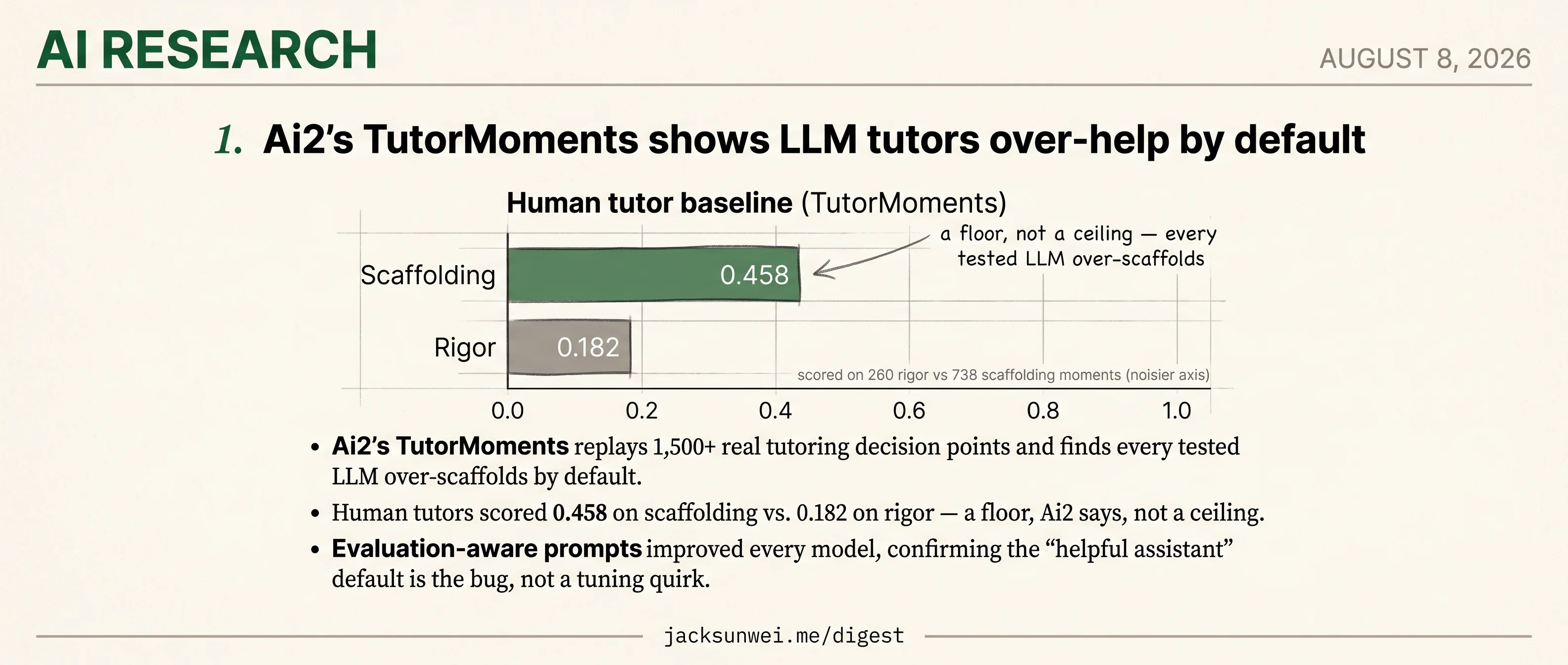
Ai2's TutorMoments turns the 'helpful assistant' default into a scorable bug
Ai2's TutorMoments benchmark scores 1,500 real tutoring moments and finds every tested LLM over-scaffolds by default.
Ai2’s TutorMoments turns the ‘helpful assistant’ default into a scorable bug
TL;DR
- Ai2’s TutorMoments replays 1,500+ real tutoring decision points as a scaffolding-versus-rigor benchmark.
- Every tested LLM over-scaffolds by default, giving away answers instead of coaching.
- Human tutors scored 0.458 on scaffolding versus 0.182 on rigor, framed as a floor.
- Evaluation-aware prompts lifted every model, pinning the failure on the helpful-assistant default.
- Rigor scorer rests on 260 moments against 738 scaffolding ones, a reliability gap Ai2 concedes.
Today’s one research drop is Ai2’s TutorMoments, and it lands as a benchmark aimed squarely at a posture the field usually treats as a virtue: helpfulness. By replaying 1,500+ decision points from real tutoring transcripts and scoring model responses on scaffolding versus rigor, Ai2 turns the vague complaint that LLM tutors give away answers into a number — and every tested model fails it by defaulting to over-help.
The editorial pull here is the reframing more than the leaderboard. Ai2 argues the helpful assistant default is the bug, not a tuning quirk — evaluation-aware prompts improved every model, which is the tell. Worth reading with the caveats in view: the rigor scorer is built on 260 human moments against 738 scaffolding ones, and Ai2 flags it as the less reliable of the two axes.
Ai2’s TutorMoments shows LLM tutors over-help by default
Source: huggingface-blog · published 2026-08-07
TL;DR
- Ai2’s TutorMoments replays 1,500+ real tutoring decision points and finds every tested LLM over-scaffolds by default.
- Human tutors scored 0.458 on scaffolding vs. 0.182 on rigor — a floor, Ai2 says, not a ceiling.
- Evaluation-aware prompts improved every model, confirming the “helpful assistant” default is the bug, not a tuning quirk.
- Ai2 concedes the rigor scorer is less reliable — 260 human rigor moments vs. 738 scaffolding ones.
Ai2 gives the “over-help” pathology a metric
TutorMoments, released by the Allen Institute for AI, is a diagnostic for a failure mode the tutoring-LLM literature has been circling for a year: models blurt out answers instead of letting students struggle. MathDial’s authors named it the “tell-tale” problem back in 2024 1. Ai2’s contribution is timing — pausing 462 de-identified grade 2–7 math transcripts at moments where a human teacher flagged a scaffold-vs-rigor decision, then letting an LLM tutor take over for five turns against a simulated student.
The headline finding: seven tested LLMs all default to over-scaffolding, and all seven improve when the prompt explicitly names the trade-off. That’s damning in a subtle way — it means the models can hold back, but RLHF-shaped “helpfulness” pushes them to hand out hints the moment a student stalls.
The replay design, in one picture
flowchart LR
    A[Real 1:1 tutoring<br/>transcript] --> B{{Pause at<br/>key moment}}
    B --> C[LLM tutor<br/>takes over<br/>5 turns]
    D[LLM-simulated<br/>student] <--> C
    C --> E[Automated scorer:<br/>scaffolding / rigor /<br/>over-scaffolding]
Independent evidence backs the “over-help hurts” thesis. A Wharton study on AI-assisted skill acquisition found students with unrestricted AI help realized less than half the learning gains of peers on restricted access 2. ETH’s benchmark survey argues more broadly that subject expertise and pedagogical quality actively trade off — a model that can solve the problem is not, by that fact, a model that can teach it 3.
Where the benchmark is soft
Two caveats deserve loud placement. First, Ai2 itself flags that the rigor half of the metric rests on thinner ice: 260 successful human rigor moments vs. 738 scaffolding moments, and the “rigor push” scorer is explicitly less reliable than its scaffolding counterpart 4. The most quotable claim — that LLMs under-push for rigor — is measured on the noisier axis.
Second, the simulated student is doing a lot of load-bearing work. Recent validity work finds LLM-simulated students routinely “hallucinate learning” — declaring comprehension without any underlying state change, and failing to reproduce realistic misconception trajectories 5. A too-cooperative simulated 3rd-grader flatters any tutor.
The question TutorMoments can’t answer
Better in-the-moment judgment is not the same as better learners. Khanmigo — the most-deployed AI tutor, with hundreds of thousands of students — is the cautionary data point: a controlled study with 69 undergraduate physics students found it delivered noticeably better step-by-step guidance than Google search, and produced no statistically significant difference in learning outcomes 6. Ai2 concedes the point directly — TutorMoments measures tutor behavior at moments, not longitudinal gains.
That makes this a useful diagnostic, not a verdict. Ai2 has open-sourced the dataset and pipeline on Hugging Face and GitHub, which is the right move: the interesting work now is whether anyone can fine-tune against the scaffolding-vs-rigor axis without eroding raw capability — the trade-off the wider benchmark literature keeps surfacing 3.
Footnotes
-
arXiv 2606.15766 (MathDial / tutoring dialogue dataset) — https://arxiv.org/pdf/2606.15766
↩MathDial is specifically designed to address the ‘tell-tale’ problem, where models often reveal answers too early rather than guiding students through reasoning.
-
Wharton (Knowledge@Wharton) — https://knowledge.wharton.upenn.edu/article/when-does-ai-assistance-undermine-learning/
↩Students with on-demand AI assistance in complex tasks (e.g., chess) achieved less than half the performance gains of those using controlled, restricted assistance.
-
ETH Zürich research collection (MathTutorBench / benchmark survey) — https://www.research-collection.ethz.ch/items/5cd636fa-0030-4af7-b178-d9a3dbcb1424
↩ ↩2A model’s ability to solve a math problem does not correlate with its ability to teach it; subject expertise and pedagogical quality often form a trade-off.
-
Allen Institute for AI blog (TutorMoments release) — https://allenai.org/blog/tutormoments
↩The dataset contains fewer successful human rigor moments (260) compared to scaffolding moments (738), and the scoring pipeline for ‘rigor pushes’ is currently less reliable than its scaffolding counterpart.
-
ResearchGate: ‘Towards Valid Student Simulation with Large Language Models’ — https://www.researchgate.net/publication/399666786_Towards_Valid_Student_Simulation_with_Large_Language_Models
↩Simple prompting strategies for student simulation frequently result in ‘hallucinated’ learning, where a model claims to understand a concept without a corresponding shift in its underlying epistemic state.
-
GlobalSociety.earth report on Khanmigo deployment — https://www.globalsociety.earth/post/khan-academy-rolls-out-ai-powered-teaching-tools-as-school-districts-scale-up-adoption
↩A study involving 69 undergraduate physics students found that while Khanmigo provided superior step-by-step guidance compared to Google searches, there were no statistically significant differences in learning outcomes between the groups.