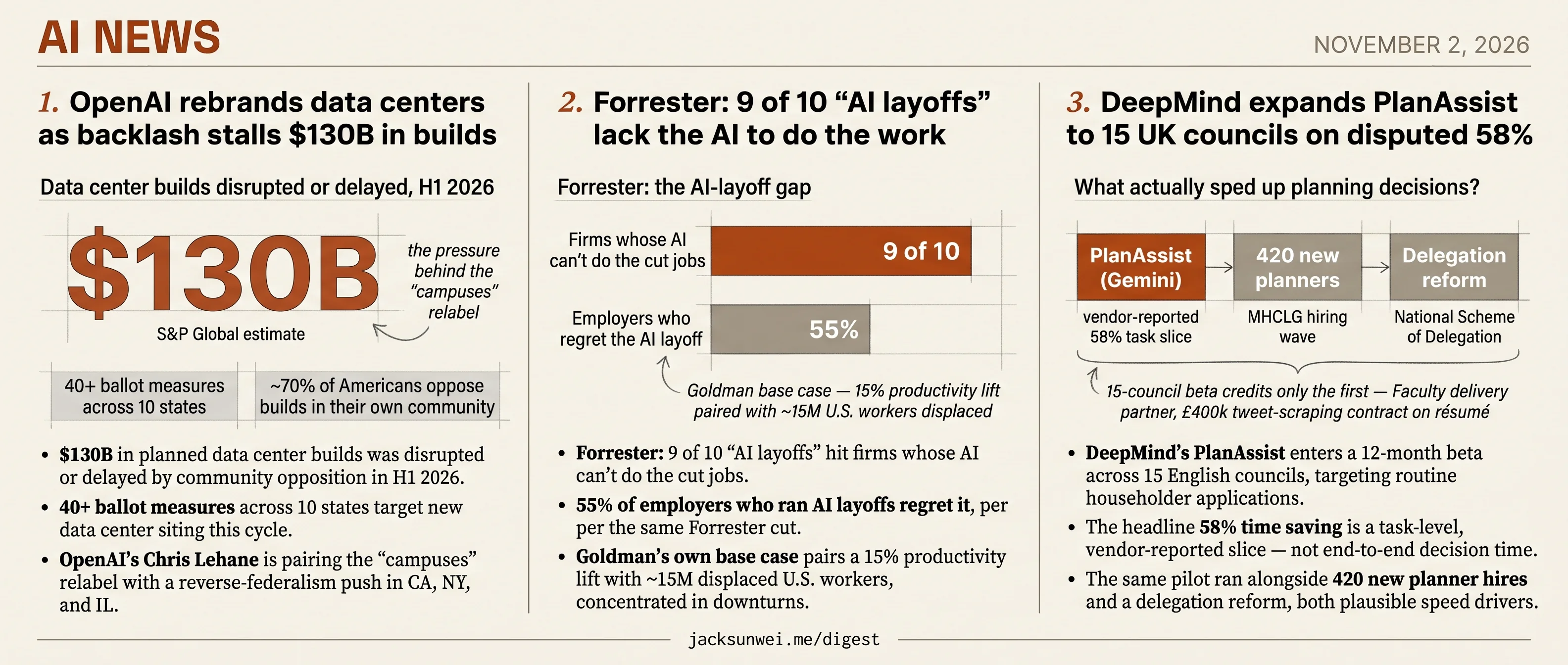
UK councils hire 420 planners, $130B of builds stall, 55% regret AI cuts
New council planner hires, stalled data-center builds, and employer regret all show the humans AI vendors pitched to displace.
UK councils hire 420 planners, $130B of builds stall, 55% regret AI cuts
TL;DR
- $130B in US data-center builds stalled in H1 2026 amid community opposition.
- OpenAI’s Chris Lehane is relabeling sites as campuses and pushing state preemption in CA, NY, IL.
- Forrester: 9 of 10 AI layoffs hit firms whose AI cannot do the cut jobs.
- 55% of employers who ran AI layoffs now regret the cut, per the same Forrester data.
- DeepMind’s PlanAssist enters 15 UK councils on a 58% figure sitting alongside 420 planner hires.
Three AI news stories today, and in each one the humans the vendor pitch was meant to displace or route around are the ones producing the counter-evidence. OpenAI’s $130B of planned data-center builds hit enough community opposition in H1 2026 that Chris Lehane is now relabeling sites as campuses and lobbying for state preemption against 40+ local ballot measures. Forrester reports that 9 of 10 companies announcing AI layoffs are cutting jobs their AI cannot actually do, and 55% of those employers already regret the cut. DeepMind’s PlanAssist touts a 58% time saving across 15 English councils — alongside 420 new planner hires MHCLG made in parallel, and a delegation reform that could explain the speed on their own.
The pitch in each case treated people as the cost line. The numbers coming back — ballot filings, council headcount, regret surveys — are the same people answering.
OpenAI rebrands data centers as backlash stalls $130B in builds
Source: techcrunch-ai · published 2026-11-01
TL;DR
- $130B in planned data center builds was disrupted or delayed by community opposition in H1 2026.
- 40+ ballot measures across 10 states target new data center siting this cycle.
- OpenAI’s Chris Lehane is pairing the “campuses” relabel with a reverse-federalism push in CA, NY, and IL.
- Nearly 70% of Americans oppose data centers in their own community.
The rebrand is a defensive move, not a marketing whim
TechCrunch framed OpenAI’s reported pivot to calling its data centers “AI compute campuses” as a euphemism joke. The numbers behind it are not funny. S&P Global estimates community opposition disrupted or delayed roughly $130 billion in planned data center construction in the first half of 2026 alone, with voters in at least 10 states weighing more than 40 local ballot measures to block, delay, or regulate new builds 1. Loudoun County polling cited in local coverage puts opposition to in-community siting near 70%, with 54% of Americans now viewing data centers as environmentally harmful — citing cooling-fan noise, utility-bill spikes, and NDA-shielded land deals 2.
That is the pressure Chris Lehane, OpenAI’s policy chief, is answering.
One tile in a much bigger Lehane mosaic
The vocabulary swap is the visible edge of a political program. Lehane has publicly called AI the number-one issue of the 2028 election and is pursuing a “reverse federalism” strategy — lobbying for safety laws in California, New York, and Illinois to create a critical mass of state rules that function as a de facto national standard while federal legislation stalls 3. Alongside that, he is pitching mandatory “speed limits” on frontier models and “community compacts” promising an “Intelligence Dividend” to host towns 3. “Campus” is the retail-facing word for the same campaign.
The word collides with the facts on the ground
The civic connotations of “campus” — borrowed, as The New Republic notes, from universities and hospitals — “lend a sheen of civic legitimacy to windowless industrial plants that consume vast quantities of water and power while providing few permanent jobs” 4. The gap is not rhetorical. In Saline Township, Michigan, OpenAI’s Stargate developer Related Digital sued a 2,400-resident town for “exclusionary zoning” after it voted down a $16 billion project, forcing a settlement that greenlit construction over near-unanimous local opposition. Nineteen Michigan municipalities have since enacted moratoriums 5. It is hard to sell a word that means “community” while suing the community.
Mocked where it needed to land
Reception has been openly hostile. ExplainX’s roundup of coverage finds reporters at The Verge and Business Insider calling the label “chic” corporate spin trading on college nostalgia; Hacker News and r/singularity threads floated satirical counter-names like “AI Parks” and warned the term is “cheap to float” but risks becoming a specific talking point opponents can hang their campaigns on 6.
“Campus” lends a sheen of civic legitimacy to windowless industrial plants that consume vast quantities of water and power while providing few permanent jobs. 4
What’s actually at stake
Treat the relabel as a tell, not a story. OpenAI’s policy shop is reading the same polling everyone else is and has concluded that permitting, zoning, and ballot-measure losses are now a tier-one risk to the capex plan Sam Altman has staked the company on. A noun change will not survive contact with the lawsuits, moratoriums, and 2028 primary ads already in motion 52 — but the compacts, state-level safety bills, and “Intelligence Dividend” offers queued up behind it might.
Forrester: 9 of 10 “AI layoffs” lack the AI to do the work
Source: techcrunch-ai · published 2026-11-01
TL;DR
- Forrester: 9 of 10 “AI layoffs” hit firms whose AI can’t do the cut jobs.
- 55% of employers who ran AI layoffs regret it, per the same Forrester cut.
- Goldman’s own base case pairs a 15% productivity lift with ~15M displaced U.S. workers, concentrated in downturns.
- Recent Altman and Mayer quotes aren’t isolated gaffes — they’re the vendor narrative colliding with labor data in public.
The gaffes aren’t the story — the pattern is
TechCrunch’s Equity hosts spent an episode asking why tech-CEO AI quotes keep landing as tone-deaf. The honest answer is that the quotes have gotten remarkably specific. Former Yahoo CEO Marissa Mayer told the NYT that her startup Dazzle AI’s description of her 10-year-old daughter — “empathetic, creative, and an animal lover” — was “perfect,” a line that could apply to roughly any child with a pulse 7. Days later, Sam Altman argued on the Cheeky Pint podcast that consumer PCs “hoard” DRAM better allocated to OpenAI data centers; Elon Musk’s “the people deserve to have their RAM too” turned it into a meme about compute capture 8. That followed Altman’s August claim that workers “secretly enjoy the daily grind” and shouldn’t expect AI gains to shorten the week 9.
Taken individually, each is a bad PR day. Taken together, they describe a worldview in which end-users exist to subsidize the training run.
The numbers don’t back the CEO story
What makes the backlash sticky is that independent data is now actively contradicting the executive narrative used to justify restructuring. Forrester’s latest cut of the layoff wave finds that in nine out of ten cases, companies announcing “AI-driven” cuts do not have mature systems ready to automate the eliminated roles — and 55% of employers who ran those layoffs already regret the decision 10. Analysts have started calling the pattern “AI-washing” or the “AI Boomerang”: restructuring narratives dressed up for the earnings call, then quietly reversed when the work doesn’t get done.
Even the bull case concedes the human cost. Goldman Sachs’ baseline projection pairs an eventual 15% productivity gain with displacement of up to 9% of the U.S. workforce — roughly 15 million workers — with most of the pain landing during downturns rather than being smoothed out by reallocation 11.
| Claim from the CEO podcast circuit | What the data says |
|---|---|
| AI is already automating roles | 9 of 10 AI-layoff firms lack mature systems 10 |
| Restructuring is working | 55% of employers regret the AI layoff 10 |
| Productivity gains lift everyone | Baseline: 15% gain, ~15M displaced 11 |
The backlash is organizing, not just venting
The disconnect is now producing collective action, not just quote-tweets. Students at UNC Chapel Hill protested Altman at the G20 Innovation Ministerial with chants of “down, down with AI nation,” which The New Republic read as the emergence of a self-identifying “surplus generation” — young workers being credentialed for jobs the same CEOs are dismantling 12. That framing matters because it reclassifies the backlash: not consumers grumbling about a bad quote, but a cohort naming itself in opposition to the industry’s own forecast of its labor market.
What’s actually at stake
The Equity segment is commentary, but it’s tracking a measurable credibility gap. For a decade, the industry got to narrate its own disruption. The Forrester regret number 10, the Goldman displacement figure 11, and the on-campus protests 12 mean that for the first time, the counter-narrative has receipts. CEOs who keep speaking as if it doesn’t should expect the next Mayer-style quote to travel farther and land harder.
DeepMind expands PlanAssist to 15 UK councils on disputed 58%
Source: deepmind-blog · published 2026-10-30
TL;DR
- DeepMind’s PlanAssist enters a 12-month beta across 15 English councils, targeting routine householder applications.
- The headline 58% time saving is a task-level, vendor-reported slice — not end-to-end decision time.
- The same pilot ran alongside 420 new planner hires and a delegation reform, both plausible speed drivers.
- Delivery partner Faculty previously held a £400k MHCLG contract to scrape UK citizens’ tweets.
The announcement
Google DeepMind, Google Cloud, Faculty and the Ministry of Housing have moved PlanAssist out of its three-council pilot (Barnet, Camden, Dorset) into a 15-council beta, with the stated goal of making the tool available to every English local authority by 2027. The system runs on Gemini and automates document validation, policy cross-referencing, Tree Preservation Order checks, sentiment analysis of resident objections, and cited draft assessment reports — all under human sign-off. The policy framing is explicit: unblock the 1.5 million-homes-by-2029 target by taking the roughly 70% of workload that is loft conversions and extensions off officers’ desks.
The 58% figure is doing a lot of work
The pilot’s two headline statistics — 58% less officer time on householder assessments and 70% of AI-drafted reports approved without edits — are the entire empirical case for scaling. Both are contested. The IDHUS Institute reads 58% as “a narrow slice of the process,” covering validation and drafting rather than the months-long clock applicants actually experience, and warns that the path from evidence to decision risks becoming opaque 13. Independent analysis points out the pilot coincided with the National Scheme of Delegation reform and the hiring of 420 new planners — either of which could carry much of the speed-up the software is being credited with 14.
The 70%-no-edits number cuts both ways. DeepMind frames it as output quality; critics read it as early automation bias, where throughput pressure makes human review performative 1315.
Faculty’s résumé
The DeepMind blog names Faculty as a delivery partner without context. The firm (formerly ASI Data Science) built models for Vote Leave under Dominic Cummings and — most relevant — previously held a £400,000 MHCLG contract to analyse UK citizens’ social media posts, which Big Brother Watch characterised as covert mass surveillance 16. The same department now extending Faculty’s remit into statutory planning decisions is a procurement story the announcement elides.
The profession is not uniformly sold
Adam Bennett, a Dorset planning director, flagged a long-term capacity concern: householder cases are where “junior planners cut their teeth,” and automating them removes a core training ground 17. Legal commentators separately argue that statutory tests like “neighbourhood character” and daylight impact are exactly the subjective, judgement-laden calls LLMs oversimplify 15. The RTPI has responded with traffic-light guidance treating substantive AI drafting as off-limits.
AI on both sides of the counter
PlanAssist is being deployed into a system already drowning in generative text from the other direction. A 2026 survey found nearly 90% of councils believe they have received AI-authored objections, including cases of single residents submitting hundreds of bespoke emails and 160-page error-strewn reports against individual applications 18. GLA’s Peter Kemp has told authorities to “get wise” to this.
The honest framing of PlanAssist’s expansion is not “58% faster planning” but a governance experiment: whether Gemini-drafted assessments reviewed by overstretched officers can keep up with Gemini-drafted objections from residents — and whether anyone can later tell which of the three interventions (software, staffing, delegation reform) actually moved the numbers.
Footnotes
-
S&P Global — data center backlash shapes midterm ballots — https://www.spglobal.com/energy/en/news-research/latest-news/electric-power/100126-data-center-backlash-shapes-midterm-ballots-campaigns-across-us
↩Community opposition disrupted or delayed an estimated $130 billion in planned data center construction during the first half of 2026 alone, with voters in at least 10 states considering over 40 local ballot measures to prohibit, delay, or regulate new developments.
-
Hoodline — Loudoun County midterm revolt — https://hoodline.com/2026/10/loudoun-county-data-centers-spark-midterm-revolt-over-noise-power-and-taxes/
↩ ↩2Approximately 54% of Americans now view data centers as harmful to the environment, and polling shows nearly 70% oppose building them in their immediate communities, citing noise from cooling fans, utility-bill spikes, and ‘secretive’ NDA-shielded deals.
-
Unite.ai — Lehane calls AI the #1 issue of the 2028 election — https://www.unite.ai/openais-lehane-calls-ai-the-number-one-issue-of-the-2028-election/
↩ ↩2Lehane is pursuing a ‘reverse federalism’ strategy — lobbying for safety laws in California, New York, and Illinois to create a critical mass of state rules that set a de facto national standard — alongside mandatory ‘speed limits’ for frontier models and ‘community compacts’ promising an ‘Intelligence Dividend’ to host towns.
-
The New Republic — ‘Data Centers on Campus’ — https://newrepublic.com/article/205525/data-centers-campus-virginia
↩ ↩2The word ‘campus’ — historically associated with universities and hospitals — lends a sheen of civic legitimacy to windowless industrial plants that consume vast quantities of water and power while providing few permanent jobs.
-
Startup Fortune — Michigan Stargate zoning fight — https://startupfortune.com/a-michigan-data-center-fight-shows-ai-infrastructure-is-outgrowing-local-vetoes/
↩ ↩2After Saline Township’s planning commission and board voted down a $16 billion data center, developer Related Digital sued the 2,400-resident town for ‘exclusionary zoning,’ forcing a settlement that allowed construction despite near-unanimous public opposition; 19 Michigan municipalities have since enacted moratoriums.
-
ExplainX.ai — rebrand reaction roundup — https://explainx.ai/blog/openai-ai-compute-campuses-data-center-rebrand-post-midterm-pr-what-is-reported-2026
↩Reporters at The Verge and Business Insider mocked the label as ‘chic’ corporate spin meant to evoke ‘warm and fuzzy’ college-campus nostalgia; on Hacker News and r/singularity users floated satirical alternatives like ‘AI Parks’ and argued the term is ‘cheap to float’ but could backfire by becoming a specific talking point for local opposition.
-
↩Former Yahoo CEO Marissa Mayer… used her startup’s tool, Dazzle AI, to generate three bullet points describing her 10-year-old daughter for a school assignment. The AI returned ‘empathetic, creative, and an animal lover,’ which Mayer called ‘perfect.’
-
↩Altman argued consumers owning high-performance personal computers was ‘quite terrible’ from a ‘global allocation perspective,’ claiming people ‘hoard’ scarce DRAM. Elon Musk responded on X: ‘the people deserve to have their RAM too.’
-
Times Now News — https://www.timesnownews.com/technology-science/sam-altman-says-ai-ceos-arent-the-future-as-meta-builds-ai-zuckerberg-article-155213045
↩Altman suggested that humans ‘secretly enjoy the daily grind’ and that increased AI productivity would not necessarily lead to a shorter work week — a stance widely panned by labor advocates.
-
Forbes / Forrester — https://www.forbes.com/sites/carolinecastrillon/2026/04/27/the-dirty-secret-behind-ai-layoffs-according-to-forrester/
↩ ↩2 ↩3 ↩4In nine out of ten cases, companies announcing AI-driven layoffs do not yet have mature AI systems ready to fully automate those roles; 55% of employers who conducted AI-related layoffs now regret the decision.
-
Business Insider (Goldman Sachs) — https://africa.businessinsider.com/markets/goldman-sachs-sees-ai-fueled-layoffs-displacing-nearly-10-of-workers/9354jsf
↩ ↩2 ↩3Goldman Sachs estimates that productivity may eventually rise 15% in a baseline scenario, but this could displace up to 9% of the U.S. workforce — roughly 15 million workers — primarily during economic downturns.
-
The New Republic — https://newrepublic.com/article/216462/ok-zoomer-youre-first-human-surplus-generation
↩ ↩2At the G20 Innovation Ministerial, students at UNC Chapel Hill protested Altman with chants of ‘down, down with AI nation,’ reflecting a growing ‘surplus generation’ sentiment among young workers.
-
IDHUS Institute — https://idhus.org/faster-planning-reviewable-decisions-what-englands-expanded-planassist-trial-needs-to-demonstrate/
↩ ↩2The 58% figure represents a narrow slice of the process… public value is lost if the path from evidence to conclusion becomes opaque. [We advocate for] a system where the relationship between documents, policies, and professional judgment remains intelligible.
-
AF.net analysis — https://af.net/realtime/uk-expands-deepmind-partnered-ai-tool-to-speed-planning-decisions-by-58/
↩The pilot coincided with a National Scheme of Delegation and the recruitment of 420 new planners, both of which likely contributed to faster turnaround times… critics argue that without careful evaluation, the government may over-attribute improvements to software while ignoring the contributions of increased staffing and simplified delegation rules.
-
ResultSense analysis — https://www.resultsense.com/news/2026-11-02-planassist-ai-planning-15-councils/
↩ ↩2Legal experts argue that planning decisions often hinge on nuanced, subjective criteria—such as ‘neighborhood character’ or ‘impact on daylight’—which LLMs may oversimplify or misinterpret… skeptics fear this human oversight may become performative in high-volume environments.
-
The Guardian (2020) — https://www.theguardian.com/world/2020/aug/10/government-paid-vote-leave-ai-firm-to-analyse-uk-citizens-tweets
↩Government paid Vote Leave AI firm to analyse UK citizens’ tweets — the Ministry of Housing paid Faculty £400,000 to analyse UK citizens’ social media posts… Big Brother Watch argued this work was done secretively to inform government policy without public debate.
-
Ken Parke Planning (Dorset) — https://kenparkeplanning.com/blog/dorset-among-three-pilots-for-ai-planning-tool/
↩Adam Bennett, a Planning Director in Dorset, noted that while the tool’s ability to distill historic context is valuable, it may deprive junior planners of the opportunity to ‘cut their teeth’ on smaller applications, which traditionally serves as a foundational training ground.
-
Today’s Conveyancer / Planning Resource survey — https://todaysconveyancer.co.uk/government-plans-roll-out-of-ai-assisted-planning-tool-after-initial-trials-suggest-a-50-increase-decision-speed/
↩A 2026 survey found that nearly 90% of councils have received what they believe to be AI-authored objections from the public… single residents submitting hundreds of bespoke, AI-generated emails against a single application — Peter Kemp of the GLA warned authorities must ‘get wise’ to residents using these tools.