Uber picks ChatGPT, OpenAI's Decisions API ranks 14th, Anthropic donates Skills
Uber swaps Claude for ChatGPT at 30,000 seats, OpenAI's Decisions API lands 14th in Jev's category, Anthropic donates Agent Skills.
Uber picks ChatGPT, OpenAI’s Decisions API ranks 14th, Anthropic donates Skills
TL;DR
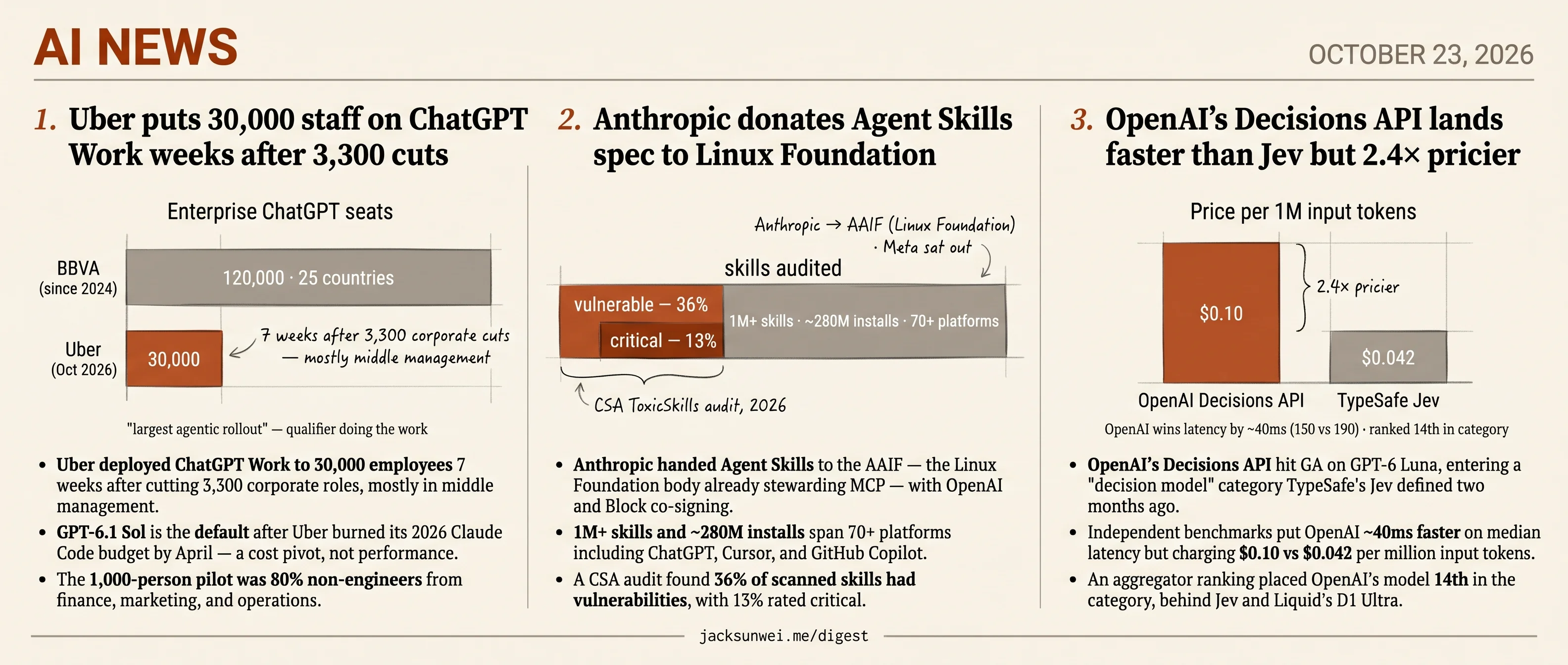
- Uber rolled out ChatGPT Work to 30,000 staff, 7 weeks after cutting 3,300 corporate roles.
- GPT-6.1 Sol replaced Claude at Uber on cost after the 2026 Claude Code budget burned by April.
- OpenAI’s Decisions API shipped on GPT-6 Luna and ranked 14th in a category Jev defined.
- Anthropic donated Agent Skills to the Linux Foundation, with OpenAI and Block co-signing.
- OpenAI is raising $30B at a $1.25T pre-IPO valuation, a record for private companies.
Today’s beat has no shared thread. Uber flipped 30,000 corporate seats to ChatGPT Work seven weeks after a 3,300-person restructuring — and the switch from Claude was a budget decision, not a benchmark one, after burning its 2026 Claude Code allocation by April. OpenAI’s Decisions API reached GA on GPT-6 Luna but entered a product category TypeSafe’s Jev defined two months earlier, landing 14th on independent aggregator rankings while charging 2.4× per input token. And Anthropic handed the Agent Skills spec to the Linux Foundation’s AAIF, with OpenAI and Block co-signing — Meta pointedly absent, preferring open-weights to foundation transparency.
In the briefs: OpenAI is lining up a $30B raise at a $1.25T pre-IPO mark, DeepSeek closed $15B days after a US federal ban, and GPT-5.6 and Gemini 4 jointly surfaced a PHP RCE touching 70% of the web.
Uber puts 30,000 staff on ChatGPT Work weeks after 3,300 cuts
Source: openai-blog · published 2026-10-22
TL;DR
- Uber deployed ChatGPT Work to 30,000 employees 7 weeks after cutting 3,300 corporate roles, mostly in middle management.
- GPT-6.1 Sol is the default after Uber burned its 2026 Claude Code budget by April — a cost pivot, not performance.
- The 1,000-person pilot was 80% non-engineers from finance, marketing, and operations.
- BBVA already runs 120,000 ChatGPT seats across 25 countries, making Uber’s “largest agentic rollout” claim lean on the qualifier.
The announcement, and the one next to it
OpenAI’s blog post frames the Uber rollout as a milestone for frontier AI in the enterprise: 30,000 employees, native hooks into Google Drive, Gmail, Calendar and Slack, GPT-6.1 Sol as the default engine, and an internal skills library to drive adoption. A companion TechCrunch write-up carries the same beats. Read on its own, it’s a clean productivity story.
Read next to Uber’s September 2026 restructuring, it’s a different story. Uber eliminated roughly 3,300 corporate roles — about 10% of staff — and specifically gutted the middle: micro-teams of one or two reports were cut by nearly 50%, and headcount seven-plus layers below the CEO fell 20% 1. Leadership called it “de-layering.” Former employees quoted by Business Insider called the agentic rollout “dynamite under the bridge,” naming client briefs and internal guidance — classic middle-manager work — as tasks the model now absorbs 2. The sequencing is the news OpenAI’s post does not want to be about.
The cost story the blog omits
The most load-bearing fact about this deployment is not in the announcement. Forkast reports Uber exhausted its full 2026 Claude Code budget by April, which forced the pivot to GPT-6.1 Sol as the default for all 30,000 seats 3. OpenAI’s language about “a sophisticated balance between high-tier reasoning performance and operational cost-efficiency” is doing a lot of work there — the balance was dictated by a blown budget, not chosen for its elegance. Forkast reads this as an industry turn away from “tokenmaxxing,” and Uber is the loudest example yet of a buyer picking the cheaper frontier model because the expensive one priced itself out of production use.
Not the biggest, just the agentic-est
Uber is being marketed as a landmark enterprise deployment, but the headcount comparison is unflattering:
| Deployment | Seats | Model posture | Structural tie-in |
|---|---|---|---|
| Uber ChatGPT Work | 30,000 | GPT-6.1 Sol default after Claude budget overrun 3 | Follows 3,300-role cut 1 |
| BBVA ChatGPT Enterprise | 120,000 across 25 countries | Founding partner in OpenAI’s $4B DeployCo JV 4 | Embedded OpenAI engineers in-house |
BBVA is 4× the seat count and bought its way into OpenAI’s new deployment arm. Uber’s distinction is the agentic qualifier — multi-step workflows that return finished artifacts rather than chat replies — and the fact that the pilot leaned 80% toward finance, marketing and operations rather than engineers 5. That non-technical skew is why the “AI Pods” program paired 30 internal AI engineers with business units for two-week sprints to surface automatable tasks 5. The hand-holding that got 1,000 users productive is nowhere in the plan for the next 29,000.
What’s actually being tested
Two things, simultaneously. First: whether a cheaper default model plus deep SaaS connectors can clear the productivity bar that justified displacing a management layer. Second: whether Uber’s two automation frontiers — ChatGPT Work for white-collar staff and the algorithmic management that European drivers are now suing over as “soulless” and “scary” 6 — can keep being described as unrelated programs. The press release treats them as separate. The labor-side reaction increasingly does not.
Further reading
- Uber puts all 30,000 employees on ChatGPT Work — techcrunch-ai
Anthropic donates Agent Skills spec to Linux Foundation
Source: anthropic-news · published 2026-10-22
TL;DR
- Anthropic handed Agent Skills to the AAIF — the Linux Foundation body already stewarding MCP — with OpenAI and Block co-signing.
- 1M+ skills and ~280M installs span 70+ platforms including ChatGPT, Cursor, and GitHub Copilot.
- A CSA audit found 36% of scanned skills had vulnerabilities, with 13% rated critical.
- Meta sat out the foundation, preferring open-weights releases over AAIF transparency obligations.
The second handoff, not the first
Anthropic has given the Agent Skills name, GitHub org, and agentskills.io domain to the Agentic AI Foundation — the Linux Foundation subsidiary that absorbed MCP a year earlier. Simon Willison, who publicly predicted this exact handoff back in December 2025 when Anthropic first slapped “open standard” on the spec, treats the move as sequencing rather than news 7. The pattern is now explicit: ship a protocol, let the ecosystem adopt it, then launder it through a neutral foundation while Anthropic engineers continue chairing the working groups. AAIF now hosts ten projects, and the two most load-bearing — MCP and Skills — both originated inside Anthropic.
Why the Skills layer matters
The developer community has mostly dropped the “MCP is dead” framing in favor of a layered mental model: MCP is the instrument, Skills are the sheet music, the agent is the musician 8. Skills are cheap — a folder with a SKILL.md file costs roughly 100 tokens of context until an agent decides to load it — which fixes the “context rot” problem that plagued early MCP deployments where every connected tool bloated the prompt. One benchmark cited by practitioners claims combining Skills with MCP cuts erroneous tool calls by ~43% 8. That’s the real reason the donation lands with weight: it standardizes the procedural half of a stack whose connectivity half is already foundation-governed.
flowchart LR
    A[Agent / LLM] -->|loads on demand| B[SKILL.md<br/>procedural knowledge]
    A -->|calls| C[MCP servers<br/>tools & data]
    B -. instructs .-> C
    D[AAIF governance] --- B
    D --- C
Security is the half the press release skips
The announcement’s “security frameworks” line papers over an uncomfortable surface. A 2026 Cloud Security Alliance audit of public skill directories found roughly 36% contained security flaws and nearly 13% were critical 9. Independent prompt-injection work is harsher: GUI-based agents breach at >70% under persistence testing, and researcher Johann Rehberger’s exploits reportedly bypass Claude Code’s “auto mode” defenses about 80% of the time 10.
LLMs cannot reliably be told to “ignore” malicious natural-language instructions embedded in a SKILL.md body.
The AAIF roadmap promises versioned releases and RFC-style change control, but there is no deterministic sandboxing requirement for skill execution — and because skills routinely ship scripts that touch sensitive data, the supply-chain shape looks closer to npm than to a vetted package registry.
The “neutral foundation” has visible cracks
Two absences define the governance story. Meta has conspicuously declined to join, preferring open-weights releases over the transparency obligations foundation membership imposes 11; LangChain similarly stays outside with its own LAP stack. More structurally, the AAIF is a Western consortium: China launched parallel Agent Interconnection Protocols in mid-2026, and critics describe AAIF’s tiered membership as a “platinum paywall” where Bloomberg and Cloudflare buy influence over agentic infrastructure 12. Huawei and Lenovo hold Gold seats while their domestic ecosystem builds a separate closed-loop standard.
What to actually watch
The donation is real consolidation — Anthropic now formally controls neither of the two protocols its ecosystem runs on. But the interesting questions are downstream: whether AAIF mandates sandboxing before the next ToxicSkills headline, whether Meta’s absence hardens into a competing stack, and whether the China split turns Agent Skills into a regional rather than global standard.
Further reading
- Donating Agent Skills to the Agentic AI Foundation — simon-willison
OpenAI’s Decisions API lands faster than Jev but 2.4× pricier
Source: openai-blog · published 2026-10-22
TL;DR
- OpenAI’s Decisions API hit GA on GPT-6 Luna, entering a “decision model” category TypeSafe’s Jev defined two months ago.
- Independent benchmarks put OpenAI ~40ms faster on median latency but charging $0.10 vs $0.042 per million input tokens.
- An aggregator ranking placed OpenAI’s model 14th in the category, behind Jev and Liquid’s D1 Ultra.
- Security researchers flag “poisoned input” attacks with no evidence trail — a problem for the shell-command risk-scoring use case OpenAI advertises.
A category OpenAI didn’t create
The headline on OpenAI’s Tuesday launch is that it exists at all. “Decision models” — bounded-output, non-generative APIs tuned for classification, routing, and scoring — were a category TypeSafe AI’s Jev named in September, launched by ex-OpenAI InstructGPT co-author Diogo Almeida on the pitch that LLMs are “awkward components” for dependable software 13. OpenAI’s product branding (“Decisions API”), its no-charge-for-output-tokens pricing, and its three answer types (predicate, choice, score) all mirror Jev’s conventions closely enough that TechCrunch and others frame the GA as fast-follower positioning rather than a new primitive.
The urgency is real: Jev reportedly cleared $100M in bookings in its first week 13, and ExplainX’s independent category ranking still puts OpenAI’s model as low as 14th, trailing both Jev and Liquid’s D1 Ultra 14.
Faster on latency, worse on price
OpenAI’s “10× faster than Responses API” marketing is an in-house comparison. Head-to-head against Jev, the picture inverts on cost:
| Dimension | OpenAI Decisions API | TypeSafe Jev |
|---|---|---|
| Median latency 15 | 150ms | 190ms |
| Price / M input tokens 15 | $0.10 | $0.042 |
| Output token cost | $0 | $0 |
| Category rank 14 | ~14th | Top 3 |
Respan’s benchmark gives OpenAI the latency win by ~40ms, but Jev remains roughly 2.4× cheaper per call 15. The architectural critique in developer forums is sharper: this is GPT-6 Luna with reasoning disabled for speed — a repackaged zero-shot classifier wearing a new SKU, not the ground-up “System One” design Almeida pitched for Jev 13.
The audit trail problem
NeuralTrust’s security review identifies the trade-off hiding inside the bounded-output design. Removing free text shrinks the prompt-injection surface, but introduces poisoned-input attacks where crafted context flips a verdict silently — and because the API returns a probability vector rather than a reasoning trace, there is no evidence trail to replay post-incident 16.
Fewer than 25% of AI-driven decisions in production can be traced and replayed end-to-end. 17
That matters directly for OpenAI’s showcase case study: Datadog’s 40× faster p95 on scoring agent-generated shell commands [1 — OpenAI data] is only valuable if the “block” decision is defensible when something goes wrong in production.
The GPT-Live asterisk
The native integration with GPT-Live is the launch’s most differentiated feature — a decisions event inside session.triggers that lets a voice agent pick avatar expressions or route intents mid-stream without a separate API round-trip. The catch, surfaced by developers walking through the config: native delegation locks the decision schema at session start 18. Any app that needs to rewrite inputs, log pre-decision context, or swap questions dynamically falls back to the slower custom-delegation path, eroding the headline latency win for anything beyond fixed-choice UI triggers.
What the drop actually means
OpenAI wins on raw latency, distribution, and the GPT-Live tie-in. It loses on price, independent accuracy benchmarks, and auditability — the three dimensions enterprise buyers of a decision primitive weigh most heavily. The GA announcement reads less like a product launch and more like category defense against a startup that caught OpenAI’s roadmap flat-footed.
Further reading
- OpenAI makes its Jev competitor widely available as decision model competition heats up — techcrunch-ai
Round-ups
OpenAI eyes $30B raise at $1.25T pre-IPO valuation
Source: techcrunch-ai
OpenAI is lining up a fresh $30 billion round that would value the company at roughly $1.25 trillion ahead of a planned IPO. Closing at that mark would make OpenAI the most highly valued private company ever recorded.
DeepSeek raises $15B days after US federal ban
Source: techcrunch-ai
DeepSeek has reportedly closed $15 billion in one of China’s largest-ever funding rounds. The raise lands just days after Washington ordered federal agencies to strip the Chinese lab’s models from government systems on national security grounds.
GPT-5.6 and Gemini 4 uncover PHP2Shell RCE affecting 70% of web
Source: latent-space, ars-technica-ai
OpenAI’s Patch the Planet program and a parallel Google effort independently surfaced the PHP2Shell remote-code-execution flaw in core PHP, which runs an estimated 70% of the web. Coordinated disclosure took two months, but attackers were probing the bug four days before defenders were notified.
Microsoft’s diagnostic orchestrator beats generalist doctors in Science study
Source: techcrunch-ai, the-verge-ai
Microsoft AI chief Mustafa Suleyman says the company’s diagnostic orchestrator outperforms generalist physicians on hard cases, with claimed accuracy up to four times higher. Most of the gain, however, appears to come from the underlying frontier models, not Microsoft’s routing layer.
SpaceX and Tesla form committees to explore merger
Source: the-verge-ai
SpaceX and Tesla have set up special committees to study combining the two Musk companies, a deal whose logic rests largely on faith in the CEO. The talks arrive as SpaceX prepares to borrow another $40 billion to stockpile Nvidia chips.
Canva Craft debuts two-stage image model that plans before drawing
Source: the-verge-ai, techcrunch-ai
Canva Craft, the design platform’s first in-house image generator, uses a two-stage architecture that drafts a layout before rendering pixels for tighter precision and consistency. It ships to all users and takes direct aim at image models from OpenAI, Microsoft, and Google.
Modal CEO on elastic GPUs and the economics of agent cloud
Source: latent-space
Modal founder Erik Bernhardsson unpacks why AI compute keeps arriving in rectangular slabs, tracing how elastic GPU scheduling, sandbox growth, and agent workloads reshape cloud unit economics. The conversation frames serverless GPU pricing as the next battleground for inference infrastructure.
Footnotes
-
The Guardian — https://www.theguardian.com/technology/2026/sep/02/uber-to-cut-3300-corporate-jobs-in-management-overhaul
↩ ↩2Uber to cut 3,300 corporate jobs in management overhaul… eliminated nearly 50% of its ‘micro-teams’—groups consisting of only one or two direct reports—and reduced the number of employees sitting seven or more layers below the CEO by 20%.
-
Business Insider — https://www.businessinsider.com/uber-ai-usage-layoffs-questioned-by-former-staff-2026-9
↩Former employees have described the pervasive integration of AI as ‘dynamite under the bridge,’ noting that the technology now handles substantial portions of tasks—such as preparing client briefs and providing internal guidance—that were previously the responsibility of human managers.
-
Forkast — https://forkast.news/uber-rolls-chatgpt-work-to-all-30000-employees-the-unpriced-labor-benchmark/
↩ ↩2Uber reportedly exhausted its 2026 budget for Anthropic’s Claude Code by April, leading to a strategic pivot toward ‘cost-efficient’ models like GPT-6.1 Sol for the 30,000-seat deployment… an industry-wide move away from ‘tokenmaxxing.’
-
BBVA / DeployCo announcement — https://www.bbva.com/en/innovation/bbva-joins-deployco-openais-new-company-to-accelerate-ai-enterprise-transformation/
↩BBVA expanded its rollout from 11,000 initial users to its entire global workforce of 120,000 employees across 25 countries… became a founding partner in the OpenAI Deployment Company, a $4 billion joint venture that embeds OpenAI engineers directly into client workflows.
-
↩ ↩2Approximately 80% of the early [1,000-person pilot] users were non-engineers from departments including finance, marketing, and operations… a separate internal initiative where 30 AI engineers were paired with business units for two weeks to identify and automate high-value tasks.
-
Channel Insider — https://www.channelinsider.com/channel-business/news-uber-3300-job-cuts-robotaxi-restructuring/
↩In Europe, drivers launched a class-action lawsuit in September 2026 against Uber’s ‘soulless’ and ‘scary’ AI algorithms, which they claim automate punitive management decisions without human oversight.
-
Simon Willison blog (Oct 22, 2026) — https://simonwillison.net/2026/Oct/22/donating-agent-skills/
↩I’m pleased to note I called this one last December… I wouldn’t be surprised to see this end up in the AAIF, recently the new home of the MCP specification.
-
Medium — ‘MCP is dead? Or MCP vs Skills revisited’ (Alon Nisser) — https://medium.com/@alonisser/mcp-is-dead-or-mcp-vs-skills-revisited-daaa51b9a519
↩ ↩2The Skill is the sheet music, the MCP is the instrument, and the Agent is the musician… combining Skills with MCP has been shown to reduce erroneous tool calls by approximately 43%
-
Cloud Security Alliance research note on SKILL.md context poisoning — https://labs.cloudsecurityalliance.org/research/csa-research-note-skill-md-agent-context-poisoning-20260506/
↩A 2026 ‘ToxicSkills’ audit found approximately 36% of scanned skills contained security flaws, with nearly 13% rated at critical severity
-
VentureBeat on measurable prompt-injection metrics — https://venturebeat.com/security/prompt-injection-measurable-security-metric-one-ai-developer-publishes-numbers
↩Persistence testing reveals that successful breaches can rise to over 70% in GUI-based agent surfaces without robust safeguards; independent researchers have shown exploits bypass Claude Code’s ‘auto mode’ defenses roughly 80% of the time
-
CIO.com — ‘It’s everyone but Meta in a new AI standards group’ — https://www.cio.com/article/4104546/its-everyone-but-meta-in-a-new-ai-standards-group.html
↩Meta has reportedly opted out to pursue proprietary model development… the company prefers an ‘open weights’ model over the governance and data transparency requirements of a truly open-source foundation
-
SmarterArticles — ‘The fragmented future: why AI agent standards cannot solve governance’ — https://smarterarticles.co.uk/the-fragmented-future-why-ai-agent-standards-cannot-solve-governance
↩While Western tech giants consolidate around AAIF protocols, a significant portion of the global AI economy is moving toward a decentralized model that operates outside these Western-led governance frameworks
-
Forkast — TypeSafe/Jev origin story — https://forkast.news/typesafe-ais-jev-is-not-an-llm-and-that-may-be-the-point/
↩ ↩2 ↩3Diogo Almeida… argues that current LLMs are ‘awkward components’ for building dependable software because they were designed with the assumption that a human is always the end consumer. TypeSafe is credited with creating a new category of AI called System One Models.
-
ExplainX ‘Top 10 Decision Models’ ranking — https://explainx.ai/blog/top-10-decision-models-jev-perplexity-openai-open-source-ranked-2026
↩ ↩2In public rankings, OpenAI’s Decision Model was placed as low as 14th, significantly trailing Liquid’s D1 Ultra and TypeSafe’s Jev.
-
Respan.ai head-to-head benchmark — https://www.respan.ai/articles/openai-decisions-api-vs-jev
↩ ↩2 ↩3OpenAI’s Decisions API is frequently faster, clocking median latencies of 150ms compared to Jev’s 190ms… Jev is priced significantly lower than frontier models at roughly $0.042 per million input tokens, while OpenAI’s Decisions API sits at $0.10 per million.
-
NeuralTrust security analysis — https://neuraltrust.ai/blog/jev-typesafe-ai-security
↩While Jev shrinks the attack surface by not generating text, it remains vulnerable to ‘poisoned inputs’ where specifically crafted context can manipulate the model’s verdict without triggering traditional prompt-injection filters. Furthermore, the lack of an evidence trail… presents a significant auditability gap.
-
TechTimes — AI decisions governance report — https://www.techtimes.com/articles/329368/20261022/ai-decisions-outrun-accountability-four-five-enterprise-deployments-have-no-named-owner.htm
↩Fewer than 25% of AI-driven decisions in production can be traced and replayed end-to-end… a ‘production blind spot,’ where models influence live systems without clear ownership or a documented logic trail.
-
Developers Digest — GPT-Live native delegation walkthrough — https://www.developersdigest.tech/blog/openai-gpt-live-decisions-native-delegation-2026
↩Native delegation is a fixed choice made at session startup; if an application needs to rewrite requests or perform complex logging before a decision is made, the older ‘custom delegation’ path remains necessary despite the higher latency.