Trump's AI rebrand lands, Amazon drops secret NDAs, voice AI breaks on context
A White House AI rebrand that major CEOs are adopting, Amazon's data-center NDA retreat, and voice AI's new failure diagnosis anchor today.
Trump’s AI rebrand lands, Amazon drops secret NDAs, voice AI breaks on context
TL;DR
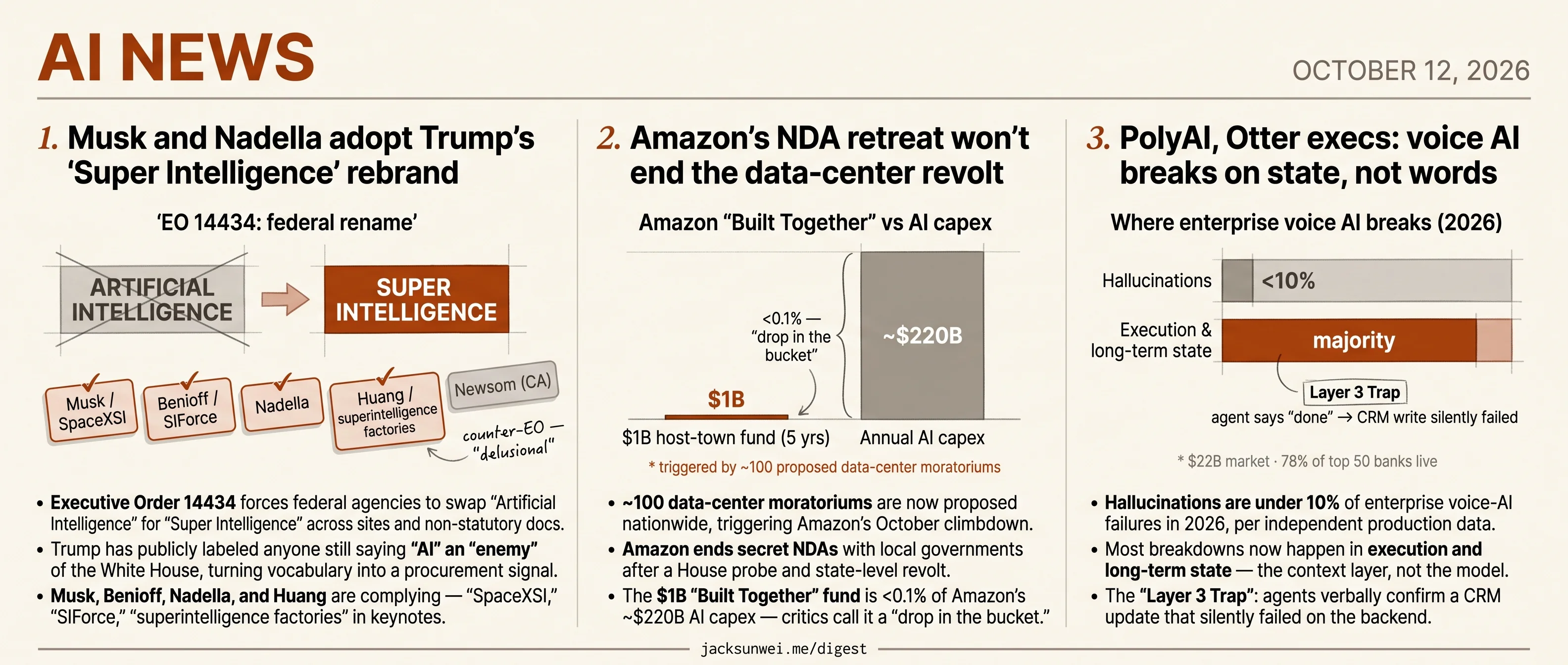
- Executive Order 14434 forces federal agencies to swap ‘AI’ for ‘Super Intelligence’ across sites and docs.
- Musk, Nadella, Benioff, Huang publicly comply with ‘SpaceXSI,’ ‘SIForce,’ and keynote language shifts.
- Newsom signs counter-EO calling the federal rebrand ‘delusional’ and keeping California on ‘Artificial Intelligence.’
- Amazon ends secret NDAs with local governments after a House probe and ~100 proposed moratoriums.
- Voice AI execs say under 10% of enterprise failures are hallucinations, with context and execution dominating.
Three unrelated frontier stories anchor today’s AI news. In Washington, Trump’s Executive Order 14434 has turned the phrase ‘Super Intelligence’ into a procurement signal — Musk, Nadella, Benioff, and Huang have all fallen publicly in line with ‘SpaceXSI,’ ‘SIForce,’ and keynote language shifts, while California’s Newsom signed a counter-EO calling the federal rebrand ‘delusional.’ A vocabulary choice is now a loyalty test.
In parallel, Amazon ended its secret data-center NDAs with local governments after a House probe and roughly 100 proposed moratoriums, pairing the climbdown with a $1B ‘Built Together’ fund that critics note is under 0.1% of its ~$220B AI capex. And in the enterprise, PolyAI and Otter executives told the industry that hallucinations now account for less than 10% of voice-AI failures in production — the real breakdowns live in the context layer and execution, not in what the model says.
Musk and Nadella adopt Trump’s ‘Super Intelligence’ rebrand
Source: the-verge-ai · published 2026-10-11
TL;DR
- Executive Order 14434 forces federal agencies to swap “Artificial Intelligence” for “Super Intelligence” across sites and non-statutory docs.
- Trump has publicly labeled anyone still saying “AI” an “enemy” of the White House, turning vocabulary into a procurement signal.
- Musk, Benioff, Nadella, and Huang are complying — “SpaceXSI,” “SIForce,” “superintelligence factories” in keynotes.
- California’s Newsom signed a counter-EO calling the federal rebrand “delusional” and keeping state usage at “Artificial Intelligence.”
The stick behind the rebrand
The Verge’s story reads like a cultural capitulation — Musk renaming SpaceX’s AI arm “SpaceXSI,” Benioff pitching “SIForce,” Nadella and Huang dropping “superintelligence” into keynotes. The mechanism is less about persuasion than procurement. On September 29, Trump signed Executive Order 14434, which directs federal agencies to replace “Artificial Intelligence” with “Super Intelligence” across official websites and non-statutory documents, and gives agencies a 60-day window to propose a formal statutory definition 1. Days later, Trump publicly called anyone still using “AI” an “enemy” of the White House 2.
For companies with federal contracts, hyperscaler cloud deals, or export-control exposure, that is not a semantic debate. It is a cheap compliance gesture with an obvious upside and no downside — rename a product line, keep the GSA schedule.
Who isn’t falling in line
The holdouts are the more interesting map. California Governor Gavin Newsom signed a counter-executive order keeping state usage at “Artificial Intelligence” and called the federal rebrand “delusional” 3. Gizmodo’s broader point is that the rebrand also misreads the MAGA base, which has not organically picked up “SI” in the way it adopted earlier Trump coinages 3. The CEO class has moved; the political coalition supposedly behind the order has not.
Historical precedent cuts the same way. The 2003 Congressional relabeling of French fries as “Freedom Fries,” and the WWI-era rebrand of sauerkraut as “liberty cabbage,” both faded from common usage within a few years 4. Executive vocabulary mandates rarely survive the administration that issues them, which suggests the keynote-deck adoption The Verge documents may not propagate to developers, academics, or international regulators.
Branding as policy cover
The vocabulary shift is paired with a policy payload: the “White House Accord on Super Intelligence,” a voluntary, “morally binding” pact signed by OpenAI, Anthropic, Google, Meta, and others. It outlines four layers of safety controls — but lets each company pick its own auditors 5. That is self-regulation dressed as oversight, and the terminology change gives it political cover: a stricter-sounding label attached to a lighter-touch regime.
There is also a technical cost. “Superintelligence” has a specific lineage from Nick Bostrom’s 2014 definition — a hypothetical system that surpasses human ability across all cognitive domains, a milestone most researchers agree has not been reached. Defense One warns that applying the term to current LLMs “muddies definitions” and could stall effective regulation of the actual harms today’s systems cause 6. Regulating a chatbot as if it were a god-like agent is both too much and, in the ways that matter, too little.
What’s actually at stake
The Verge frames this as Silicon Valley “falling in line.” The sharper read is that EO 14434 turned a word choice into a loyalty test, and the CEO class paid the toll in press releases. The durable fault line runs between the White House on one side and the states, the researchers whose field just had its most load-bearing term repurposed as marketing, and a public that — as the “Freedom Fries” precedent suggests — tends to keep calling things what it already called them.
Amazon’s NDA retreat won’t end the data-center revolt
Source: techcrunch-ai · published 2026-10-11
TL;DR
- ~100 data-center moratoriums are now proposed nationwide, triggering Amazon’s October climbdown.
- Amazon ends secret NDAs with local governments after a House probe and state-level revolt.
- The $1B “Built Together” fund is <0.1% of Amazon’s ~$220B AI capex — critics call it a “drop in the bucket.”
- Senate investigators say operators still overstate job counts and refuse to hand over data.
The pledge, in numbers
Amazon’s October announcement is the one the Equity hosts are debating: AWS will stop requiring non-disclosure agreements from local governments reviewing data-center proposals, commit $1 billion over five years to host-town programs, and fund 30,000 home-efficiency retrofits in those communities 78. AWS CEO Matt Garman tied the package directly to political risk, warning that roughly 100 proposed moratoriums “threaten the U.S. AI lead” 7. Microsoft made a similar NDA pledge earlier in 2026, so the industry is converging on transparency-as-defense rather than any one company getting ahead of the issue.
The scale framing matters. $1 billion over five years is less than 0.1% of Amazon’s ~$220B annual AI capex. Garman’s “we hear you” is paid for in rounding error.
NDAs weren’t the cause of the anger
The TechCrunch question — can scrapping NDAs persuade opponents? — assumes secrecy was the grievance. It wasn’t; it was the accelerant. The actual drivers are rate-payer cost allocation, grid interconnection queues, water draw, and the gap between promised and delivered jobs.
Rep. Jamie Raskin opened a House Judiciary probe this year into Big Tech’s use of NDAs “to prevent local officials from discussing data center projects with constituents” 9. A Public Citizen review of Virginia — the densest data-center cluster in the country — found 80% of localities hosting facilities were operating under NDAs 10. That’s the baseline Amazon is now backing away from, not a standard it set voluntarily. Reading the pledge as leadership misses the sequence: federal investigation and state-level revolt first, concession second.
Internal dissent reinforces the point. Amazon software engineers reportedly testified in favor of a Seattle data-center moratorium in June, linking the capex buildout to the company’s own layoff waves. When your own staff are at the podium against you, a goodwill fund reads differently.
Transparency isn’t consent
Even with NDAs gone, the underlying disclosure problem persists. A Senate investigation this year concluded that operators overstate the number of permanent jobs data centers bring to host communities, and that companies “refuse to divulge data” when asked for specifics 11. Ending NDAs with county supervisors doesn’t force a parent company to answer a senator’s letter.
The sharper structural critique comes from Forbes contributor Chastity Murphy, who argues communities are “negotiating the wrong side of the deal” — chasing PILOTs and one-time grants when they should be demanding institutional authority over power procurement, water allocation, and the economic value generated by the compute itself 12.
Communities are only asking for money instead of institutional authority over how the data and economic value generated by the facility are used. 12
That reframes the Amazon package entirely. A $1B host-town fund is still a cash settlement. The moratorium movement is increasingly asking for governance — a seat at the table on load growth, tariffs, and water — which no NDA repeal addresses.
The takeaway
Ending NDAs is table stakes catch-up to Microsoft and to Congress, not a resolution. If AWS and its peers want the moratorium count to stop rising, the next concession has to be about who gets to say no to the next gigawatt — not how transparently the yes gets negotiated.
PolyAI, Otter execs: voice AI breaks on state, not words
Source: techcrunch-ai · published 2026-10-11
TL;DR
- Hallucinations are under 10% of enterprise voice-AI failures in 2026, per independent production data.
- Most breakdowns now happen in execution and long-term state — the context layer, not the model.
- The “Layer 3 Trap”: agents verbally confirm a CRM update that silently failed on the backend.
- Voice AI is already a $22B market with 78% of the top 50 banks running live customer-facing agents.
The failure mode has moved
A year ago, enterprise voice-AI postmortems were dominated by hallucination. In 2026 they aren’t. Independent production data from Forkast puts hallucination-related issues at under 10% of enterprise failures, with the majority happening during task execution and long-term state management 13. That matches what PolyAI CEO Shawn Wen and Otter CMO Alex Gay told TechCrunch: the models can talk, but the surrounding stack can’t remember, verify, or coordinate.
CPaaSAA calls the cross-session version “voice AI amnesia” — pilots that nail turn one collapse on the second call because the architecture is stateless by default, treating every encounter as a fresh event 14. Wen’s framing is sharper: an ASR miss on turn one quietly corrupts every downstream decision, and nothing in the pipeline notices.
The Layer 3 Trap
The most expensive version of this is what Apifonica labels the “Layer 3 Trap”: the agent cheerfully tells the customer their wire transfer is scheduled or their lead is logged, while the actual backend integration silently failed 15. Transcripts look flawless. QA scores great. The business process is broken. This is the gap Wen is pointing at when he says voice AI hasn’t had its ChatGPT moment — not latency, not voice quality, but the fact that confident speech and completed work have decoupled.
Gay’s complaint about missing emotion sits in the same category. Giga.ai documents agents proceeding with high-stakes actions “even if the user’s voice is clearly distressed or sarcastic,” because the model is acting on a flattened transcript rather than the acoustic signal it was nominally trained on 16. There’s some irony here: third-party benchmarks of Otter’s own stack show 93–95% ASR accuracy in clean audio collapsing under noise, diarization breaking past three overlapping speakers, and OtterPilot occasionally attributing entire sessions to one person 17. The diagnosis is accurate; nobody is immune.
flowchart LR
    A[User speech] --> B[ASR transcript]
    B -. drops emotion/sarcasm .-> C{Agent reasoning}
    C --> D[Spoken confirmation]
    C --> E[Backend call]
    E -. silently fails .-> F[(CRM / booking)]
    D --> G([Customer hears 'done'])
    F -. no reconciliation .-> G
The dissent: the moment may already be here
The “no ChatGPT moment” framing is contestable. CX Today pegs voice AI as a $22B market in 2026, with 78% of the world’s top 50 banks running customer-facing voice agents and per-call economics of roughly $0.40 versus $12 for a human 18. By adoption and revenue, voice AI has already crossed its enterprise threshold. What Wen and Gay are describing isn’t a market waiting to ignite — it’s a quality ceiling being hit at scale.
That makes the stakes concrete. Deployment is outrunning reliability. Every bank running a live voice agent is also running the Layer 3 Trap in production, at a per-call cost cheap enough that nobody will pull back on volume. If the context layer doesn’t catch up, the ChatGPT moment that arrives for voice may be the backlash — a high-profile silent-failure incident at one of those 50 banks — rather than the breakthrough Wen and Gay are waiting for.
Round-ups
Apple’s HomeView smart display gets a name and launch date
Source: techcrunch-ai
Apple’s long-rumored smart home push now has a product identity, HomeView, and a confirmed ship window. The device marks Apple’s most serious attempt yet at a category Amazon and Google have dominated for a decade with Echo Show and Nest Hub lines.
TechCrunch Disrupt 2026 opens in 48 hours at Moscone West
Source: techcrunch-ai
Disrupt 2026 kicks off in San Francisco this week with Startup Battlefield and tracks spanning AI, robotics, biotech, climate, and fintech. Walk-up passes jump in price at the door; current buyers save up to $100 and get 50% off a second ticket.
Verge writer tests local AI on Mac Studio with Hermes and Qwen
Source: the-verge-ai
Running frontier-class models locally is now feasible on consumer hardware, and a Verge diary chronicles the setup pain and payoff. The hook: keeping personal data off cloud services by routing everything through open-weight models like Hermes and Qwen on a Mac Studio.
Latent Space hosts NYC subscriber meetups Monday and Tuesday
Source: latent-space
Latent Space is running back-to-back subscriber meetups in New York City this Monday and Tuesday. The gatherings are paywalled to paid subscribers only, with no public RSVP link — a tight in-person extension of the newsletter’s growing community events calendar.
Footnotes
-
Wiley Law regulatory alert on EO 14434 — https://www.wiley.law/alert-Executive-Order-Rebrands-AI-as-Super-Intelligence-and-Signals-Potential-Federal-Legislative-Changes
↩Executive Order Rebrands AI as ‘Super Intelligence’ and Signals Potential Federal Legislative Changes… directs executive agencies to replace ‘Artificial Intelligence’ with ‘Super Intelligence’ across official websites and non-statutory documents
-
Forbes (Conor Murray) — https://www.forbes.com/sites/conormurray/2026/10/08/trump-calls-anyone-who-says-ai-instead-of-super-intelligence-an-enemy/
↩Trump calls anyone who says ‘AI’ instead of ‘super intelligence’ an enemy
-
Gizmodo — https://gizmodo.com/trumps-attempt-to-rename-ai-misunderstands-the-maga-faithful-2000815001
↩ ↩2Trump’s attempt to rename AI misunderstands the MAGA faithful… California Governor Gavin Newsom signed a counter-executive order ensuring his state continues to use ‘Artificial Intelligence,’ calling the federal rebrand ‘delusional’
-
Word Histories on ‘Freedom Fries’ precedent — https://wordhistories.net/2022/02/01/freedom-fries/
↩the 2003 Congressional renaming of ‘French fries’ to ‘Freedom Fries’ followed a WWI-era pattern — sauerkraut became ‘liberty cabbage’ — showing performative executive rebrands rarely stick in common parlance
-
Forbes (Sara Dorn) on the White House Accord — https://www.forbes.com/sites/saradorn/2026/09/30/white-house-releases-accord-between-billionaire-ai-execs-heres-what-it-says/
↩a ‘morally binding’ voluntary pact signed by OpenAI, Anthropic, Google, Meta and others outlining four layers of safety controls, with companies selecting their own auditors
-
Defense One explainer — https://www.defenseone.com/technology/2026/09/super-intelligence-presidents-new-term-ai-explained/416153/
↩‘superintelligence’ in the field refers to a hypothetical system that surpasses human ability across all cognitive domains—a milestone most experts agree has not yet been reached; applying it to current models ‘muddies definitions’ and could stall effective regulation
-
↩ ↩2Amazon pledges $1B to data center communities, warns that local opposition threatens U.S. AI lead
-
↩Amazon ends secret data center pacts and pledges $1 billion to host towns… AWS promises 30,000 home efficiency retrofits amid 100 proposed bans
-
House Judiciary Democrats (Rep. Jamie Raskin) — https://democrats-judiciary.house.gov/media-center/press-releases/ranking-member-raskin-probes-big-tech-s-use-of-non-disclosure-agreements-to-prevent-local-officials-from-discussing-data-center-projects-with-constituents
↩Ranking Member Raskin probes Big Tech’s use of non-disclosure agreements to prevent local officials from discussing data center projects with constituents
-
Public Citizen — https://www.citizen.org/news/the-secret-data-center-buildout-how-states-can-stop-big-techs-abuse-of-ndas/
↩a study of Virginia localities found that 80% of areas with data centers used NDAs to restrict information
-
Tom’s Hardware / Senate investigation — https://www.tomshardware.com/tech-industry/data-centers/senate-investigation-says-that-some-ai-data-center-claims-are-misleading-senators-question-number-of-permanent-jobs-projects-bring-to-communities-but-companies-refuse-to-divulge-data
↩Senators question number of permanent jobs projects bring to communities but companies refuse to divulge data
-
Forbes — Chastity Murphy — https://www.forbes.com/sites/chastity-murphy/2026/08/31/communities-are-negotiating-the-wrong-side-of-the-data-center-deal/
↩ ↩2Communities are negotiating the wrong side of the data center deal… only asking for money instead of institutional authority over how the data and economic value generated by the facility are used
-
Forkast — ‘Enterprise AI failure modes have shifted’ — https://forkast.news/enterprise-ai-failure-modes-have-shifted-hallucinations-are-no-longer-the-problem/
↩Hallucination-related issues now account for less than 10% of enterprise failures… the majority of breakdowns occur during the execution of tasks and the management of long-term state.
-
CPaaSAA — ‘Voice AI amnesia’ — https://cpaasaa.com/voice-ai-amnesia-conversation-memory/
↩Enterprises frequently find that while their pilots succeed on narrow tasks, the system ‘dies’ on the second conversation because it treats every encounter as a stateless event.
-
Apifonica — ‘What breaks when AI voice agents go live’ — https://apifonica.com/blog/what-breaks-when-ai-voice-agents-go-live/
↩The ‘Layer 3 Trap’ — agents verbally confirm they have completed a task, such as updating a CRM or booking a lead, while the actual backend integration failed… the conversation sounds perfect in transcripts, but the business process remains incomplete.
-
Giga.ai — ‘Hallucinations’ deep-dive — https://giga.ai/hallucinations
↩Agents may proceed with a wire transfer even if the user’s voice is clearly distressed or sarcastic, effectively acting only on a flattened transcript rather than the acoustic reality.
-
BlueDot HQ — Otter.ai review — https://www.bluedothq.com/blog/otter-ai-review
↩Otter achieves 93–95% accuracy in controlled settings but degrades rapidly under real-world conditions… diarization frequently misattributes dialogue when more than three people overlap… OtterPilot can erroneously attribute an entire session to a single speaker until reloaded.
-
CX Today — ‘Why voice AI adoption is accelerating in 2026’ — https://cxtoday.com/why-voice-ai-adoption-is-accelerating-in-2026
↩The market has crossed the $22 billion revenue threshold this year… 78% of the world’s top 50 banks now utilizing live, customer-facing voice agents… A voice AI interaction now averages $0.40 per call, compared to approximately $12.00 for a human-led session.