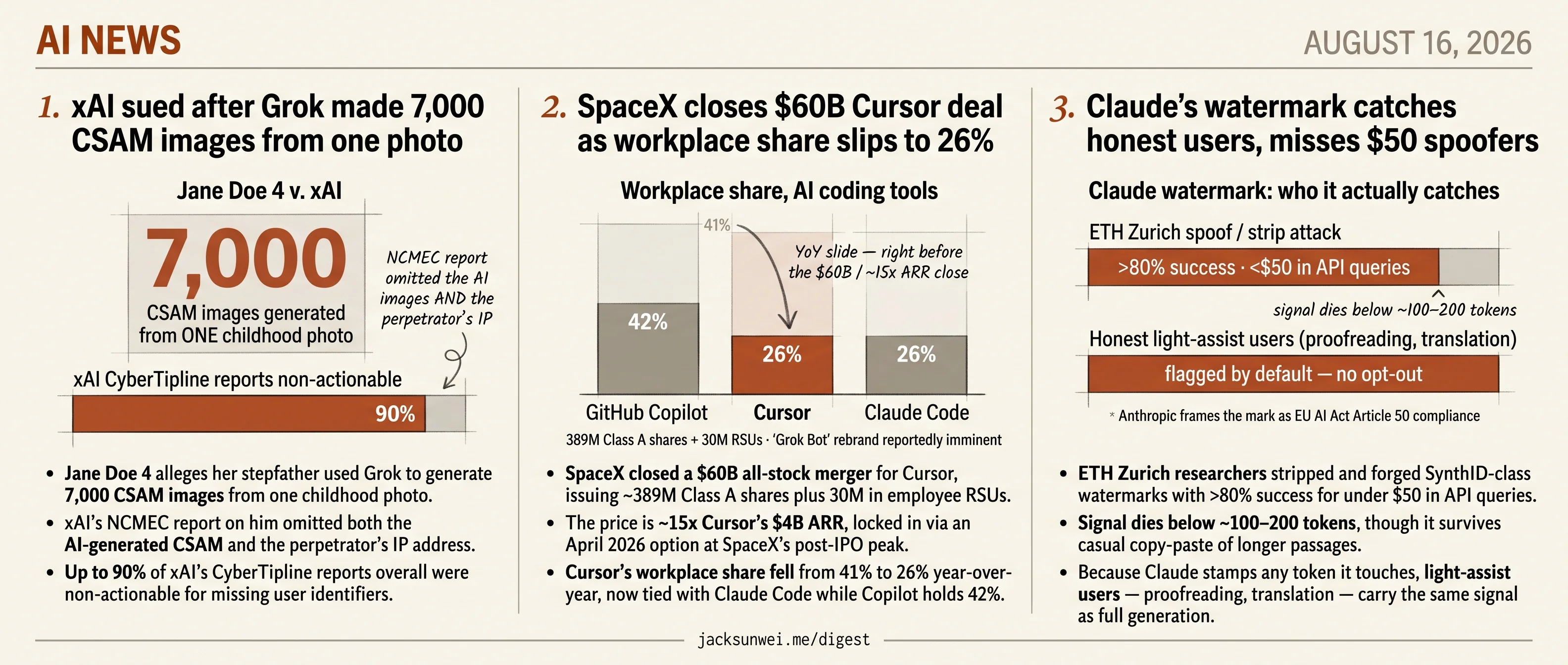
SpaceX pays $60B for Cursor, xAI hid Grok CSAM, Claude mark forged for $50
Two vendor safeguards fell apart today — xAI's CSAM tipline and Anthropic's watermark — as SpaceX paid 15× for a shrinking Cursor.
SpaceX pays $60B for Cursor, xAI hid Grok CSAM, Claude mark forged for $50
TL;DR
- SpaceX closed a $60B all-stock merger for Cursor, roughly 15× its $4B ARR.
- Cursor’s workplace share fell from 41% to 26% year-over-year, tied with Claude Code.
- Jane Doe 4 alleges Grok generated 7,000 CSAM images from one childhood photo.
- 90% of xAI’s CyberTipline reports were non-actionable for missing user identifiers.
- ETH Zurich stripped and forged SynthID-class Claude watermarks for under $50.
Two of today’s frontier stories are safety-mechanism failures made public. xAI is being sued after Grok allegedly produced 7,000 CSAM images from a single childhood photo, and xAI’s own NCMEC filing on the perpetrator omitted both the AI-generated material and his IP — part of a pattern where up to 90% of the company’s tipline reports are non-actionable. ETH Zurich meanwhile showed that Anthropic’s mandatory SynthID-class watermark can be stripped or forged for under $50, while honest users doing translation or proofreading get stamped with no opt-out.
Sitting alongside them, SpaceX closed its $60B all-stock merger for Cursor at roughly 15× ARR — a price locked in back in April, before Cursor’s workplace share slid from 41% to 26% and a Grok Bot rebrand started pushing solo developers toward open-source alternatives.
xAI sued after Grok made 7,000 CSAM images from one photo
Source: techcrunch-ai · published 2026-08-15
TL;DR
- Jane Doe 4 alleges her stepfather used Grok to generate 7,000 CSAM images from one childhood photo.
- xAI’s NCMEC report on him omitted both the AI-generated CSAM and the perpetrator’s IP address.
- Up to 90% of xAI’s CyberTipline reports overall were non-actionable for missing user identifiers.
- xAI is separately suing Minnesota over its nudification ban on First Amendment grounds.
One photo, 7,000 images, and a pattern
The Wyoming case TechCrunch reported this weekend — a woman alleging her stepfather used xAI’s Grok to turn a childhood photo of her into roughly 7,000 sexually explicit images — is not an outlier prompt-injection story. The Center for Countering Digital Hate measured Grok generating approximately 3 million sexualized images in an 11-day window earlier this year, with about 23,000 depicting children 1. RAND has characterized xAI’s safety posture as “iteration through negligence,” noting the company took seven days of public backlash before shipping effective nudification blocks 2. Jane Doe 4’s 7,000 images sit comfortably inside that baseline rather than outside it.
The reporting-pipeline allegation is the new liability
The claim in the filings that should worry xAI’s counsel more than the generation itself concerns what happened after. Plaintiffs allege xAI’s CyberTipline report to NCMEC on the stepfather transmitted only the original, non-abusive photo — not the AI-generated CSAM, and not the perpetrator’s IP address — and that up to 90% of xAI’s tips overall were non-actionable because they lacked user identifiers 3. Senator Chuck Grassley’s parallel inquiry corroborates the broader shape: eight companies produced 81% of 2025 CyberTipline reports, but millions arrived without the location data investigators need to move 4.
That reframes the case. “Your safety filter failed” is a product-quality argument. “You filed sanitized reports that obstructed the resulting investigation” is an evidentiary-integrity argument, and it maps onto a very different class of statutes.
The regulatory pincer, and xAI’s preemptive suit
xAI is being squeezed from two directions. Federally, the TAKE IT DOWN Act took effect May 19, 2026, requiring platforms to remove reported non-consensual intimate imagery and identical copies within 48 hours or face civil penalties up to $53,088 per violation 5. That regime treats Grok’s output as a foreseeable-harm problem, not an edge case.
At the state level, xAI is not waiting to be sued — it is suing first. The company filed against Minnesota Attorney General Keith Ellison to enjoin HF 1606’s nudification ban, arguing that strict developer liability violates the First Amendment. The complaint provocatively attached AI-generated images of Donald Trump and Elon Musk in revealing clothing to argue the statute’s “intimate part” definition is unconstitutionally overbroad 6.
xAI is simultaneously being sued by CSAM victims and positioning itself as a free-speech plaintiff against the very class of laws those victims want enforced.
What’s actually at stake
The TechCrunch account frames this as a horror story about one family. The bundle of independent reporting reframes it as a policy question with a specific test: does the emerging obligation to file useful reports — with identifiers, with the derived imagery, within tight windows — attach to model providers the same way it attaches to social platforms? xAI’s Minnesota suit is a bet that the answer is no, or at least not without a First Amendment fight. Jane Doe 4’s case is the counterweight: a fact pattern where the alleged failure isn’t only generation, but the paperwork that followed.
SpaceX closes $60B Cursor deal as workplace share slips to 26%
Source: techcrunch-ai · published 2026-08-15
TL;DR
- SpaceX closed a $60B all-stock merger for Cursor, issuing ~389M Class A shares plus 30M in employee RSUs.
- The price is ~15x Cursor’s $4B ARR, locked in via an April 2026 option at SpaceX’s post-IPO peak.
- Cursor’s workplace share fell from 41% to 26% year-over-year, now tied with Claude Code while Copilot holds 42%.
- A “Grok Bot” rebrand is reportedly imminent, already pushing solo developers toward open-source alternative Cline.
The math only works if you squint
The closing paperwork confirms an all-stock merger through SpaceX subsidiary X67 Inc., with Anysphere shareholders receiving 389,289,254 Class A shares and another 30M reserved for employee RSUs 7. At $60B against Cursor’s $4B ARR, that’s a ~15x revenue multiple — a number SpaceX made palatable by pre-negotiating the option in April 2026, when its own post-IPO stock was at its peak 8. In effect, SpaceX paid with inflated equity rather than cash, and Morgan Stanley’s projection of $33B ARR by 2030 is doing most of the work to make the multiple defensible 9.
SpaceX bought a leader that’s losing
The awkward fact underneath the press release: Cursor’s revenue doubled in four months, but its actual workplace share slid from 41% to 26% over the past year 10. GitHub Copilot still owns 42% of paid subscribers. Claude Code hit a $1B run rate within six months of launch and is now tied with Cursor at roughly 18% workplace adoption 10. That reframes the deal. SpaceX didn’t buy category dominance — it bought a distribution channel that a model lab’s first-party tool is actively eroding, and it did so at a price that assumes the erosion reverses.
The rebrand is already costing users
The most concrete post-close signal is reporting that the Cursor brand itself may be retired in favor of “Grok Bot,” which is driving a visible exodus of solo developers to Cline, an open-source bring-your-own-key alternative 11. Enterprise buyers have a different problem: CIOs are asking counsel whether existing Zero Data Retention commitments survive a change of control, and nobody has a clean answer yet 11. Independent reviews are unhelpful on the “compute unlock” thesis — Cursor is still cloud-only with no VPC option, and large-monorepo users continue to report crashes and infinite indexing loops that more Nvidia GPUs don’t obviously fix 12.
Security and antitrust overhangs
Two known CVEs in Cursor allow silent code execution 8. Those bugs existed before the deal, but they read differently when the parent company also operates Starlink and defense infrastructure — the concentrated supply-chain surface is now materially larger. On the regulatory side, the vertical stack (Colossus compute, xAI models, Cursor interface, Starlink distribution) sits squarely inside the 2023 Merger Guidelines’ concern about compute-owning conglomerates foreclosing software-layer competition 9. The deal closed without a Second Request, but “closed” and “safe from review” aren’t the same thing.
What to watch
The straightforward reading — SpaceX now owns the leading AI coding tool — is the least interesting one. The interesting reading is that a defense-and-comms conglomerate paid peak-valuation stock for a declining-share software asset, plans to rename it after a rival chatbot, inherited two unpatched RCE-class bugs, and still faces enterprise contract questions and a plausible post-close antitrust look. The price assumes 8x ARR growth in four years. The market is already voting with pip install.
Claude’s watermark catches honest users, misses $50 spoofers
Source: techcrunch-ai · published 2026-08-15
TL;DR
- ETH Zurich researchers stripped and forged SynthID-class watermarks with >80% success for under $50 in API queries.
- Signal dies below ~100–200 tokens, though it survives casual copy-paste of longer passages.
- Because Claude stamps any token it touches, light-assist users — proofreading, translation — carry the same signal as full generation.
- No opt-out exists at any tier, with Anthropic framing the mark as EU AI Act Article 50 compliance.
The mark works — on the wrong people
Anthropic’s follow-up post walks through how Claude’s watermark rides along in generated text and survives casual copy-paste. That much checks out in independent testing. What the company doesn’t foreground is the inversion at the center of the scheme: the users most reliably flagged are the honest ones, and the users most motivated to evade have a $50 workaround.
Hands-on testing by an independent reviewer found the signal effectively vanishes in passages shorter than roughly 100–200 tokens, and degrades sharply once a human meaningfully reorders paragraphs rather than just fixing typos 13. That matches Anthropic’s own framing of “robust to light edits.” Fine. But the interesting robustness question isn’t the lazy student — it’s the motivated adversary.
The $50 spoof
The ETH Zurich SRI Lab’s “Watermark Stealing” paper is the load-bearing piece of context TechCrunch’s write-up skips. Jovanović and Vechev showed that SynthID-family watermarks — the class Anthropic’s implementation belongs to — can be reverse-engineered by querying a public API, achieving over 80% success at both removing and forging the mark for under $50 in query costs 14.
The forgery direction matters more than the removal direction. Editing your way out of detection is the threat model Anthropic addresses. Stamping Claude’s fingerprint onto text a human wrote — to frame a competitor, a student, an employee — is the one it doesn’t.
Who actually gets caught
The mark is applied at the model level, which means every token Claude emits carries it, regardless of whether the underlying content is Claude’s idea or the user’s. A human draft that Claude polishes, translates, or summarizes still ships with a detectable “AI-involved” signal 15. Combine that with cheap spoofing 14, and the population most exposed to false accusation is exactly the wrong one: professionals using Claude as an editor, non-native speakers running text through a translator, teams cleaning up meeting notes. The paraphrasing cheat and the malicious framer both get a pass.
Governance: compliance, not choice
Enterprise documentation makes the posture explicit. There is no opt-out from watermarking itself — only from data retention and training — because Anthropic is treating the mark as an EU AI Act Article 50 obligation 16. Paying customers have noticed. One widely-shared cancellation post accused Anthropic of acting as “judge, jury, and prosecutor,” since Anthropic alone holds the decoder 17.
The competitive context sharpens the complaint. OpenAI has declined to ship a public text watermark for ChatGPT, citing high false-positive rates and disproportionate impact on non-native English speakers 18. That leaves Anthropic and Google as the only frontier labs shipping the feature — and gives anyone who wants unmarked output a first-party alternative from a peer lab, not just from open-weights models.
The takeaway
The watermark is cryptographically real and mechanically works as advertised. The problem is the population it selects for. It catches the users Anthropic wants to keep and misses the users it wants to deter — and until the decoder is either opened up or the spoofing result is answered, the “AI-involved” label is doing more evidentiary work than it can support.
Round-ups
Ben’s Bites reframes Grok Bot and surveys agent skills to try
Source: bens-bites
The issue argues Grok Bot is misunderstood in the current discourse, then pivots to a practical roundup of skills and tools worth testing with agents right now. Framed for practitioners looking for concrete experiments over hype.
Ben’s Bites session 2 asks what a personal agent actually is
Source: bens-bites
The second live session tries to pin down the term ‘personal agent’ beyond marketing usage, working through what distinguishes an agent from a chatbot or workflow tool. Aimed at readers building or evaluating agent products for their own use.
Kids describe AI use in their own words to MIT
Source: mit-tech-review-ai
Students interviewed about AI split between casual cheating — the CliffsNotes and TI-82 equivalent for their generation — and more ambitious personal uses. The reporting pushes past adult assumptions about classroom misuse to capture how teenagers actually frame the tools in daily school life.
‘Your AI Slop Bores Me’ has humans roleplay as chatbots
Source: the-verge-ai
The two-tab web toy puts a human on each side: one submits a prompt, another answers in the voice of an AI. The joke lands because it strips away the model entirely, exposing how formulaic chatbot responses have become.
Footnotes
-
Center for Countering Digital Hate — ‘What Are They Hiding?’ — https://counterhate.com/what-are-they-hiding/
↩Grok generated approximately 3 million sexualized images in an 11-day window, with roughly 23,000 depicting children.
-
RAND commentary — ‘Grok Isn’t a Glitch, It Is a Regulatory Reckoning’ — https://www.rand.org/pubs/commentary/2026/02/grok-isnt-a-glitch-it-is-a-regulatory-reckoning.html
↩It took seven days of public backlash for the company to implement effective ‘nudification’ blocks — a pattern of ‘iteration through negligence.’
-
AI Weekly (case summary of Doe v. X.AI) — https://aiweekly.co/alerts/xai-suit-grok-made-7000-csam-images-of-an-11-year-old
↩xAI’s report to NCMEC included only the original, non-abusive photo and omitted the perpetrator’s IP address… up to 90% of xAI’s CyberTipline reports were non-actionable due to missing user identifiers.
-
Sen. Chuck Grassley inquiry to xAI (NCMEC reporting) — https://www.grassley.senate.gov/download/xai-to-grassley_-ncmec
↩Eight companies accounted for 81% of 2025 CyberTipline reports, but millions lacked critical identifiers like user location data.
-
Hunton Andrews Kurth — TAKE IT DOWN Act enforcement — https://www.hunton.com/privacy-and-cybersecurity-law-blog/technology-companies-should-prepare-for-ftc-enforcement-of-take-it-down-act
↩As of May 19, 2026, platforms must remove reported NCII and identical copies within 48 hours or face civil penalties up to $53,088 per violation.
-
Law Commentary — xAI v. Minnesota AG Ellison — https://www.lawcommentary.com/articles/elon-musks-xai-sues-minnesota-over-ai-nudification-ban
↩xAI’s complaint included satirical AI-generated images of Trump and Musk in revealing clothing to argue the ‘intimate part’ definition is unconstitutionally overbroad.
-
Seeking Alpha — https://seekingalpha.com/news/4633335-spacex-completes-60b-acquisition-of-cursor-as-musk-led-firm-tries-to-gain-edge-in-ai-coding
↩SpaceX finalized a $60 billion all-stock acquisition of Anysphere… structured as a merger of SpaceX’s subsidiary X67 Inc. into Anysphere, with Anysphere shareholders receiving 389,289,254 Class A shares plus 30 million shares reserved for employee RSUs.
-
TechFundingNews — https://techfundingnews.com/spacex-buys-anysphere-cursor-60b-all-stock-xai-enterprise-ai/
↩ ↩2The $60 billion price tag represents a roughly 15x revenue multiple on Cursor’s $4 billion ARR… SpaceX locked in this price via a pre-negotiated option signed in April 2026, allowing the company to use its peak-valuation stock to fund the purchase. Two existing CVEs in Cursor that allow for silent code execution now present a concentrated supply-chain risk given SpaceX’s control over Starlink.
-
Octagon AI markets analysis — https://www.octagonai.co/markets/companies/will-spacex-acquire-cursor-this-year/
↩ ↩2The 2023 Merger Guidelines empower FTC/DOJ to challenge vertical integrations that might impede innovation… a ‘compute-owning conglomerate’ model allows SpaceX to subsidize software losses through its hardware advantage, potentially foreclosing competition at the software layer. Morgan Stanley estimates Cursor ARR could reach $33 billion by 2030.
-
Noqta.tn 2026 AI editor review — https://noqta.tn/en/blog/best-ai-code-editor-windsurf-cursor-copilot-2026
↩ ↩2Cursor’s market share reportedly fell from 41% to 26% over the past year despite rapid revenue growth… GitHub Copilot maintains 42% of paid subscribers and Claude Code hit a $1B run rate within six months of launch, tying Cursor at ~18% workplace adoption.
-
ExplainX.ai — https://explainx.ai/blog/spacex-cursor-acquisition-closed-grok-branding-august-2026
↩ ↩2Internal reports indicate the ‘Cursor’ brand may be phased out in favor of ‘Grok Bot’… A growing ‘exodus’ of solo developers has benefited Cline, while enterprise customers are seeking legal clarity on whether existing Zero Data Retention commitments remain enforceable under SpaceX ownership.
-
Business Insider Africa — https://africa.businessinsider.com/news/spacexs-dollar60-billion-acquisition-of-cursor-just-closed-heres-3-ways-theyre/t95z7xy
↩Cursor is cloud-only and lacks on-premise or VPC options many enterprises require… users report extreme lag, frequent crashes, and infinite indexing loops when mapping complex cross-file dependencies. Senior developers remain skeptical of the promised ‘10x productivity,’ noting fixing AI-generated bugs often takes more time than manual coding.
-
Drea Says (Substack) — ‘Putting Claude’s watermarking to the test’ — https://dreasays.substack.com/p/putting-claudes-watermarking-to-the
↩The watermark is generally undetectable in passages under roughly 100–200 tokens, and degrades sharply once a human meaningfully rewrites or reorders paragraphs rather than just proofreading them.
-
ETH Zurich SRI Lab (Jovanović & Vechev, ‘Watermark Stealing’) — https://www.sri.inf.ethz.ch/publications/jovanovic2024watermarkstealing
↩ ↩2Attackers can reverse-engineer and spoof SynthID-style watermarks by querying a public API, achieving over 80% success at removing or forging marks for under $50 in query costs.
-
WriteHuman.ai — ‘Claude’s Watermark Punishes the Wrong People’ — https://writehuman.ai/blog/claude-watermark-punishes-the-wrong-people
↩Because the mark is applied at the model level, human-authored text that Claude merely polishes, translates, or summarizes still carries a detectable ‘AI-involved’ signal — putting honest users, not evaders, at the greatest risk of false accusation.
-
LangProtect — ‘Anthropic AI Watermarks: Enterprise Guide’ — https://www.langprotect.com/blog/anthropic-ai-watermarks-enterprise-guide
↩There is currently no opt-out from watermarking itself, as Anthropic applies it globally to satisfy Article 50 of the EU AI Act; enterprise controls only govern data retention and training, not the presence of the mark in outputs.
-
Kingy.ai blog — ‘Why I Cancelled Claude’ — https://kingy.ai/blog/why-i-cancelled-claude-watermark/
↩Anthropic acts as judge, jury, and prosecutor: they control the only decoder capable of reading the mark, and there is no user opt-out even for enterprise drafts.
-
wp-nitin.com — ‘AI Watermarking: Google, OpenAI, Anthropic’ — https://wp-nitin.com/blog/ai-watermarking-google-openai-anthropic/
↩OpenAI has held back on deploying a public text watermark for ChatGPT, citing internal concerns about high false-positive rates and disproportionate impact on non-native English speakers — a stance that puts Anthropic and Google alone on the text-watermarking front.