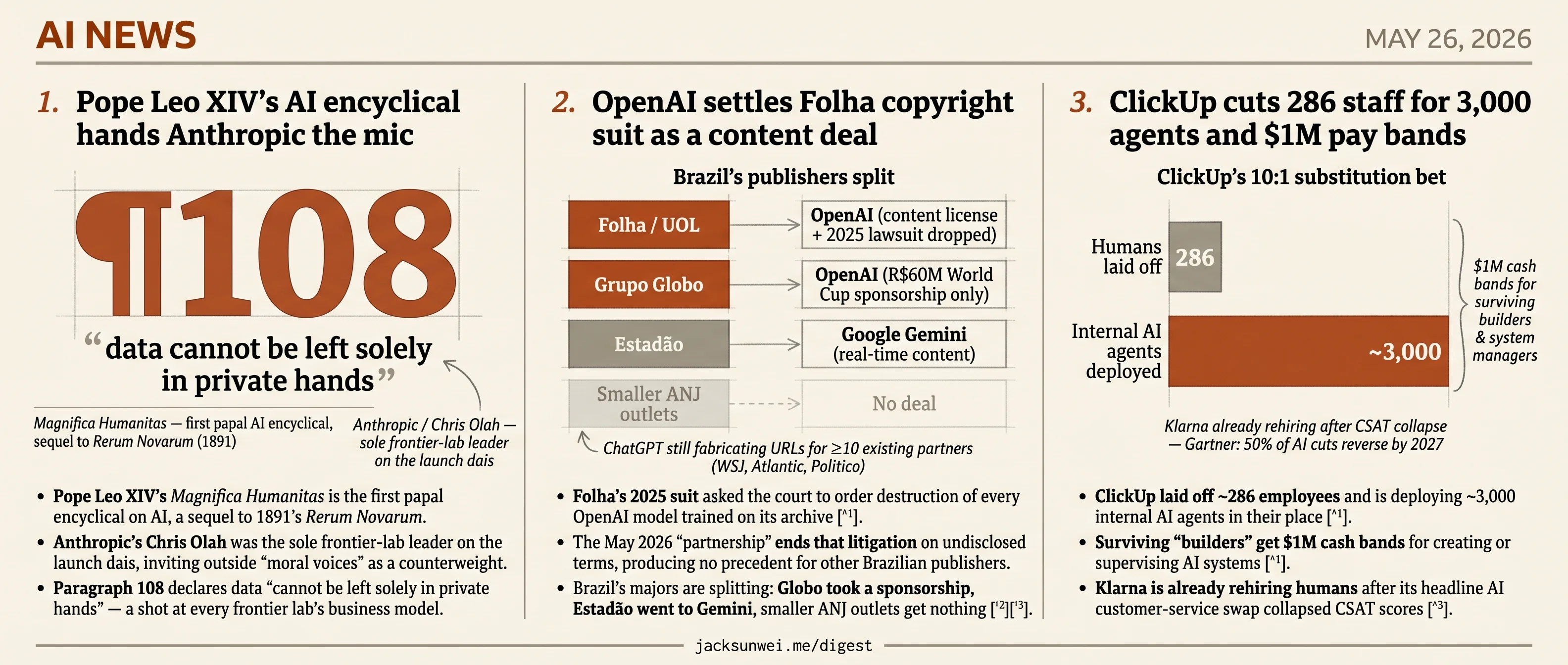
Pope hands Anthropic the dais, Folha suit ends in deal, ClickUp cuts 286
Pope Leo XIV's AI encyclical hands Anthropic the launch dais, Folha's copyright suit becomes a partnership, and ClickUp swaps 286 staff for agents.
Pope hands Anthropic the dais, Folha suit ends in deal, ClickUp cuts 286
TL;DR
- Pope Leo XIV publishes Magnifica Humanitas, the first papal AI encyclical, with Anthropic on the launch dais.
- OpenAI settles Folha’s copyright suit as an undisclosed-terms content partnership, setting no precedent for other Brazilian publishers.
- ClickUp replaces ~286 employees with ~3,000 internal AI agents across the workforce.
- Surviving ClickUp builders get $1M cash bands for creating or supervising AI systems.
- Klarna is rehiring humans after its AI customer-service swap collapsed CSAT scores.
Three loosely connected AI stories today, each turning on an institution outside the labs. Pope Leo XIV’s Magnifica Humanitas — the first papal encyclical on AI, and a deliberate sequel to 1891’s Rerum Novarum — names data concentration as the moral problem, yet the launch dais belonged to Anthropic’s Chris Olah. OpenAI closed out Folha de S.Paulo’s copyright suit not with a verdict but a content partnership, leaving Brazil’s other publishers without precedent and splitting the market three ways.
ClickUp turned the agent-replacement thesis into a payroll line: ~286 staff out, ~3,000 internal agents in, and $1M cash bands dangled at the builders who survived the cut. Klarna’s quiet rehiring after its own AI customer-service swap collapsed CSAT sits in the same story for a reason.
Pope Leo XIV’s AI encyclical hands Anthropic the mic
Source: simon-willison · published 2026-05-25
TL;DR
- Pope Leo XIV’s Magnifica Humanitas is the first papal encyclical on AI, a sequel to 1891’s Rerum Novarum.
- Anthropic’s Chris Olah was the sole frontier-lab leader on the launch dais, inviting outside “moral voices” as a counterweight.
- Paragraph 108 declares data “cannot be left solely in private hands” — a shot at every frontier lab’s business model.
- Traditionalist Catholics call paragraph 192’s “just war is outdated” line the gravest doctrinal rupture in the text.
A Rerum Novarum for the AI era
On May 25 the Vatican released Magnifica Humanitas, Pope Leo XIV’s encyclical on “Safeguarding the Human Person in the Time of Artificial Intelligence.” The framing is the point: Leo took his name from Leo XIII, whose 1891 Rerum Novarum defined Catholic social teaching for the first industrial revolution. The new document is positioned as that letter’s sequel — a 135-year callback that signals the Church intends to treat AI as a labor-and-dignity question, not a technology question.
The text itself is unusually fluent for a papal document. It describes modern systems as “cultivated” rather than “built,” names sycophancy and the illusion of relationship as first-order harms, calls out data-center energy and water use, and warns against delegating decisions about credit, employment and reputation to systems that lack “compassion, mercy, forgiveness.” Simon Willison’s appreciative read captures the tone; the more interesting story is what surrounded the release.
Anthropic shares the dais
Chris Olah, Anthropic’s interpretability lead and co-founder, was the named industry partner on stage. His published remarks concede that “every frontier lab, Anthropic included” operates under commercial, geopolitical and personal pressures that “can conflict with doing the right thing,” and explicitly invite outside moral voices as a counterweight 1. He called potential large-scale labor displacement “a real possibility” and worker support “a moral imperative of historic proportions” 2 — language the encyclical itself echoes.
OpenAI, Google and Microsoft, by contrast, issued only carefully calibrated statements praising the dialogue while avoiding binding commitments. Critics noted that Anthropic alone got the stage, reading it as a “papal stamp of approval” for the lab most heavily branded around safety 3. Olah’s concession that frontier labs face incentives that “can conflict with doing the right thing” cuts both ways: it lends Anthropic credibility precisely by conceding what cynics already believed, while leaving Anthropic as the Vatican’s named partner of choice.
The doctrinal fight tech press missed
The sharpest substantive criticism comes from inside the Church, not from technologists. Michael Pakaluk calls paragraph 192’s declaration that just-war theory is “now outdated” the document’s gravest problem — a “rupture, not a development” with Augustine, Aquinas and the Catechism, made awkward by paragraph 121’s citation of Viktor Frankl, whose witness emerged from camps liberated by the very armed force the encyclical dismisses as “relational poverty” 4. InfoVaticana adds that the text is “empirically and philosophically underargued” in places, carries Latin and hyperlink errors suggesting hurried production, and is conspicuously silent on how wealth is actually created 5.
The buried lede: data as commons
The most operationally radical claim sits in paragraph 108: data is “the product of many contributors” and “ownership of data cannot be left solely in private hands” 6. That sentence directly challenges the business model of every lab that signed on to the dialogue, including the one on the dais. Whether the contradiction is productive tension or successful neutralization is the open question — and the one almost no AI-press coverage has engaged with on its merits. If the next round of EU or national AI regulation cites paragraph 108 by number, this will have been the most consequential moment in AI policy this year. If it doesn’t, the stage-management critique wins.
Further reading
- Anthropic co-founder Chris Olah’s remarks on Pope Leo XIV’s encyclical “Magnifica humanitas” — anthropic-news
- The pope’s AI encyclical isn’t really about AI — techcrunch-ai
- Pope Leo calls for being ‘profoundly human’ in the age of AI — the-verge-ai
- Quoting Corey Quinn — simon-willison
OpenAI settles Folha copyright suit as a content deal
Source: openai-blog · published 2026-05-25
TL;DR
- Folha’s 2025 suit asked the court to order destruction of every OpenAI model trained on its archive 7.
- The May 2026 “partnership” ends that litigation on undisclosed terms, producing no precedent for other Brazilian publishers.
- Brazil’s majors are splitting: Globo took a sponsorship, Estadão went to Gemini, smaller ANJ outlets get nothing 89.
- ChatGPT has fabricated URLs for ≥10 existing partners including WSJ and The Atlantic, despite OpenAI’s clickable-attribution promise 10.
From lawsuit to press release
OpenAI’s announcement frames this as a natural alliance between “professional journalism” and generative AI. It is more accurately a settlement. Folha de S.Paulo sued OpenAI in August 2025 for unfair competition and systematic paywall circumvention, and its original prayer for relief included destroying any model trained on its content 7. Nine months later, that case quietly dissolves into a commercial agreement whose financial value neither side has disclosed.
That matters because Folha’s suit was the most aggressive copyright remedy yet sought by a Brazilian publisher against a frontier lab. Trading it for an undisclosed licensing fee produces no judicial precedent the rest of the market — particularly the smaller regional outlets in ANJ — can lean on the next time their archives surface in a training corpus.
Brazil’s publishers are not aligned
The Brazilian press is not “joining ChatGPT.” Each conglomerate is cutting its own bespoke deal, and they don’t agree on what the deal should look like.
flowchart LR
    F[Folha / UOL] -->|content license<br/>+ lawsuit dropped| O[OpenAI]
    G[Grupo Globo] -->|R$60M World Cup<br/>sponsorship only| O
    E[Estadão] -->|real-time content| GG[Google Gemini]
    S[Smaller ANJ outlets] -.->|no leverage| X[No deal]
Globo signed a R$60M sponsorship tied to the 2026 World Cup broadcasts — a marketing arrangement, explicitly not a training license. Estadão has supplied real-time content to Google Gemini instead 9. Eduardo Tessler, quoted in Meio & Mensagem, argues that bilateral deals like Folha’s “weaken the collective strength of the industry” and let platforms divide and conquer the smaller outlets that lack the legal budget to sue in the first place 8.
The attribution promise has a track record
OpenAI’s framing leans heavily on “rigorous source attribution” and “direct clickable links to original editorial content.” That claim has a documented failure mode. Futurism found ChatGPT inventing URLs for at least ten existing publishing partners — the Wall Street Journal, The Atlantic, Politico among them — routing users to 404s rather than the licensed investigations 10. The bug persists regardless of how long the partnership has been live.
The asymmetry shows up in the crawl data too: nearly 60% of major news sites now block AI crawlers outright, and OpenAI’s bots crawl at high frequency while referring a fraction of the traffic legacy search engines send 11. A “transparency” pitch built on hallucinated citations and a shrinking referral funnel is not the value exchange the press release implies.
The wider buyer’s remorse
Folha and UOL are buying into a model that publishers elsewhere are starting to regret. The Vox Media union formally objected to its parent’s OpenAI deal, and The Atlantic’s own CEO called such arrangements a “devil’s bargain” as model self-sufficiency erodes the leverage licensors thought they had locked in 12. The New York Times and Ziff Davis continue to litigate rather than license, on the theory that any fee on offer vastly understates the damage to the underlying business.
What Folha gained: a payment, an exit from costly litigation, and priority API access. What it gave up: the strongest copyright case Brazilian journalism had — and the option to set the price for everyone else.
ClickUp cuts 286 staff for 3,000 agents and $1M pay bands
Source: techcrunch-ai · published 2026-05-25
TL;DR
- ClickUp laid off ~286 employees and is deploying ~3,000 internal AI agents in their place 13.
- Surviving “builders” get $1M cash bands for creating or supervising AI systems 13.
- Klarna is already rehiring humans after its headline AI customer-service swap collapsed CSAT scores 14.
- Stanford data backs a junior squeeze: developer employment for ages 22–25 is down ~20% from peak while senior roles hold 15.
The substitution pitch
CEO Zeb Evans isn’t hiding the thesis. ClickUp is firing roughly 286 people, standing up about 3,000 internal agents, and reorganizing the remaining workforce into three archetypes — “builders,” “system managers,” and “front-liners” — with cash bands reaching $1M for those who create or supervise AI systems 13. There’s no recession narrative attached. This is an explicit 10:1 agent-to-human bet, timed to IPO margin optics, and that explicitness is what makes it the cleanest public test of the labor-substitution playbook so far.
Why economists aren’t buying it
The macro evidence cuts the other way. Daron Acemoglu projects substitution-first AI deployments will add only ~1% to cumulative GDP over a decade, and argues the headline productivity spikes are a “statistical mirage” — output-per-worker rises mechanically when you fire the denominator 16. Oxford Economics goes harder, concluding firms aren’t yet replacing labor with AI at any meaningful scale and that “AI washing” is being used to justify cost-cutting and the unwinding of pandemic-era over-hiring 17.
Oxford Economics concludes firms are not yet replacing human labor with AI at a significant scale — and that “AI washing” is dressing up routine cost-cutting as transformation. 17
ClickUp’s tell is that Evans tied the move to margin structure, not to a capability demonstration. Nobody has shown the 3,000 agents doing the work of the 286 people.
The Klarna problem
The strongest in-the-wild counterexample is Klarna. After loudly replacing large swaths of customer service with OpenAI, the company began rebuilding parts of its human support team in early 2026 as customer satisfaction slid. Gartner now expects 50% of AI-driven workforce cuts to reverse by 2027 14. That’s not a forecast about whether agents work — it’s a forecast about whether the org charts that fired humans first survive contact with customers.
ClickUp brings an extra wrinkle: former engineers on r/clickup describe a product carrying severe technical debt, with simple views consuming over 1.5GB of RAM and the CEO’s “never-ending new ‘brilliant’ ideas” displacing bug fixes 18. Layering 3,000 agents onto an unstable substrate is a different bet than layering them onto a clean one.
The one signal that does corroborate
Stanford’s Digital Economy Lab found employment for software developers aged 22–25 has fallen nearly 20% from peak, while senior roles stayed flat or grew 15. ClickUp’s restructure — gutting mid- and junior-tier engineering in favor of a small “builder” elite on million-dollar bands — is the org-chart instantiation of that macro pattern. Whether the agents actually do the work or not, the entry-level rung is the one getting pulled.
What’s actually being tested
Treat ClickUp less as proof of an agentic future than as a falsifiable experiment. If margins hold through IPO and product quality doesn’t degrade, the substitution thesis gets its first clean win. If CSAT, bug counts, or churn move the way Klarna’s did, Gartner’s 50%-reversal number stops looking aggressive. Either way, the bill arrives on a public timetable now.
Round-ups
Startup Battlefield 200 applications close May 27
Source: techcrunch-ai
TechCrunch’s Startup Battlefield 200 stops accepting applications and nominations on May 27. Selected founders pitch at Disrupt 2026 for a $100,000 prize, plus VC introductions, press coverage, and a slot on the global startup competition’s main stage.
Disrupt 2026 early-bird pricing ends May 29
Source: techcrunch-ai
Early-bird passes to TechCrunch Disrupt 2026 in San Francisco close at 11:59 p.m. PT on May 29, with savings of up to $410 against standard rates. Prices step up the following day across all attendee tiers.
Footnotes
-
Anthropic — Chris Olah Vatican remarks — https://www.anthropic.com/news/chris-olah-pope-leo-encyclical
↩Every frontier lab, Anthropic included, operates under commercial competition, geopolitical stress, and personal ambition that can conflict with doing the right thing; the AI community needs informed critics and moral voices from outside the industry.
-
Forbes — Alicia Park — https://www.forbes.com/sites/aliciapark/2026/05/25/anthropic-billionaire-cofounder-joins-pope-leo-warns-ai-job-losses-will-spark-moral-imperative-of-historic-proportions/
↩Olah described support of workers displaced by AI as a ‘moral imperative of historic proportions,’ calling potential large-scale labor displacement ‘a real possibility’ rather than a distant theoretical risk.
-
Via.bible — ‘When Silicon Valley meets Rome’ — https://www.via.bible/en/magnifica-humanitas-when-silicon-valley-meets-rome-and-doesnt-know-what-to-say/
↩OpenAI, Google and Microsoft issued carefully calibrated statements praising the dialogue but avoided binding commitments; Anthropic alone got the stage, which critics read as a ‘papal stamp of approval’ for the lab most heavily branded around safety.
-
Michael Pakaluk Substack — https://michaeljosephpakaluk.substack.com/p/special-post-on-magnifica-humanitas
↩Paragraph 192’s flat declaration that ‘just war’ theory is ‘now outdated’ is the document’s gravest problem — a rupture, not a development, that contradicts Augustine, Aquinas and the Catechism; paragraph 121 even cites Viktor Frankl, whose witness emerged from camps liberated by the very armed force the encyclical dismisses as ‘relational poverty.’
-
InfoVaticana — ‘Thematic dispersion of Magnifica Humanitas’ — https://infovaticana.com/en/2026/05/26/the-thematic-dispersion-of-magnifica-humanitas/
↩The text is empirically and philosophically underargued in places, contains Latin and hyperlink errors suggesting hurried production, and is silent on how wealth is actually created — a ‘silence’ that lay readers have dismissed as unactionable moralizing.
-
Diakonos — Magnifica Humanitas analysis — https://www.diakonos.be/magnifica-humanitas-what-unites-the-mathematician-pope-to-the-ai-technocrats-and-what-divides-them/
↩The encyclical’s call to treat data as a ‘common or shared good’ and its insistence that ‘ownership of data cannot be left solely in private hands’ directly challenges the foundational business models of the labs the Vatican simultaneously platformed.
-
StartSe (Brazilian tech outlet) — https://www.startse.com/artigos/folha-de-spaulo-x-openai-nos-acessamos-o-processo-e-preparamos-um-resumo-de-tudo-o-que-voce-precisa-saber/
↩ ↩2Folha accused OpenAI of ‘unfair competition’ and copyright infringement, alleging the company systematically bypassed paywalls and diverted readers by reproducing full articles — and originally sought destruction of models trained on its content.
-
Meio & Mensagem — https://www.meioemensagem.com.br/midia/folha-e-uol-fecham-acordo-de-conteudo-com-openai
↩ ↩2Expert Eduardo Tessler warned that when major outlets like Folha strike private agreements, it weakens the collective strength of the industry, allowing tech giants to ‘divide and conquer’ publishers and leaving smaller regional outlets without leverage or compensation.
-
StartupHub.ai — https://www.startuphub.ai/ai-news/artificial-intelligence/2026/openai-inks-brazil-media-deal
↩ ↩2In April 2026 Grupo Globo signed an unprecedented R$60 million sponsorship deal with OpenAI tied to the 2026 World Cup broadcasts — a marketing arrangement rather than a content-training license — while Estadão has instead supplied real-time content to Google Gemini.
-
Futurism — https://futurism.com/the-byte/chatgpt-hallucinating-fake-links-business-insider
↩ ↩2ChatGPT produced fabricated URLs for at least ten major publishing partners including the Wall Street Journal, The Atlantic, and Politico, often leading users to 404 errors instead of the reported investigations — a failure that persists regardless of how long a partnership has been active.
-
Will Scott — AI Licensing Deals & Search Visibility (Oct 2025) — https://willscott.me/2025/10/04/ai-licensing-deals-search-visibility-in-2025/
↩Nearly 60% of major news sites block AI crawlers by 2026, and OpenAI bots crawl at high frequencies while referring significantly less traffic than legacy search engines — effectively forcing a pay-to-play landscape.
-
Mashable — https://mashable.com/article/all-the-media-companies-that-have-licensing-deals-with-openai-so-far
↩Vox Media’s union formally objected to its company’s OpenAI partnership, and The Atlantic’s own CEO called such deals a ‘devil’s bargain’ as the value of content licensing plummets while AI models become more self-sufficient.
-
The Next Web — Evans’ ‘100x org’ memo coverage — https://thenextweb.com/news/clickup-layoffs-22-percent-ai-100x-org-million-salary
↩ ↩2 ↩3ClickUp introduced new salary bands reaching up to $1 million in annual cash compensation… available to ‘builders’ and ‘system managers’ who demonstrate ‘outsized impact’ by creating or supervising AI systems
-
Neomanex AI customer service report (Klarna rehiring) — https://neomanex.com/posts/ai-customer-service-statistics
↩ ↩2By early 2026, Klarna reportedly began rebuilding parts of its human customer service team after a sharp decline in customer satisfaction (CSAT) scores… Gartner predicts that 50% of companies that cut staff due to AI will be forced to rehire by 2027
-
CBS News — entry-level hiring data — https://www.cbsnews.com/news/ai-layoffs-hiring-entry-level-workers/
↩ ↩2A Stanford Digital Economy Lab analysis found that employment for software developers aged 22–25 fell nearly 20% from its peak, while senior roles remained stable or grew
-
The Guardian — Acemoglu critique — https://www.theguardian.com/commentisfree/2026/may/19/billionaires-ai-complacency-resistance
↩focusing on ‘labor substitution’ (replacing workers) rather than ‘augmentation’ will lead to disappointing GDP gains of only 1% over the next decade… recent productivity spikes attributed to AI may actually be a ‘statistical mirage’ caused by mass layoffs
-
InformationWeek — Oxford Economics ‘AI washing’ — https://www.informationweek.com/it-staffing-careers/2026-tech-company-layoffs
↩ ↩2Oxford Economics recently concluded that firms are not yet replacing human labor with AI at a significant scale, suggesting instead that ‘AI Washing’ is being used to justify routine cost-cutting and the correction of pandemic-era over-hiring
-
r/clickup ‘mass lay off’ thread (former employees) — https://www.reddit.com/r/clickup/comments/1tjtpfy/mass_lay_off/
↩the product suffering from immense technical debt that has never been fully addressed… the CEO’s ‘never-ending new “brilliant” ideas’ often took precedence over fixing core bugs, leading to performance issues where simple views could consume over 1.5GB of RAM