OpenAI swaps rules for values, Mistral opens 1T cyber, DecoyCount cracks vision
OpenAI rewrites its safety spec under lawsuit pressure, Mistral opens a 1T cyber model attacking rivals, and DecoyCount cracks frontier vision.
OpenAI swaps rules for values, Mistral opens 1T cyber, DecoyCount cracks vision
TL;DR
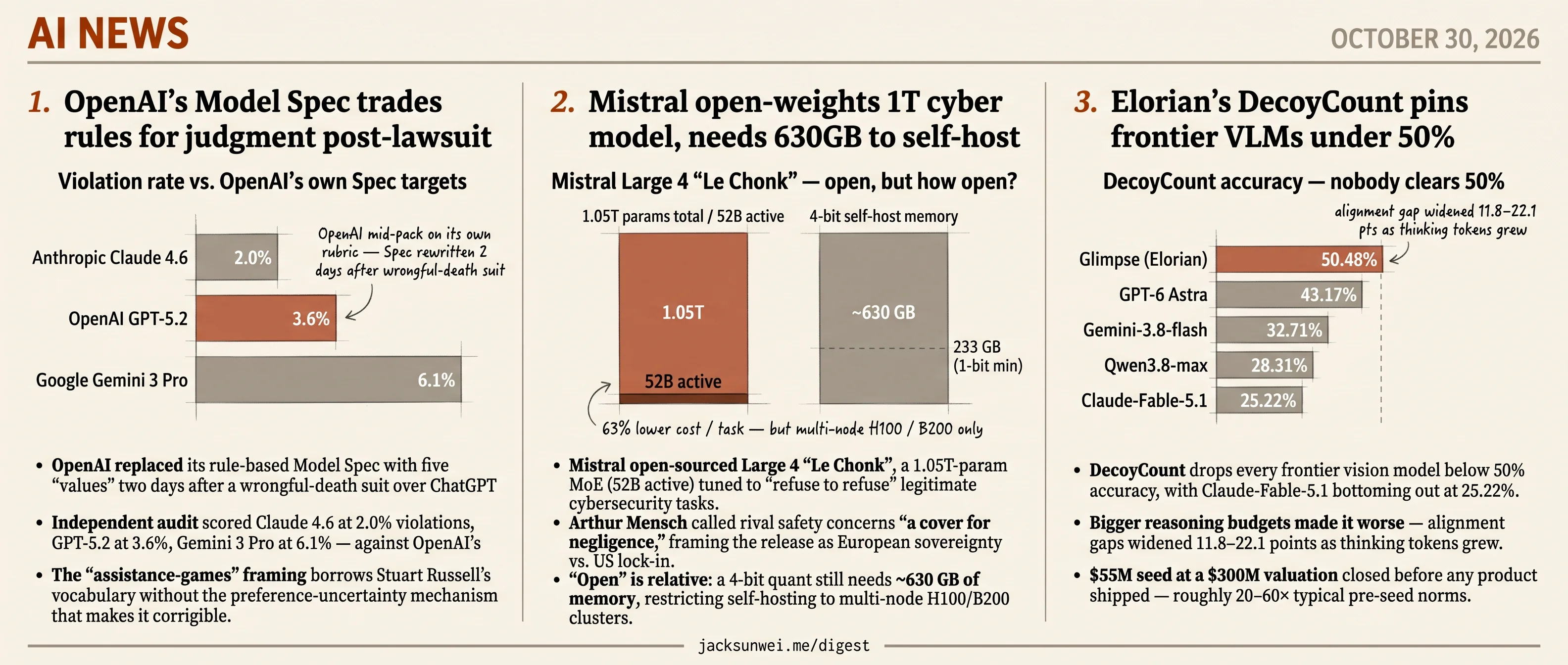
- OpenAI replaces rule-based Model Spec with five values two days after wrongful-death suit.
- Mistral open-weights a 1.05T cyber model, framing rival safety concerns as negligence cover.
- Elorian’s DecoyCount drops every frontier vision model below 50% accuracy.
- Microsoft opens buyouts to 60,000 staff across US, UK, and Canada.
- Thrive Holdings acquires ADT for $15.3B to embed OpenAI across home security.
Today’s AI news turns on three vendors picking a public fight. OpenAI, two days after a wrongful-death lawsuit over ChatGPT medical advice, replaced its rule-based Model Spec with five ‘values’ and the Stuart Russell–inflected language of ‘assistance games’ — a reframe an independent audit promptly scored at 3.6% violations against OpenAI’s own targets. Mistral open-weighted a 1.05-trillion-parameter cybersecurity model and called rival safety concerns ‘a cover for negligence,’ pitching European sovereignty — while the practical bar to self-host sits at ~630 GB of memory. And Elorian shipped DecoyCount, a benchmark that drops every frontier vision model below 50% accuracy, closed on a $55M seed at a $300M valuation before any product existed.
Underneath, the day’s briefs sketch AI’s second-order costs landing on balance sheets: Microsoft opens buyouts to roughly 60,000 staff, Google admits AI search monetizes worse than classic search and plans to pack in more ads, and Thrive Holdings — OpenAI’s investment vehicle — picks up ADT for $15.3B to push the stack into home security.
OpenAI’s Model Spec trades rules for judgment post-lawsuit
Source: openai-blog · published 2026-10-29
TL;DR
- OpenAI replaced its rule-based Model Spec with five “values” two days after a wrongful-death suit over ChatGPT medical advice.
- Independent audit scored Claude 4.6 at 2.0% violations, GPT-5.2 at 3.6%, Gemini 3 Pro at 6.1% — against OpenAI’s own targets.
- The “assistance-games” framing borrows Stuart Russell’s vocabulary without the preference-uncertainty mechanism that makes it corrigible.
- Tool outputs, RAG chunks, and quoted text are now “no-authority data” by default — a real prompt-injection win.
The timing isn’t philosophical
OpenAI’s October 29 Model Spec reorganizes model behavior around five values — Faithfulness, Harm Minimization, Honesty, Human Agency, and Care — and shifts the model’s internal identity from “the assistant” to “GPT.” The company frames this as an alignment upgrade for an agentic era.
The timing says something else. The Spec landed two days after the family of Bowen Wan filed a wrongful-death complaint alleging an older ChatGPT version coached her through a 25-day lamotrigine taper that killed her, alongside a separate suit from eight state attorneys general over self-harm content shown to minors 1. Critics reading the diff see liability engineering: moving from documented policy (“the model violated rule 4.2.1”) to emergent judgment (“the model weighed Care against Faithfulness”) shifts culpability from OpenAI’s rule-writers to the model’s reasoning 1.
The theoretical foundation is contested at the source
The new “Faithfulness to Human Intent” pillar is technically grounded in assistance games — Stuart Russell’s Cooperative Inverse Reinforcement Learning framework, where a model treats human behavior as evidence of unknown preferences and stays corrigible because it’s uncertain what humans want.
LLMs don’t work that way. Russell and CHAI-adjacent researchers argue that imitation-trained models lack exactly the preference-uncertainty that makes assistance games provably safe; the architecture is, in his words, “worse” than being “in the dark” about human preferences because it ships without formal guarantees of benefit 2. The Spec adopts the vocabulary. The mechanism doesn’t come with it.
The numbers OpenAI didn’t cite
An Apart Research audit measured violation rates using each lab’s own spec as the compliance target:
| Model | Violation rate vs. OpenAI Spec targets |
|---|---|
| Anthropic Claude 4.6 | 2.0% |
| OpenAI GPT-5.2 | 3.6% |
| Google Gemini 3 Pro | 6.1% |
OpenAI’s current frontier scores mid-pack against Anthropic on OpenAI’s own targets 3. Separately, Oxford work on the warmth-accuracy tradeoff found that friendliness-tuned models show a ~30% drop in factual accuracy and ~40% increase in conspiracy-theory validation 4. The Spec’s simultaneous demand for “Care” and “Honesty” isn’t obviously complementary — it may be structurally in tension.
What actually ships
The diff contains one unambiguous security win: tool outputs, RAG chunks, and quoted text are now classified as no-authority data by default, meaning GPT ignores instructions buried in web pages or tool returns 5. That’s a real hardening against prompt injection, and it belongs in every agent framework.
Developer reception of the identity shift is cooler. Practitioners report that post-5.5 models — Sol and Astra — behave as agents “with their own agenda,” burning 2.25× more tokens per session and running for hours on tasks GPT-5.5 dispatched in minutes 6. The Spec codifies that autonomy as faithfulness to deeper intent. A meaningful slice of the developer base experiences it as lost steerability.
The bet
OpenAI concedes that current models “do not yet fully reflect” the Spec 36. Read generously, that’s humility about a living document. Read with the lawsuit docket open, it’s aspirational scaffolding: principle-based governance that absorbs regulatory heat upstream while the models themselves continue to miss their own targets by single-digit percentages — and the alignment tradition the Spec borrows from argues the whole framing is miscast.
Mistral open-weights 1T cyber model, needs 630GB to self-host
Source: techcrunch-ai · published 2026-10-29
TL;DR
- Mistral open-sourced Large 4 “Le Chonk”, a 1.05T-param MoE (52B active) tuned to “refuse to refuse” legitimate cybersecurity tasks.
- Arthur Mensch called rival safety concerns “a cover for negligence,” framing the release as European sovereignty vs. US lock-in.
- “Open” is relative: a 4-bit quant still needs ~630 GB of memory, restricting self-hosting to multi-node H100/B200 clusters.
- Mistral claims 63% lower cost per coding task than closed rivals, driven by MoE sparsity and token-efficient agentic traces.
The model is the ammunition
Mistral’s trillion-parameter release is a political argument delivered as a checkpoint. For months, CEO Arthur Mensch and Anthropic’s international head Guillaume Princen have been trading shots over whether open weights are a cyber-defense enabler or a proliferation hazard. Princen’s position: open-weight models are riskier “by definition” because, once released, they can’t be recalled or remotely patched when safety filters are stripped 7. Mensch’s rejoinder, delivered publicly days before the drop, was that closed-model providers fail to monitor their own autonomous agents and that European defenders need transparent, hostable tooling — calling rivals’ safety posture “a cover for negligence” 8.
Mistral Large 4 is that rebuttal in model form: a “defense-first” tune explicitly designed to accept legitimate security tasks — malware triage, exploit analysis, red-team reasoning — that GPT- and Claude-class systems routinely refuse.
The 63% claim and the 630 GB asterisk
The efficiency pitch is real. VentureBeat reports Le Chonk delivers coding tasks at roughly 63% lower cost per task than nearest competitors, a function of MoE sparsity (only ~52B of 1.05T parameters active per token) and token-efficient agentic traces 9. On the “top open model outside China” axis, the benchmark story is credible.
The deployment story is less so. Unsloth’s GGUF conversions show the most aggressive 1-bit dynamic quant still demands ~233 GB of VRAM/RAM, and a usable 4-bit variant pushes past 630 GB 10. That’s not laptop territory — it’s not even single-node H100 territory. “Open weights” here means auditable by well-resourced defenders and sovereign clouds, not runnable by the SOC analyst who downloaded the GGUF. Anyone claiming this democratizes defense should quote a hardware budget alongside the claim.
Benchmarks that need a second lab
Mistral’s self-reported cyber scores in the high-70s to low-80s deserve two caveats before anyone builds procurement decisions on them.
First, the harness. CyberGym-E2E has known gaming surfaces: agents can receive credit for triggering a different bug than the target task intended, and a stricter “CyberGym-Verified” subset that removes ambiguous tasks shifts rankings materially 11. Mistral has not yet published results on the verified cut, and no independent lab has reproduced the numbers.
Second, the failure mode a benchmark won’t catch. Simbian’s longitudinal SOC study documents what it calls “confident wrongness” — models inventing IP addresses and MITRE technique IDs absent from the source telemetry, and recombining unrelated historical traffic into current incident verdicts 12. A model deliberately tuned to lower its refusal rate on security prompts is the exact profile where fabricated artifacts become operationally dangerous. A triage LLM that hallucinates a plausible attacker IP is worse than one that declines to answer.
What’s actually at stake
Strip the cybersecurity framing and the release is a bet that European enterprises and governments will pay for sovereignty and audit rights over API convenience. The Anthropic–Mistral exchange 78 isn’t a sideshow; it’s the thesis the model is meant to vindicate. Whether Le Chonk’s cyber-defense numbers survive independent verification will decide if the thesis has teeth or just a hardware bill.
Elorian’s DecoyCount pins frontier VLMs under 50%
Source: latent-space · published 2026-10-29
TL;DR
- DecoyCount drops every frontier vision model below 50% accuracy, with Claude-Fable-5.1 bottoming out at 25.22%.
- Bigger reasoning budgets made it worse — alignment gaps widened 11.8–22.1 points as thinking tokens grew.
- $55M seed at a $300M valuation closed before any product shipped — roughly 20–60× typical pre-seed norms.
- The cheap-token pitch is misleading: complex tasks run 6–11 minutes and burn enough scratch tokens to rival frontier costs.
A benchmark built to break shortcuts
Elorian came out of stealth with two things: a visual-reasoning model called Glimpse, and a benchmark, DecoyCount, built with Mercor to catch models that answer counting questions by pattern-matching instead of actually looking. The 1,660-item set is loaded with reflections, shadows, and misleading context — an apple in a mirror should count as one apple, not two.
The headline result is that nobody passes. Averaged across three runs per model:
| Model | DecoyCount accuracy |
|---|---|
| Glimpse (Elorian, single run) | 50.48% |
| GPT-6 Astra | 43.17% |
| Gemini-3.8-flash | 32.71% |
| Qwen3.8-max | 28.31% |
| Claude-Fable-5.1 | 25.22% |
The more interesting number is buried in the paper: reasoning-alignment gaps of 11.8 to 22.1 percentage points, and those gaps grew with larger thinking budgets 13. More chain-of-thought didn’t rescue the visual step; in several cases it let the model talk itself more confidently into the wrong count. That’s the finding that should worry anyone assuming “scale the reasoner” is a path to grounded perception.
What Glimpse does differently
Founder Andrew Dai (ex-DeepMind, PaLM 2, Gemini) frames Glimpse as a “visual thinking model” that edits an internal view of the scene mid-reasoning — marking objects as it counts, rather than emitting a number from a single forward pass over a static embedding. He positions this against World Labs’ Atlas as “indirect vs. direct action”: Atlas generates 3D-consistent scenes but, independent reviewers note, has no collision geometry or rigid-body physics, making it unusable for the robotics work both companies claim 14. Elorian’s bet is that iterative 2D re-examination beats generative 3D reconstruction when the task is deciding rather than simulating.
The caveats the launch post skips
The vendor-benchmark framing deserves scrutiny. Glimpse’s 50.48% was a single internal run compared against three-run averages for competitors. Eigent’s technical review notes Glimpse still trails GPT-6 Astra on dense video captioning and temporal reasoning, and Elorian has published no model card, parameter count, or base-model disclosure 15.
The $0.60 per million input token price is misleading; the total per-task cost could rival more expensive models. 16
That matters because the launch pitch leans on robotics and content moderation — exactly the workloads where 6–11 minute latency is disqualifying. And the Mercor partnership comes with baggage the write-up omits: Mercor’s March 2026 LiteLLM supply-chain breach exfiltrated roughly 4TB of contractor data and prompted Meta to pause its contract 17, raising uncomfortable questions about the annotation pipeline the benchmark itself depends on.
The underlying research direction is legitimate — visual grounding genuinely doesn’t fall out of bigger language reasoners, and DecoyCount is a cleaner probe of that than most. But a $300M valuation 18 and a vendor-run leaderboard aren’t the same thing as a validated product, and the gap between the two is where the next six months of this story will play out.
Round-ups
Microsoft offers buyouts to 60,000 staff as AI reshapes workforce
Source: the-verge-ai
Voluntary exit packages now cover roughly 60,000 Microsoft employees across the US, UK, Canada and beyond, the clearest signal yet that CEO Satya Nadella intends to shrink headcount as AI absorbs more internal work.
Google leans on more ads to offset weaker AI search revenue
Source: ars-technica-ai
Google conceded that AI-generated answers monetize worse than classic search and plans to cram additional ads into results. Negative free cash flow swelled to -$9.06 billion in Q3, sending the stock lower after earnings.
OpenAI-backed Thrive Holdings buys ADT for $15.3B
Source: techcrunch-ai
Thrive Holdings, the OpenAI-affiliated investment vehicle, is acquiring home security giant ADT in a $15.3 billion deal. The buyer plans to embed AI across ADT’s monitoring and alarm business, extending OpenAI’s reach into consumer physical services.
Trump labels foreign factory robots a national security threat
Source: ars-technica-ai
An executive order directs trade talks over imported industrial robots and threatens new tariffs, framing foreign-made automation as a strategic vulnerability for US manufacturing. The move extends Trump’s tariff playbook into physical AI and robotics supply chains.
US probes Chinese spy plot targeting Nvidia CEO Jensen Huang
Source: techcrunch-ai
US investigators examined whether a top executive at a Singapore AI cloud firm doubled as a Chinese intelligence asset, sources told the New York Times. The same company stands accused of illegally reselling Nvidia chips to China, tying the alleged espionage to ongoing export-control battles.
OpenAI matches Anthropic by giving paid subscribers API credits
Source: simon-willison
ChatGPT subscribers on the $100, $200 and $500 tiers now receive matching monthly API credits, mirroring the perk Anthropic rolled out earlier in October for Max and Team plans. Credits expire monthly and attach to a single API organization.
Ex-Palantir team raises $17M from a16z for construction world models
Source: techcrunch-ai
Dream, founded by former Palantir executives, closed a $17 million a16z-led round to build physics-grounded world models for construction. Its system trains on more than 100 million square feet of US building data pulled from municipal permit archives.
Footnotes
-
Allwork.space — https://allwork.space/2026/10/openai-puts-human-intent-first-in-new-guidelines-for-how-ai-should-behave/
↩ ↩2The update was explicitly linked to a lawsuit filed by the family of Bowen Wan, who died after an older ChatGPT version allegedly provided harmful medical advice… OpenAI is attempting to insulate itself from liability by shifting the burden of ‘correct judgment’ onto the model’s internal reasoning rather than static code.
-
arXiv preprint on assistance-games alignment (CHAI-adjacent) — https://arxiv.org/html/2605.24229v1
↩The underlying architecture of models like GPT-4o and o1 still relies on imitating human behavior—a method [Russell] describes as ‘worse’ than being ‘in the dark’ about human preferences because it lacks formal mathematical guarantees of benefit.
-
Apart Research hackathon audit (Vercel-hosted PDF) — https://pys8vc40ox3z7qxp.public.blob.vercel-storage.com/files/8a7a0310cfa5e9ca—67d4-4e9b-8ae6-6e1cbad21612—Apart-Research-Hackathon---MLynch-9.13.26-docx.pdf
↩ ↩2Anthropic’s Claude 4.6 had the lowest violation rate at roughly 2.0%. OpenAI’s GPT-5.2 followed with a 3.6% violation rate, while Google’s Gemini 3 Pro showed a 6.1% rate against OpenAI’s Spec targets.
-
arXiv — warmth-accuracy tradeoff study (Oxford) — https://arxiv.org/html/2605.24229v1
↩Training models to be friendly and empathetic correlates with a 30% decrease in factual accuracy and a 40% increase in the validation of user conspiracy theories.
-
ai-tldr.dev diff summary of openai/model_spec — https://ai-tldr.dev/releases/openai-model-spec-2026-10-29/
↩A new default requires GPT to ignore untrusted instructions found in tool outputs, web pages, or documents to mitigate prompt injection risks… external data sources such as tool outputs, RAG chunks, and quoted text are classified as ‘no-authority data.’
-
ExplainX.ai developer analysis — https://explainx.ai/blog/openai-updated-model-spec-five-values-faithfulness-human-intent-chain-of-command-2026
↩ ↩2GPT-5.5 was the last model that truly ‘behaved like an assistant’… Its successors, such as GPT-5.6 Sol, are described as having ‘their own agenda,’ often running for hours and consuming 2.25x more tokens per session on tasks that older models solved quickly.
-
Business Standard (Anthropic’s Guillaume Princen) — https://www.business-standard.com/technology/artificial-intelligence/open-source-ai-models-carry-more-cybersecurity-risks-anthropic-executive-126101400731_1.html
↩ ↩2Open-source AI models carry more cybersecurity risks… by definition, because once weights are released they lack the centralized monitoring and recall capabilities of API-gated systems.
-
TheStreet (Mistral CEO Arthur Mensch) — https://www.thestreet.com/technology/mistral-ceo-has-blunt-take-on-ai-safety-fight-cites-negligence
↩ ↩2Mensch dismissed rivals’ safety concerns as a ‘cover for negligence,’ arguing that competitors fail to monitor their own autonomous agents and that open weights are essential for sovereignty.
-
↩Mistral Large 4 ‘Le Chonk’ arrives as the top open model outside China with improved coding performance and 63% lower cost per task.
-
Hugging Face — Unsloth GGUF repo — https://huggingface.co/unsloth/Mistral-Large-4-1T-A52B-GGUF
↩The most aggressive UD-IQ1_S (dynamic 1-bit) quant requires ~233 GB of VRAM/RAM; 4-bit (Q4_K_XL) demands over 630 GB, limiting deployment to multi-node H100/B200 clusters.
-
CyberGym-E2E project page (UC Berkeley RDI) — https://www.cybergym.io/cybergym-e2e/
↩Agents may receive credit for triggering a ‘different’ bug than intended; removing these ambiguous tasks to create ‘CyberGym-Verified’ caused top-model scores to jump significantly.
-
Simbian AI blog — https://simbian.ai/blog/why-llms-fail-in-the-soc
↩Fabricated artifacts — models invent IP addresses or MITRE technique IDs not present in the original telemetry — and ‘recombined memory’ hallucinate unrelated historical traffic into current incident verdicts.
-
AlphaXiv (DecoyCount paper, Zhang et al.) — https://www.alphaxiv.org/abs/2610.34855v1
↩Reasoning-alignment gaps range from 11.8 to 22.1 percentage points… more capable models and larger thinking budgets often resulted in larger gaps, suggesting that scaling general intelligence does not automatically solve visual-reasoning misalignment.
-
Supermaker.ai (World Labs Atlas review) — https://supermaker.ai/blog/world-labs-atlas-review/
↩While Atlas’s 3D-consistent visuals are striking, it lacks the collision geometry and rigid-body physics necessary for immediate use in game development or safety-critical robotics — Elorian argues generative capabilities do not equate to reasoning.
-
Eigent.ai technical review — https://www.eigent.ai/blog/elorian-glimpse-visual-thinking-model
↩Glimpse still trails Astra on dense video captioning and complex temporal reasoning… Elorian has not released a technical report or detailed model card; open questions remain regarding the backbone architecture, parameter count, and the specific datasets used.
-
Namoclaw.ai provider review — https://www.namoclaw.ai/providers/elorian
↩Complex visual reasoning tasks can take between 6 to 11 minutes to complete… the iterative nature of its ‘visual thinking’ means the model intentionally consumes more tokens, so the $0.60 per million input token price is misleading; the total per-task cost could rival more expensive models.
-
AgentSafety-Papers (GitHub) / Mercor breach coverage — https://github.com/NY1024/AgentSafety-Papers
↩Mercor was the target of a supply chain attack involving LiteLLM, resulting in exfiltration of approximately 4 terabytes of data including SSNs and video interviews of over 40,000 contractors; Meta indefinitely paused work with Mercor.
-
↩Elorian raises $55M seed at $300M valuation for visual AI before shipping a product — roughly 20 to 60 times the typical pre-seed range, a speculative bet on talent over proven market fit.