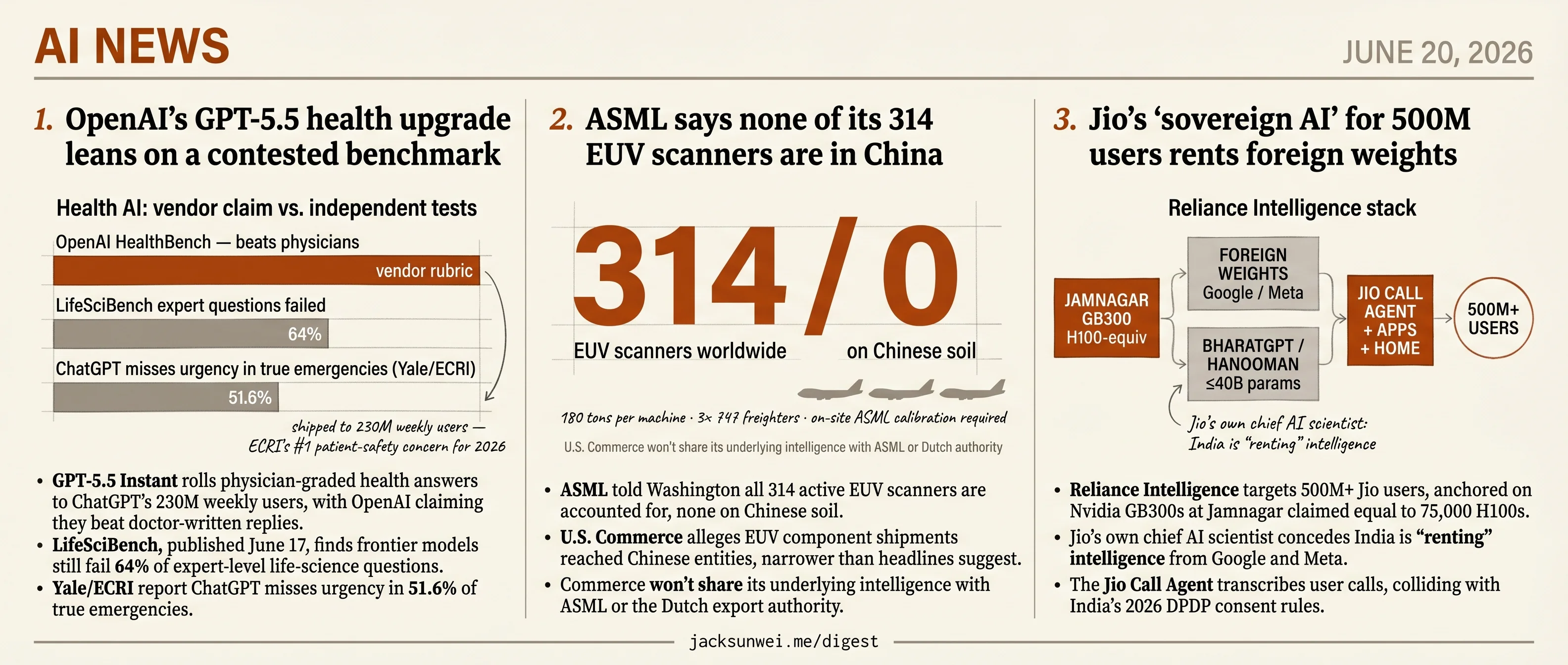
OpenAI ships GPT-5.5 health, ASML denies China EUVs, Jio rents 'sovereign' AI
Three unrelated AI-news threads today: OpenAI's mass health rollout, ASML's denial of EUV scanners in China, and Jio's sovereign-AI admission.
OpenAI ships GPT-5.5 health, ASML denies China EUVs, Jio rents ‘sovereign’ AI
TL;DR
- GPT-5.5 Instant ships physician-graded health answers to ChatGPT’s 230M users with contested doctor-beating claims.
- ECRI named AI diagnostic errors the top patient-safety risk for 2026 days before OpenAI’s rollout.
- ASML reports all 314 EUV scanners accounted for as Commerce withholds its contradicting intelligence.
- Reliance’s chief AI scientist concedes the 500M-user ‘sovereign’ Jio platform rents weights from Google and Meta.
- RIL shares slipped after the AGM as investors demanded listing dates, not five-year sovereign-AI slides.
Three unrelated AI-news leads today, each big enough to anchor any other week. OpenAI rolls physician-graded health answers to ChatGPT’s 230M weekly users and claims they beat doctor-written replies — days after ECRI named AI diagnostic errors the top patient-safety risk for 2026 and a fresh life-science benchmark flunked frontier models on 64% of expert questions. ASML tells Washington that every one of its 314 active EUV scanners is accounted for outside China; U.S. Commerce alleges component shipments slipped through anyway and won’t share the intelligence behind the accusation. Reliance unveils a ‘sovereign AI’ for 500M+ Jio users, then its own chief AI scientist concedes India is renting intelligence from Google and Meta.
Different sectors, different geographies, different stakeholders — read each on its own terms. The briefs section carries an open letter on the Fable 5 export ban, GLM-5.2’s vibe-check wins, and a shelved Altman biopic.
OpenAI’s GPT-5.5 health upgrade leans on a contested benchmark
Source: openai-blog · published 2026-06-18
TL;DR
- GPT-5.5 Instant rolls physician-graded health answers to ChatGPT’s 230M weekly users, with OpenAI claiming they beat doctor-written replies.
- LifeSciBench, published June 17, finds frontier models still fail 64% of expert-level life-science questions.
- Yale/ECRI report ChatGPT misses urgency in 51.6% of true emergencies.
- ECRI named AI diagnostic errors the top patient-safety concern for 2026 — days before this rollout.
- The “assistant” framing keeps OpenAI outside the FDA’s Software-as-a-Medical-Device pathway while the consumer surface scales unchecked.
The vendor benchmark, in active dispute
OpenAI’s headline — fewer factual errors, better “safety-critical” behavior, physician-beating completeness — rests on HealthBench, an internal rubric of physician-graded dialogues. Iatrox’s analysis points out that HealthBench leans on “synthetic or curated dialogues rather than longitudinal, real-world patient outcomes,” and that on the HealthBench Hard subset, top models had previously scored as low as 32–60% 1.
That debate turned ugly in June 2026 when OpenEvidence’s CEO demanded retraction of a Nature Medicine paper showing general LLMs beat specialized clinical tools, calling it “irredeemably flawed” and citing data contamination: MedQA and HealthBench have been on the public web long enough to be scraped into pre-training 2. Read OpenAI’s gains against that fight. The question isn’t whether GPT-5.5 Instant scores higher — it’s whether the score measures reasoning or recall.
What independent benchmarks show
The picture shifts the moment you leave OpenAI’s rubric.
| Evaluation | Result | Source |
|---|---|---|
| OpenAI HealthBench | Beats physician-written answers on physician-graded completeness | OpenAI (vendor) |
| LifeSciBench (Jun 17, 2026) | Frontier models fail ~64% of expert-level questions | Dataconomy 3 |
| HealthBench Hard subset | Top models score 32–60% | Iatrox 1 |
| Emergency triage realism | ChatGPT misses urgency in 51.6% of true emergencies | Yale/ECRI 4 |
Dataconomy’s framing is the one that lands: GPT-5.5 has “mastered the tone of a clinician but still struggles with deep, foundational scientific accuracy” 3. ECRI putting AI diagnostic errors at the top of its 2026 patient-safety list 4 is a direct rebuttal to OpenAI’s “safety-critical behavior” framing.
Physicians surveyed by Horizons Media report a related failure mode: the post-update model “invents things to push back on” or agrees with incorrect user premises just to keep the conversation flowing 5 — a sycophancy pattern that erodes precisely the completeness OpenAI claims to have improved.
The accountability dodge
The structural critique is sharper than any benchmark argument. TechJack Solutions argues OpenAI’s “assistant” branding is deliberate regulatory positioning: keep the product out of the FDA’s Software-as-a-Medical-Device pathway while the consumer-facing ChatGPT Health service reaches 230 million weekly users, most without a licensed clinician in the loop 6.
Physician commentary surfaced by Horizons Media keeps returning to the same two phrases: clinicians object to the “mass deployment” of health intelligence to a free tier of millions without a “clinician in the loop” 5. That gap — clinical-grade marketing on one side, consumer-grade legal posture on the other — is the through-line. If the model is good enough to outperform doctors on HealthBench, it’s good enough to regulate. If it’s a wellness assistant that shouldn’t be regulated, OpenAI shouldn’t be benchmarking it against doctors.
What’s actually at stake
GPT-5.5 Instant is plausibly better than GPT-5 at health Q&A on OpenAI’s own rubric. The load-bearing claim — better than physicians — is a vendor benchmark in live methodological dispute 21, contradicted by independent tests on harder distributions 34, and shipped through a deployment posture critics read as a deliberate FDA workaround 65. The next move worth watching isn’t a model update; it’s whether ECRI’s 2026 designation pulls a regulator into the room.
ASML says none of its 314 EUV scanners are in China
Source: techcrunch-ai · published 2026-06-19
TL;DR
- ASML told Washington all 314 active EUV scanners are accounted for, none on Chinese soil.
- U.S. Commerce alleges EUV component shipments reached Chinese entities, narrower than headlines suggest.
- Commerce won’t share its underlying intelligence with ASML or the Dutch export authority.
- Each scanner weighs 180 tons and needs 3 Boeing 747 freighters plus on-site ASML calibration to run.
The denial is unusually specific
ASML didn’t issue a press release. It circulated a numbered lobbying document in Washington titled “No indication of any ASML EUV system in China,” asserting that every one of the 314 EUV scanners in operation globally is accounted for and none sits on Chinese soil 7. CEO Fouquet went further on the record, calling the U.S. claims “inaccurate and damaging to our reputation” 8.
The physical case backs the denial. Each EUV machine weighs roughly 180 tons, requires three Boeing 747 cargo flights to transport, and cannot operate without continuous servicing from ASML-trained engineers 8. Diverting a complete system isn’t a smuggling operation — it’s a logistics convoy that leaves a trail. ASML’s serial-number tracking covers not just whole tools but modules: no component “specially designed” for EUV, the company says, has ever shipped to China.
What Washington actually claims — and won’t show
The accusation, as Commerce Secretary Lutnick framed it, is narrower than the headlines. The U.S. says it has intelligence on shipments of EUV-related components and specialized transport equipment to Chinese entities — not a scanner running in a Chinese fab 9. And U.S. officials have declined to share the underlying evidence with either ASML or the Dutch export authority, citing source sensitivity 9.
That asymmetry — public accusation, private evidence — is why ASML feels safe issuing a categorical denial. It’s also why the dispute is unlikely to resolve cleanly. The narrow factual question (“is a full EUV scanner in China?”) almost certainly breaks ASML’s way. The looser version (“did any EUV-adjacent hardware reach Chinese hands?”) is the one Commerce won’t litigate in the open.
The know-how gap ASML can’t track
The more interesting evidence sits outside the shipment ledger. A Shenzhen consortium of Huawei, SMEE and the Changchun Institute reportedly activated a domestic EUV prototype that generated 13.5nm light using a Laser-Induced Discharge Plasma source — architecturally distinct from ASML’s Laser-Produced Plasma approach 10. Different physics weakens the “they cloned ours” reading, but it sharpens a different question: how did China close the gap this fast?
Analyst reporting points to recruitment of former ASML engineers operating under aliases, plus reverse-engineering of sub-systems salvaged from secondary-market machines — what one writeup calls “human-capital leakage” that serial-number tracking cannot detect 11. ASML can credibly prove no whole machine left the factory. It cannot prove no know-how did.
Why the timing matters
Washington has recently backed xLight, a domestic lithography startup aiming to challenge ASML’s monopoly — a detail flagged as a “secondary motivation for heightened scrutiny of the Dutch firm” 12. That gives the Commerce accusation a useful second life regardless of whether the diversion claim holds up. To skeptics, the EUV-in-China story reads as leverage in a broader push to pry the lithography supply chain out of Dutch hands. ASML is fighting a logistics question in public and an industrial-policy question in private — and only one of those has a clean answer.
Jio’s ‘sovereign AI’ for 500M users rents foreign weights
Source: techcrunch-ai · published 2026-06-19
TL;DR
- Reliance Intelligence targets 500M+ Jio users, anchored on Nvidia GB300s at Jamnagar claimed equal to 75,000 H100s.
- Jio’s own chief AI scientist concedes India is “renting” intelligence from Google and Meta.
- The Jio Call Agent transcribes user calls, colliding with India’s 2026 DPDP consent rules.
- RIL shares slipped after the AGM as investors wanted listing dates, not five-year vision slides.
The scale is real, the sovereignty isn’t
Mukesh Ambani’s AGM pitch — “Reliance Intelligence” embedded in every call, app and home — is backed by a 120 MW solar-powered compute hall in Jamnagar stocked with Nvidia GB300 systems, claimed equivalent to 75,000 H100s in phase one and scaling toward 200,000 13. That is the largest single AI buildout announced outside the US and China, and it is genuinely unmatched in India.
But the intelligence running on that iron is not Reliance’s. Jio’s chief AI scientist Gaurav Aggarwal has publicly described a “sovereignty crisis” in which India is “renting” intelligence from firms like Google and Meta rather than innovating from the ground up 14. The IIT-Bombay-led BharatGPT/Hanooman models top out at roughly 40B parameters — useful for 22-language coverage but a generation behind frontier 15. So “sovereign AI for 500 million users” is, in practice, sovereign infrastructure wrapping foreign weights plus mid-sized Indic models.
flowchart LR
    A[Jamnagar GB300<br/>~75k H100-equiv] --> B[Foreign frontier weights<br/>Meta / Google]
    A --> C[BharatGPT / Hanooman<br/>≤40B params, 22 langs]
    B --> D[Jio Call Agent<br/>+ apps + home]
    C --> D
    D --> E((500M+ users))
Telecom AI is a race, not a Jio monopoly
The framing that Reliance is uniquely embedding AI into Indian telecom understates the field. Airtel’s network-level spam detector already processes 2.5 billion calls per day in real time across ten Indian languages 16. Operator-level AI is table stakes; the differentiator Reliance is reaching for is the agent layer on top — transcribing, summarising and acting on conversations — not spam filtering.
The Call Agent meets DPDP
That agent layer is also where the regulatory risk concentrates. Jio Platforms’ own DRHP warns that new AI-specific laws “could necessitate costly modifications to its AI and machine learning systems or even restrict specific use cases” 17. A call-transcribing agent deployed across half a billion lines has an obvious consent problem for the non-Jio party on the other end of the call, and India’s 2026 DPDP amendments classify a fiduciary at that scale as subject to mandatory data-protection impact assessments. The TechCrunch framing of “AI in every call” elides what every call legally requires.
The market wasn’t buying the vision
Against a multi-year capex envelope reported around ₹6.48 lakh crore, RIL shares saw marginal declines after the AGM as investors looked for concrete Jio Platforms listing dates and near-term revenue triggers rather than long-term vision statements 18. Analyst valuations of $130–180B for Jio Platforms are premium to Airtel — but contingent on ARPU growth that the DRHP itself flags as facing “stiff user resistance” 17. Translation: the public market is already discounting the slideware.
What’s actually at stake
Reliance can credibly claim the biggest AI distribution channel outside the US-China duopoly. It cannot yet claim the model layer, the legal cover, or investor patience. The next twelve months — Jio Platforms’ IPO pricing, MeitY’s enforcement posture on call-agent consent, and whether Hanooman closes any of the gap to frontier — will decide whether “Reliance Intelligence” is a sovereign AI story or a very expensive Nvidia reseller with a SIM card attached.
Round-ups
TechCrunch unpacks why the Fable 5 and Mythos export ban backfires
Source: techcrunch-ai, techcrunch-ai, techcrunch-ai
Washington forced Anthropic to pull Fable 5 and Mythos 5 after Amazon researchers bypassed guardrails, citing national security. Cybersecurity researchers signed an open letter calling the move counterproductive, noting 30 years of crypto export controls failed to contain comparable software.
Taiwan ramps drone production for self-defense and US military buyers
Source: ars-technica-ai
Taiwan is expanding domestic drone manufacturing as a hedge against Chinese aggression, with planned defense spending also positioning local makers to win export orders from the US military and other allied buyers seeking alternatives to Chinese suppliers.
GLM-5.2 passes vibe checks as Z.ai teases December ‘Open Fable’ release
Source: latent-space
Zhipu’s GLM-5.2 is winning informal head-to-heads against GPT in community testing, and Z.ai has signaled an Open Fable model arriving by December — a milestone moment where open-weights contenders cross into genuine frontier territory.
AI sees its first big exit as acquisition activity heats up
Source: bens-bites
The AI sector logs its first major exit, marking a shift from pure fundraising into liquidity events. The deal signals that strategic acquirers are now willing to pay up for applied AI tooling rather than wait for IPO windows.
a16z’s Anjney Midha details bets on Anthropic, Mistral, and Periodic Labs
Source: latent-space
The investor traces his path from Singapore to leading rounds in Anthropic, Mistral, Black Forest Labs, and Periodic Labs, and lays out AMP’s master plan for what he calls ‘outputmaxxing’ — backing founders who compound research throughput.
Radical AI’s Joseph Krause argues the materials moat is the lab, not the model
Source: latent-space
Radical AI is building self-driving laboratories for materials discovery, and founder Joseph Krause argues defensibility lives in physical experimentation infrastructure rather than model weights — a counter to the prevailing view that frontier models alone capture value in science.
Amazon MGM drops Sam Altman biopic ‘Artificial’ starring Andrew Garfield
Source: the-verge-ai
Luca Guadagnino’s film about OpenAI’s 2023 boardroom coup has been shelved after roughly a year in development. Garfield was set to play Altman opposite Monica Barbaro, dramatizing the five days that saw Altman fired and reinstated as CEO.
Footnotes
-
Iatrox — HealthBench Professional analysis — https://www.iatrox.com/blog/healthbench-professional-clinical-ai-benchmarking
↩ ↩2 ↩3HealthBench primarily relies on synthetic or curated dialogues rather than longitudinal, real-world patient outcomes… performance on the ‘HealthBench Hard’ subset remains lower, with top-tier models previously scoring as low as 32% to 60%.
-
Becker’s Hospital Review — OpenEvidence retraction dispute — https://www.beckershospitalreview.com/healthcare-information-technology/ai/chatgpt-gemini-claude-beat-clinical-ai-tools-study/
↩ ↩2OpenEvidence CEO Daniel Nadler alleged the Nature Medicine study was ‘irredeemably flawed,’ citing data contamination and undisclosed conflicts of interest… benchmarks like MedQA and HealthBench have been publicly available long enough to be ingested by large-scale web scrapers.
-
Dataconomy — GPT-5.5 Instant health accuracy review — https://dataconomy.com/2026/06/19/gpt-5-5-instant-health-accuracy/
↩ ↩2 ↩3Independent benchmarks such as LifeSciBench, published on June 17, 2026, found that even frontier models fail approximately 64% of expert-level life science questions… the AI has mastered the tone of a clinician but still struggles with deep, foundational scientific accuracy.
-
Yale New Haven Health — Risks of diagnosing with AI — https://www.ynhhs.org/articles/risks-of-diagnosing-with-ai
↩ ↩2 ↩3ChatGPT missed the urgency in 51.6% of true emergencies… ECRI named AI diagnostic errors the top patient safety concern for 2026.
-
Horizons Media — physician reactions to GPT-5.5 Instant health update — https://www.horizonsmedia.fr/en/gpt-5-5-instant-health-doctors/
↩ ↩2 ↩3Physicians have criticized the ‘mass deployment’ of health intelligence to a free tier of millions without a ‘clinician in the loop’… users have noted that the June update often ‘invents things to push back on’ or agrees with incorrect user premises just to maintain a conversational flow.
-
TechJack Solutions — ‘Medical AI’s Accountability Gap’ — https://techjacksolutions.com/ai-brief/medical-ais-accountability-gap-who-is-responsible-when-gpt-5/
↩ ↩2By labeling its health products as ‘assistants,’ OpenAI intends to remain outside the FDA’s Software as a Medical Device (SaMD) regulatory pathway… the consumer-facing ‘ChatGPT Health’ service reached 230 million weekly users by mid-2026, many of whom use the tool without a licensed clinician in the loop.
-
DutchNews.nl — https://www.dutchnews.nl/2026/06/asml-denies-us-accusation-an-advanced-machine-reached-china/
↩ASML circulated a formal document in Washington titled ‘No indication of any ASML EUV system in China,’ stating that none of the 314 EUV machines in operation globally are located within Chinese borders.
-
↩ ↩2ASML calls the rumors ‘inaccurate and damaging to our reputation’; each EUV system weighs roughly 180 tons, requires three Boeing 747 cargo flights to ship, and cannot operate without continuous on-site ASML servicing.
-
MLQ.ai brief — https://mlq.ai/news/us-tells-asml-it-has-evidence-euv-lithography-tool-reached-china/
↩ ↩2U.S. officials say they possess intelligence indicating shipment of EUV-related components and specialized transport equipment to Chinese entities, but have declined to share the evidence publicly or with Dutch authorities, citing source sensitivity.
-
FinancialContent / TokenRing wire — https://markets.financialcontent.com/wral/article/tokenring-2025-12-29-china-shatters-the-silicon-ceiling-shenzhen-validates-first-domestic-euv-lithography-prototype
↩A Shenzhen-based consortium involving Huawei, SMEE and the Changchun Institute activated a domestic EUV prototype that successfully generated 13.5nm light using a Laser-Induced Discharge Plasma source, distinct from ASML’s LPP approach.
-
DefenseDomain analysis — https://defensedomain.com/chinas-semiconductor-manhattan-project-breaking-the-euv-monopoly/
↩Reports suggest former ASML engineers, recruited under aliases with significant bonuses, helped reverse-engineer EUV sub-systems using components salvaged from secondary-market machines — a ‘human-capital leakage’ that ASML’s serial-number tracking cannot detect.
-
The Next Web — https://thenextweb.com/news/asml-euv-china-us-export-control-dispute-lutnick
↩U.S. pressure may be strategically timed: Washington has recently backed domestic lithography startup xLight, which aims to challenge ASML’s monopoly, giving the Commerce Department a secondary motivation for heightened scrutiny of the Dutch firm.
-
Republic World — Reliance Intelligence / Nvidia GB300 buildout — https://www.republicworld.com/business/jio-reliance-intelligence-sovereign-ai-nvidia-infrastructure-call-agent-2026-06-19-129041
↩GB300 processors… capable of providing inference capacity equivalent to more than 75,000 H100 units in the initial phase, with plans to scale beyond 200,000 H100-equivalent units
-
AI Weekly summary citing Jio chief AI scientist Gaurav Aggarwal — https://aiweekly.co/alerts/reliance-jio-embeds-ai-into-calls-and-homes-for-500m-users
↩India is largely ‘renting’ intelligence from firms like Google and Meta rather than innovating from the ground up
-
Times of India on BharatGPT/Hanooman — https://timesofindia.indiatimes.com/gadgets-news/bharatgpt-hanooman-all-you-need-to-know-about-the-ai-model-developed-by-reliance-and-9-iits-across-the-country/articleshow/107879328.cms
↩Large Language Models (LLMs) ranging up to 40 billion parameters, developed with IIT Bombay… trained to handle the nuances of Hindi and other regional dialects
-
Airtel press release on AI spam detection — https://www.airtel.in/press-release/04-2025/airtel-announces-new-features-in-its-continued-fight-against-spam
↩network-level, AI-powered spam detection system that processes over 2.5 billion calls daily to flag suspected scammers in real-time
-
Groww analysis of Jio Platforms DRHP — https://groww.in/blog/jio-platforms-ltd-files-drhp-with-sebi-check-key-issue-details
↩ ↩2new AI-specific laws across various jurisdictions could necessitate costly modifications to its AI and machine learning systems or even restrict specific use cases
-
Indian Express — Reliance AGM 2026 coverage — https://indianexpress.com/article/technology/artificial-intelligence/affordable-trusted-ai-mukesh-ambani-at-reliance-agm-2026-10747762/
↩RIL shares saw marginal declines following the meeting as some investors sought more concrete listing dates and immediate revenue triggers rather than long-term vision statements