OpenAI gates EU watermarks, Reflection's Beam needs CUDA, ChatGPT runs ads
OpenAI's EU-only watermarks, Reflection's CUDA-bound sovereign model, and ChatGPT's ad launch each ship with the carve-out that undercuts the pitch.
OpenAI gates EU watermarks, Reflection’s Beam needs CUDA, ChatGPT runs ads
TL;DR
- OpenAI defaults EU ChatGPT to watermarks ahead of the Dec 2 AI Act deadline.
- OpenAI’s API keeps watermarking opt-in worldwide, with detection collapsing to 17% after a synonym swap.
- Reflection’s Beam ships a 501B open-weight sovereign-AI model locked top-to-bottom to Nvidia CUDA.
- ChatGPT launches visual ads to 1.2B weekly users as Claude and Perplexity pitch ad-free.
- Nolla Health issues autonomous AI acne prescriptions in Utah with no clinician in the loop.
Today’s three frontier moves each pair a public commitment with a quieter carve-out that lets the pitch slip. OpenAI defaults watermarks on for EU ChatGPT ahead of the Dec 2 AI Act deadline, then keeps the global API opt-in — where the paying deployers live. ChatGPT rolls visual ads into image generation just as Claude and Perplexity turn ad-free into their premium wedge. And Reflection’s Beam ships as a 501B open-weight model pitched at sovereign-AI buyers, then runs top-to-bottom on Nvidia and CUDA, relocating the lock-in to the chip vendor instead of removing it. Each announcement reads as a boundary; each ships with the commercial escape route attached.
OpenAI defaults EU ChatGPT to watermarks, API stays opt-in
Source: openai-blog · published 2026-10-05
TL;DR
- OpenAI’s textGrain flips on by default for EU ChatGPT and Codex, racing a Dec 2, 2026 EU AI Act deadline.
- Global API customers get opt-in watermarking, off by default, letting commercial deployers quietly decline.
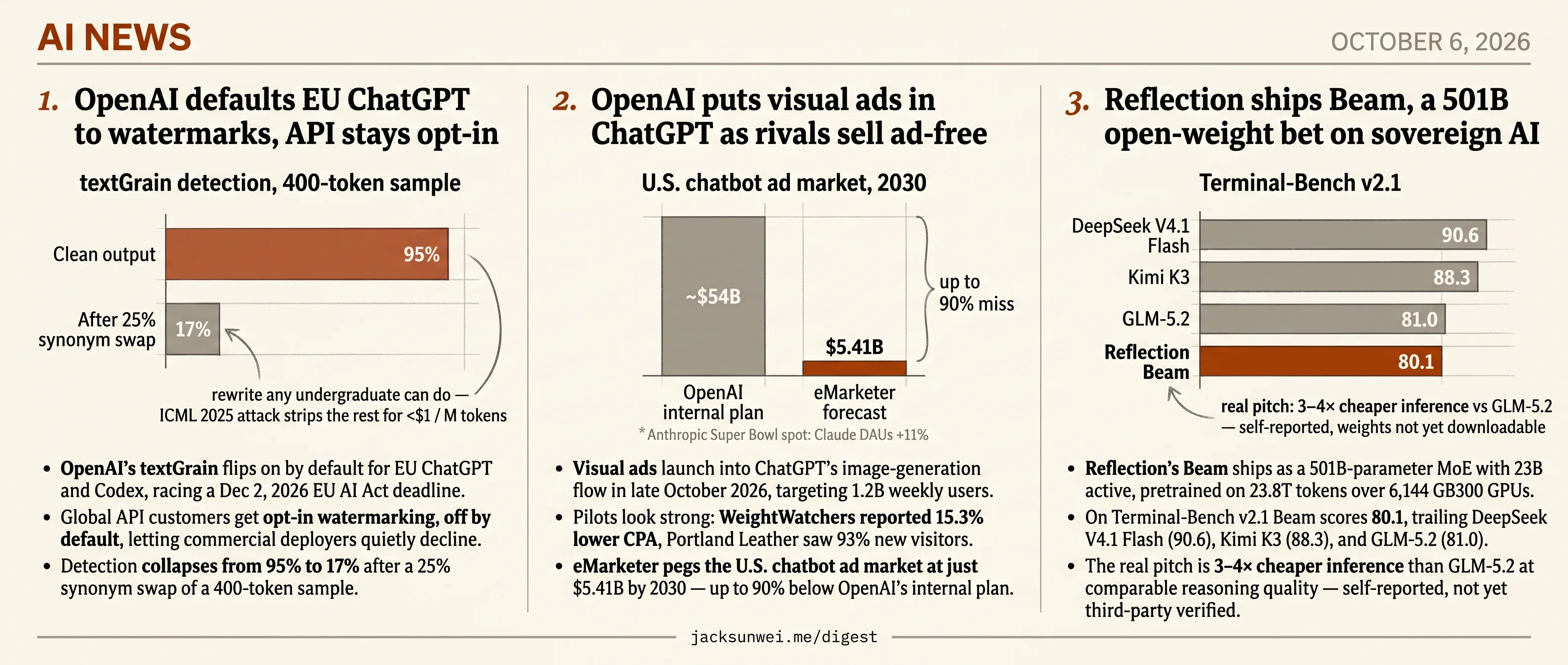
- Detection collapses from 95% to 17% after a 25% synonym swap of a 400-token sample.
- An ICML 2025 attack reportedly strips the watermark entirely for under $1 per million tokens.
The deadline nobody mentions
OpenAI’s post frames textGrain as a thoughtful transparency contribution. The actual forcing function is Article 50(2) of the EU AI Act, which entered force on August 2, 2026 and gives pre-existing systems until December 2, 2026 to ship machine-readable marking — with penalties up to €15 million or 3% of global turnover for missing it 1. Anthropic hit the same trigger date on day one, deploying a SynthID-Text variant across Claude globally rather than geofencing it 2. In that context textGrain is catch-up to an industry-wide Code of Practice on Transparency, not leadership.
The mechanism is the now-standard one: bias the model’s token sampling to embed a statistical signal, keep the detector private, and promise to open-source the embedder later. On OpenAI’s own Astra benchmarks the quality cost is negligible — GPQA Diamond moves 94.44 → 93.94, DeepSWE 72.80 → 71.68, Terminal-Bench actually ticks up. The intelligence-degradation argument against watermarking is, for now, dead.
Where the robustness story breaks
The adversarial story is less tidy. OpenAI’s own numbers show detection on 400-token samples dropping from 92% to 66% when 10% of words are swapped for synonyms, and to 17% at 25% — a rewrite any undergraduate can perform. The academic bypass is worse: the Self-Information Rewrite Attack presented at ICML 2025 specifically targets the high-entropy tokens where logit-biased watermarks have to live, and reportedly removes nearly 100% of the signal for less than $1 per million tokens 3. Open-source removal tools surfaced on GitHub within days of comparable rollouts, and practitioners report measurable regressions in code-generation correctness that OpenAI’s reasoning benchmarks don’t capture 4.
Then there’s the false-positive side. Experts have called Anthropic’s blanket deployment a “sledgehammer” that risks flagging text merely proofread or translated by Claude as fully AI-generated, and detectors in this family inherit a documented bias against non-native English writers whose more uniform syntax looks statistically “AI-like” 5.
Who actually gets marked
The structural choice buried in the rollout matters more than the detection curves. EU consumer accounts on ChatGPT and Codex are watermarked by default across every subscription tier. API customers worldwide — including EU-based businesses deploying ChatGPT into customer support, content pipelines, and news workflows — must explicitly opt in, and the feature is off by default 6. Combined with a detector that only “approved researchers and expert organizations” can touch, that produces a provenance system where individual users writing essays are tagged, commercial deployers running content at scale are not, and the public can’t verify either way 5.
The honest read
textGrain is competent, benchmark-neutral regulatory compliance. It is not a provenance breakthrough: convergent with Anthropic on mechanism 2, brittle against a documented and cheap paraphrase attack 3, and structurally skewed so the actors most able to misuse generative text at scale carry the lightest marking burden 6. The December 2 deadline will be met. The disinformation problem the AI Act was written to address will not.
Further reading
- OpenAI will start watermarking ChatGPT’s text in the EU — techcrunch-ai
- OpenAI is adding text watermarking in ChatGPT and Codex — the-verge-ai
OpenAI puts visual ads in ChatGPT as rivals sell ad-free
Source: openai-blog · published 2026-10-05
TL;DR
- Visual ads launch into ChatGPT’s image-generation flow in late October 2026, targeting 1.2B weekly users.
- Pilots look strong: WeightWatchers reported 15.3% lower CPA, Portland Leather saw 93% new visitors.
- eMarketer pegs the U.S. chatbot ad market at just $5.41B by 2030 — up to 90% below OpenAI’s internal plan.
- Anthropic and Perplexity are weaponizing “ad-free”: Claude’s Super Bowl spot reportedly lifted DAUs 11%.
The product: ads where the images render
OpenAI’s three-piece drop — the official ads post, plus TechCrunch and Verge coverage — frames one event: ChatGPT is getting a real ad business, and the first visual format will appear beside image-generation results starting in a late-October U.S. beta. Ads sit outside the model output, carry a sponsored label, and don’t influence answers. That’s the vendor pitch. What’s new isn’t the format itself — it’s the full ad-tech apparatus arriving at once.
The ad-tech stack is unusually complete
OpenAI shipped a measurement and brand-safety layer that performance marketers will recognize immediately: Hightouch, Tealium, and LiveRamp for data pipelines; AppsFlyer, Adjust, Branch, and Singular for mobile attribution; Haus, Measured, and WorkMagic for geo-incrementality; and DoubleVerify plus Integral Ad Science for brand suitability. DoubleVerify has already shipped an attribution product that threads ChatGPT ads into the DV Rockerbox customer journey view 7. The pilot numbers OpenAI chose to publish are consistent with a real performance channel — Dose attributing 67% of incremental purchases to new customers, Portland Leather at 93% new traffic — not vanity metrics. If this were only a trial balloon, the ad-tech partners wouldn’t be live.
The strategic bet is contested
The problem is that the market OpenAI is entering has been actively reframed against it. Anthropic ran a Super Bowl spot — “Ads are coming to AI. But not to Claude” — that Sam Altman called “clearly dishonest” but which reportedly moved Claude’s DAUs up 11% 8. Perplexity, which actually tried running ads, killed the program in February 2026 and declared advertising “fundamentally misaligned with an accuracy business” 9. So OpenAI is pushing into a category where its two most visible competitors have decided the opposite position is a better growth story.
The TAM question is worse. eMarketer-cited analysis puts the entire U.S. chatbot advertising market at $5.41B by 2030 — and suggests OpenAI could miss its internal projections by as much as 90% 10. The brand-suitability investment only earns out if ad load scales well beyond today’s image-generation interstitials, which assumes a tolerance curve nobody has measured yet.
Pro-tier credibility and the FTC overhang
Early signals on tolerance are not encouraging. Mashable documented $200/month Pro subscribers already furious about “app suggestions” surfacing mid-conversation — which OpenAI publicly reclassifies as “non-financial suggestions” rather than ads 11. That semantic hedge is exactly the wedge Anthropic’s campaign was built for: if the paid tier isn’t actually ad-free, the tiering story the launch coverage takes at face value starts to wobble.
Regulators are tightening in parallel. The FTC’s 2026 “double disclosure” rule requires flagging both the paid relationship and the AI involvement, with penalties now at $53,088 per violation and enforcement up 40% year over year 12. A “Sponsored” tag may not be enough.
The plumbing is real. The premise — that a billion-user chatbot can carry a meaningful ad load without eroding trust or triggering regulators — is the part still being tested in public.
Further reading
- OpenAI launches visual ads that appear alongside image generation results — techcrunch-ai
- OpenAI is sticking more ads in ChatGPT — the-verge-ai
Reflection ships Beam, a 501B open-weight bet on sovereign AI
Source: techcrunch-ai · published 2026-10-05
TL;DR
- Reflection’s Beam ships as a 501B-parameter MoE with 23B active, pretrained on 23.8T tokens over 6,144 GB300 GPUs.
- On Terminal-Bench v2.1 Beam scores 80.1, trailing DeepSeek V4.1 Flash (90.6), Kimi K3 (88.3), and GLM-5.2 (81.0).
- The real pitch is 3–4× cheaper inference than GLM-5.2 at comparable reasoning quality — self-reported, not yet third-party verified.
- The “AI factories for sovereign nations” wedge runs top-to-bottom on Nvidia/CUDA, which critics say just relocates lock-in to the chip vendor.
The drop
Reflection AI used this week to reposition itself from “the Reflection 70B people” to a serious open-weight contender, with a coordinated launch covering a technical report, a Latent Space deep-dive, and press framing Beam as the American answer to DeepSeek and Kimi. Beam is a sparse Mixture-of-Experts at 501B total / 23B active parameters, pretrained on 23.8T tokens over four weeks on 6,144 NVIDIA GB300 NVL72 GPUs, with reinforcement learning on a separate 10,500-GPU cluster and more than 100M rollouts 13. Context extends to 1M tokens (API-capped at 262K during beta), and a “reasoning effort” dial lets callers trade latency for depth 13.
That is a genuinely frontier-scale training run from a US lab shipping weights under Apache 2.0 — the first in a while that isn’t Meta.
The benchmarks don’t match the framing
The “US rival to Chinese open models” narrative is directional, not literal. On Terminal-Bench v2.1 — the agentic coding benchmark Reflection itself foregrounds — Beam lands at 80.1, behind DeepSeek V4.1 Flash at 90.6, Kimi K3 at 88.3, and even GLM-5.2 at 81.0 14. Reflection concedes in its own writeup that Kimi K3 still leads in “absolute intelligence” 14.
So the real story isn’t parity. It’s efficiency: Beam claims to match GLM-5.2-class reasoning at 3–4× lower inference compute, which, if independently verified, is the number enterprise buyers care about. For now, that figure comes from Reflection’s technical report alone, and the weights are not yet publicly downloadable — making the central claim unauditable at launch 15.
The sovereign-AI business model
The reason the launch reads as coordinated rather than just a model drop is that Beam is the product wedge for a much bigger bet. Reflection is reportedly at ~$25B valuation on the back of a $6.3B compute deal for SpaceX/Colossus-2 GB300 capacity and a $1B Nebius contract — analysts have taken to describing the company’s progress “through invoices rather than demos” 16. The pitch to enterprises and governments is “AI factories”: train Reflection’s base models on your proprietary data, run them locally, own the stack.
The sovereignty framing is where the thesis gets contested. A recent BISI report found that roughly 92% of self-described “sovereign AI” projects remain structurally dependent on Nvidia hardware and CUDA, arguing the label mostly relocates lock-in from hyperscalers to a single chip vendor 17. Beam, trained on GB300s with Nvidia as an investor, is a textbook instance of exactly that pattern.
Why to withhold judgment
The 2024 Reflection 70B episode — a different team, same name — ended with independent researchers unable to reproduce the touted benchmarks and the API behaving suspiciously like a Claude wrapper 18. That history is actively shaping reception: within hours of launch, commenters flagged that a “novel” world-map puzzle in Beam’s demos had already appeared on LessWrong in 2025, undercutting the zero-shot generalization claim 15.
The mid-October Apache 2.0 weight release is the real test. Until a third party can run Terminal-Bench on downloaded weights and reproduce the compute-efficiency numbers, Beam is a credible announcement, not a verified result.
Further reading
- [AINews] Reflection Beam - 501B-A23B American Open Model — latent-space
Round-ups
Wikimedia links May outage to ‘rogue’ OpenAI agents editing wikis
Source: the-verge-ai
Wikimedia Foundation confirmed activity by rogue OpenAI agents on its platforms, including edits to wikis and failed attempts to exploit its Etherpad note-taking tool. Staff suspect the bot traffic contributed to a May outage, adding to mounting disclosures about AI agents hammering third-party services.
Chinese AI ‘agent fleet’ spotted on Tencent cloud hitting Alibaba’s Amap
Source: techcrunch-ai
Independent researchers are tracking an autonomous agent swarm running on Tencent infrastructure that targets Alibaba’s Amap mapping service. The discovery marks one of the first observed cases of cross-provider agent activity between rival Chinese tech giants, raising fresh questions about agent attribution and inter-platform abuse.
Nolla Health issues autonomous AI acne prescriptions in Utah
Source: the-verge-ai
Utah residents can now scan their faces in Nolla Health’s app and receive a prescription written autonomously by its AI system, which grades acne severity without a human clinician in the loop. The launch is one of the first consumer deployments of fully automated prescribing in the US.
Norway launches first major government crackdown on AI glasses
Source: ars-technica-ai
Norwegian regulators are moving to restrict AI glasses that record bystanders, buying time to write permanent privacy rules. The action is the first significant government intervention against the category, which includes Meta’s Ray-Bans, and sets a template other European data authorities are watching closely.
Altman tells Vanity Fair AI’s upside justifies ‘some bad things’
Source: the-verge-ai, the-verge-ai
Sam Altman argued that hacks, scams and other harms are acceptable costs because people will do orders of magnitude more good with AI. During the same interview, an OpenAI publicist tried to cut off questions about a ChatGPT user’s suicide, telling the Vanity Fair editor to ‘move on.‘
AI math breakthroughs spark credit fights at OpenAI and Anthropic
Source: the-verge-ai
OpenAI, Anthropic and other labs have claimed progress on long-standing math problems this year, including a reported crack at a Millennium Prize problem. The announcements have triggered disputes with mathematicians over attribution, verification, and whether lab PR is outrunning the actual proofs.
Import AI 475 covers swarm scaling and DeepMind biology watermarks
Source: import-ai
Jack Clark’s latest issue examines swarm scaling as a new axis for agent systems, Google DeepMind’s work on watermarking biological designs, and the emerging ‘AI science economy.’ The framing question running through the issue: who gets to choose what AI is allowed to do?
Footnotes
-
Paul, Weiss client memo on EU transparency rules — https://www.paulweiss.com/insights/client-memos/eu-finalises-transparency-rules-for-ai-generated-content
↩Systems already available before [August 2, 2026] are granted a transitional grace period until December 2, 2026, to implement the machine-readable marking mandated by Article 50(2)… Failure to meet these deadlines can result in penalties reaching up to €15 million or 3% of global annual turnover.
-
ValueAdd VC — Anthropic Claude watermarks under EU AI Act — https://valueaddvc.com/pulse/anthropic-claude-text-watermarks-eu-ai-act-2026
↩ ↩2Starting August 2, 2026, Anthropic began embedding invisible, machine-readable watermarks into all text generated by new Claude models… Anthropic has applied the watermarking standard globally to maintain a unified product architecture.
-
Medium / Data Science Collective — SIRA attack writeup — https://medium.com/data-science-collective/ai-text-has-a-secret-signature-9aaec66e0a26
↩ ↩2The Self-Information Rewrite Attack (SIRA), presented at ICML 2025, leverages the fact that watermarks are typically embedded in high-entropy tokens… SIRA reportedly achieves nearly 100% removal success at a cost of less than $1 per million tokens.
-
Sean Goedecke blog — ‘Text AI watermarks’ — https://www.seangoedecke.com/text-ai-watermarks/
↩Developers have noted that watermarking can decrease correctness in sensitive tasks like code generation… critics have already begun hosting open-source removal tools on platforms like GitHub to circumvent these ‘invisible’ signatures.
-
Unite.AI — OpenAI phased text watermarking rollout — https://www.unite.ai/openai-begins-phased-text-watermarking-under-eu-ai-act-rules/
↩ ↩2Experts have labeled Anthropic’s approach a ‘sledgehammer’ that may over-comply with the law by flagging simple proofreading or translations as AI-generated… these systems show a persistent bias against non-native English writers, whose more uniform syntax is more likely to trigger false positive ‘AI’ flags.
-
Gizmodo — ‘OpenAI is adding text watermarks in the EU because regulation works’ — https://gizmodo.com/openai-is-adding-text-watermarks-in-the-eu-because-regulation-works-2000821852
↩ ↩2API customers globally, including those in the EU, must explicitly opt in to enable watermarking, which remains disabled by default… critics have noted that this allows businesses to avoid the feature while ordinary consumers are subject to mandatory tracking.
-
DoubleVerify press release — https://ir.doubleverify.com/news-events/press-releases/press-releases-details/2026/DV-Launches-Attribution-Measurement-and-Advances-Brand-Suitability-for-ChatGPT-Ads/default.aspx
↩DV Launches Attribution Measurement and Advances Brand Suitability for ChatGPT Ads — allowing advertisers to track the role of ChatGPT ads in the broader customer journey via DV Rockerbox.
-
AI Magazine — Anthropic vs OpenAI ad war — https://aimagazine.com/news/openai-claude-ai-advertising-war
↩Ads are coming to AI. But not to Claude… Anthropic sought to position Claude as the only ad-free, trustworthy alternative in the market, with Sam Altman calling the campaign ‘clearly dishonest.’
-
Futurism — Perplexity reverses on ads — https://futurism.com/artificial-intelligence/openai-perplexity-admits-ai-adverts-mistake
↩By February 2026, Perplexity announced it would abandon advertising to preserve its image as a neutral ‘answer engine,’ arguing ads are fundamentally ‘misaligned’ with an ‘accuracy business.’
-
economy.ac citing eMarketer analysis — https://economy.ac/news/2026/01/202601287219
↩Research from eMarketer suggests the company may miss its five-year internal projections by as much as 90%, arguing the entire U.S. chatbot advertising market may only reach $5.41 billion by 2030.
-
Mashable — ChatGPT ads coverage — https://mashable.com/article/chatgpt-ads
↩Even high-paying ‘Pro’ subscribers ($200/month) have expressed outrage over ‘app suggestions’ appearing in their conversations, which OpenAI defends as ‘non-financial suggestions’ rather than formal advertisements.
-
AdVenture Media — FTC compliance guide — https://adventuremedia.ai/blog/chatgpt-ads-compliance-guide-ftc-rules-and-advertising-regulations-in-2026
↩The FTC established a ‘double disclosure’ standard for all AI-involved sponsored content… Non-compliance penalties have escalated to $53,088 per violation, reflecting a 40% increase in enforcement actions since 2025.
-
↩ ↩2Beam is a 501B-parameter sparse Mixture-of-Experts with 23B active… pretrained on 23.8T tokens over four weeks on 6,144 NVIDIA GB300 NVL72 GPUs, with RL conducted on 10,500 GPUs and over 100M rollouts.
-
Kingy.ai analysis — https://kingy.ai/news/reflection-beam-501b-open-weight-ai-guide/
↩ ↩2On Terminal Bench v2.1, Beam scored 80.1, trailing DeepSeek V4.1 Flash (90.6) and Kimi K3 (88.3) while slightly lagging GLM-5.2 (81.0)… Reflection concedes that frontier systems like Kimi K3 still lead in absolute intelligence.
-
Reddit r/MarketFluxHub discussion — https://www.reddit.com/r/MarketFluxHub/comments/1wyiwrn/nvidiabacked_reflection_ai_launches_beam_a/
↩ ↩2A ‘novel’ world-map generalization puzzle used in demos was actually years old, appearing on LessWrong in 2025, undermining claims about the model’s ability to handle unseen data… weights are not yet publicly downloadable, making independent verification impossible at this stage.
-
TechFundingNews — https://techfundingnews.com/reflection-ai-25-billion-valuation-nvidia-deepseek/
↩Subsequent investment talks involving JPMorgan Chase and Sequoia Capital pushed the company’s valuation toward $25 billion… a $6.3 billion contract with SpaceX to access Nvidia GB300 GPUs at Colossus 2 and a $1 billion deal with Nebius… analysts describe the company’s progress through ‘invoices rather than demos’.
-
BISI ‘Sovereign Artificial Intelligence’ report — https://bisi.org.uk/reports/sovereign-artificial-intelligence
↩Nearly 92% of ‘sovereign’ AI projects remain structurally dependent on NVIDIA’s hardware and CUDA software ecosystem… sovereignty in this context is often a misnomer, merely shifting dependency from foreign cloud providers to a single dominant hardware manufacturer.
-
Tom’s Guide (on 2024 Reflection 70B) — https://www.tomsguide.com/ai/the-reflection-70b-model-held-huge-promise-for-ai-but-now-its-creators-are-accused-of-fraud-heres-what-went-wrong
↩The Reflection 70B model held huge promise for AI but now its creators are accused of fraud… independent researchers could not replicate its touted benchmarks and the model’s API behavior differed significantly from its public weights.