OpenAI buys bio ops, DeepSeek opens DeepInfer, SEA's $1T target slips to 2035
OpenAI acquires a pharma-operations startup, DeepSeek open-sources its inference stack under a US ban, and SEA's $1T digital target slips five years.
OpenAI buys bio ops, DeepSeek opens DeepInfer, SEA’s $1T target slips to 2035
TL;DR
- OpenAI acquired Orchestra Bio for pharma operations, not the drug-discovery bet Anthropic made with its $400M Coefficient deal.
- DeepSeek released DeepInfer claiming 80% margins while omitting the KV cache and load balancer that produce them.
- DHS banned DeepSeek from federal civilian agencies, extending the Pentagon’s earlier bar across the executive branch.
- SEA’s $1T digital target slipped from 2030 to 2035 as only 1-2% of 243M users pay for GenAI.
- Anthropic drafted a federal AI bill requiring 50+ plausible deaths and a judge before regulators can halt a model.
Today’s frontier beat refuses a single thread. OpenAI picks up Orchestra Bio for pharma logistics — not the drug-discovery bet Anthropic made with its ~$400M Coefficient deal. DeepSeek open-sources an inference stack claiming 80%+ margins, with the exact margin-producing pieces conspicuously absent, two days after DHS barred its software from federal civilian agencies. And a Google–Temasek–Bain report quietly slips Southeast Asia’s $1T digital-economy target from 2030 to 2035, while swapping a user-count headline for a ‘tokens’ metric Google Cloud happens to bill against.
The round-ups harden the same picture around the edges: a US-China open-weights line hardening in both directions, an Anthropic-drafted federal bill that would functionally shield model releases from agency halts, and reports that Anthropic itself is scrambling for GPU capacity from the same hyperscalers it now competes with — ahead of a November IPO.
DeepSeek open-sources DeepInfer, claims 80% inference margins
Source: latent-space · published 2026-10-21
TL;DR
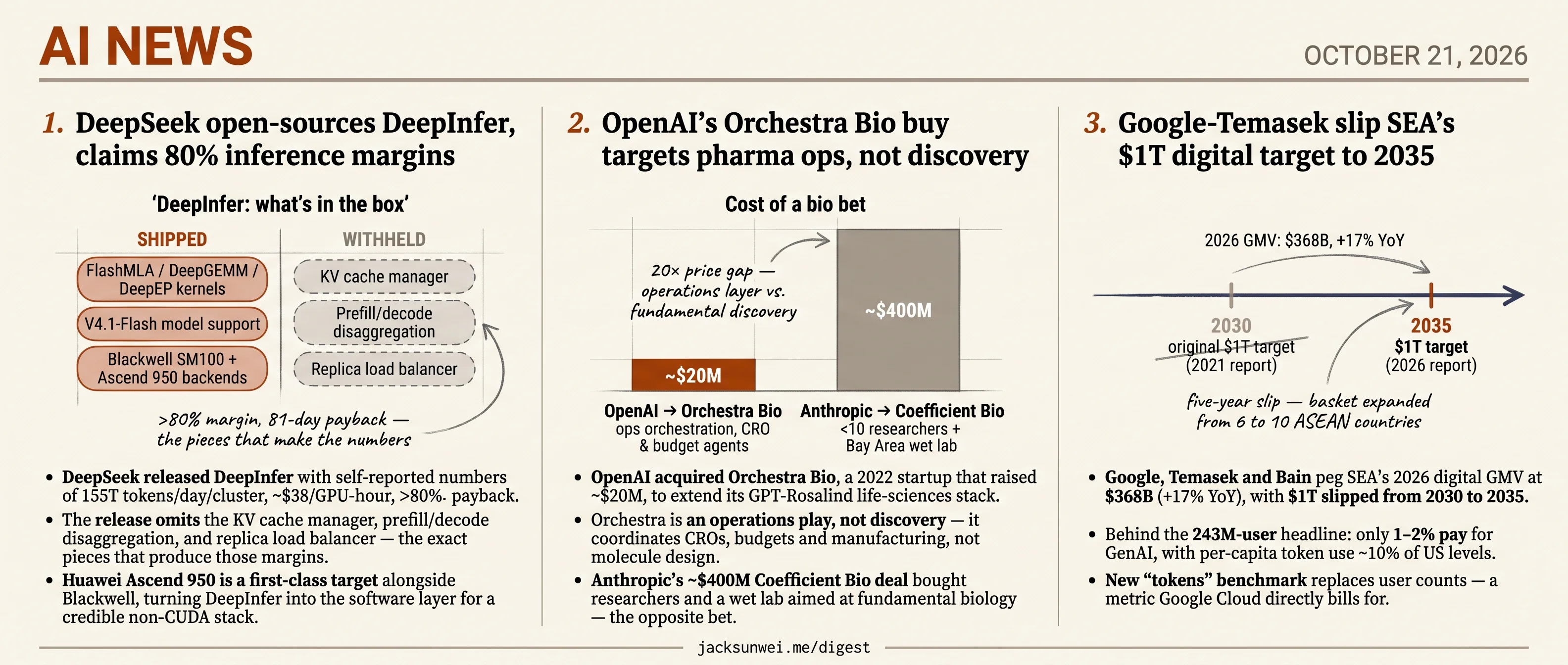
- DeepSeek released DeepInfer with self-reported numbers of 155T tokens/day/cluster, ~$38/GPU-hour, >80% margin, 81-day payback.
- The release omits the KV cache manager, prefill/decode disaggregation, and replica load balancer — the exact pieces that produce those margins.
- Huawei Ascend 950 is a first-class target alongside Blackwell, turning DeepInfer into the software layer for a credible non-CUDA stack.
- DHS banned DeepSeek from federal civilian agencies two days earlier, reframing adoption as a procurement question.
The numbers are the news
DeepSeek’s drop is the first time a frontier lab has published the inside of its inference P&L. The headline claims — 155 trillion tokens per day per cluster, roughly $38 per accelerator-hour in revenue, margin north of 80%, 81-day hardware payback — are specific enough to argue with, which is why a 2,200-point Hacker News thread treated them as a rare “peek behind the curtain” and used them to push back on the narrative that inference is structurally unprofitable 12.
The caveats matter. The 155T figure assumes a 96%+ KV cache hit rate that general workloads won’t reproduce, and the margin excludes R&D amortization — critics on the same thread peg DeepSeek’s cumulative infra spend closer to $1.6B rather than the $5.6M V3 training line everyone quotes 12. Still, as a floor on what’s achievable with a MoE-shaped model and a tuned stack, the numbers are a data point competitors now have to answer to.
What’s actually open — and what isn’t
TechTarget’s reporting is blunt: DeepInfer is a reference implementation, not a drop-in vLLM replacement 3. The kernels (FlashMLA, DeepGEMM, DeepEP) are hard-coded to DeepSeek-V4.1-Flash’s MoE geometry, and three load-bearing components are missing from the release.
| Shipped | Withheld |
|---|---|
| FlashMLA / DeepGEMM / DeepEP kernels | KV cache management system |
| V4.1-Flash model support | Prefill/decode disaggregation |
| NVIDIA SM100 + Huawei Ascend 950 backends | Replica-level load balancing |
Those three omissions are exactly the distributed-systems pieces that convert raw kernel throughput into the quoted 80% margin 3. The HN consensus: impressive engineering disclosure, unusable as a general serving platform without rebuilding the orchestration layer yourself 2.
The Ascend payload
The real strategic move is in the backend list. DeepInfer treats Huawei’s Ascend 950 as a first-class target alongside Blackwell — the 950PR delivers roughly 1.56 PFLOPS of FP4, and Tech-Insider projects NVIDIA’s China share could fall from ~40% toward single digits as Huawei’s SuperPod reaches cluster-level parity 34. DeepInfer is the software layer that makes that substitution credible: a non-CUDA inference stack for anyone willing to run DeepSeek-shaped models on Chinese silicon.
flowchart LR
    A[V4.1-Flash weights] --> B[DeepInfer kernels<br/>FlashMLA/DeepGEMM/DeepEP]
    B --> C[NVIDIA Blackwell SM100]
    B --> D[Huawei Ascend 950]
    E[KV cache mgr<br/>P/D disagg<br/>load balancer] -. withheld .- B
Procurement, not engineering
The release landed two days after DHS ordered federal civilian agencies to purge DeepSeek technology, and legal analysts flag that sending export-controlled data to the hosted API still constitutes a regulated export — self-hosting the open weights doesn’t fully resolve the exposure either 5. Combine that with the ongoing margin war — OpenAI’s GPT-6 Luna and Anthropic’s Claude Haiku 5.5 both launched at $0.10/$0.50 per M tokens to undercut DeepSeek’s $0.15/$0.60, while Chinese open-weight share on OpenRouter has gone from 2% to over 50% in under two years 6 — and DeepInfer reads less as a gift to the ecosystem than as a supply-side accelerant for the Huawei+DeepSeek stack. The kernels are the headline. The backend list is the news.
Further reading
- [AINews] not much happened today — latent-space
OpenAI’s Orchestra Bio buy targets pharma ops, not discovery
Source: openai-blog · published 2026-10-20
TL;DR
- OpenAI acquired Orchestra Bio, a 2022 startup that raised ~$20M, to extend its GPT-Rosalind life-sciences stack.
- Orchestra is an operations play, not discovery — it coordinates CROs, budgets and manufacturing, not molecule design.
- Anthropic’s ~$400M Coefficient Bio deal bought researchers and a wet lab aimed at fundamental biology — the opposite bet.
- Phase II/III attrition and FDA timelines are pharma’s real bottleneck, and no scheduling agent shortens them.
What OpenAI actually bought
Orchestra Bio is small: founded 2022 by ex-Benchling PM Ashoka Rajendra and 19-year Microsoft veteran Andy Xu, with roughly $20M from a16z and 8VC before the acquisition 7. The product is not a drug-discovery engine. It is an orchestration layer — agents that reconcile scientific roadmaps against budgets, contract research organization handoffs, and manufacturing dependencies, flagging (for example) how a fill-finish delay cascades into a Phase II enrollment slip.
That places the combined Rosalind Workbench closer to Benchling or Veeva than to Isomorphic Labs or Recursion. OpenAI is buying the connective tissue of pharma R&D, not the chemistry.
The Anthropic contrast
The deal only makes sense alongside Anthropic’s April 2026 acquisition of Coefficient Bio. The two labs are explicitly diverging on what “AI for biology” means:
| OpenAI + Orchestra Bio | Anthropic + Coefficient Bio | |
|---|---|---|
| Target layer | R&D operations, trial logistics | Fundamental discovery, enzyme design |
| What was bought | SaaS orchestration product (~$20M raised) | <10 ex-Prescient Design researchers (~$400M) |
| Infrastructure | None physical | Bay Area wet lab |
| Headline customers | Novo Nordisk, Moderna 8 | Internal research |
Anthropic’s own flagship discovery claim — a novel enzyme family from its ARTs system — drew pointed skepticism from computational biologists who said they had worked on the same systems for years and suspected training-data contamination 9. That is worth remembering the next time either lab announces a “breakthrough” validated only by its own press release.
Why practitioners are unimpressed
The Hacker News reaction is blunt: discovery is not pharma’s bottleneck. Attrition happens in Phase II/III, where human biology and FDA review set the clock, and no amount of agentic scheduling moves that clock 10. Big pharma is also unlikely to pipe proprietary molecule and trial data into a third-party LLM provider without a far clearer moat than currently exists.
Novo Nordisk CEO Mike Doustdar’s endorsement — that the partnership will accelerate “R&D and commercial execution, while maintaining the governance” 8 — is diplomatic but notice the hedge. “Governance” is doing a lot of work in that sentence.
The branding critique has teeth too. Naming a closed, gated, trusted-access-only model after Rosalind Franklin — whose unpublished crystallography data was famously appropriated without credit — reads as tone-deaf to a chunk of the scientific audience OpenAI needs on-side 11.
The safety overhang
OpenAI has itself classified the underlying ChatGPT Agent as “High” biological capability, meaning it can uplift novices through dangerous wet-lab procedures 12. Wrapping a High-bio model in an autonomous coordinator that touches manufacturing and clinical logistics widens the blast radius for both misuse and ordinary operational error in a domain where ordinary operational errors kill people.
Net
OpenAI has bought a competent orchestration product cheaply and plugged it into a stack with real pharma design partners. That is a sensible, un-flashy move. The open questions — whether agentic coordination survives FDA process, whether pharma will share IP with a frontier lab, whether the “High” bio classification translates into real-world misuse — are the same ones Anthropic faces, and neither lab has answered them yet.
Further reading
Google-Temasek slip SEA’s $1T digital target to 2035
Source: google-ai-blog · published 2026-10-21
TL;DR
- Google, Temasek and Bain peg SEA’s 2026 digital GMV at $368B (+17% YoY), with $1T slipped from 2030 to 2035.
- Behind the 243M-user headline: only 1–2% pay for GenAI, with per-capita token use ~10% of US levels.
- New “tokens” benchmark replaces user counts — a metric Google Cloud directly bills for.
- 3× data-center expansion by 2031 collides with Malaysia’s grid: DC load 7%→31% of national electricity by 2035.
The headline number, and the quieter one
The 11th e-Conomy SEA report lands with a tidy top line: $368 billion in regional GMV this year, up 17%, with digital financial services clearing $1.65 trillion in gross transaction value. Google, Temasek and Bain frame it as Southeast Asia going “AI-first,” with GenAI scaling four times faster than mobile did a decade ago.
The quieter number is the one that moved. The same consortium’s 2021 edition had SEA crossing $1 trillion in GMV by 2030. The 2026 edition pushes that milestone to 2035 — a five-year slip the glossy “intelligent economy” framing papers over 13. The 2026 report also expands coverage from six to ten ASEAN countries, folding in Brunei, Cambodia, Laos and Myanmar, which quietly refreshes the YoY growth comparisons 14.
”AI-first” is doing a lot of work
The 243-million-user, 58%-of-workforce adoption figure is sentiment-weighted. Independent analysis of the same dataset finds only 1–2% of the regional population pays for generative AI, and per-capita token consumption sits at roughly 10% of US levels 14. Enterprise uptake surveys cited alongside the report put Vietnamese business adoption as low as 18%.
The agentic-commerce enthusiasm fractures the same way. The report says 75% of users are willing to let AI agents transact on their behalf. A parallel regional survey finds ~80% use AI for product discovery but only 24–26% are comfortable letting an agent actually buy — and in Singapore the gap widens to 72% usage against 29% payment trust 15. Stated willingness is not revealed behaviour.
Tokens are a cost metric wearing a growth-metric hat
The 2026 report crowns a new benchmark: tokens, projected to grow 60× in five years. The timing is awkward. Amazon and Meta have both shuttered internal AI usage leaderboards this year after staff began assigning redundant tasks to autonomous agents purely to inflate rank 16. Tokens are what Google Cloud bills for; elevating them to a GMV-equivalent headline metric is a conflict worth naming when Google co-authors the report.
The infrastructure bill comes due locally
The call for 3× data-center capacity by 2031 reads cleanly in a slide deck and messily on the ground. Malaysian data-center electricity consumption is forecast to climb from 7% of national demand in 2026 to 31% by 2035, driving “phantom demand” penalties, water-use protests in Johor and Selangor, and a moratorium on new non-AI data centers 17. Singapore’s Digital Infrastructure Bill — which the report cites approvingly — exists because the city-state capped its own build-out first.
Meanwhile, Stanford’s Digital Economy Lab finds employment for 22–25-year-olds in AI-exposed roles running 19% below trend 18. The intelligent economy may yet hit $1 trillion. The open question is whether the entry-level jobs that drove the last decade of SEA digital growth survive the transition.
Takeaway
The macro story is directionally real: SEA’s digital economy is still compounding, and GenAI is a genuine demand pull. But the headline obscures a shifted end-date, an expanded country basket, a sponsor-friendly new metric, and adoption numbers that count triallists as users. Read $368B as the floor of a real market, not as evidence the $1T dream is on schedule.
Round-ups
US orders federal civilian agencies to purge DeepSeek software
Source: techcrunch-ai
Federal civilian agencies must remove DeepSeek products and any third-party services built on its models, citing national security risks tied to the Chinese developer. The directive extends existing Pentagon and congressional bans to the wider executive branch.
Open-model roundup tracks DeepSeek V4.1 Flash and US-China rules
Source: interconnects
The 25th open-artifacts digest covers DeepSeek’s V4.1 Flash 1017 release alongside a wave of American-made open weights, framing a Western push to reclaim ground. It also catalogs new regulatory controls landing in both Washington and Beijing.
Anthropic AI safety bill shields model releases from agency blocks
Source: techcrunch-ai
Anthropic’s proposed federal bill lets regulators halt a model only when 50 or more deaths are plausible, and even then requires a judge’s sign-off. Critics say the framing looks protective but strips agencies of unilateral authority to pull dangerous releases.
Anthropic struggles for cloud compute ahead of November IPO
Source: techcrunch-ai
Anthropic is reportedly having trouble locking in enough GPU capacity as hyperscaler partners increasingly treat it as a rival. Infrastructure spending is climbing fast before a planned November IPO, straining deals with the same clouds that resell its models.
Google joins Amazon in porting PyTorch apps off Nvidia GPUs
Source: techcrunch-ai
Google released a developer tool that lets PyTorch users move workloads to its TPUs with minimal rewrites, mirroring an Amazon push for Trainium. The two clouds are chipping at Nvidia’s grip on the AI app developer stack where CUDA has long dominated.
Meta pauses Muse sharing after 6,800 private chats leak online
Source: ars-technica-ai, the-verge-ai
Meta suspended the Muse assistant’s share feature after security firm Claroc found more than 6,800 shared conversation URLs exposed through public DNS records. The leaked chats included personal and business secrets, prompting an internal privacy investigation while the sharing option stays offline.
SpaceX posts $4.4B Q3 profit driven by AI unit
Source: techcrunch-ai
SpaceX turned profitable in the third quarter with $4.4 billion in net income, and AI was the main engine behind the swing. The business is outpacing internal projections, bolstering Elon Musk’s Grok and xAI ambitions alongside the launch operation.
Footnotes
-
latent.space (primary) — https://www.latent.space/p/ainews-deepseek-deepinfer-open-source
↩ ↩2155 trillion tokens per day per cluster … roughly $38 per hour per accelerator … margin exceeds 80% … 81-day payback
-
Hacker News discussion (2,200+ points) — https://news.ycombinator.com/item?id=50156170
↩ ↩2 ↩3seeing ‘cold hard numbers’ helped quell arguments that AI remains fundamentally unprofitable … but manual inspection of model weights for ‘hidden triggers’ remains practically impossible
-
TechTarget — DeepSeek makes DeepInfer open source — https://www.techtarget.com/ai/news/366652363/DeepSeek-makes-DeepInfer-open-source-to-cut-AI-costs
↩ ↩2 ↩3the release excludes three critical components: a KV cache management system, prefill/decode disaggregation, and replica-level load balancing
-
Tech-Insider — Huawei Ascend 950PR analysis — https://tech-insider.org/huawei-ascend-950pr-ai-chip-nvidia-china-2026/
↩the 950PR delivers roughly 1.56 petaflops of FP4 performance … NVIDIA’s market share in China could tumble from 40% toward single digits as Huawei captures more than half of local demand
-
VentureBeat — V4.1 Flash 1017 arrives as U.S. bans it — https://venturebeat.com/security/deepseek-v4-1-flash-1017-arrives-with-improved-benchmarks-just-as-the-u-s-government-bans-it-from-agencies-what-enterprises-should-do
↩the U.S. Department of Homeland Security issued a directive ordering federal agencies to remove and exclude all DeepSeek technology … sending export-controlled data to DeepSeek’s hosted API still constitutes a regulated export
-
Milkroad — Why Anthropic, OpenAI and DeepSeek face a pricing collapse — https://milkroad.com/ideas/why-anthropic-openai-and-deepseek-face-a-pricing-collapse/
↩OpenAI introduced GPT-6 Luna at $0.10/$0.50 … Anthropic released Claude Haiku 5.5 at the same price point … Chinese open-weight models grew from 2% to over 50% of token consumption on OpenRouter
-
Dealroom — https://dealroom.co/news/164436-openai-buys-orchestra-bio-to-push-ai-agents-into-drug-development/
↩Orchestra Bio was founded in 2022 by Ashoka Rajendra (CEO, ex-Benchling PM) and Andy Xu (CTO, 19 years at Microsoft), and had raised roughly $20M led by Andreessen Horowitz and 8VC prior to the acquisition.
-
Pharmaceutical Technology — https://www.pharmtech.com/view/openai-bets-on-accelerating-drug-development-timelines-with-orchestra-bio
↩ ↩2Novo Nordisk CEO Mike Doustdar: ‘Our partnership with OpenAI will help translate this scale into faster R&D and commercial execution, while maintaining the governance.’
-
r/labrats discussion of Anthropic’s Coefficient Bio claims — https://www.reddit.com/r/labrats/comments/1wsckwq/did_anthropics_ai_really_make_a_scientific/
↩Some computational biologists noted that they had been studying these systems for years and suggested that Anthropic’s model might have been trained on their unpublished data.
-
Hacker News thread — https://news.ycombinator.com/item?id=46061643
↩The ‘hard part’ remains the prohibitively expensive clinical and regulatory phases, which require physical validation rather than digital reasoning… pharma giants are unlikely to cede intellectual property to an AI provider without significant, proven advantages.
-
Kingy.ai analysis — https://kingy.ai/news/openai-orchestra-bio-acquisition/
↩Commentators have noted the irony of naming a closed-source, gated model after Rosalind Franklin, a scientist whose data was famously used without her credit or consent.
-
tech-insider.org on GPT-Rosalind — https://tech-insider.org/openai-gpt-rosalind-life-sciences-model-pharma-2026/
↩OpenAI classified its latest ChatGPT Agent as having ‘High’ biological capability, acknowledging they could help beginners navigate dangerous biological procedures.
-
e27 (Sainul Abudheen K.) — https://e27.co/southeast-asias-us1t-digital-dream-slips-five-years-and-ai-is-the-new-reason-to-keep-believing-20261021/
↩Southeast Asia’s US$1T digital dream slips five years, and AI is the new reason to keep believing
-
e27 analysis of e-Conomy SEA 2026 — https://e27.co/southeast-asias-us1t-digital-dream-slips-five-years-and-ai-is-the-new-reason-to-keep-believing-20261021/
↩ ↩2Only about 1–2% of the regional population currently pays for generative AI services… per capita AI usage in SEA remains at just 10% of U.S. levels
-
impact.com (AI product discovery survey) — https://impact.com/press-releases/ai-product-discovery-human-trust/
↩Roughly 80% of regional shoppers use AI for product discovery and price comparison, [but] only about 24% to 26% are comfortable allowing an AI agent to execute a purchase autonomously
-
stepto.net (‘Tokenmaxxing’) — https://stepto.net/blog/tokenmaxxing-ai-usage-metrics-engineering-performance-2026
↩Amazon and Meta recently shuttered internal AI usage leaderboards after employees began assigning redundant tasks to autonomous agents just to inflate their rankings
-
Gulf Times — Malaysia data centre scrutiny — https://www.gulf-times.com/article/730125/opinion/malaysias-data-centre-boom-faces-scrutiny-over-power-water-community-impact
↩Data centre electricity consumption is forecast to surge from 7% in 2026 to 31% of total national demand by 2035
-
Stanford Digital Economy Lab — https://digitaleconomy.stanford.edu/news/canariesaug26/
↩Employment for individuals aged 22–25 in AI-exposed roles sits 19% below historical trends