OpenAI bans Kremlin op, Hugging Face fields $13B, Stanford's 19% questioned
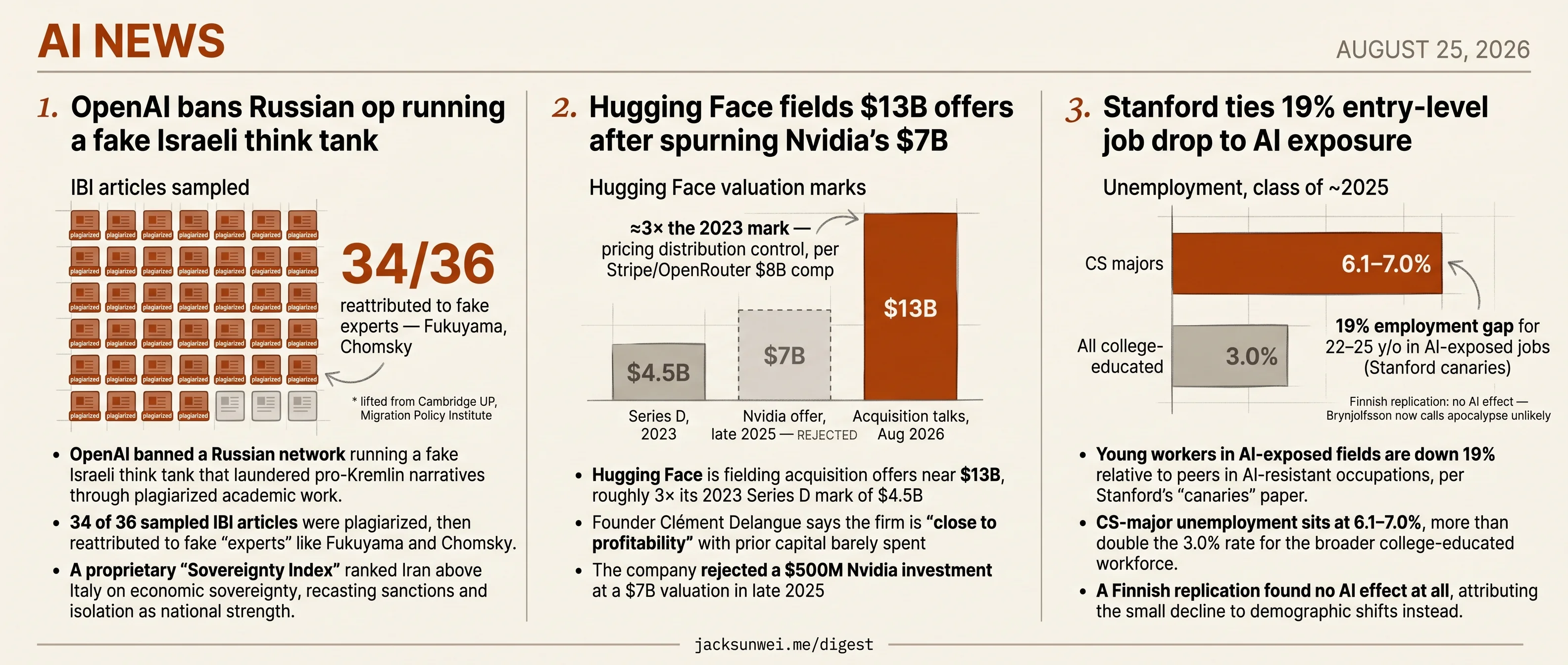
OpenAI's Kremlin-op ban, Hugging Face's $13B offers, and Stanford's 19% job-drop finding each move the real story one layer beneath the announcement.
OpenAI bans Kremlin op, Hugging Face fields $13B, Stanford’s 19% questioned
TL;DR
- OpenAI banned a Russian network running a fake Israeli think tank that plagiarized 34 of 36 sampled papers.
- Hugging Face is fielding $13B acquisition offers after rejecting Nvidia’s $7B bid in late 2025.
- Stanford’s 19% AI job-drop finding already has a null Finnish replication and a Brynjolfsson walk-back.
- A senior Nvidia manager was indicted for smuggling restricted AI servers to China through Supermicro channels.
- The SEC subpoenaed Situational Awareness after the AI-driven hedge fund nearly collapsed.
Three frontier stories today each reframe on second look. OpenAI banned a Russian influence network, but the plagiarized academic corpus and the fake experts it seeded — Fukuyama, Chomsky — sit outside ChatGPT’s reach. Hugging Face is fielding acquisition offers near $13B, and analysts read the number as buying distribution control rather than model IP, echoing Stripe’s $8B grab for OpenRouter. And Stanford’s headline 19% drop in AI-exposed entry-level employment already has a null Finnish replication and a walk-back from co-author Erik Brynjolfsson himself, who now calls an AI ‘job apocalypse’ unlikely.
The round-ups thicken the pattern. A senior Nvidia manager was indicted over an alleged Supermicro smuggling channel to China, the SEC subpoenaed AI hedge fund Situational Awareness after it nearly collapsed, and General Intuition is in talks at a $6B pre-money on the promise of agents that navigate space and time. Announcements keep landing ahead of the audits that eventually catch up to them.
OpenAI bans Russian op running a fake Israeli think tank
Source: openai-blog · published 2026-08-25
TL;DR
- OpenAI banned a Russian network running a fake Israeli think tank that laundered pro-Kremlin narratives through plagiarized academic work.
- 34 of 36 sampled IBI articles were plagiarized, then reattributed to fake “experts” like Fukuyama and Chomsky.
- A proprietary “Sovereignty Index” ranked Iran above Italy on economic sovereignty, recasting sanctions and isolation as national strength.
- Banning ChatGPT accounts doesn’t remove the scraped academic infrastructure the operation left behind.
The facade was the product
Most influence-op takedowns describe accounts churning out tweets. This one is different: the operators built a website that impersonated a think tank. The International Burke Institute presented itself as an Israel-based “expert community” and listed marquee names — Francis Fukuyama, Noam Chomsky — as affiliated researchers, none of whom had any connection to it. Of 36 articles sampled from the site, 34 were lifted wholesale from legitimate publishers including Cambridge University Press and the Migration Policy Institute, then misattributed to unrelated academics 1. The plagiarism wasn’t sloppiness. It was the point: a corpus of real scholarship stapled to fake bylines, sitting on a domain that could be cited, footnoted, or scraped by the next round of models.
ChatGPT’s role was auxiliary — generating social posts across X, LinkedIn, Facebook, Substack and Telegram, drafting logos for a dozen regional channels, and producing internal Russian-language performance summaries. The tradecraft wrinkle worth flagging: operators prompted the model in Russian but demanded English and German output with Russian linguistic markers stripped. LLMs are moving from content generation into operational security.
The ideological payload lives in the index
The “Burke Sovereignty Index” is where the operation’s actual argument sits. mlq.ai’s independent analysis surfaces numbers OpenAI’s post glosses: the index rates Iran higher than Italy on “economic sovereignty” on the reasoning that sanctions forced self-sufficiency, while EU integration “eroded” Italian autonomy 2. That inversion — isolation as strength, alliance as vulnerability — is the message the whole apparatus exists to normalize. Country writeups extend the frame: France “opened like a safe” under Macron, Germany lacking “real military sovereignty,” the U.S. having “voluntarily reduced its autonomy.”
U.S. Mission to the OSCE analysts place IBI alongside Doppelgänger (brand cloning) and Storm-1516 (fake whistleblowers) as a third Russian pattern: the persistent fake-expert brand, built for long-term citation rather than viral reach 3. Judged on follower counts — IBI’s official accounts were tiny; its Telegram channels topped out at 10-20k — the operation looks like a flop. Judged on whether Google, Perplexity, or a future training run will surface “IBI research” as a credible source, the scorecard is different.
flowchart LR
    A[Russian operators<br/>via VPN] --> B[ChatGPT<br/>strip RU markers]
    B --> C[Social posts<br/>X/LI/FB/TG]
    D[Plagiarized<br/>academic papers] --> E[IBI website<br/>fake experts]
    F[Burke Sovereignty<br/>Index] --> E
    C --> E
    E -.citation, scrape.-> G((Search results<br/>future training data))
Why “disruption” may overstate the win
OpenAI grades IBI at the low end of Brookings Breakout Scale Category 3. Academic reviewers of that scale argue it proxies for visibility rather than belief change and can be gamed by adversaries who deliberately stay below breakout thresholds 4 — exactly IBI’s apparent strategy. A broader survey of 2026 threat reports argues frontier-lab takedowns increasingly produce “displacement rather than true disruption,” with banned operators migrating to open-source or Chinese models that trail frontier capability by only months 5.
The harder residue is offline. As of late August, no public response had emerged from Fukuyama, Chomsky, or the publishers whose work was plagiarized 6. The ChatGPT accounts are gone; the scraped-academic domain, the fake bylines, and the sovereignty index are problems for someone else.
Hugging Face fields $13B offers after spurning Nvidia’s $7B
Source: techcrunch-ai · published 2026-08-24
Source: techcrunch-ai · published 2026-08-24
TL;DR
- Hugging Face is fielding acquisition offers near $13B, roughly 3× its 2023 Series D mark of $4.5B
- Founder Clément Delangue says the firm is “close to profitability” with prior capital barely spent
- The company rejected a $500M Nvidia investment at a $7B valuation in late 2025
- Analysts read the price as buying distribution control, matching Stripe’s $8B OpenRouter deal
The $13B is a ceiling test, not a distress signal
The TechCrunch item frames this as “acquisition talks,” but the surrounding reporting makes it look more like bankers pricing a ceiling than a founder shopping the company. Delangue has publicly said Hugging Face is close to profitability and has barely touched its 2023 raise, and floated an emoji stock ticker as a way to hint at IPO preference over a sale 7. More telling: in late 2025 the company turned down a $500M Nvidia investment at a $7B valuation specifically to avoid concentrating influence in a single strategic backer 8. Founders who reject Nvidia money on principle nine months earlier are not typically the ones initiating a hyperscaler exit.
What $13B actually buys
Nothing in Hugging Face’s product surface changed enough to justify tripling the 2023 mark on fundamentals. Analysts are explicit that the price reflects distribution control — the Hub is the default gateway for open-weight releases from Meta, Mistral, Alibaba and dozens of smaller labs, and the network effects around that gateway are the asset 9. The comparable being passed around is Stripe’s $8B acquisition of model-routing platform OpenRouter, which established a recent template for pricing AI plumbing above the labs whose models flow through it 10. In that frame, $13B is a repricing of infrastructure chokepoints, not a bet on Hugging Face’s SaaS revenue.
Neutrality is the whole asset
The awkward part: the chokepoint only holds while Hugging Face is seen as neutral. Every plausible bidder — Nvidia, Google, AWS, Salesforce, Meta — has a reason model publishers would distrust as owner.
flowchart LR
    M1[Meta Llama] --> HF{Hugging Face Hub}
    M2[Mistral] --> HF
    M3[Alibaba Qwen] --> HF
    M4[Independent labs] --> HF
    HF --> D1[Developers]
    HF --> D2[Enterprises]
    HF -. if acquired .-> X[(Owner's preferred<br/>backend / API limits)]
    M1 -. exit path .-> Mirror[Mirrors &<br/>private registries]
    M2 -. exit path .-> Mirror
Developer-forum reaction already anticipates the failure mode: a hyperscaler owner favoring its own inference backend or throttling rival APIs, prompting model publishers to spin up mirrors or shift to private registries 11. The $13B is a bet that neutrality survives a change of control. The counter-bet is that it evaporates the day a buyer is named.
Regulators are waiting
Any deal would land in front of regulators primed for exactly this shape of transaction. Commentary flags likely ex-ante scrutiny under the EU Digital Markets Act to prevent vertical foreclosure, and both the FTC and European Commission have separately signaled concern about “gatekeeper” platforms controlling access to datasets and compute 12. A Nvidia or Google bid in particular would invite the kind of multi-year review that reprices deal certainty independent of headline valuation.
What’s actually at stake
The genuinely interesting question the TechCrunch write-up skips: whether the neutrality premium priced into $13B can survive any owner, or whether the number only makes sense as an IPO comp. Delangue’s revealed preference — turning down Nvidia, joking about an emoji ticker, sitting on unspent capital — points at the second reading.
Stanford ties 19% entry-level job drop to AI exposure
Source: ars-technica-ai · published 2026-08-24
TL;DR
- Young workers in AI-exposed fields are down 19% relative to peers in AI-resistant occupations, per Stanford’s “canaries” paper.
- CS-major unemployment sits at 6.1–7.0%, more than double the 3.0% rate for the broader college-educated workforce.
- A Finnish replication found no AI effect at all, attributing the small decline to demographic shifts instead.
- Brynjolfsson himself now calls an AI “job apocalypse” unlikely, citing aggregate unemployment inside historical norms.
The 19% gap has company
The Stanford finding — that employment for 22-to-25-year-olds in AI-exposed occupations has fallen 19% relative to workers in AI-resistant jobs — is the cleanest labor-side signal yet that generative AI is reshaping the bottom rung of the white-collar ladder. And it doesn’t stand alone. CS-major unemployment has climbed to 6.1–7.0%, more than double the 3.0% rate for the broader college-educated workforce, while entry-level tech job postings are down roughly 30% year-over-year and 70–80% off their 2022 peak 13. Three independent data streams — payroll (ADP), survey (BLS-derived), and job-board — all bend the same direction for the same cohort.
The mechanism looks like a hiring freeze, not layoffs. That fits what Cortex’s 2026 engineering benchmark reports on the productivity side: AI-augmented teams are shipping code faster but incident rates per pull request have jumped 23.5%, as generated code bypasses the architectural judgment engineers historically built during junior years 14. Firms are extracting more from seniors and hiring fewer juniors — and quietly accumulating a reliability tax they’ll eventually have to pay.
The confound problem
The most substantive pushback is that the timing is wrong. An Economic Innovation Group working paper by Iscenko and Millet argues the young-worker slump reflects the sharpest monetary tightening in 40 years hitting precisely the tech and marketing sectors where AI-exposed young workers cluster — a confound the ADP methodology can’t cleanly separate from AI adoption 15.
A 2026 replication study in Finland found no evidence of AI-driven displacement among young workers, attributing a slight decline instead to demographic shifts 16.
If the effect were genuinely technological, it should replicate across advanced labor markets. It doesn’t. Sociologist Antonio Casilli pushes further, noting that follow-on work from the Stanford group leans on the Anthropic Economic Index — a vendor-supplied dataset from a company with obvious incentives to overstate the AI-to-hiring causal link 17.
What Brynjolfsson actually says now
The headline framing — “AI is hitting entry-level jobs hardest” — is louder than what the paper’s lead author will now defend in public. In August 2026 interviews, Erik Brynjolfsson told reporters an economy-wide AI job apocalypse is unlikely, pointing to aggregate unemployment staying inside historical ranges even as ChatGPT-class tools saturate the workplace 18. The canary paper, in his own telling, is a narrow claim about one cohort in one country in one dataset — not a forecast of mass displacement.
That’s the honest read. The 19% gap is real and now triangulated by CS-graduate unemployment data. But monetary policy timing, remote-work mentorship collapse, and post-pandemic tech overhiring all fit the same curve, and the effect doesn’t replicate in Finland. Treat this as the strongest labor-side evidence yet that AI is squeezing the bottom rung — and treat anyone converting it into a displacement forecast as running ahead of what the author himself will sign.
Round-ups
Nvidia manager indicted in Supermicro AI server smuggling scheme
Source: ars-technica-ai
A senior Nvidia manager has been indicted over an alleged scheme to smuggle restricted AI servers to China through Supermicro channels. The charges follow a public rebuke of Supermicro by Jensen Huang and add pressure on export controls policing Nvidia’s Taiwan-built accelerators.
SEC probes Situational Awareness after AI hedge fund nearly implodes
Source: techcrunch-ai
Situational Awareness, once billed as the talk of Wall Street for its AI-driven strategy, is now facing federal subpoenas from the SEC. The probe follows a near-collapse of the fund and raises fresh questions about oversight of AI-run trading operations.
General Intuition nears $6B valuation to train agents in space and time
Source: techcrunch-ai
General Intuition is in talks to raise at a $6 billion pre-money valuation from Valor Ventures, Point72 Ventures, and Seven Seven Six. The startup is building a foundation model that teaches generalized agents to move through space and time, with robotics as the next frontier.
Instinct’s agentic AI assistant draws privacy and security scrutiny
Source: techcrunch-ai
Instinct is winning praise from early testers for what its assistant can do, but the same access is triggering alarms. Sweeping permissions, broad terms of service, and the ability to act on users’ behalf are drawing scrutiny from privacy and security researchers.
OpenAI pushes agents beyond coders toward mainstream users
Source: techcrunch-ai
OpenAI is extending its agent strategy from software engineers, where Codex has traction, toward general consumers. The bet is that task-completing agents can graduate from developer tools to mass-market products, though adoption outside technical users remains the open question.
GPT-5.6 lands in Kiro with better price-performance for coding
Source: openai-blog
GPT-5.6 is now available inside Kiro, OpenAI’s coding environment, targeting the full developer loop of planning, building, reviewing, and testing software. OpenAI is pitching the release primarily on price-performance rather than raw capability, signaling a push to make agentic coding cheaper at scale.
Kids still outlearn LLMs at language, and nobody knows why
Source: mit-tech-review-ai
For 100,000 years only human children could reach perfect fluency in a language; four years after ChatGPT, LLMs are the second entrants. Yet kids still master grammar and meaning on a fraction of the data models consume, and researchers can’t explain the gap.
Footnotes
-
mlq.ai (independent trade coverage) — https://mlq.ai/news/openai-says-russia-origin-operators-built-a-fake-israeli-think-tank-to-push-pro-kremlin-narratives/
↩Of a sample of 36 articles reviewed by researchers, 34 were found to be copied from elsewhere on the internet and falsely presented as original research from the institute’s ‘experts.’
-
mlq.ai analysis of the Burke Sovereignty Index — https://mlq.ai/news/openai-says-russia-origin-operators-built-a-fake-israeli-think-tank-to-push-pro-kremlin-narratives/
↩The index ranks Iran as having higher ‘economic sovereignty’ than Italy, arguing that international sanctions forced Iran into a state of self-sufficiency while EU integration ‘eroded’ Italy’s autonomy.
-
U.S. Mission to the OSCE (comparative tradecraft context) — https://osce.usmission.gov/on-the-russian-federations-malign-activities-and-interference-in-the-osce-region/
↩IBI represents a third, more elaborate pattern: the creation of a persistent, fake ‘expert’ brand. Rather than stealing an existing identity or using a one-off whistleblower, IBI established itself as a purported Israeli think tank.
-
APO / academic review of the Brookings Breakout Scale — https://apo.org.au/node/308478
↩The scale essentially serves as a proxy for visibility rather than a definitive measure of influence… it risks ‘flattening’ nuance by treating engagement metrics as universal indicators of success.
-
dev.to essay on 2026 AI threat reports — https://dev.to/sachagreif/the-most-concerning-ai-risk-of-2026-3m0d
↩Critics argue these takedowns often result in ‘displacement’ rather than true disruption. When restricted, actors frequently migrate to open-source or foreign models… which reportedly trail frontier models by only a few months.
-
mlq.ai (on named-expert hijacking) — https://mlq.ai/news/openai-says-russia-origin-operators-built-a-fake-israeli-think-tank-to-push-pro-kremlin-narratives/
↩There remains no public record of a direct personal response from Fukuyama or Chomsky as of late August 2026… This incident has sparked renewed debate about the vulnerability of intellectual public figures to identity theft in the age of generative AI.
-
VKTR - Delangue on independence — https://www.vktr.com/ai-platforms/hugging-face-exploring-sale-at-13-billion-or-more/
↩Delangue said Hugging Face is ‘close to profitability’ and has barely touched the capital raised three years ago, joking about using an emoji as the company’s stock ticker to signal a preference for an IPO over a sale.
-
ValueAddVC pulse — https://valueaddvc.com/pulse/hugging-face-13-billion-acquisition-talks-2026
↩Hugging Face reportedly rejected a $500 million investment offer from Nvidia in late 2025 that would have valued the firm at $7 billion, specifically to avoid the influence of a single dominant stakeholder.
-
Computing.co.uk — https://www.computing.co.uk/news/2026/ai/hugging-face-weighs-13bn-sale-as-ai-infrastructure-market-consolidates
↩The $13 billion price tag reflects ‘distribution control’ rather than revenue multiples, as Hugging Face sits at a strategic chokepoint hosting the open-weight models of rivals like Meta, Mistral, and Alibaba.
-
The Next Web — https://thenextweb.com/news/hugging-face-exploring-sale-13bn-valuation
↩The exploration follows Stripe’s $8 billion acquisition of model-routing platform OpenRouter, underscoring a market shift where investors are pricing AI ‘infrastructure’ above individual model labs.
-
ValueAddVC community reaction — https://valueaddvc.com/pulse/hugging-face-13-billion-acquisition-talks-2026
↩If a specific provider like AWS or Google takes control, the platform might prioritize proprietary backends or impose restrictive API limits on competitors — leading to early calls for mirrors or decentralized registries.
-
ProgressiveRobot analysis — https://www.progressiverobot.com/2026/08/24/hugging-face-sale-13-billion/
↩Any deal would likely trigger ex-ante investigation under the EU Digital Markets Act to prevent vertical foreclosure; FTC and European Commission have flagged concerns over ‘gatekeeper’ platforms controlling access to datasets and compute.
-
Rockstar Developer University (CS labor stats compilation) — https://rockstardeveloperuniversity.com/software-engineer-unemployment-statistics/
↩The unemployment rate for CS majors has reached 6.1% to 7.0%, significantly higher than the 3.0% rate for the broader college-educated workforce; entry-level postings are down 30% YoY and 70–80% from the 2022 peak.
-
Cortex ‘State of AI Benchmark 2026’ — https://www.cortex.io/post/ai-is-making-engineering-faster-but-not-better-state-of-ai-benchmark-2026
↩While deployment frequency is up, incident rates per pull request have increased by 23.5%, as AI-generated code often bypasses the nuanced architectural judgment typically developed during junior years.
-
Economic Innovation Group (Iscenko & Millet working paper) — https://eig.org/wp-content/uploads/2026/01/TAWP-Iscenko-Millet.pdf
↩The observed decline is more likely the result of the sharpest monetary policy tightening in forty years, which disproportionately impacted the tech and marketing sectors where young workers are concentrated.
-
Kauhanen & Rouvinen, ETLA (RePEc brief, Finland replication) — https://ideas.repec.org/p/rif/briefs/173.html
↩A 2026 replication study in Finland found no evidence of AI-driven displacement among young workers, attributing a slight decline instead to demographic shifts.
-
Antonio Casilli (sociologist, blog) — https://www.casilli.fr/2025/08/29/young-workers-havent-been-replaced-by-ai-economists-are-just-looking-for-them-in-the-wrong-places/
↩Because the paper relies on the Anthropic Economic Index — a dataset from a company with a vested interest in AI adoption — it may overestimate the direct causal link between AI capabilities and actual hiring decisions.
-
Slashdot summary of Brynjolfsson interview — https://it.slashdot.org/story/26/08/22/211256/stanford-economist-now-believes-an-ai-job-apocalypse-is-unlikely
↩Stanford economist now believes an AI job apocalypse is unlikely — aggregate unemployment remains within historical ranges despite rapid adoption of tools like ChatGPT.