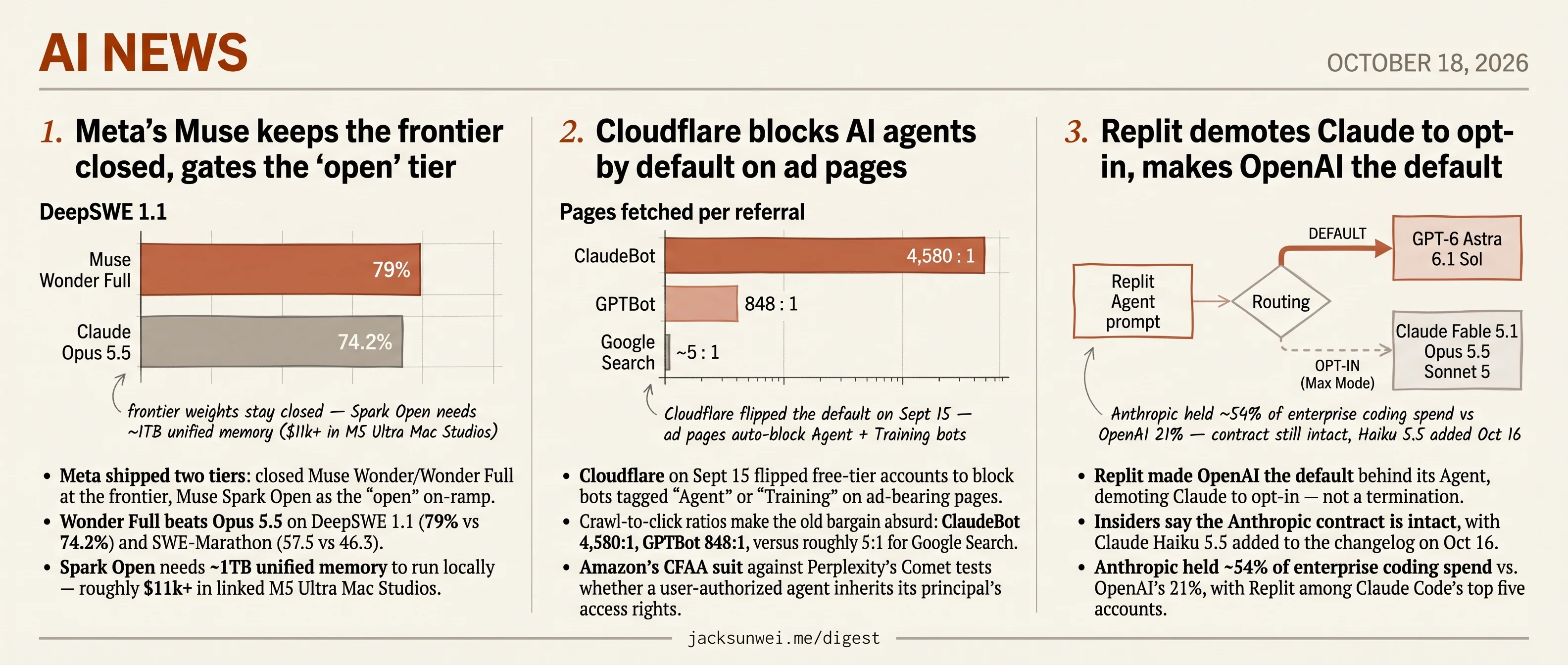
Meta gates 'open' Muse, Replit defaults to OpenAI, Cloudflare blocks AI agents
Meta, Cloudflare, and Replit each flip a default this week — on openness, on crawler access, on which model runs by default.
Meta gates ‘open’ Muse, Replit defaults to OpenAI, Cloudflare blocks AI agents
TL;DR
- Meta’s Muse Spark Open needs ~$11k of linked M5 Ultra hardware to run locally.
- Wonder Full beats Opus 5.5 on DeepSWE 1.1 at 79% vs 74.2% while staying closed-weights.
- Cloudflare default-blocks bots tagged Agent or Training on ad pages, citing 4,580:1 ClaudeBot crawl ratios.
- Replit makes OpenAI its Agent default and demotes Claude to opt-in despite an intact Anthropic contract.
- Anthropic still held ~54% of enterprise coding spend to OpenAI’s 21% going into the swap.
Today’s frontier beat is three gatekeepers quietly flipping defaults in their own favor. Meta ships Muse at two tiers and calls the cheaper one open, but Spark Open needs roughly $11k of linked M5 Ultra hardware before it runs locally — and Nathan Lambert gives US open weights about six months before a possible Executive Order caps frontier releases. Cloudflare switched free-tier accounts on Sept 15 to block any bot tagged Agent or Training on ad-bearing pages, pointing at crawl-to-click ratios like ClaudeBot’s 4,580:1 to justify the flip. Replit made OpenAI the Agent default and demoted Claude to opt-in, even as insiders insist the Anthropic contract is intact and developers read the swap as pricing arbitrage, not a quality call.
The releases themselves aren’t the story — the defaults around them are. Who counts as open, which model runs when a user doesn’t choose, which crawlers get a free pass: each one got rewritten this week by the party holding the switch.
Meta’s Muse keeps the frontier closed, gates the ‘open’ tier
Source: interconnects · published 2026-10-17
TL;DR
- Meta shipped two tiers: closed Muse Wonder/Wonder Full at the frontier, Muse Spark Open as the “open” on-ramp.
- Wonder Full beats Opus 5.5 on DeepSWE 1.1 (79% vs 74.2%) and SWE-Marathon (57.5 vs 46.3).
- Spark Open needs ~1TB unified memory to run locally — roughly $11k+ in linked M5 Ultra Mac Studios.
- Nathan Lambert gives US open weights ~6 months before a possible Executive Order caps frontier releases.
A split-tier launch, not an open-weights revival
“US open weights are back” is the headline Meta would like you to take away. What Meta Superintelligence Labs actually shipped is two different animals: a closed frontier pair (Muse Wonder and Wonder Full) and Muse Spark Open, released under a custom “Muse Model License” that imposes a $20M revenue ceiling on Model-as-a-Service providers and mandates “Built with Muse Spark Open” attribution 1. European observers read the license as deliberately engineered to clear EU AI Act open-source exemptions without ceding anything commercially valuable 1. (Parameter counts for Spark Open — reported as an 816B MoE with 42B active in the primary piece — are not independently verified in the research bundle.)
The hardware floor compounds the gap. Running Spark Open locally takes roughly 1TB of unified memory — in practice, two to four linked Apple M5 Ultra Mac Studios north of $11,000 — which makes “open” a word that only applies to well-funded institutions 2. The actual frontier weights never leave Meta’s servers at all; Wonder Full is gated behind $50–$200/month Muse Code subscriptions rather than a public API 3.
Benchmarks are close; the private-code vibes are not
On third-party trackers, Wonder Full is genuinely competitive with Anthropic’s top tier:
| Benchmark | Wonder Full | Claude Opus 5.5 |
|---|---|---|
| DeepSWE 1.1 | 79% | 74.2% |
| SWE-Marathon | 57.5 | 46.3 |
| OS World | 78.4 | 81 |
| Artificial Analysis Intelligence Index | 56 | 58 |
Source: kie.ai head-to-head 4.
The caveat is practitioner reports surfaced in the Latent Space coverage: testers running Wonder Full against private codebases hit a >50% false-claim rate despite the strong public numbers 3. That gap matters because the model everyone will actually use is the subscription-gated one, not something a third party can independently audit at scale. Memories of the Llama 4 “Maverick” leaderboard-tuning scandal — Meta submitting a tuned variant that didn’t match the downloadable weights — give those dissents extra weight 5.
MSL’s six-month window
Nathan Lambert, who wrote the primary piece, is explicit in his follow-up that this launch is as much geopolitics as product. Without Spark Open, he argues, “there would be 20+ open-weight models built and released by Chinese companies better than the best Western models” — and he gives US open weights roughly six months before a plausible Executive Order bars releases above GPT-5.5/Claude-4.8 capability thresholds 6.
That frame changes how to read the dual-track strategy. Spark Open exists partly to deny Chinese labs an uncontested open-weights narrative while a regulatory window is still open; Wonder Full keeps the commercially valuable weights behind a paywall where the Executive Order can’t reach them anyway. The MSL org itself is a product of this logic — Zuckerberg paid $14.3B for a 49% Scale AI stake to install Alexandr Wang as CAIO after Llama 4’s reception, and the Muse family is the first thing to ship under that reorganization 5.
Net
Meta is back in the tier-1 conversation. But calling this an open-weights revival requires ignoring the license, the hardware floor, the subscription paywall on the actual frontier model, and Lambert’s own warning that the window may close by spring. It is a well-marketed retreat dressed as a comeback.
Further reading
Cloudflare blocks AI agents by default on ad pages
Source: the-verge-ai · published 2026-10-17
TL;DR
- Cloudflare on Sept 15 flipped free-tier accounts to block bots tagged “Agent” or “Training” on ad-bearing pages.
- Crawl-to-click ratios make the old bargain absurd: ClaudeBot 4,580:1, GPTBot 848:1, versus roughly 5:1 for Google Search.
- Amazon’s CFAA suit against Perplexity’s Comet tests whether a user-authorized agent inherits its principal’s access rights.
- Shopify, Walmart, Meta and Stripe launched a Personal Agent Protocol using OAuth to verify agent identity.
The economics finally made blocking rational
The Verge frames the lockout as a mood shift, but the proximate cause has a date on it. On September 15, 2026, Cloudflare began auto-blocking bots classified as “Training” or “Agent” on any page displaying ads, applied by default to new domains and every free-tier account 7. That one toggle covers a large share of the open web.
The telemetry behind the toggle is the real story. Cloudflare’s own measurements show Anthropic’s ClaudeBot fetching about 4,580 pages for every referral it sends back to a publisher, and GPTBot sitting near 848:1 — against roughly 5:1 for traditional Google search 8. Pair that with a 40% year-over-year drop in Google referrals to major publishers and a 61% click-through collapse on queries where AI Overviews appear 9, and “closing the doors” looks less like reflex and more like repricing a trade that stopped paying.
| Crawler | Pages fetched per referral |
|---|---|
| Google Search | ~5 |
| GPTBot | ~848 |
| ClaudeBot | ~4,580 |
Litigation is doing what robots.txt cannot
The blocking isn’t only technical. Amazon’s suit against Perplexity alleges that the Comet agent committed computer fraud by browsing and transacting without disclosing its automated nature — forcing a court to decide whether a bot acting as a human’s proxy inherits that human’s access rights, or is unauthorized per se 10. That question is the governance vacuum under every “agent-first” product roadmap at OpenAI, Google and Meta. Until a court answers it, every autonomous checkout is a potential CFAA defendant and every publisher’s block is a hedge against being the test case.
Web Bot Auth solves identity, not intent
The industry’s standards answer is Web Bot Auth: Ed25519 signatures over HTTP messages per RFC 9421, with public keys discoverable at a /.well-known/http-message-signatures-directory endpoint 11. It replaces trivially-spoofed user-agent strings with cryptography a server can actually verify. The caveat practitioners keep flagging:
Identity does not equal intent. A cryptographically verified bot can still ignore robots.txt or scrape aggressively.
Which is why Cloudflare layered “continuous accountability” scoring on top of signed identity 11. Signing alone will not reopen the doors.
The split is strategic, not web-wide
The “web is closing” headline obscures a sharper fault line. In October 2026, Shopify, Walmart, Meta and Stripe launched the Personal Agent Protocol, using OAuth to verify agent identity and actively courting agent-driven checkout — while Amazon and Adidas restrict autonomous agents from completing purchases, citing unauthorized-transaction risk and the loss of direct customer relationships 12.
That’s the real shape of 2026’s agent web: platforms whose revenue depends on the scroll are throttling and suing; platforms selling SKUs are issuing agents OAuth tokens and a welcome mat. The question isn’t whether agents get blocked, but which half of the internet decides your agent is a customer and which half decides it’s a trespasser.
Replit demotes Claude to opt-in, makes OpenAI the default
Source: techcrunch-ai · published 2026-10-17
TL;DR
- Replit made OpenAI the default behind its Agent, demoting Claude to opt-in — not a termination.
- Insiders say the Anthropic contract is intact, with Claude Haiku 5.5 added to the changelog on Oct 16.
- Anthropic held ~54% of enterprise coding spend vs. OpenAI’s 21%, with Replit among Claude Code’s top five accounts.
- Developers read it as pricing arbitrage rather than a quality win, with Masad’s cited “VBench” numbers internal and unpublished.
The headline overshoots the change
At TechCrunch Disrupt, Replit CEO Amjad Masad said the company is “no longer working with Anthropic.” Within 48 hours he was walking that back: OpenAI is now the default model behind Replit Agent, but Claude is still selectable, and the formal partnership is still in place per people familiar with the deal 13. Replit’s own changelog undercuts the breakup framing further — Claude Haiku 5.5 was added on Oct 16, and late-September production logs still showed Fable 5.1 and Opus 5.5 inside the Agent loop 14.
The actual mechanic is the Max Mode selector. Pro and Enterprise users can still pick Claude Fable 5.1, Opus 5.5 or Sonnet 5 alongside GPT-6 Astra and GPT-6.1 Sol, but Auto routing now favors OpenAI 15. Because most users never leave Auto, Replit quietly redirects the bulk of its token spend to OpenAI without removing Anthropic as an option — which is also why Anthropic has no incentive to escalate publicly.
flowchart LR
    U[Replit user prompt] --> R{Routing mode}
    R -->|Auto default| O[GPT-6 Astra / 6.1 Sol]
    R -->|Max Mode opt-in| C[Claude Fable 5.1 / Opus 5.5 / Sonnet 5]
    O --> A[Replit Agent]
    C --> A
Why the economics bit now
Anthropic went into this with roughly 54% of enterprise coding-model spend to OpenAI’s 21%, Claude Code at an $8B ARR, and Replit named among its top five customers 16. That concentration cuts both ways. Replit had unusual leverage to demand better terms; Anthropic losing default status at a top-five account is a real revenue dent even if the logo stays on the slide.
The pricing backdrop is hostile too. A class action alleges Anthropic’s $200/month Max 20x tier delivers only 6–8× the Pro plan’s capacity, not the advertised 20× 17 — the same unit-economics complaint heavy agentic customers like Replit have been voicing privately. Masad’s onstage grievance about “cost and partnership terms” lines up neatly with that.
Developers aren’t buying the performance story
Practitioner reaction is skeptical, not celebratory. Aggregated commentary argues the swap looks like pricing arbitrage, and power users still prefer Claude for greenfield builds where it follows complex prompts with less hand-holding 18. The “VBench” numbers Masad cited to justify the switch are internal and unpublished; public leaderboards referenced in the same threads still favor Claude on multi-file reasoning.
Many power users still prefer Claude for ‘greenfield’ development due to its ability to follow complex prompts without manual correction. 18
What’s actually at stake
Strip the stage theatrics and this is a default-provider swap at one of Anthropic’s largest coding customers, driven by token economics and dressed up as a divorce. The signal worth tracking isn’t whether Claude disappears from Replit — it won’t — but whether other top-five Claude Code accounts use Replit’s leverage play as a template the next time their bill comes up for renewal. If they do, Anthropic’s 54% coding-spend lead is a lot more fragile than the headline number suggests.
Round-ups
Meta strips TOS clause implying it can scrape news sites for AI
Source: the-verge-ai, techcrunch-ai
Meta pulled commercial-terms language stating it may use content from any domain or URL to develop its AI, following backlash from publishers. A spokesperson insisted the edit does not reflect any change in how Meta actually crawls the web.
Itaú rolls out OpenAI-powered assistant to its full customer base
Source: openai-blog
Brazil’s largest private bank is deploying a conversational interface called ia.i alongside an internal governance platform, IARA, under an AI-First strategy. The rollout tests generative AI at scale inside one of the country’s most tightly regulated sectors.
Anthropic workforce skews senior as meeting time climbs
Source: techcrunch-ai
Anthropic’s internal composition has shifted markedly over the past year, with fewer junior hires and more time spent in meetings. The change hints at how a frontier lab reorganizes work as headcount, product surface, and coordination load all grow.
Narayanan and Kapoor publish research agenda to steer AI past automation
Source: ai-snake-oil
The Normal Tech authors lay out a plan for action that pushes AI development away from pure labor automation and toward augmentation. The agenda frames research priorities, policy levers, and deployment choices as decisions society can actively steer.
Anthropic shares prompting playbook as Google’s new model draws mixed reviews
Source: bens-bites
Ben’s Bites rounds up fresh prompting guidance from Anthropic alongside first impressions of Google’s latest model release. Early hands-on tests landed mixed, with the newsletter’s author saying the model did not click for his own workflows.
‘Super Scam Me’ doc tracks a victim hunting down her romance scammer
Source: ars-technica-ai
The National Geographic documentary follows victims through love-bombing tactics and deepfake-assisted deception, including an exclusive clip in which one woman tracks down her scammer. The film arrives as AI tools make romance fraud cheaper and harder to detect.
Latent Space pilots new ‘High Taste Testers’ show on quiet news day
Source: latent-space
A slow news cycle gave the AINews team room to pilot High Taste Testers, a new show format focused on hands-on model evaluation by discerning users. Episode 1 serves as the pilot run before the format gets a wider rollout.
Footnotes
-
Trending Topics EU — https://www.trendingtopics.eu/muse-spark-open-meta-open-weight-license/
↩ ↩2Muse Spark Open uses a custom ‘Muse Model License’ with a $20 million revenue threshold for Model-as-a-Service providers and mandatory ‘Built with Muse Spark Open’ attribution — a design seen as compliant with EU AI Act open-source exemptions while keeping the strongest weights proprietary.
-
Axiom Studio — open-weights landscape 2026 — https://axiomstudio.ai/blog/open-weight-models-deepseek-kimi-open-vs-closed
↩Running Muse Spark Open locally requires roughly 1TB of unified memory — typically two to four linked Apple M5 Ultra Mac Studios costing over $11,000 — leading developers to argue the model is ‘open’ only for well-funded institutions.
-
RiverfrontAI recap of Latent Space / swyx coverage — https://riverfrontai.com/journal/meta-releases-muse-wonder-models-claiming-return-to-ai-front-3f92c1b9
↩ ↩2The flagship ‘Wonder Full’ is gated behind Muse Code subscriptions ($50–$200/month) rather than the public API, and testers reported a >50% false-claim rate when the model analysed private codebases despite strong public benchmarks.
-
kie.ai head-to-head (Muse Wonder vs Claude Opus 5.5) — https://kie.ai/blog/muse-wonder-vs-claude-opus-5-5
↩Muse Wonder Full scored 79% on DeepSWE 1.1 vs Opus 5.5’s 74.2% and led SWE-Marathon 57.5% to 46.3%, but Opus 5.5 beat it on OS World (81 vs 78.4) and still tops the Artificial Analysis Intelligence Index (58 vs 56).
-
Crypto Briefing — Alexandr Wang / MSL profile — https://cryptobriefing.com/alexandr-wang-meta-superintelligence-labs-leader/
↩ ↩2MSL was formed in June 2025 after the Llama 4 ‘benchmarking scandal’ in which Meta submitted a tuned ‘Maverick’ variant to leaderboards that did not match the downloadable weights; Zuckerberg paid $14.3B for a 49% Scale AI stake to install Wang as CAIO and abandon the purely open-source posture.
-
Interconnects — Nathan Lambert (‘6 months to live’) — https://www.interconnects.ai/p/6-months-to-live-for-open-models
↩Without Spark Open ‘there would be 20+ open-weight models built and released by Chinese companies better than the best Western models’ — but Lambert warns U.S. open weights have roughly six months before an Executive Order may bar releases above GPT-5.5/Claude-4.8 capability thresholds.
-
PYMNTS — Cloudflare blocks AI agents from ad-supported pages — https://www.pymnts.com/news/artificial-intelligence/2026/cloudflare-blocks-ai-agents-from-ad-supported-pages/
↩On September 15, 2026, Cloudflare began automatically blocking bots classified as ‘Training’ or ‘Agent’ on any page displaying advertisements, applied by default to new domains and all free-tier accounts.
-
Cloudflare blog — The Agentic Web / crawl-to-click data — https://blog.cloudflare.com/agentic-web/
↩Anthropic’s ClaudeBot was recorded fetching as many as 4,580 pages for every single referral it sent back to a publisher; GPTBot sits near 848:1, versus roughly 5:1 for traditional Google search.
-
UCLA Anderson Review — ‘Google Zero’ / zero-click web — https://anderson-review.ucla.edu/large-language-models-are-pushing-the-web-toward-zero-clicks/
↩Organic click-through rates have plummeted by as much as 61% on queries where AI Overviews are present, with Google Search referrals to hundreds of major publishers down 40% between July 2025 and July 2026.
-
IAPP — Amazon v. Perplexity liability analysis — https://iapp.org/news/a/amazon-perplexity-dispute-raises-questions-over-ai-agent-liability
↩Amazon alleged that the Comet agent committed computer fraud by browsing and transacting on the site without disclosing its automated nature, raising the central question of whether a bot acting as a proxy for a human user inherits that user’s access rights.
-
Fingerprint — Web Bot Auth guide (RFC 9421) — https://fingerprint.com/blog/web-bot-auth-guide/
↩ ↩2Web Bot Auth uses Ed25519 signatures over HTTP messages with public keys discoverable at /.well-known/http-message-signatures-directory — but identity does not equal intent; a cryptographically verified bot can still ignore robots.txt or scrape aggressively.
-
Matt Britton — Personal Agent Protocol launch — https://www.mattbritton.com/blog-posts/agentic-commerce-ai-agents-personal-agent-protocol
↩Shopify, Walmart, Meta and Stripe announced the Personal Agent Protocol in October 2026 using OAuth to verify agent identity — while Amazon and Adidas have restricted autonomous agents from completing purchases, citing unauthorized-transaction risk and loss of direct customer relationships.
-
AI Weekly / insider pushback summary — https://aiweekly.co/alerts/replit-ceo-says-company-dropped-anthropic-for-openai-but-insiders-dispute-the
↩Replit CEO says company dropped Anthropic for OpenAI — but insiders dispute the claim, saying the formal partnership is still in place and the shift is a default-routing change, not a termination.
-
ExplainX — ‘Claimed vs Verified’ audit — https://explainx.ai/blog/replit-no-longer-working-with-anthropic-masad-disrupt-claimed-vs-verified-2026
↩Replit’s own changelog added Claude Haiku 5.5 as recently as Oct 16, and production data from late September showed Claude Fable 5.1 and Opus 5.5 actively powering core agent workflows — contradicting a clean ‘no longer working with Anthropic’ framing.
-
RapiDevelopers — guide to Replit’s AI models — https://www.rapidevelopers.com/blog/what-llm-does-replit-use-the-complete-guide-to-replits-ai-models
↩Max Mode lets Pro and Enterprise users manually choose Claude Fable 5.1, Claude Opus 5.5 and Claude Sonnet 5 alongside GPT-6 Astra and GPT-6.1 Sol when the default Auto routing isn’t appropriate for complex work.
-
Tech-Insider — Anthropic vs OpenAI 2026 — https://tech-insider.org/anthropic-vs-openai-2026/
↩Menlo Ventures estimated Anthropic captured 54% of enterprise coding-model spend by mid-2026 versus 21% for OpenAI, with Claude Code reaching an $8B ARR and Replit previously among its top five customers.
-
Beeble — Claude Max class action explainer — https://beeble.com/en/blog/why-anthropic-faces-a-class-action-lawsuit-over-its-claude-max-subscription-tiers
↩A class action alleges Anthropic’s $200/month Max 20x plan delivers only 6–8x the capacity of the base Pro plan, not the advertised 20x — fueling broader complaints from heavy agentic users about unit economics.
-
BigGo finance aggregation of developer reaction — https://finance.biggo.com/news/9871b3f0-9ea4-457f-9bbc-b5fddb4c2f74
↩ ↩2Developers argued the change might be driven more by API pricing and business partnerships than pure coding superiority; many power users still prefer Claude for ‘greenfield’ development due to its ability to follow complex prompts without manual correction.