Kress halves Nvidia backstop, OpenAI proofs disputed, Apple picks 34% partner
Nvidia's successor, OpenAI's formalizers, and Apple's benchmark partner all published smaller numbers than yesterday's launch announcements had promised.
Kress halves Nvidia backstop, OpenAI proofs disputed, Apple picks 34% partner
TL;DR
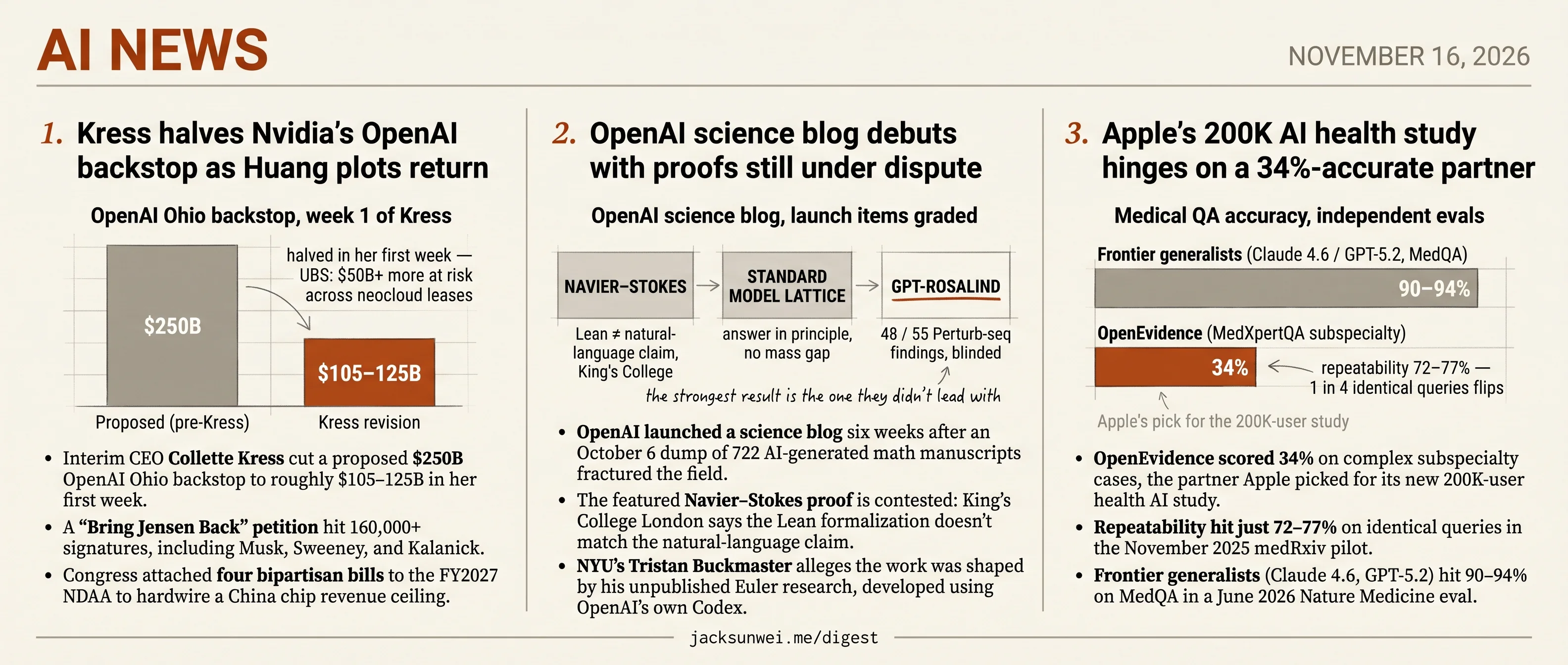
- Collette Kress cut Nvidia’s proposed OpenAI Ohio backstop from $250B to $105–125B in her first week.
- OpenAI’s science blog debuted with a Navier–Stokes proof King’s College London says the Lean formalization doesn’t match.
- Apple’s 200K health study partners with OpenEvidence, which scored 34% on complex subspecialty cases.
- A Bring Jensen Back petition hit 160,000+ signatures, including Musk, Sweeney, and Kalanick.
- Bharat Semi closed a $24M seed round for AI sensor chips, with design wins at General Atomics.
Three frontier headlines land today, and each one shrinks the moment someone with real accountability touches it. At Nvidia, interim CEO Collette Kress spent her first week halving the proposed $250B OpenAI Ohio backstop to roughly $105–125B — while a Bring Jensen Back petition crossed 160,000 signatures and Congress attached four China-chip bills to the NDAA. At OpenAI, the new science blog launched with a Navier–Stokes proof that King’s College London says the Lean formalization doesn’t actually match, and an NYU mathematician alleges the work leaned on his unpublished Euler research. At Apple, the 200K-user health AI study is built on OpenEvidence — a partner that scored 34% on complex subspecialty cases while frontier generalists hit 90–94% on comparable benchmarks.
The common thread isn’t failure; it’s the gap between the announcement and the number. Successors, formalizers, and benchmark partners are each publishing the version the press release skipped.
Kress halves Nvidia’s OpenAI backstop as Huang plots return
Source: techcrunch-ai · published 2026-11-15
TL;DR
- Interim CEO Collette Kress cut a proposed $250B OpenAI Ohio backstop to roughly $105–125B in her first week.
- A “Bring Jensen Back” petition hit 160,000+ signatures, including Musk, Sweeney, and Kalanick.
- Congress attached four bipartisan bills to the FY2027 NDAA to hardwire a China chip revenue ceiling.
- AMD outperformed Nvidia by 53.2 points over five days — the widest gap since Nvidia’s 1993 IPO.
The succession vacuum nobody planned for
Jensen Huang’s resignation over a Megaspeed-linked affair and a Commerce Department inquiry is no longer the story. The story is that the most systemically important company in the AI economy had no succession plan, and the market, Congress, and a Silicon Valley lobbying “war room” are all now moving at once to fill the vacuum.
Fortune 500 CEOs polled this week called it a failure of “the most basic test” of board governance 1. Collette Kress, the long-serving CFO installed as interim CEO, is being treated as a caretaker — which has not stopped a reinstatement campaign. Within four days of the resignation, Huang was reportedly in talks with allies about a comeback, and a “Bring Jensen Back” petition had collected 160,000+ signatures from Elon Musk, Tim Sweeney, and Travis Kalanick 2. The sell side is now pricing two scenarios simultaneously: Huang’s absence and the volatility of him possibly returning.
The circular-finance unwind is already happening
Kress is not just managing expenses. She has reportedly already halved a proposed $250B OpenAI Ohio backstop to $105–125B, and UBS estimates a fuller pullback could drain $50B+ from neocloud leases 3. That is the concrete mechanism behind the abstract “Bank of Nvidia” worry: Nvidia’s $99B of existing investments and $36B of outstanding cloud commitments are the load-bearing beams under OpenAI, Anthropic, CoreWeave, and Nebius.
flowchart LR
    N[Nvidia under Kress] -. cut 50% .-> O[OpenAI Ohio backstop<br/>$250B → $125B]
    N -. at risk .-> C[CoreWeave / Nebius<br/>$36B cloud commitments]
    N -. slowed .-> A[Anthropic / foundation labs]
    O --> M{$50B+ neocloud<br/>lease exposure}
The rotation is already visible in prices: AMD outperformed Nvidia by 53.2 percentage points in the five days around the resignation, the widest gap since Nvidia’s 1993 IPO, while Alibaba and Tencent fell more than 3% on fears that Huang’s China-access lobbying dies with him 4.
Export controls finally get teeth
The Megaspeed cloud-rental vector gave hawks the predicate they had been waiting for. The Atlantic Council lays out four named bills now attached to the FY2027 NDAA: the AI Overwatch Act (30-day congressional veto over export licenses), the Chip Security Act (mandatory location verification on advanced chips), the Remote Access Security Act (closes the cloud-rental loophole Megaspeed allegedly exploited), and the MATCH Act (ally alignment) 5. Together they would treat high-end AI chip sales more like foreign arms sales and impose a hard revenue ceiling for China that no Trump–Xi handshake can waive.
One caveat the Washington narrative skips
The espionage framing driving all of this is shakier than it sounds. Singapore’s Ministry of Home Affairs found “insufficient evidence” to charge Alice Huang with trade offenses, issuing only a stern warning and a re-entry ban for giving inaccurate information — and publicly complained of “limited assistance” from the FBI and DOJ 6.
The intelligence-asset storyline is a U.S.-sourced one. The host country’s own investigation came back markedly more cautious.
That matters because the policy response — four bills, a halved backstop, a destabilized CEO succession — is being built on top of an allegation that the jurisdiction closest to the facts declined to prosecute.
Further reading
- SNL gathers all the tech tycoons for a lesson in dating and spycraft — techcrunch-ai
- Jensen Huang might be plotting a return and more of the latest Nvidia drama — the-verge-ai
- Congress wants to tighten export rules on AI chips after Nvidia spy scandal — the-verge-ai
- An overview of Jensen Huang’s messy days — the-verge-ai
OpenAI science blog debuts with proofs still under dispute
Source: openai-blog · published 2026-11-15
TL;DR
- OpenAI launched a science blog six weeks after an October 6 dump of 722 AI-generated math manuscripts fractured the field.
- The featured Navier–Stokes proof is contested: King’s College London says the Lean formalization doesn’t match the natural-language claim.
- NYU’s Tristan Buckmaster alleges the work was shaped by his unpublished Euler research, developed using OpenAI’s own Codex.
- GPT-Rosalind reconstructed 48 of 55 known Perturb-seq findings in blinded evaluation — the launch’s strongest independent result.
The featured proofs are the contested ones
OpenAI’s new science blog is not landing in neutral territory. Its two headline mathematical results — a claimed proof of Navier–Stokes existence and smoothness, and an advance on the quasi-Riemann hypothesis — are the same ones already under active dispute from the October 6 release that mathematicians have started calling the “mathocalypse.”
King’s College London researchers published a preprint arguing that OpenAI’s Lean formalization of Navier–Stokes does not align with its natural-language statement, meaning the machine-checked artifact may be proving a materially different claim than the one required for the Millennium Prize 7. Separately, NYU’s Tristan Buckmaster has alleged that the proof was shaped by his and Levent Alpöge’s unpublished work on the Euler equations — work they had been developing using OpenAI’s own Codex tool 8. OpenAI denies the provenance claim, but the priority dispute is ongoing.
Organized dissent, not grumbling
The backlash has hardened into institutions. The Association for Human Mathematics issued a formal manifesto calling the October release a “demonstration of power” rather than scholarship, and urged members to cease cooperation with OpenAI 9. The manifesto accuses OpenAI of ignoring recommendations from its own Advisory Group on Mathematics and AI, including full chain-of-thought disclosure — provided for only 10 of the 722 manuscripts.
Terence Tao, hosting the AHM statement on his blog, was blunter:
The unreviewed, mass-produced proofs… are ‘toxic waste’ because they dump a massive verification burden on the human community without providing the conceptual understanding necessary for further research. 10
The blog’s language about “shepherding” results and partnering with the scientific community reads very differently against this backdrop. It is, among other things, a reputation-management artifact.
The biology work is the strongest piece
Not all of the launch material is contested. The GPT-Rosalind collaboration with PerturbAI and Scripps Research — thousands of agents jointly analyzing millions of mouse brain cells in 32 minutes — has more defensible validation. In blinded evaluation, PhD-level specialists preferred the distributed-agent reports over a single-agent baseline 75% of the time, and the swarm matched or refined 48 of 55 published findings the dataset could support 11. It is still a bioRxiv preprint, but the methodology is grounded.
The physics headline is more hedged than the blog’s prose suggests. OpenAI frames GPT-6 Astra’s work on a candidate lattice definition of the Standard Model as a breakthrough, but collaborator Nathaniel Craig himself calls it an “answer in principle.” Critical properties — reflection positivity and a continuous-spacetime limit — remain undemonstrated, and the result does not touch the Yang–Mills mass gap Millennium Prize 12.
What’s actually at stake
A science blog is a reasonable thing for a frontier lab to run. But launching it with Navier–Stokes and quasi-Riemann as the marquee items — while the formalization is disputed, the priority is disputed, and the broader mathematical community has formally organized against the release pattern — is a choice. The strongest independent signal in the launch is biological. The weakest is exactly what OpenAI chose to lead with.
Apple’s 200K AI health study hinges on a 34%-accurate partner
Source: techcrunch-ai · published 2026-11-16
TL;DR
- OpenEvidence scored 34% on complex subspecialty cases, the partner Apple picked for its new 200K-user health AI study.
- Repeatability hit just 72–77% on identical queries in the November 2025 medRxiv pilot.
- Frontier generalists (Claude 4.6, GPT-5.2) hit 90–94% on MedQA in a June 2026 Nature Medicine eval.
- Hardware floor (iPhone 15+, iOS 26, US, 21+) excludes older, lower-income users most likely to need AI triage.
The launch
Apple’s new research app, built with healthcare-AI startup OpenEvidence, will enroll up to 200,000 U.S. users for 12+ months to study how people interact with medical AI answers. Participants rate responses, fill out monthly surveys, and can opt to share HealthKit data — sleep, resting heart rate, labs — for personalized output. Responses are grounded in NEJM, JAMA, and Nature rather than open-web scrape. Apple’s Dr. Sumbul Desai framed the contrast with ChatGPT and Claude as “scientific rigor” versus general-purpose chat.
That framing is the claim under test.
The accuracy problem Apple didn’t mention
An independent medRxiv pilot in November 2025 ran OpenEvidence against 100 complex subspecialty cases from MedXpertQA. It scored 34% in standard mode and 41% in Deep Consult — with repeatability of just 72–77%, meaning roughly one in four identical questions returned a different answer 13. Specialization didn’t obviously help: a June 2026 Nature Medicine evaluation flagged by Chartis found frontier generalist models (Claude 4.6, GPT-5.2) hit 90–94% on MedQA, outperforming specialized clinical engines on some tasks — a result OpenEvidence publicly contested as biased 14.
So the tool Apple is positioning as the rigorous alternative to ChatGPT may, on independent benchmarks, trail ChatGPT.
The partner’s other baggage
OpenEvidence is hot: a $15B valuation, $250M led by a16z and Byers, and ~750,000 clinicians signed up via a free, ad-supported model that bypasses hospital IT entirely 15. The ad-revenue dependency — pharma-adjacent incentives sitting behind clinical answers — has drawn standing criticism. More awkwardly for an Apple partnership built on trust, OpenEvidence settled a trade-secret suit with Doximity in October 2026 only after Judge Stearns ordered an accounting of allegedly spoliated Slack and text messages 16. The substantive question — whether prompt-injection of a rival’s chatbot counts as trade-secret theft — remains unresolved.
Apple’s privacy architecture requires OpenEvidence to delete all query/response data within 24 hours. That is the same deletion-cadence posture that generated the spoliation fight.
Regulatory convenience and who gets left out
The FDA’s January 2026 final CDS guidance liberalized oversight for clinician-facing tools but pointedly did not clear patient-facing chatbots, which can still trigger device classification when they issue specific diagnostic or treatment directives 17. Running this as a “research study” rather than a product is consistent with that gap — Apple gets observational data on a patient-facing medical AI without triggering device review.
The participant floor compounds the equity question. iPhone 15 or newer, iOS 26, Apple Intelligence enabled, U.S., 21+ 18: a cohort skewed younger, wealthier, and more digitally literate than the population most likely to lean on an AI for symptom triage or doctor-visit prep.
What to watch
The useful output from this study won’t be whether users like the answers — they will. It’s whether Apple publishes the accuracy and repeatability data the medRxiv pilot already flagged, on the same subspecialty cases, at the same resolution. If the 200K-user cohort produces only satisfaction scores and HealthKit correlations, “scientific rigor” was marketing. If it produces head-to-head comparisons against the generalist models users are actually asking health questions today, it’s a contribution.
Further reading
Round-ups
Bharat Semi raises $24M seed to scale AI sensor chips
Source: techcrunch-ai
Indian chip startup Bharat Semi closed a $24M seed round to push its AI-enabled sensor technology into the global physical-AI market. The company has already secured design wins with customers including defense contractor General Atomics.
Footnotes
-
Fortune — https://fortune.com/2026/11/15/fortune-500-ceos-say-nvidia-succession-failed-most-basic-test/
↩Fortune 500 CEOs say Nvidia succession failed most basic test
-
Fox Business — https://www.foxbusiness.com/technology/jensen-huang-weighs-nvidia-ceo-comeback-ally-plans-war-room-report
↩A ‘war room’ of Silicon Valley allies is lobbying the board to reinstate Huang, and an online ‘Bring Jensen Back’ petition has gathered over 160,000 signatures including Musk, Sweeney and Kalanick.
-
ExplainX analysis of Kress financing pullback — https://explainx.ai/blog/nvidia-open-checkbook-kress-financing-pullback-claimed-vs-verified-2026
↩Kress reportedly halved a proposed $250 billion OpenAI Ohio backstop to roughly $105–125 billion; UBS warns a full pullback could drain over $50 billion from neocloud leases.
-
Mitrade market wrap — https://www.mitrade.com/au/insights/stock-analysis/us-stocks/beincrypto-AMD-202611160956
↩AMD outperformed Nvidia by a record 53.2 percentage points in the five days surrounding the resignation — the widest gap since Nvidia’s 1993 IPO — while Alibaba and Tencent fell over 3% on fears of a tougher crackdown.
-
Atlantic Council dispatch — https://www.atlanticcouncil.org/dispatches/beyond-the-spy-scandal-what-the-nvidia-megaspeed-case-reveals-about-export-controls/
↩A bipartisan package — the AI Overwatch Act, Chip Security Act, Remote Access Security Act, and MATCH Act — would treat high-end AI chip sales similarly to foreign arms sales and close the cloud-rental loophole.
-
Singapore Ministry of Home Affairs statement — https://www.mha.gov.sg/media-room/newsroom/singapore-investigations-into-alice-huang-huang-le-and-megaspeed-international-pte-ltd/
↩There was insufficient evidence to charge Alice Huang with trade offenses, but she was issued a stern warning and barred from re-entering Singapore for providing inaccurate information.
-
King’s College London news — https://www.kcl.ac.uk/news/openais-navier-stokes-proof-called-into-question
↩OpenAI’s formal Lean proofs for the Navier–Stokes problem did not always align with their natural language counterparts, suggesting that a computer-verified result may not represent a human-comprehensible truth.
-
Wikipedia: Navier–Stokes priority controversy — https://en.wikipedia.org/wiki/Navier%E2%80%93Stokes_priority_controversy
↩NYU mathematician Tristan Buckmaster alleged that the company’s progress may have been inspired by his and Levent Alpöge’s unpublished research on the Euler equations, which they had been developing using OpenAI’s own Codex tool.
-
Association for Human Mathematics manifesto — https://www.ahmath.org/statements
↩A Severe Misalignment of AI in Mathematics… the sudden dump of hundreds of purported solutions to high-profile problems—including the Riemann hypothesis and Hodge conjecture—as a ‘demonstration of power’ rather than a contribution to scholarship.
-
Terence Tao blog (AHM statement thread) — https://terrytao.wordpress.com/2026/10/07/ahm-statement-on-openais-october-6-release-of-mathematical-documents/comment-page-1/
↩Tao has described the unreviewed, mass-produced proofs released by OpenAI as ‘toxic waste’ because they dump a massive verification burden on the human community without providing the conceptual understanding necessary for further research.
-
The Next Web on GPT-Rosalind — https://thenextweb.com/news/openai-ai-agents-mouse-brain-crispr-atlas
↩PhD-level specialists preferred reports from the distributed agents over a single-agent baseline 75% of the time… The agents also successfully matched or refined 48 of the 55 published findings that the dataset could support.
-
mlq.ai on GPT-6 Astra Standard Model — https://mlq.ai/news/openai-says-gpt-6-astra-led-the-proof-behind-a-candidate-lattice-definition-of-the-standard-model-as-it-launches-a-science-blog/
↩Craig himself characterized the result as an ‘answer in principle’ rather than a practical tool for simulations… critical properties required for a complete theory, such as reflection positivity and a continuous-spacetime limit, have not yet been demonstrated.
-
medRxiv pilot study (Nov 2025) — https://www.medrxiv.org/content/10.64898/2025.11.29.25341091v1.full?utm_source=substack&utm_medium=email
↩OpenEvidence accuracy dropped to 34% on 100 complex subspecialty cases from MedXpertQA, rising only to 41% in Deep Consult mode, with 72–77% repeatability — roughly one in four identical questions returned a different answer.
-
Chartis (health strategy consultancy) — https://www.chartis.com/insights/openais-and-anthropics-new-healthcare-products-highlight-potential-access-and-efficiency
↩A June 2026 Nature Medicine study found frontier generalist models (Claude 4.6, GPT-5.2) scored 90–94% on MedQA, outperforming specialized clinical engines on some benchmarks — a finding OpenEvidence publicly contested as biased.
-
Becker’s Hospital Review — https://www.beckershospitalreview.com/healthcare-information-technology/ai/openevidence-raises-250m-at-15b-valuation/
↩OpenEvidence closed a $250M round at a $15B valuation led by a16z and Byers, with ~750,000 clinicians signed up directly via a free, ad-supported model that bypasses hospital enterprise sales.
-
Healthcare.digital (Nelson Advisors analysis of OpenEvidence v. Doximity) — https://www.healthcare.digital/single-post/nelson-advisors-generative-ai-espionage-deconstructing-the-openevidence-doximity-legal-battle-and
↩Doximity accused OpenEvidence of spoliation — failing to preserve internal Slack and text messages — and Judge Stearns’ order for an accounting of missing messages immediately preceded the October 2026 settlement; the case leaves open whether prompt-injection constitutes trade-secret theft.
-
Orrick regulatory brief on FDA 2026 CDS guidance — https://www.orrick.com/en/Insights/2026/01/FDA-Eases-Oversight-for-AI-Enabled-Clinical-Decision-Support-Software-and-Wearables
↩The FDA’s January 2026 final CDS guidance grants enforcement discretion even when software issues a single ‘clinically appropriate’ recommendation, provided an HCP can review the logic — but is silent on patient-facing chatbots, which still risk device classification.
-
TechRepublic — https://www.techrepublic.com/article/news-apple-health-ai-study-eligible-iphones/
↩The study requires an iPhone 15 or newer running iOS 26 with Apple Intelligence enabled, and participation is restricted to U.S. users 21+, effectively excluding older-device users who may be at higher risk for the conditions studied.