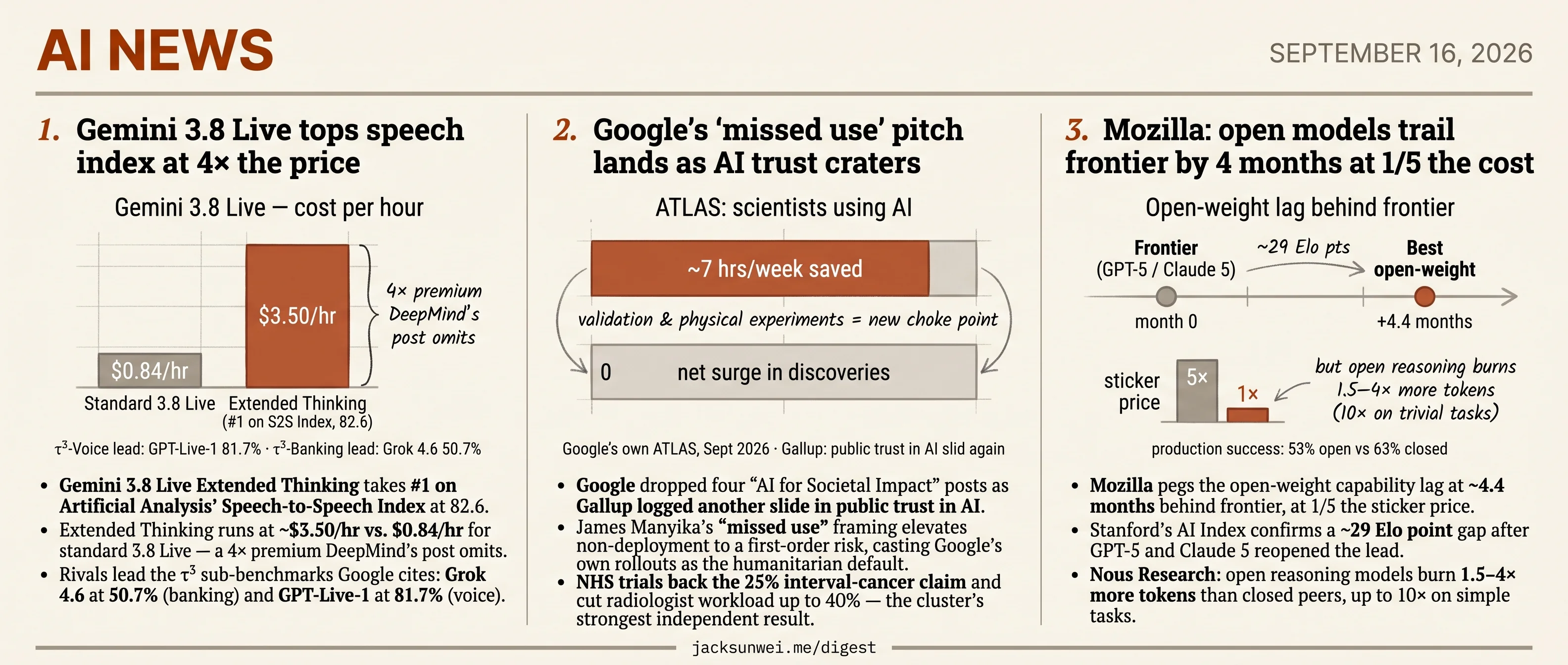
Gemini 3.8 hides 4× cost, Google pitches 'missed use', Mozilla logs open lag
Three vendor pitches — Google's Gemini 3.8 speech win, its missed-use framing, Mozilla's open-weight case — each shrink under third-party data.
Gemini 3.8 hides 4× cost, Google pitches ‘missed use’, Mozilla logs open lag
TL;DR
- Gemini 3.8 Live Extended Thinking hits #1 on the speech-to-speech index at 4× the standard hourly price.
- Google’s ATLAS logs no discovery surge despite scientists saving ~7 hrs/week with AI.
- Mozilla pegs open-weight models 4.4 months behind frontier at 1/5 the sticker price.
- AIUC raises $40M to underwrite rogue-agent misbehavior, with a hotline agents themselves can call.
- 61% of US voters oppose new data centers as gas-burn forecasts harden the siting backlash.
Today is a positioning day. Google ships a Gemini 3.8 Live variant that tops Artificial Analysis’ speech index — and buries the 4× hourly premium plus the sub-benchmarks where Grok and GPT-Live-1 actually lead. Google also drops four AI for Societal Impact posts that reframe non-deployment as harm, on the same day Gallup logs another slide in public trust and Google’s own ATLAS shows no measurable discovery surge from the 7 hours a week scientists say they’re saving.
Mozilla’s State of Open Models sits in the same shape from the other side: open weights lag frontier by ~4.4 months at a fifth of the price, but Stanford’s index confirms GPT-5 and Claude 5 just reopened a ~29-Elo gap, and Nous Research clocks open reasoning models burning up to 10× more tokens on simple tasks. Three pitches, three third-party numbers that don’t ratify them. In the round-ups: OpenAI, Anthropic and Google’s quiet safety coordination surfaces against Washington pushback, and AIUC raises $40M to underwrite rogue agents.
Gemini 3.8 Live tops speech index at 4× the price
Source: deepmind-blog · published 2026-09-15
TL;DR
- Gemini 3.8 Live Extended Thinking takes #1 on Artificial Analysis’ Speech-to-Speech Index at 82.6.
- Extended Thinking runs at ~$3.50/hr vs. $0.84/hr for standard 3.8 Live — a 4× premium DeepMind’s post omits.
- Rivals lead the τ³ sub-benchmarks Google cites: Grok 4.6 at 50.7% (banking) and GPT-Live-1 at 81.7% (voice).
- Mid-session notifications from WhatsApp/Slack/SMS have already hijacked Gemini Live to exfiltrate location data.
The pitch: voice that doesn’t go silent to think
Google DeepMind’s 3.8 Live release reframes voice agents around one architectural claim: the model no longer pauses to reason. Extended Thinking runs tool calls and multi-step logic in the background while the conversation continues, using verbal filler (“I’m looking into the data”) to bridge latency. The demo reel — playing chess from a live camera feed, turning a sketch into a React component while narrating progress — is meant to sell asynchronous interaction as the new baseline for voice.
The pitch has an independently verified anchor. Artificial Analysis confirms Extended Thinking at #1 on the Speech-to-Speech Quality Index with 82.6 1. The base 3.8 Live sits second on the Speech Agent Arena.
The number Google left out: a 4× price gap
DeepMind’s post doesn’t mention what tier-two costs. Artificial Analysis does: ~$3.50/hour for Extended Thinking versus $0.84/hour for standard 3.8 Live 1. The reasoning that earns the top ranking runs at roughly a 4× premium — a material fact for anyone budgeting a call-center or support deployment.
Benchmark leadership is genre-specific
Google cites 68.6% on τ-Voice and 35.1% on τ³-Banking as evidence of “leading the field in agentic autonomy.” Independent leaderboard tracking says otherwise 2:
| Benchmark | Gemini 3.8 Live ET | Leader |
|---|---|---|
| Speech-to-Speech Index | 82.6 (#1) | Gemini 3.8 Live ET 1 |
| τ³-Voice | 68.6% | GPT-Live-1 — 81.7% 2 |
| τ³-Banking | 35.1% | Grok 4.6 — 50.7% 2 |
| Big Bench Audio | 97.7% | Gemini 3.8 Live ET |
Gemini wins the composite quality index. It does not lead every agentic sub-benchmark it name-checks.
Naturalness dissent
The Speech Agent Arena silver masks a softer signal. In Prolific’s HUMAINE blind benchmark, DeepSeek V3 beat Gemini 3 on communication style, preferred 43% of the time, and Google’s own developer forums have logged a “prosody regression” since March — voices like Lyra reportedly lost warmth and sound “artificially flattened” 3. Some testers say the older 3.1 Flash Live still wins blind trials 3. Reason-while-speak is a real capability; whether it sounds more human is contested.
Safety story is thinner than the release implies
DeepMind leans on SynthID watermarking as the provenance answer. Independent audio-watermarking reviewers report that neural re-synthesis through codecs like EnCodec strips the mark cleanly, and overwriting attacks displace the original watermark with near-100% success 4. Separately, SafeBreach and Kaspersky have already demonstrated a Gemini Live-specific exploit: crafted notifications from WhatsApp, Slack, or SMS delivered mid-session can hijack the assistant into forwarding location data to an external server 5. Widening the tool-call surface with background execution enlarges that attack surface rather than shrinking it.
flowchart LR
    U[User voice session] --> G{Gemini 3.8 Live ET}
    N[WhatsApp/Slack/SMS notification] -. injected prompt .-> G
    G --> T[Background tool calls]
    T -. exfiltrated location .-> X((External server))
What actually shipped
A defensible #1 on one composite index, a genuine architectural step in async function calling, and an integration story across Docs/Gmail/Search that OpenAI can’t match on price 6. Also: a 4× price cliff between tiers, category losses to Grok and GPT-Live-1, a contested naturalness claim, and pre-existing exploits against the exact surface being expanded. Developers should also note that turnComplete: true no longer means idle — they’ll need to track new interaction_status fields 6.
Google’s ‘missed use’ pitch lands as AI trust craters
Source: google-ai-blog · published 2026-09-15
TL;DR
- Google dropped four “AI for Societal Impact” posts as Gallup logged another slide in public trust in AI.
- James Manyika’s “missed use” framing elevates non-deployment to a first-order risk, casting Google’s own rollouts as the humanitarian default.
- NHS trials back the 25% interval-cancer claim and cut radiologist workload up to 40% — the cluster’s strongest independent result.
- Google’s own ATLAS shows scientists saving ~7 hrs/week with AI have produced no surge in discoveries.
A synchronized pitch, not a scattered week
Google published a four-post collection on the same day — a headline essay on AI-accelerated science, a societal-impact hub, a language-inclusion post, and an AI & Economy ATLAS refresh — and treated the bundle as a single argument: AI is a positive feedback loop for human welfare, and the biggest risk is failing to deploy it. That’s the “missed use” trilemma James Manyika has been road-testing (misuse / misapplication / missed use), and it’s the connective tissue linking every member of the drop.
The timing is not incidental. A Gallup poll released the day after Google’s collection landed found trust in AI has fallen again over the past year — including among daily users — with respondents explicitly rejecting industry self-policing 7. Read into that headwind, “bold and responsible” reads less like disclosure and more like positioning. Microsoft’s contemporaneous “Community-First AI Infrastructure” pledge to not raise local utility rates 8 suggests a broader industry pivot to societal-benefit framing at a moment of eroding permission to operate.
What the numbers actually say
The medical claims hold up best under outside scrutiny. Independent NHS-run trials corroborate the 25% interval-cancer detection lift and add a workload dimension Google’s post underplays: up to 40% fewer radiologist reads, though arbitration specialists still overrule some AI catches 9. That’s a real, deployed win.
The rest is softer. AMIE’s diagnostic-dialogue victories come from simulated patients and video OSCEs; clinicians caution that beating doctors in scripted encounters “does not account for the messy complexity of actual patient care” and that AMIE remains a support tool, not a replacement 10. WeatherNext 3’s “50% better precipitation” headline has a specific hole worth naming: Brightband’s Operational WeatherBench — the main third-party leaderboard — excludes WeatherNext 3’s precipitation output because Google trained it against satellite targets rather than the reanalysis fields peer models use, making the comparison Google implies non-comparable to the one independent evaluators actually run 11. Weights remain closed, so the community can’t re-run it either.
The paradox Google shipped in its own dashboard
The most interesting tension is internal. The ATLAS September update, which anchors the cluster’s economic-opportunity story, contains a joint MIT FutureTech finding that scientists save nearly seven hours a week with AI but this has not produced a surge of discoveries. Validation and physical experimentation have become the new choke point, and an “unprecedented backlog of untested hypotheses” is accumulating 12.
That is a productivity paradox buried inside a launch designed to celebrate acceleration. It doesn’t refute the AlphaFold-scale wins — 200 million protein structures is a real artifact — but it complicates the linear “AI → discovery → welfare” arrow the primary essay draws.
Net read
The cluster’s strongest evidence (clinical imaging) is genuinely load-bearing. Its weakest links are the closed-weight forecasting claims and an economic narrative partly undercut by Google’s own data. The framing move — non-deployment as a headline risk — is the actual news, and it’s aimed squarely at a public that Gallup says has stopped granting the industry the benefit of the doubt 7.
Further reading
- AI for Societal Impact — google-ai-blog
- AI for everyone in every language — google-ai-blog
- New insights from Google’s AI & Economy ATLAS — google-ai-blog
Mozilla: open models trail frontier by 4 months at 1/5 the cost
Source: ars-technica-ai · published 2026-09-15
TL;DR
- Mozilla pegs the open-weight capability lag at ~4.4 months behind frontier, at 1/5 the sticker price.
- Stanford’s AI Index confirms a ~29 Elo point gap after GPT-5 and Claude 5 reopened the lead.
- Nous Research: open reasoning models burn 1.5–4× more tokens than closed peers, up to 10× on simple tasks.
- Only 53% of open-model pilots reach production vs. 63% for closed APIs.
What Mozilla actually measured
Mozilla’s State of Open Source AI report frames the current gap as a stable plateau, not a closing race: pay frontier prices and you get roughly a four-month head start on capability, at about 5× the per-token cost of the best open-weight alternatives 13. Stanford’s 2026 AI Index tells a compatible story from a different angle. The LMArena Elo gap between the top proprietary and open-weight systems fell from 8% in early 2024 to essentially zero by January 2025, then reopened to about 29 Elo points once GPT-5 and Claude 5 shipped in late 2025 14. Read together, Mozilla’s “4.4 months” is less a snapshot than a rhythm — frontier labs sprint, open weights catch up within a quarter or two, repeat.
The 5× number is a sticker price, not a delivered price
The cost half of the headline is where the reporting gets thinner. Nous Research’s token-efficiency benchmark finds open-weight reasoning models consume 1.5–4× more tokens than GPT-5 or Claude equivalents to solve identical problems, and up to 10× more on trivial retrieval tasks 15. Multiply that against a 5× per-token discount and the delivered savings on a Kimi K3 or DeepSeek deployment shrink fast — sometimes to nothing. Lenovo’s 2026 TCO analysis adds the infrastructure caveat: on-prem inference can break even against closed APIs in under four months, but only for high-utilization workloads and only when the buyer already has the DevOps and MLOps talent to run the stack 16. Neither finding refutes Mozilla’s arithmetic; both suggest it describes a ceiling, not a floor.
What buyers are actually doing
The adoption data cuts against the “open weights are eating the frontier” read. Coverage of the Mozilla report notes that while a large majority of surveyed teams experiment with open models, only 53% ship them to production — versus 63% for closed APIs 17. DoorDash is the poster child for the emerging split: open weights as the default for summarization and routine coding, closed models reserved for a narrow band of long-horizon agent work and expert-judgment tasks 17. MindStudio’s tracking puts the market weight bluntly: roughly 80% of global token volume still runs through closed systems, and the reason isn’t intelligence — it’s the “commodity enterprise features” (SLAs, compliance certifications, multimodal, guaranteed uptime) that proprietary vendors bundle in 18.
The takeaway
Mozilla’s numbers hold up, but the framing needs adjustment. The frontier premium in 2026 is increasingly a convenience-and-compliance premium rather than an intelligence premium — and the token-efficiency gap Nous documented 15 means the raw price story is softer than headline pricing implies. The interesting question isn’t whether open weights will close the capability gap again (they will, on schedule). It’s whether the open ecosystem can close the operational gap — the 10-point production-success delta 17 and the missing enterprise plumbing 18 — before the next frontier sprint reopens the lead.
Round-ups
OpenAI, Anthropic and Google quietly coordinate on AI safety as Washington pushes back
Source: techcrunch-ai, techcrunch-ai, mit-tech-review-ai, bens-bites
Weeks of private safety talks among the three labs surfaced just as Nvidia’s Jensen Huang argued regulation is unnecessary and the Trump team dismissed extinction concerns to keep pace with China. The split frames the fall’s policy fight: self-governance versus federal rules.
AIUC raises $40M to underwrite rogue AI agents, launches tip hotline
Source: techcrunch-ai, techcrunch-ai
Founded by an early Anthropic hire and METR’s former COO, AIUC closed a Ribbit-led Series A to insure against agent misbehavior. Alongside the round, the team opened an AI Contact Hotline where agents themselves can discreetly report wrongdoing to authorities.
Salesforce and Nvidia ship Koa, a reasoning model tuned for sales work
Source: techcrunch-ai
Koa targets sales, marketing, and customer-support tasks rather than general chat, and runs on Nvidia’s open-weight Nemotron base. The pairing hints at an enterprise path around frontier labs: buy the reasoning stack from your CRM vendor, skip the API tax.
WhatsApp Business gets an MCP server for Claude, Cursor and Codex
Source: techcrunch-ai
Meta’s new Model Context Protocol server exposes WhatsApp Business setup, message templates, testing, and troubleshooting to AI coding agents. Developers can drive onboarding from Claude, Cursor, Codex, or ChatGPT rather than clicking through Meta’s console — the first major MCP surface from the company.
61% of US voters oppose new data centers as gas demand and siting fights escalate
Source: the-verge-ai, techcrunch-ai, techcrunch-ai
A New York Times/Siena poll of 1,503 likely voters found 61% oppose data-center construction, echoing a Philadelphia backlash over building near a defunct oil refinery. Forecasts that US data centers will burn more natural gas than Germany and Japan combined by 2035 are hardening the mood.
Agility’s new humanoid squats to avoid hitting human coworkers
Source: ars-technica-ai
The updated Digit robot reacts to nearby workers by stopping and lowering itself instead of relying on physical cages or safety barriers. Agility says the behavior clears humanoids to operate in shared warehouse floors without the fencing that currently walls off industrial robots.
Good Start Labs shows game-trained AI transfers to financial research
Source: latent-space
A model trained on a railroad simulation game improved at financial research tasks in one variant, with the gains traced to training design rather than the game itself. The result revives the case that synthetic game environments can teach transferable reasoning skills.
Footnotes
-
Artificial Analysis — Speech-to-Speech Index — https://artificialanalysis.ai/articles/announcing-the-artificial-analysis-speech-to-speech-index
↩ ↩2 ↩3Gemini 3.8 Live Extended Thinking tops the index at 82.6, but costs ~$3.50/hour versus $0.84/hour for the standard Gemini 3.8 Live — the reasoning capabilities that propelled it to the top come at roughly a 4x premium.
-
Rail Governance — τ-bench leaderboard analysis — https://railgovernance.com/posts/model-validation-requirements-for-ai-agents-that-execute-transactions
↩ ↩2 ↩3xAI’s Grok 4.6 currently leads τ³-Banking at 50.7%, ahead of GPT-5.5 at 44.6%; on τ³-Voice, OpenAI’s GPT-Live-1 holds top spot at 81.7% success across retail/airline/telecom domains.
-
Unite.ai — Gemini 3.8 Live launch coverage — https://www.unite.ai/google-launches-gemini-3-8-live-and-extended-thinking-voice-models/
↩ ↩2In the HUMAINE blind benchmark conducted by Prolific, Gemini 3 lost the ‘communication style’ category to DeepSeek V3, which users preferred 43% of the time; developer forums have flagged a ‘prosody regression’ with voices like Lyra sounding ‘artificially flattened’ since March 2026.
-
Watermarking.media — audio watermark robustness review — https://watermarking.media/articles/can-music-watermarks-be-removed/
↩Neural re-synthesis through codecs like EnCodec can rebuild the waveform without the watermark, effectively erasing it; overwriting attacks can embed a new watermark over the original with nearly 100% success, displacing the first marker.
-
Kaspersky — Gemini assistant attacks — https://www.kaspersky.co.uk/blog/gemini-assistant-attacks/30743/
↩SafeBreach researchers demonstrated that crafted notifications from WhatsApp, Slack or SMS delivered during an active Gemini Live session could trick the assistant into executing hidden commands such as forwarding location data to an external server.
-
Webscraft.org — GPT-Realtime-2 vs Gemini Live comparison — https://webscraft.org/blog/gptrealtime2-vs-gemini-live-api-scho-obrati-dlya-golosovogo-agenta-u-2026-rotsi?lang=en
↩ ↩2OpenAI remains preferred for enterprise flexibility due to native Model Context Protocol (MCP) support and mature Structured Outputs; Gemini is ‘orders of magnitude’ cheaper for high-volume audio input and wins deep grounding via Workspace/Search integration.
-
PCMag (Gallup poll, Sept 16, 2026) — https://www.pcmag.com/news/trust-in-ai-eroded-significantly-over-past-year-even-among-those-who-use
↩ ↩2Trust in AI eroded significantly over the past year, even among those who use it… respondents were particularly unwilling to allow the tech industry to police itself.
-
NetworkWorld on Microsoft ‘pay its way’ pledge — https://www.networkworld.com/article/4116506/microsoft-tells-communities-it-will-pay-its-way-as-ai-data-center-resource-usage-sparks-backlash.html
↩Microsoft launched a ‘Community-First AI Infrastructure’ initiative, promising that its massive data center expansions will not increase local power or water utility rates for residents.
-
AdwaitX on NHS breast cancer trials — https://www.adwaitx.com/google-ai-breast-cancer-detection-nhs-2026/
↩The AI functioned as an independent ‘second reader,’ reducing radiologist workload by up to 40% while identifying more invasive cancers than the standard double-reading process… clinical arbitration specialists occasionally overrule AI-detected cases.
-
News-Medical on AMIE video consultations — https://www.news-medical.net/news/20260812/AI-took-on-doctors-in-simulated-video-consultations-and-the-results-were-striking.aspx
↩AI ‘beating’ doctors in a controlled text-based or video simulation does not account for the messy complexity of actual patient care… AMIE remains a clinical support tool rather than a replacement for human diagnostic judgment.
-
MLQ.ai analysis of WeatherNext 3 — https://mlq.ai/news/googles-weathernext-3-refreshes-global-forecasts-hourly-but-still-relies-on-physics-model-data/
↩Brightband currently omits WeatherNext 3’s precipitation data from its comparative scoring… Google’s 0.1-degree precipitation output is trained against satellite targets, making it non-comparable to reanalysis-based fields used by other systems.
-
YourStory on ATLAS September update — https://yourstory.com/ai-story/google-ai-economy-atlas-global-ai-usage
↩Scientists report saving nearly seven hours per week using AI, yet this has not translated into a surge of discoveries… nearly half of scientists spend significant time validating AI outputs, leading to an unprecedented backlog of untested hypotheses.
-
Mozilla Foundation — State of Open Source AI report — https://blog.mozilla.org/en/mozilla/mozilla-state-of-open-source-ai-report/
↩State of Open Source AI report
-
Stanford HAI 2026 AI Index (Technical Performance) — https://hai.stanford.edu/ai-index/2026-ai-index-report/technical-performance
↩the overall capability gap … fell from 8% in early 2024 to nearly 0% by January 2025 … the release of next-generation frontier models such as GPT-5 and Claude 5 in late 2025 reopened a marginal lead, with the gap stabilizing at approximately 29 Elo points by September 2026
-
Nous Research — ‘Measuring Thinking Efficiency in Reasoning Models’ — https://nousresearch.com/measuring-thinking-efficiency-in-reasoning-models-the-missing-benchmark
↩ ↩2open-weight models … often consume 1.5 to 4 times more tokens than closed models from OpenAI or Anthropic to solve identical tasks … some open models used up to 10 times more tokens
-
Lenovo Press — On-Premise vs Cloud Generative AI TCO (2026) — https://lenovopress.lenovo.com/lp2368-on-premise-vs-cloud-generative-ai-total-cost-of-ownership-2026-edition
↩on-premises infrastructure can achieve a breakeven point against cloud APIs in under four months for high-utilization workloads, [but] demands significant DevOps investment and specialized talent
-
AIChatDaily — coverage of Mozilla report — https://www.aichatdaily.com/ai-models/chinese-open-weight-models-close-gap-us-frontier-ai
↩ ↩2 ↩3companies like DoorDash are reportedly shifting routine tasks … to cheaper open-weights models as the default … only 53% of teams using open models successfully move them into production, compared to 63% for those using closed APIs
-
MindStudio — ‘Open Source vs Closed Source AI Pricing War’ — https://www.mindstudio.ai/blog/open-source-vs-closed-source-ai-pricing-war
↩ ↩2approximately 80% of global token usage remains concentrated in closed systems … enterprises are willing to pay for the ‘commodity enterprise features’ … that proprietary stacks provide