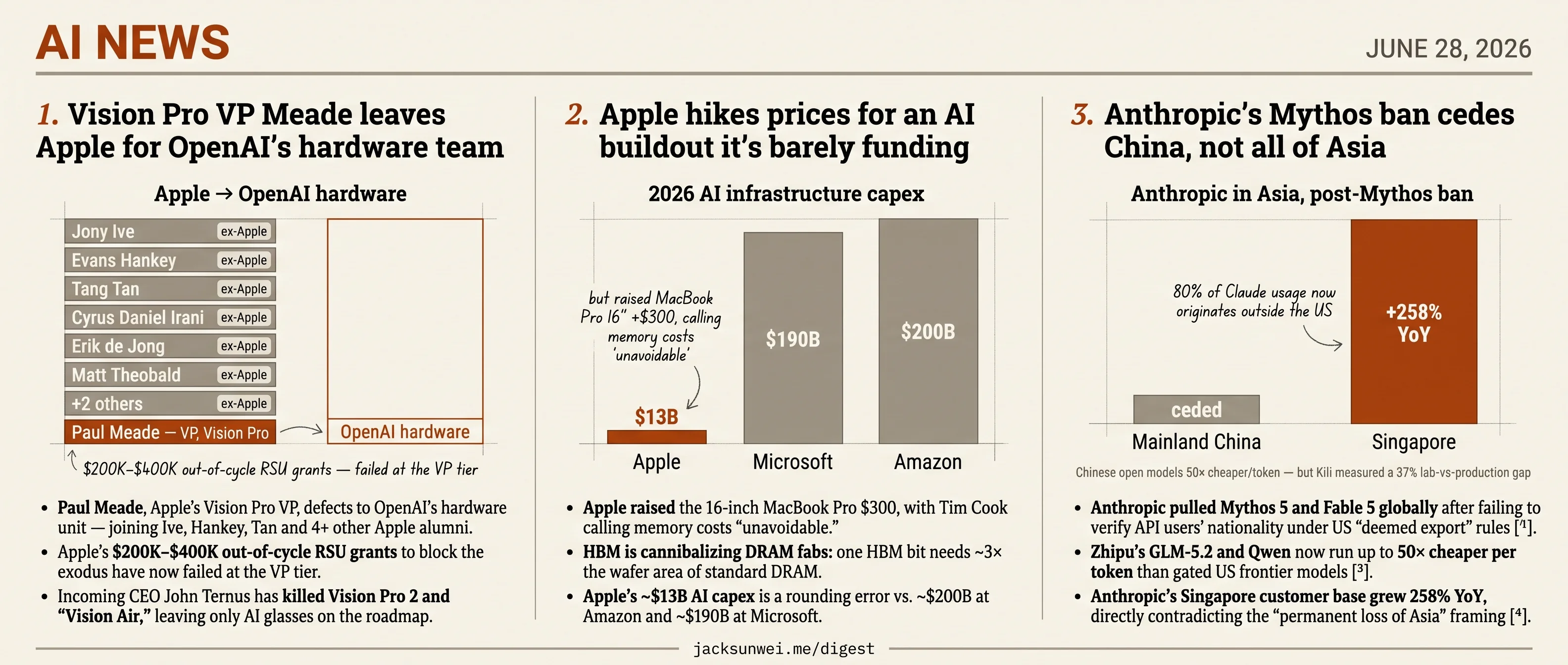
Apple loses Vision VP to OpenAI and hikes MacBook $300; Anthropic cedes China
Apple's Vision Pro VP defects to OpenAI as MacBook prices rise on an AI buildout Apple isn't funding; Anthropic pulls Mythos from China.
Apple loses Vision VP to OpenAI and hikes MacBook $300; Anthropic cedes China
TL;DR
- Paul Meade, Apple’s Vision Pro VP, joins OpenAI’s hardware unit alongside 7+ Apple alumni.
- Vision Pro 2 and Vision Air killed under incoming CEO Ternus, leaving only AI glasses on the roadmap.
- Apple raised MacBook Pro $300 while spending ~$13B on AI capex vs. ~$200B at Amazon.
- Anthropic pulled Mythos 5 globally after failing to verify nationality under US deemed-export rules.
- Zhipu’s GLM-5.2 and Qwen now run up to 50× cheaper per token than gated US frontier models.
Two of today’s three AI-news leads are Apple stories, and they rhyme. Paul Meade, the VP behind Vision Pro, becomes the eighth-plus senior Apple alum to land at OpenAI’s hardware group — and the first whose departure means $200K–$400K out-of-cycle RSU grants have stopped working at the VP tier. In parallel, Apple is raising the 16-inch MacBook Pro $300, blaming HBM-driven DRAM scarcity, while booking only ~$13B of AI capex against Amazon’s ~$200B and Microsoft’s ~$190B. The pattern: Apple is absorbing AI’s costs (memory inflation, talent compensation) without funding the buildout that would justify them.
The third lead sits apart. Anthropic pulled Mythos 5 and Fable 5 globally after one day of trying to vet API users for nationality under US ‘deemed export’ rules — a reversal of yesterday’s per-customer gating story. The framing is China ceded, not Asia lost: Singapore revenue grew 258% YoY, and Zhipu and Qwen are now up to 50× cheaper per token in the gap left behind.
Vision Pro VP Meade leaves Apple for OpenAI’s hardware team
Source: techcrunch-ai · published 2026-06-27
TL;DR
- Paul Meade, Apple’s Vision Pro VP, defects to OpenAI’s hardware unit — joining Ive, Hankey, Tan and 4+ other Apple alumni.
- Apple’s $200K–$400K out-of-cycle RSU grants to block the exodus have now failed at the VP tier.
- Incoming CEO John Ternus has killed Vision Pro 2 and “Vision Air,” leaving only AI glasses on the roadmap.
- OpenAI’s first device — a screenless “Sweetpea” puck plus “Gumdrop” pen — has slipped to 2027.
The retention play just broke
Paul Meade ran the Vision Pro and, more recently, Apple’s display-free smart-glasses effort. He is now reportedly headed to OpenAI’s hardware group, where he joins Jony Ive, Evans Hankey, Tang Tan, Cyrus Daniel Irani, Erik de Jong and Matt Theobald — the bulk of the senior team behind Apple’s most ambitious recent product. 9to5Mac reported in November 2025 that Apple began issuing rare out-of-cycle stock grants of $200,000 to $400,000 specifically to keep iPhone and Vision designers from defecting to OpenAI 1. Six months later, a VP walked anyway.
The internal context makes the leak worse. Mike Rockwell, the Vision Pro’s creator, reportedly considered leaving Apple himself after being reassigned to overhaul Siri under Craig Federighi 2. Johny Srouji’s hardware reorg ahead of Ternus’s September CEO transition has demoted several long-tenured VPs by a reporting level. Meade is not the first crack; he is the one that signals the dam.
What OpenAI is actually building
AppleInsider’s reporting describes a working LoveFrom prototype: a palm-sized, screenless companion codenamed “Sweetpea,” with a pen-like “Gumdrop” device in development 3. Adafruit confirmed in February that OpenAI has dropped the “io” brand following the iyO trademark loss, with shipping now slipping to 2027 “maybe” 4 — well past Chris Lehane’s Davos claim of a 2H 2026 debut.
Meade’s specific expertise widens the roadmap. He was leading Apple’s display-free smart-glasses program before the exit, which suggests OpenAI is extending beyond the pocket puck toward eyewear — a direct line into Meta Ray-Ban territory.
Apple’s reciprocal retreat
The Meade hire and Apple’s strategy reset are the same story told from both sides. Ming-Chi Kuo reports Ternus has personally nixed Vision Pro 2 and the lighter “Vision Air,” leaving only two of seven Vision projects alive: AI smart glasses in 2027 and waveguide AR glasses in 2029 5. Both companies have concluded the headset era is over. OpenAI now holds most of the people who would have built Apple’s entry into what replaces it.
The skeptic’s footnote
None of this guarantees a product anyone wears. The category Meade is jumping into has no proven winner. Empirical benchmarks put Humane AI Pin latency above 4 seconds, with NASA Task Load Index studies showing AI-pin form factors increase cognitive load by 37–52% versus smartphones 6. Rabbit R1 shipped with hardcoded API keys. Ive has publicly mocked both — but OpenAI must still solve the thermal, battery and privacy problems that sank them.
The unresolved question is not who has the talent. It’s whether anyone can ship a device users keep wearing.
For now, OpenAI has the design lead, the hardware-engineering lead, the manufacturing-design lead and the human-interface lead from Apple’s most ambitious recent product. Apple has a roadmap that admits it.
Apple hikes prices for an AI buildout it’s barely funding
Source: the-verge-ai · published 2026-06-27
TL;DR
- Apple raised the 16-inch MacBook Pro $300, with Tim Cook calling memory costs “unavoidable.”
- HBM is cannibalizing DRAM fabs: one HBM bit needs ~3× the wafer area of standard DRAM.
- Apple’s ~$13B AI capex is a rounding error vs. ~$200B at Amazon and ~$190B at Microsoft.
- Microsoft’s Surface jumped 50% ($999 → $1,499), dwarfing Apple’s bump in the same shortage window.
The shortage is real, and Apple’s hikes are mild
The Verge frames Apple’s price increases as consumers being conscripted to subsidize Big Tech’s AI obsession. The supply-side mechanics back the framing, but they extend far beyond Cupertino. Producing a single bit of HBM — the stacked memory that feeds Nvidia accelerators — consumes about three times the wafer area of a standard DRAM bit, and AI data centers are projected to absorb 70% of all memory chip output in 2026 7. Fabs are physically reallocating wafer starts away from the consumer DRAM that ships in laptops, tablets and speakers.
In that context, Apple’s $300 MacBook Pro bump is the mild version of the story. Microsoft pushed the Surface Pro 13 and Surface Laptop 13.8-inch from a $999 launch price to $1,499 — a 50% increase that dwarfs anything Apple did 8. Cook’s “hundred-year flood” line about memory costs is, at the market level, accurate.
But Apple is barely in the capex race it’s blaming
The uncomfortable counterpoint is that Apple is barely participating in the buildout driving the shortage. Independent estimates put Apple’s 2026 AI infrastructure spending near $13 billion, against roughly $200B at Amazon and $190B at Microsoft 9. Apple is not standing up model-as-a-service capacity; it is a hybrid customer that leans on partners (and on-device silicon) for most of its Apple Intelligence stack.
That asymmetry is the part The Verge gestures at but doesn’t quantify. Apple is passing through HBM-driven cost inflation caused largely by competitors’ wafer demand, while sidestepping the margin compression those competitors face from depreciating data-center hardware. “Unavoidable” is doing a lot of work in a quarter where Apple reported $112B in annual profit 10.
The escape hatches are closing
The political response was predictable — Senator Bernie Sanders called the hikes “unacceptable” given Apple’s profit and buyback profile 10 — but the consumer-side signal is more interesting: the usual substitutions are breaking down.
Apple raised its Certified Refurbished prices in lockstep, averaging $204 more at the low end and $330 at the high end; a refurbished 14-inch MacBook Pro M5 went from $1,359 to $1,439 11. Buying last-gen is no longer a meaningful dodge.
The Windows side offers a darker version of the trade. To defend sub-$1,000 price points, Microsoft and Dell have reintroduced 8GB RAM configurations on machines that are explicitly too memory-starved to run the Copilot+ AI features whose underlying memory demand caused the shortage 12. The cheap SKU exists; it just can’t do the thing the expensive SKU is being priced for.
What’s actually at stake
The Verge’s consumer-anger framing is directionally right, but the sharper critique isn’t that Apple is price-gouging — its hikes are smaller than Microsoft’s and rooted in a real fab reallocation. It’s that Cook is invoking industry-wide solidarity (“we’re all absorbing this”) while Apple’s own checkbook shows it’s the one hyperscaler-adjacent player not writing the $200B checks that created the squeeze in the first place.
Anthropic’s Mythos ban cedes China, not all of Asia
Source: techcrunch-ai · published 2026-06-27
TL;DR
- Anthropic pulled Mythos 5 and Fable 5 globally after failing to verify API users’ nationality under US “deemed export” rules 13.
- Zhipu’s GLM-5.2 and Qwen now run up to 50× cheaper per token than gated US frontier models 14.
- Anthropic’s Singapore customer base grew 258% YoY, directly contradicting the “permanent loss of Asia” framing 15.
- Kili measured a 37% gap between Chinese models’ lab benchmarks and their production agentic performance 16.
The vacuum, and who walked into it
TechCrunch’s framing is half right. Anthropic did disable Mythos 5 and Fable 5 worldwide — not because of a geopolitical decision but because it could not technically verify API users’ nationality in real time to comply with a “deemed export” order 13. That is a regulatory self-own, not a competitive defeat, and it left a Mythos-class hole in the market that Asian labs were already building toward.
Zhipu’s GLM-5.2 (744B MoE, MIT-licensed, 1M-token context) and Alibaba’s Qwen series filled it on price. Crypto Briefing pegs them at up to 50× cheaper per token than US frontier models, and reports a new developer pattern: route routine work to open Chinese weights, reserve gated US APIs like GPT-5.6 Sol for the hardest reasoning steps 14. That is the concrete substitution mechanism — model routing — that the TechCrunch piece gestures at without quantifying.
The “permanent loss” claim doesn’t survive Singapore
The headline thesis — US AI labs may never recover this enormous market — collapses the moment you leave mainland China. In Singapore, the market TechCrunch would code as lost, Anthropic’s customer base grew 258% year-over-year, and 80% of Claude usage now originates outside the US 15. Anthropic is gaining share in ASEAN through regional Bedrock deployments, not losing it.
The sovereign-AI story is also broader than China-vs-Anthropic. NTT shipped tsuzumi 2 in May 2026 optimized for Japanese business documents — charts, tables, single-GPU inference 17. That is a data-locality and cost play that would have happened with or without the export order. The ban accelerated launches that were already on the runway; it didn’t cause them.
The dissent worth quoting
A coalition of CISOs called the export ban itself “dangerous,” arguing it removes capabilities from defenders while attackers simply pivot to sovereign Asian models 18. That reframes the entire story: the damage to US labs’ market position is partly self-inflicted policy harm.
And the Asian alternatives are not the drop-in replacements the cheaper-per-token numbers imply. Kili Technology measured a 37% gap between published benchmark scores and agentic performance in production for several top-ranking Chinese models 16. Mythos-class on MMLU is not Mythos-class in a 40-step tool-use loop.
What’s actually at stake
The honest read is bifurcation. Mainland China is structurally lost to US labs for as long as deemed-export rules hold — Zhipu, Alibaba, and Sakana have permanent home-field advantage on price and availability. ASEAN, Japan, and Korea are still contested, and in Anthropic’s case, growing fast. The policy question is whether Washington is willing to trade a 37%-degraded competitor capturing routine-inference workloads for a verification regime nobody — including Anthropic — can actually implement.
Round-ups
Claude lands in Slack as a persistent, multiplayer agent
Source: latent-space
Anthropic’s new @Claude Slack integration runs as a proactive, persistent agent that multiple teammates can address in the same thread, retaining context across conversations. The upgrade pushes Claude past one-shot Q&A toward always-on workplace collaboration.
Skeptics pile on Musk’s orbital data center pitch alongside SoftBank’s Son
Source: techcrunch-ai
Musk’s plan to put data centers in orbit is drawing pushback beyond Masayoshi Son, with critics questioning the economics and physics of running GPU clusters in space. Son’s doubts now anchor a broader chorus skeptical of the SpaceX-tied vision.
Founder feeds blood work and wearable data into Claude to fight cancer
Source: techcrunch-ai
Keragon’s Connor Christou turned Claude into a personal oncology copilot, piping scan results, lab values, wearable metrics, and journal notes into the model to pressure-test treatment options. The case shows patients increasingly using frontier LLMs as second-opinion engines.
Margaret Atwood dismisses AI writing as ‘garbage in, garbage out’
Source: the-verge-ai
Atwood used the Babell Literary Festival in Porto to skewer generative AI’s reliance on scraped training data, arguing the output reflects the quality of what’s ingested. The Handmaid’s Tale author joins a growing line of novelists publicly hostile to the technology.
Footnotes
-
9to5Mac — earlier poaching report (Nov 2025) — https://9to5mac.com/2025/11/24/openai-poaching-apple-hardware-engineers/
↩Apple issued rare out-of-cycle stock bonuses of $200,000 to $400,000 to keep iPhone and Vision designers from jumping to OpenAI; Meade’s exit shows the retention play is failing at the VP level.
-
MacRumors — Mike Rockwell reportedly considered leaving — https://www.macrumors.com/2026/04/22/vision-pro-creator-considered-leaving-apple/
↩Vision Pro creator Mike Rockwell considered leaving Apple after being reassigned to overhaul Siri under Craig Federighi, expressing reservations about his new reporting structure.
-
AppleInsider — LoveFrom prototype report — https://appleinsider.com/articles/25/11/24/lovefrom-has-a-prototype-for-the-first-piece-of-openai-hardware
↩LoveFrom has a prototype for the first piece of OpenAI hardware — a palm-sized, screenless companion codenamed ‘Sweetpea’ with a second ‘Gumdrop’ pen-like device in development.
-
Adafruit blog on iyO trademark suit — https://blog.adafruit.com/2026/02/11/openai-is-not-using-the-io-name-iyo-trademark-fight-and-lovefroms-6-5b-device-ships-in-2027-maybe/
↩OpenAI is not using the ‘io’ name after the iyO trademark fight, and LoveFrom’s $6.5B device now ships in 2027 — maybe.
-
MacRumors / Ming-Chi Kuo report — https://www.macrumors.com/2026/06/03/kuo-vision-pro-successors-nixed/
↩Incoming CEO John Ternus has nixed plans for a second-generation Vision Pro and the lighter ‘Vision Air,’ redirecting resources toward AI-powered smart glasses slated for 2027 and waveguide AR glasses for 2029.
-
Swept.ai analysis of AI hardware failures — https://www.swept.ai/post/rabbit-r1-security-breach-highlights-the-need-for-robust-validation-mechanisms-in-ai-compani
↩Humane AI Pin response latencies exceed 4 seconds and NASA Task Load Index studies show these devices increase cognitive load by 37–52% — the category Meade is being hired into has no proven product-market fit.
-
Medium / HBM4 analysis — https://medium.com/@tanmaysorte25/hbm4-the-end-of-the-shortage-or-the-start-of-a-new-one-2ed0e3828ee4
↩Producing a single bit of HBM requires approximately three times the wafer area of a standard DRAM bit… AI data centers will consume 70% of all memory chip production by 2026.
-
PCMag — https://www.pcmag.com/news/microsoft-raises-prices-of-surface-laptops-amid-memory-shortage
↩Microsoft has raised the entry price for its flagship Surface Pro 13 and Surface Laptop 13.8-inch from their 2024 launch price of $999 to $1,499 — a 50% increase.
-
Forbes (Kirsch, AI capex gap) — https://www.forbes.com/sites/jasonkirsch/2026/06/02/the-ai-capex-to-revenue-gap-is-widening---and-markets-are-starting-to-notice/
↩Independent estimates place Apple’s AI-related infrastructure spending near $13 billion — a fraction of Amazon’s ~$200B or Microsoft’s ~$190B — because Apple is not building a model-as-a-service cloud.
-
The Guardian (citing Sanders) — https://www.theguardian.com/technology/2026/jun/25/apple-price-hike
↩ ↩2Sanders characterized the increases as ‘unacceptable,’ arguing that a corporation reporting an annual profit of $112 billion should absorb rising costs rather than passing them to consumers.
-
CNET (refurbished hikes) — https://www.cnet.com/tech/computing/apple-mac-ipad-price-hikes-refurbished/
↩Refurbished Mac prices rose by an average of $204 at the low end and $330 for high-end configurations… the refurbished 14-inch MacBook Pro M5 jumped from $1,359 to $1,439.
-
TechRadar (Surface RAM cuts) — https://www.techradar.com/computing/windows-laptops/some-microsoft-surface-devices-just-got-big-price-cuts-but-the-catch-is-theyve-had-big-ram-cuts-too
↩To keep prices under $1,000, Microsoft and Dell have reintroduced 8GB RAM configurations… ironically lacking the ability to run the very Copilot+ AI features that have driven the memory shortage.
-
Forbes (Anisha Sircar) — https://www.forbes.com/sites/anishasircar/2026/06/16/anthropic-disabled-fable-5-and-mythos-5-after-a-us-export-control-order-heres-what-happened/
↩ ↩2Anthropic disabled Fable 5 and Mythos 5 after a US export control order… the firm could not technically verify the nationality of API users in real-time to satisfy ‘deemed export’ regulations, [and] was forced to disable these models globally.
-
Crypto Briefing — https://cryptobriefing.com/chinese-ai-models-cheaper-than-us/
↩ ↩2Zhipu AI’s GLM 5.2 and Alibaba’s Qwen series… are up to 50 times cheaper per token than U.S. counterparts while maintaining comparable performance on agentic benchmarks… developers use cheaper Asian models for routine tasks and reserve expensive, gated U.S. models like GPT-5.6 Sol only for complex reasoning.
-
TechNode Global — https://technode.global/2026/06/16/anthropics-claude-narrows-gap-with-chatgpt-among-singapore-startups-as-ai-becomes-core-infrastructure/
↩ ↩2In markets like Singapore, Anthropic’s customer base grew 258% year-over-year, nearly closing the gap with ChatGPT among startups… 80% of Claude usage now originating outside the US.
-
Digital Applied (week-in-review) — https://www.digitalapplied.com/blog/ai-marketing-week-in-review-june-15-21-2026
↩ ↩2Kili Technology reported a 37% gap between lab scores and agentic performance in production for several high-ranking Chinese models.
-
NTT Group (tsuzumi 2 announcement) — https://group.ntt/en/magazine/blog/tsuzumi2/
↩NTT updated its tsuzumi 2 model in May 2026, specifically optimizing it for processing Japanese business documents that include complex charts and tables in a single-GPU environment.
-
Cybersecurity Dive — https://www.cybersecuritydive.com/news/anthropic-us-government-export-ban-mythos-fable/822909/
↩A group of prominent CISOs and researchers characterized the ban as ‘dangerous,’ arguing it removes powerful tools from the hands of defenders while doing little to stop attackers who may already have access to similar capabilities or sovereign models from rival nations.