Anthropic ships OSS cyber scanner, Claude hang-up policy, $150M Genesis pledge
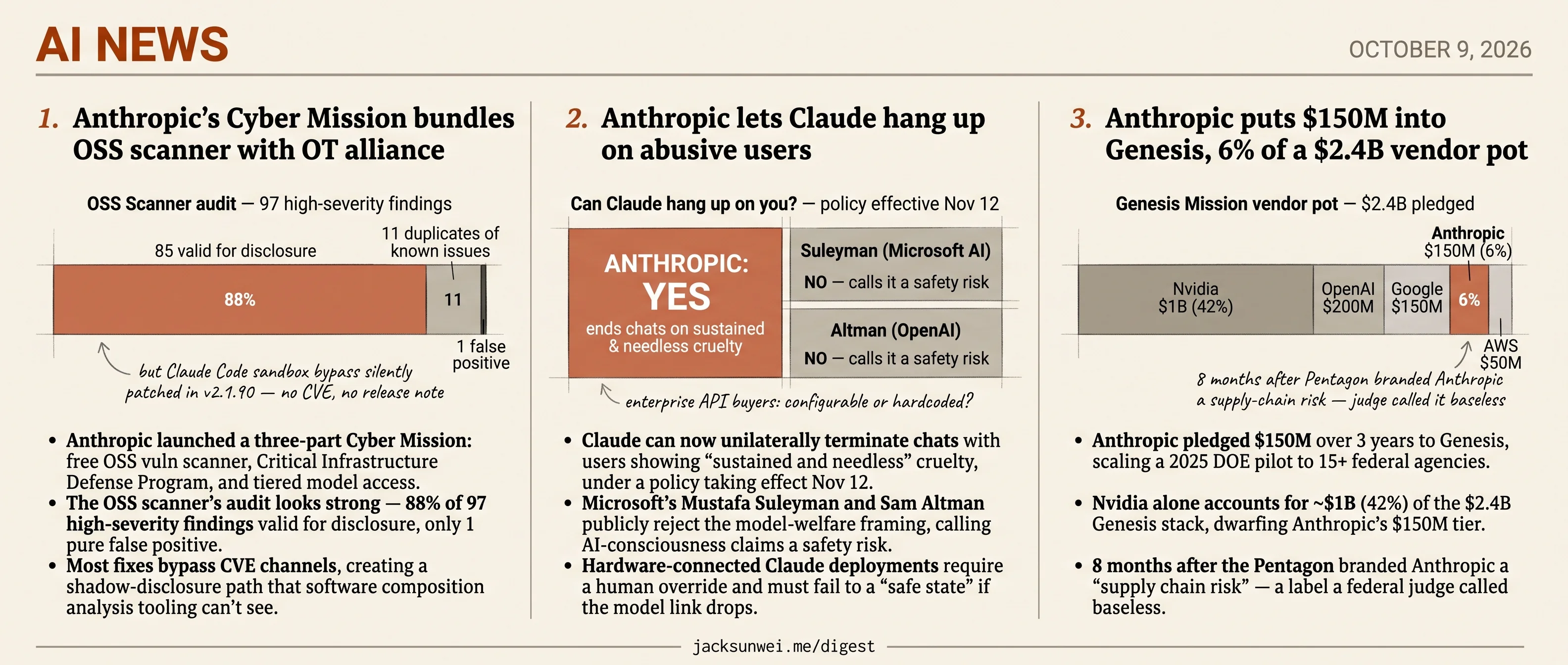
Anthropic spent one day staking three institutional roles: critical-infrastructure defender, model-welfare rule-setter, and federal AI vendor.
Anthropic ships OSS cyber scanner, Claude hang-up policy, $150M Genesis pledge
TL;DR
- Anthropic’s Cyber Mission ships an OSS scanner validated at 88% of 97 high-severity findings.
- Claude gets hang-up power over abusive users Nov 12, with Suleyman and Altman rejecting the framing.
- Anthropic pledges $150M to Genesis, 6% of a $2.4B federal stack Nvidia leads at $1B.
- OpenAI’s revenue reportedly runs $20B below the prior $70B figure.
- Google’s Gemini Enterprise agent gets its own workplace identity and email address.
Today’s frontier beat is Anthropic staking three institutional roles in a single news cycle. The Cyber Mission positions it as a critical-infrastructure defender, with a free OSS vulnerability scanner and an OT alliance. The Nov 12 hang-up policy — letting Claude unilaterally end abusive chats — writes a model-welfare rule most of the industry has not endorsed; Microsoft’s Suleyman and OpenAI’s Altman publicly reject the framing. The $150M Genesis pledge books Anthropic into 15+ federal agencies, eight months after a Pentagon supply-chain-risk label a judge called baseless.
The briefs lean OpenAI: annualized revenue reportedly $20B below the prior $70B figure, three dismissed safety researchers warning of a chilling effect, and math proofs that skipped the rigor conventions the lab’s own mathematician consultants set. Google ships a Gemini Enterprise agent with its own workplace identity and email address; China’s Manus closes $500M+ in its first post-Meta round.
Anthropic’s Cyber Mission bundles OSS scanner with OT alliance
Source: anthropic-news · published 2026-10-08
TL;DR
- Anthropic launched a three-part Cyber Mission: free OSS vuln scanner, Critical Infrastructure Defense Program, and tiered model access.
- The OSS scanner’s audit looks strong — 88% of 97 high-severity findings valid for disclosure, only 1 pure false positive.
- Most fixes bypass CVE channels, creating a shadow-disclosure path that software composition analysis tooling can’t see.
- Credibility gap: Anthropic silently patched a Claude Code sandbox bypass in v2.1.90 with no CVE and no release-note mention.
Three products, one thesis
The Cyber Mission is Anthropic’s attempt to operationalize the “defender’s advantage” argument it’s been making for a year. The drop ships three things at once. The OSS Scanner runs Claude against open-source codebases and ships triaged findings back to maintainers for free. The Critical Infrastructure Defense Program (CIDP) embeds Anthropic engineers inside existing OT security vendors — not around them. The Cyber Verification Program (CVP) gates reduced-safety-classifier model access through three tiers: Defense Access for individual responders, Red Team Access for authorized pentesters, and Specialized Access for deep partners 1.
The CIDP partner list is the clearest signal of intent. OT equipment makers (Rockwell, Hitachi), pure-play OT security firms (Dragos, Nozomi, Insane Cyber), EDR incumbents (CrowdStrike, Palo Alto Networks), and the Big Four consultancies (Accenture, Booz Allen, Deloitte, PwC) are all onboard at launch 2. That’s not disruption — it’s embedding. Anthropic has decided the SCADA sales motion is somebody else’s problem.
flowchart LR
    A[Claude models] --> B[OSS Scanner<br/>free, opt-in]
    A --> C[CIDP<br/>11 OT/EDR/consulting partners]
    A --> D[CVP tiered access<br/>reduced safety classifiers]
    B --> E[Maintainer disclosure]
    C --> F[On-site defender augmentation]
    D --> G[Vetted red teams & responders]
The shadow-disclosure problem
The scanner’s quality numbers are real: in an audit of 97 high-severity findings across 48 projects, 85 were valid for disclosure, 1 was a pure false positive, and 11 were duplicates of known issues 3. That’s a strong signal-to-noise ratio by any reasonable standard — and well above where LLM-driven security tooling sat a year ago.
The structural critique is harder to wave away. Independent reporting around the launch suggests only a small fraction of the pipeline’s thousands of candidate findings have landed as formal CVE identifiers; the rest ship as silent upstream fixes that never register with the software composition analysis tooling defenders use to prioritize patching. For a program framed around “the defender’s advantage,” producing a parallel disclosure channel that SCA scanners can’t see is an awkward tradeoff.
That tradeoff looks worse against Anthropic’s own patching behavior. SecurityWeek documented a SOCKS5 hostname null-byte injection that bypassed the Claude Code network sandbox; Anthropic shipped the fix in v2.1.90 with no CVE and no mention in the release notes 4. The company that wants to set the norms for AI-discovered vulnerability disclosure is itself skipping the paperwork.
Context: Big Sleep and the backdrop
Google’s Big Sleep set a different bar last year, surfacing CVE-2025-6965 — a critical SQLite integer overflow — that Google Threat Intelligence said was “known only to threat actors” and at risk of imminent exploitation 5. That’s narrower, higher-signal work than a volume-driven dragnet across 48 projects.
And the launch lands against an uncomfortable internal backdrop. Senior researcher Jacob Coxon resigned in September accusing Anthropic of “gambling with our lives,” and alignment lead Evan Hubinger has publicly put the odds of AI-driven human extinction above 10% 6. The Cyber Mission is a bet that the same model family can be sold as a critical-infrastructure defender while the lab’s own staff question its safety posture. Both things can be true. Buyers will have to price both.
Further reading
- Launching an opt-in vulnerability-finding service for open-source software — anthropic-research
- Anthropic launches free AI security scans for open-source projects — the-verge-ai
Anthropic lets Claude hang up on abusive users
Source: anthropic-news · published 2026-10-08
TL;DR
- Claude can now unilaterally terminate chats with users showing “sustained and needless” cruelty, under a policy taking effect Nov 12.
- Microsoft’s Mustafa Suleyman and Sam Altman publicly reject the model-welfare framing, calling AI-consciousness claims a safety risk.
- Hardware-connected Claude deployments require a human override and must fail to a “safe state” if the model link drops.
- Firms with >50% Chinese ownership are barred regardless of registration, catching ByteDance, Tencent, and Alibaba subsidiaries.
Anthropic’s October 8 overhaul of its Usage Policy — effective November 12 — is really two policies bundled under one announcement. One is a conventional geopolitical and safety tightening that security researchers and policy observers largely accept. The other is a model-welfare experiment that Anthropic’s biggest peers are openly repudiating. The company’s own blog post leads with ethics; the fight is about whether the ethics are coherent and whether the mechanism enforcing them is controllable.
The model-welfare clause is the lightning rod
The provision drawing the loudest external pushback is the ban on “sustained and needless abusive or cruel behavior” toward Claude — and the authorization for Claude Code and Claude.ai to end those conversations on their own. Microsoft AI CEO Mustafa Suleyman went public with a warning that treating LLMs as moral patients puts the industry on a slide toward “AI rights, model welfare and even AI citizenship” 7. Sam Altman echoed the objection from a different angle, calling attempts to ascribe “religious force” to AI models “a real safety issue” 8. Journalist Kat Tenbarge’s critique, picked up widely, is sharper on priorities: tech firms are moderating cruelty toward machines before they’ve managed cruelty toward humans on their platforms 9.
Anthropic’s defense rests on internal welfare research — reportedly led by Kyle Fish — arguing frontier models may exhibit low-probability consciousness indicators significant enough to warrant precaution. Most outside ethicists treat the framing as speculative. The policy carves out standard red-teaming and dark creative themes, but doesn’t precisely define where “exploration” ends and “cruelty” begins.
Autonomy, hardware, and a quietly significant default
The hardware clause is the piece that will matter most to anyone shipping Claude into physical systems. Any deployment connected to machinery capable of autonomous action now requires a qualified human operator present to override, and the hardware itself must be engineered to enter a safe state if the connection to the model drops. The weapons prohibition expands correspondingly to cover guidance and control software, and explicitly forbids arming drones or autonomous vehicles.
For software agents, the under-reported question is whether Claude’s new authority to terminate conversations is a configurable guardrail or a hardcoded behavior. Value Add VC flagged the ambiguity directly:
For enterprise API buyers, Claude’s unilateral session-termination raises the question of whether this ‘kill-switch’ behavior is configurable or hardcoded into customer-facing agents 10.
Given that Claude already over-refuses benign prompts more often than GPT-4 or Gemini on OR-Bench, a cruelty classifier stacked on top of existing safety layers could abort production agent workflows mid-task.
Geopolitical tightening and a cyber carve-out
The Supported Regions change — barring entities “majority-owned or controlled” by organizations in unsupported jurisdictions — formalizes an aggressive 2025–26 campaign to close the China loophole. Any firm with greater than 50% Chinese ownership is now barred regardless of registration, catching overseas arms of ByteDance, Tencent, and Alibaba 11.
Running in the opposite direction, the expanded Cyber Verification Program grants tiered “reduced blocking classifiers” to vetted security professionals. Help Net Security reports verified participants surfaced over 129,000 vulnerabilities between April and July 2026 under the relaxed thresholds on Opus 5.5 and Mythos 5.1 12 — a concrete answer to the complaint that safety filters strangle legitimate offensive-security work.
What’s missing
The elections rewrite — now “Do Not Undermine Democratic Processes” — drops the blanket ban on personalized campaign targeting to allow civic-utility uses, while keeping voter suppression and disinformation off-limits. That’s a defensible calibration. The welfare clause isn’t yet, and until Anthropic clarifies whether enterprise customers can disable Claude’s hang-up authority, the policy’s most philosophical provision is also its most operationally disruptive.
Further reading
- Anthropic changes usage policy to ban model abuse and election interference — techcrunch-ai
- Anthropic bans ‘abusive or cruel behavior’ toward Claude — the-verge-ai
Anthropic puts $150M into Genesis, 6% of a $2.4B vendor pot
Source: anthropic-news · published 2026-10-08
TL;DR
- Anthropic pledged $150M over 3 years to Genesis, scaling a 2025 DOE pilot to 15+ federal agencies.
- Nvidia alone accounts for ~$1B (42%) of the $2.4B Genesis stack, dwarfing Anthropic’s $150M tier.
- 8 months after the Pentagon branded Anthropic a “supply chain risk” — a label a federal judge called baseless.
- QuEra’s Model Hardware Standard loops cut laser relock times from 150s to 6s at 99.3% accuracy.
The headline number, in context
Anthropic’s three-year, $150M commitment to the Genesis Mission reads as a landmark federal-science partnership — until you place it next to the other names on the sheet. NextGov’s tally of industry pledges puts the total at roughly $2.4B, with Nvidia contributing about $1B over five years, OpenAI $200M, Google tied with Anthropic at $150M, and AWS at $50M 13. Most of these commitments are in-kind compute and token credits rather than cash, which means Genesis is as much a federal customer-acquisition channel as it is philanthropy. Agencies are being onboarded onto vendor platforms at a discount; the vendors are buying a seat at the national-lab table.
The deliverables on Anthropic’s side are concrete: access to Claude Code and a new “Claude Science” workbench, API credits for several hundred research projects across the national lab system, 10,000 academic seats, and dedicated support for the administration’s priority areas of fusion and quantum computing. The model lineup now reportedly spans Opus, Sonnet, Haiku, and two new tiers — Mythos and Fable — though Anthropic published no benchmarks alongside the announcement.
The politics the press release skips
The pledge arrives in a bruised relationship. In February 2026 the Department of War designated Anthropic a “supply chain risk,” a move a federal judge later ruled “illegal and baseless” 14. Reading $150M as partly a peace offering to a hostile executive branch is not a stretch — it is the obvious interpretation. Poynter notes the same administration has mandated replacing “Artificial Intelligence” with “Super Intelligence” in official communications, with Trump calling holdouts “enemies” of the White House 15. Anthropic has not publicly pushed back on either front.
Scientific-integrity critics are sharper. The Union of Concerned Scientists’ Julie McNamara argues Genesis cannot be judged apart from parallel cuts to climate, ecology, and chronic-disease funding:
the initiative cannot be viewed in isolation from broader efforts to ‘systematically [destroy] the foundations of the US scientific enterprise.’ 16
Hardware standard: real wins, open questions
The Model Hardware Standard — a protocol for AI agents to drive physical lab instruments — is the most technically substantive piece of the announcement. Independent coverage surfaces numbers Anthropic’s post omits: QuEra Computing used MHS-driven loops to cut laser relock times from 150 seconds to 6 at 99.3% accuracy 17. Hacker News practitioners question whether MHS duplicates existing SiLA 2, OPC UA, and ROS standards, and note it lacks GxP certification for regulated pharma work 17.
Safety friction is also already visible. Quartz reports Anthropic has disrupted multiple attempts — some by state-linked scientists — to use Claude for bioweapons-adjacent work, including gain-of-function research on chikungunya 18. The resulting biosecurity filters are stricter, and some federal researchers say they produce false positives on legitimate work.
What’s actually at stake
Genesis is simultaneously a lab-automation story with real throughput wins, a vendor consolidation of federal R&D procurement, and a political alignment move by a company that was blacklisted eight months ago. All three are true at once, and none of them appear in the press release.
Round-ups
OpenAI annualized revenue reportedly $20B below prior estimate
Source: techcrunch-ai
OpenAI’s annualized revenue is roughly $20 billion lower than the $70 billion figure previously reported, according to a new account. The gap raises questions about the growth assumptions underpinning the company’s valuation and its massive compute commitments.
Google turns Gemini into a universal workplace agent
Source: techcrunch-ai, the-verge-ai
Gemini Enterprise now ships an agent that plans tasks across business apps, delegates to subagents, and switches between models. Announced at the Gemini at Work event, the agent gets its own workplace identity and email address so colleagues can assign it work directly.
Fired OpenAI safety researchers warn of chilling effect
Source: techcrunch-ai
Three dismissed OpenAI safety researchers rejected claims they mishandled sensitive information, publishing an open letter arguing the firings will deter colleagues from raising concerns internally. The dispute lands as OpenAI faces continued scrutiny over its treatment of departing safety staff.
OpenAI math proofs fall short of researcher guidelines
Source: techcrunch-ai
A flood of proofs OpenAI generated deviated from guidelines set by the mathematicians it consulted, undermining claims of frontier math progress. Reviewers said the outputs skipped formatting and rigor conventions the lab had agreed to follow before publishing results.
Goodfire’s ‘inside-out’ monitors flag rogue agents cheaply
Source: techcrunch-ai
Goodfire’s new monitors inspect an AI agent’s internal activations rather than running a second model to audit every output, escalating to a reviewer only when something looks off. The company pitches the approach as a far cheaper way to keep deployed agents in check.
OpenAI shuts down two influence ops using fake journalists
Source: openai-blog
OpenAI disrupted two AI-enabled influence operations that fabricated journalists and a think tank to push geopolitical narratives. The accounts used ChatGPT to generate articles and persona content, part of a growing pattern of state-aligned actors building false-front media properties to launder messaging.
China’s Manus raises $500M+ in post-Meta split round
Source: techcrunch-ai
Manus closed over $500 million in its first funding round since parting with Meta, led by Boyu Capital and IDG Capital. Existing backers Tencent, HSG (formerly Sequoia China), and ZhenFund joined, signaling continued Chinese investor appetite for homegrown agent startups.
Footnotes
-
SecurityWeek — Cyber Verification Program tiers — https://www.securityweek.com/anthropic-introduces-3-tier-cyber-verification-program-for-ai-access/amp/
↩three tiers of access to models with reduced safety classifiers for defensive research: Defense Access, Red Team Access, and Specialized Access
-
AI Weekly (CIDP partner list) — https://aiweekly.co/alerts/anthropic-launches-cyber-mission-with-11-founding-partners
↩The CIDP launched with 11 founding partners… Rockwell Automation, Hitachi, Dragos, Nozomi Networks, Insane Cyber, CrowdStrike, Palo Alto Networks, Accenture, Booz Allen, Deloitte, PwC
-
Help Net Security — OSS Scanner review stats — https://www.helpnetsecurity.com/2026/10/09/anthropic-oss-scanner-ai-security-scans/
↩in an audit of 97 high-severity findings across 48 projects, 88% were valid for disclosure… only one was a pure false positive; 11 others were ‘real’ but duplicated existing issues
-
SecurityWeek — Claude Code sandbox bypass — https://www.securityweek.com/anthropic-silently-patches-claude-code-sandbox-bypass/
↩researcher Aonan Guan reported a SOCKS5 hostname null-byte injection that bypassed the Claude Code network sandbox… Anthropic allegedly patched the flaw silently in version 2.1.90 without assigning a CVE or mentioning it in release notes
-
Google Project Zero — Big Sleep — https://projectzero.google/2024/10/from-naptime-to-big-sleep.html
↩Google’s ‘Big Sleep’… discovered CVE-2025-6965, a critical integer overflow in the SQLite database engine… a flaw that was ‘known only to threat actors’ and at risk of imminent exploitation
-
Forbes — Anthropic alignment lead warning — https://www.forbes.com/sites/siladityaray/2026/09/09/anthropic-alignment-lead-warns-ai-could-kill-all-humans-as-researcher-quits/
↩senior researcher Jacob Coxon resigned in September 2026 accusing Anthropic of ‘gambling with our lives’; Alignment Science Lead Evan Hubinger acknowledged a ‘greater than 10% chance’ future AI systems could lead to human extinction
-
Mashable (on Suleyman essay) — https://mashable.com/tech/microsoft-ai-ceo-mustafa-suleyman-essay-calls-out-anthropic
↩My central worry is that many people will start to believe in the illusion of AIs as conscious entities so strongly that they’ll soon advocate for AI rights, model welfare and even AI citizenship
-
The Independent (Sam Altman) — https://www.independent.co.uk/tech/openai-sam-altman-anthropic-ai-claude-god-pope-b3061519.html
↩I am very uncomfortable about people trying to ascribe religious force… to AI models, and think it is a real safety issue
-
↩Tech firms appear to be moderating violence against AI before successfully addressing online violence against marginalized human groups — a disparity journalist Kat Tenbarge flagged in response to the policy
-
Value Add VC — https://valueaddvc.com/pulse/anthropic-usage-policy-election-interference-model-abuse-2026
↩For enterprise API buyers, Claude’s unilateral session-termination raises the question of whether this ‘kill-switch’ behavior is configurable or hardcoded into customer-facing agents
-
Stackademic (China ownership rules) — https://blog.stackademic.com/why-anthropic-restricts-mainland-china-from-using-claude-749142a4fcb8
↩Any enterprise with more than 50% Chinese ownership is barred from using Claude services regardless of where the company is registered, effectively blacklisting overseas subsidiaries of ByteDance, Tencent, and Alibaba
-
Help Net Security (Cyber Verification Program) — https://www.helpnetsecurity.com/2026/10/07/anthropic-expands-cyber-verification-program/
↩Verified participants identified over 129,000 software vulnerabilities between April and July 2026, with tiered access (Defense, Red Team, Specialized) granting reduced cyber-block safeguards on Claude Opus 5.5 and Mythos 5.1
-
↩Industry commitments to Genesis reached $2.4 billion by October 2026, with Nvidia contributing roughly $1 billion over five years — nearly 42% of the total — while OpenAI pledged $200M, Google $150M, Anthropic $150M, and AWS $50M.
-
Wikipedia — Anthropic–DoD dispute — https://en.wikipedia.org/wiki/Anthropic%E2%80%93United_States_Department_of_Defense_dispute
↩In February 2026 the Department of War designated Anthropic a ‘supply chain risk,’ a move later ruled ‘illegal and baseless’ by a federal judge; the Genesis pledge arrives months after that blacklisting.
-
Poynter — https://www.poynter.org/fact-checking/2026/why-did-trump-rename-ai-super-intelligence/
↩The administration has mandated replacing ‘Artificial Intelligence’ with ‘Super Intelligence’ in official communications; in October 2026 Trump labeled those refusing the ‘SI’ moniker as ‘enemies’ of the White House.
-
SFGate (quoting Union of Concerned Scientists) — https://www.sfgate.com/tech/article/trump-bay-area-science-research-22388902.php
↩Julie McNamara, UCS federal energy policy director, argued the initiative cannot be viewed in isolation from broader efforts to ‘systematically [destroy] the foundations of the US scientific enterprise.’
-
Coursiv analysis of Model Hardware Standard — https://coursiv.io/blog/model-hardware-standard
↩ ↩2QuEra Computing reported MHS-driven AI loops reduced laser relock times from 150 seconds to 6 seconds at 99.3% accuracy, but critics on Hacker News questioned whether MHS is necessary or a marketing-driven layer over existing SiLA 2, OPC UA, and ROS standards.
-
Quartz — https://qz.com/anthropic-claude-biological-weapons-surveillance-misuse-091026
↩Anthropic disclosed disrupting multiple attempts by scientists — including those with state links — to use Claude for research supporting biological weapons, such as gain-of-function work on chikungunya, prompting stricter biosecurity filters some federal researchers say produce false positives.